
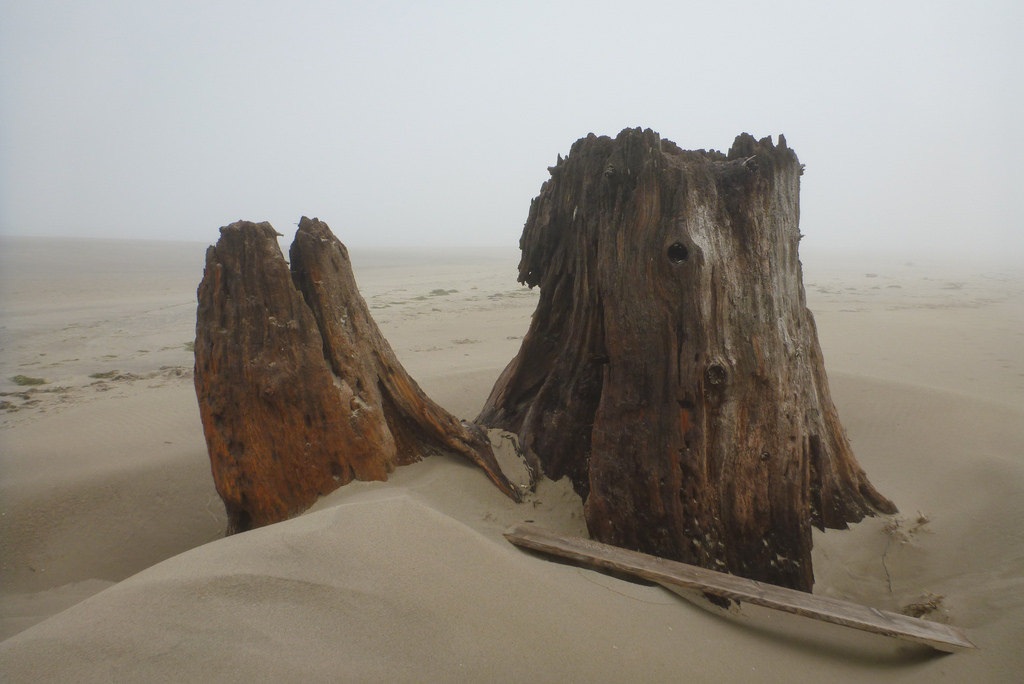
First time I noticed the weathered old stump was seven and a half years ago. I didn’t think I’d see it again, but it was impressive, so I took a photo of my gear and myself leaning leaning against it. I got a chance to recreate the scene earlier this month. Notice any changes?


I’ve come to rely on it. It’s the only stable landmark on a stretch of more or less featureless beach. But how stable? To find out, I studied the historical Google Earth imagery. The resolution of the 2005 and 2011 imagery doesn’t pick up features as small as the stump. But, in the July 2012 imagery, the stump appears about 10 feet west of it’s current location. Images from July 2014, August 2016, and June 2017, show it hasn’t budged in over three years.
The moods of a weathering stump


As a landmark, the stump appears in Comparing King Tides and King Tide 2016
 theoutershores
Fascinating biography of a stump. Keep it going!
Thanks!
Stay tuned.
Impressive, almost a foot a year! Amazing so much sand can accumulate, know wonder islands disappear!
Exactly! I’m not an expert on beach drift, but I believe that’s mostly the result of summer accumulation. Winter storms reduce the sand level, but the net result over the years has been an accumulation.
Love the photo of the waves splashing over it. What a landmark!
Thanks Jennifer, I like that one too.
PS- I enjoyed reading A Weathered Destiny a great deal.
Oh wow, thank you!
Wow. This was so interesting as a visual history of this stump. Was the tree part of a forest where there’s now beach?
As usual, great question. Seven and a half years ago, I thought it arrived as a piece of massive driftwood. I still think that, but I don’t know. Thank you for asking.
A great choice! I wonder if you know what this is? A friend is having trouble identifying it.
https://makingbagsforfun.wordpress.com/2017/09/26/at-the-beach/
Thank you! Do you think your friend’s find may be a fragment of a jellyfish? I find fragments of one called Aequorea fairly frequently and they kind of have this look. Here is a link to some images of the live version. https://www.google.com/imgres?imgurl=https://upload.wikimedia.org/wikipedia/commons/thumb/7/7a/Aequorea3.jpeg/220px-Aequorea3.jpeg&imgrefurl=https://en.wikipedia.org/wiki/Aequorea_victoria&h=180&w=220&tbnid=RThTiDuzcNtc2M:&tbnh=163&tbnw=200&usg=__dRYaAK0SIG7d22qmvGo6sXBbX24%3D&vet=10ahUKEwiSwMHi-tjYAhVKxWMKHdqQAPkQ_B0IrAEwEw..i&docid=AWs1OjKRHEQbhM&itg=1&client=safari&sa=X&ved=0ahUKEwiSwMHi-tjYAhVKxWMKHdqQAPkQ_B0IrAEwEw
Good luck figuring it out!
I recognized the stump from the main page thumbnail. I can remember when you first posted about it. I thought it was impressive then. Now, it just amazes me as it’s resistance to time.
I am completely with you about the resistance to time. The portion remaining above sand is holding its own, as you mention. When I first came across it there were barnacles on the lower portions but they have been buried for years.