After a few days away, I feel the pull of the outer shores strongly. It’s not just fish and fishing. Other things, like a more general connection to nature, and looking for drift material on the beach also exert a pull.

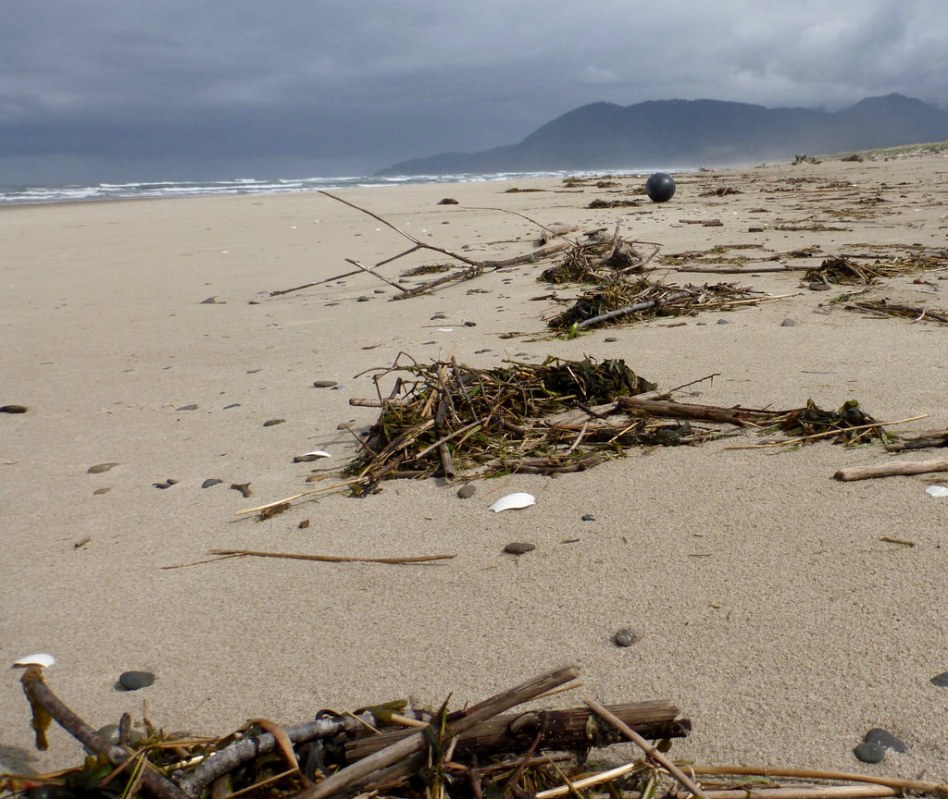
When I’m wandering along the shore I’ve always got my eyes open for agates, floats, interesting bottles and neat shells. The wrack line in the photo above is rich with floats. You can see a large black one in the distance.

Above, blue and cigar-shaped, is one of my favorite floats. The first I found of this variety was on March 3rd, 2012. I found another on March 25 and a third on May 5. You can see the kanji on this float. What is the message?

I found the buoy above on April 20. It’s a familiar styrofoam float. The kanji symbol, perhaps a trap or net number, is still evident after a long drift. The cobbles are large; this float is a foot or more in length.

These small floats will fit in the palm of your hand. They were abundant on May 5. I observed several colors. I remember gray, greenish, white and pinkish, most pretty faded. I found these two early in the morning in fresh wrack, within a few inches of each other. It made me wonder how long they had been traveling together. You can see kanji on the gray float on the left.

Large floats show up frequently, but abundance was up in March, and on May 5 they were abundant in the fresh wrack. The most common color is dark grey but I have seen black, green, orange, and an almost salmon color as well.

It is common to find a variety of organisms attached to floats. The most obvious on this one were oysters, mussels, and pelagic barnacles.
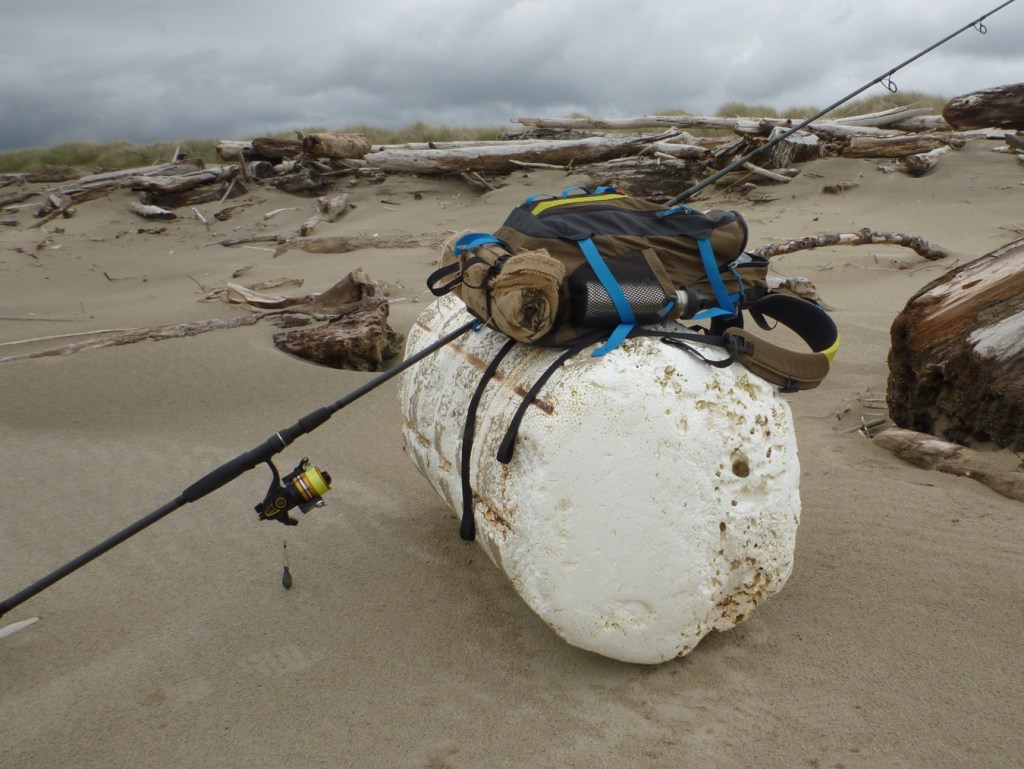
This styrofoam float is so large I can rest my pack on it. Images of other floats and things I’ve discovered in the wrack can be found on any of my wrackline pages.
Note: I updated the photos and lightly edited the text of this post on September 3, 2017. If you like the hitchhikers you may encounter on beached floats take a look at Oceanic Crab Makes Landfall and Dosima fascicularis, a Pelagic Barnacle, Builds its Own Float.
 theoutershores