Below are some worms you might find on the surface in the rocky intertidal or on the beaches. It is a limited set because I don’t flip rocks, dig around in the mussel beds, or otherwise do much disturbing—the things you would need to do to find many other very cool worms. I confess, out on the beaches, I’ve turned a spade or two of sand to uncover the occupant of a likely burrow entrance (e.g., Nephtys). Light touch or not, identifying intertidal worms is a challenge. I can usually get a tentative identification or something close to it by using the field guides and online resources at this page’s bottom, and when I can’t, I have to sit with uncertainty until I get more information. A practice in patience. So what you see here is a catalog of the worms I’ve been fortunate to find on the surface along with my photographic takes, and a few words if I’ve thought of something that resonates with me and hasn’t been oversaid. I use the organization followed by Lamb and Hanby (2005), common names, if I use them, are my choice, and the photos are from northern Oregon unless noted.
Let the worms be upon you!
The flatworm shown below is common, but pinning a credible ID on flatworms is challenging. Nevertheless, this one might be Notocomplana. If it is, it could be Notocomplana acticola. Then again, there are look-alikes. I made a video of it gliding along over its rock.

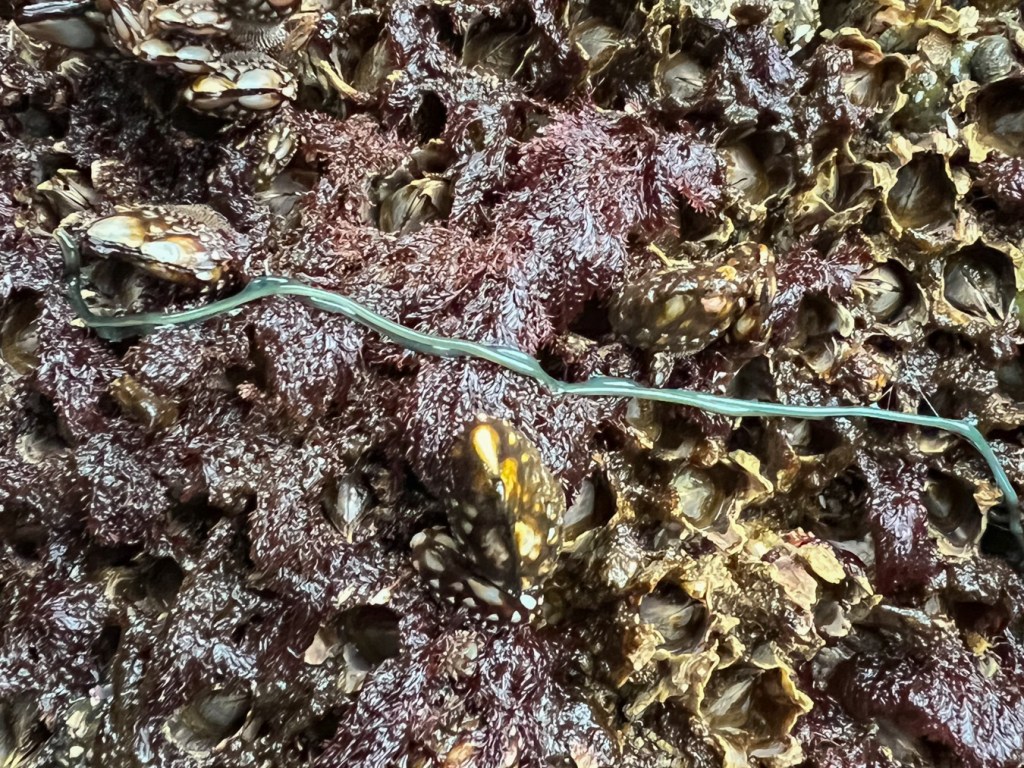
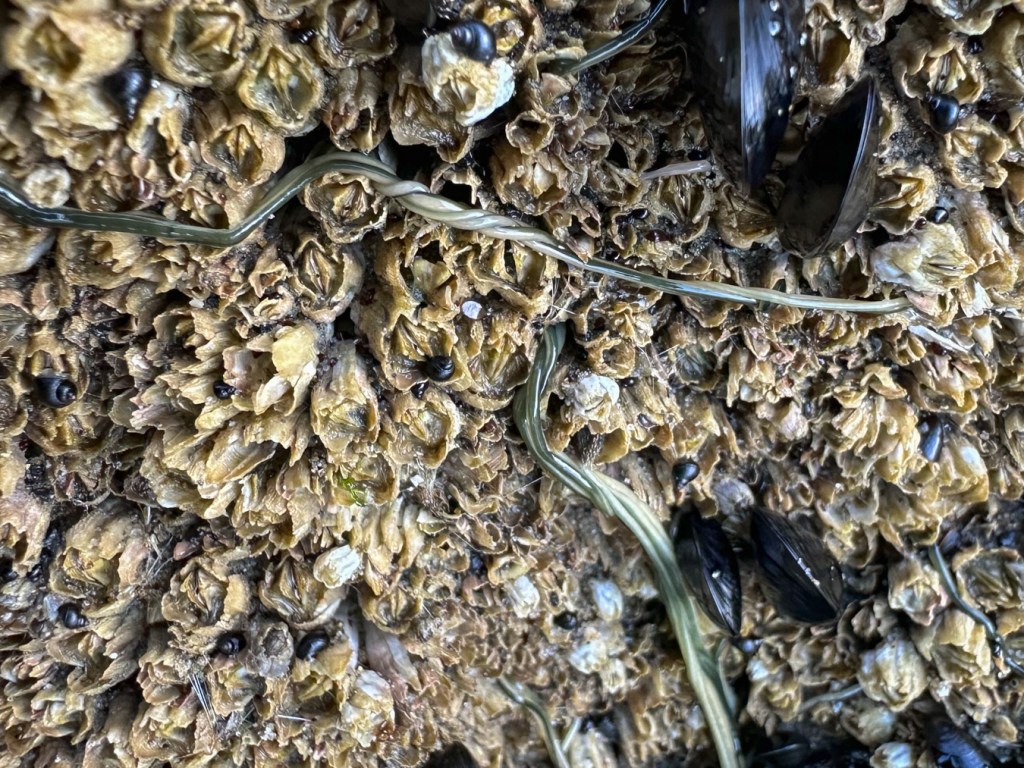
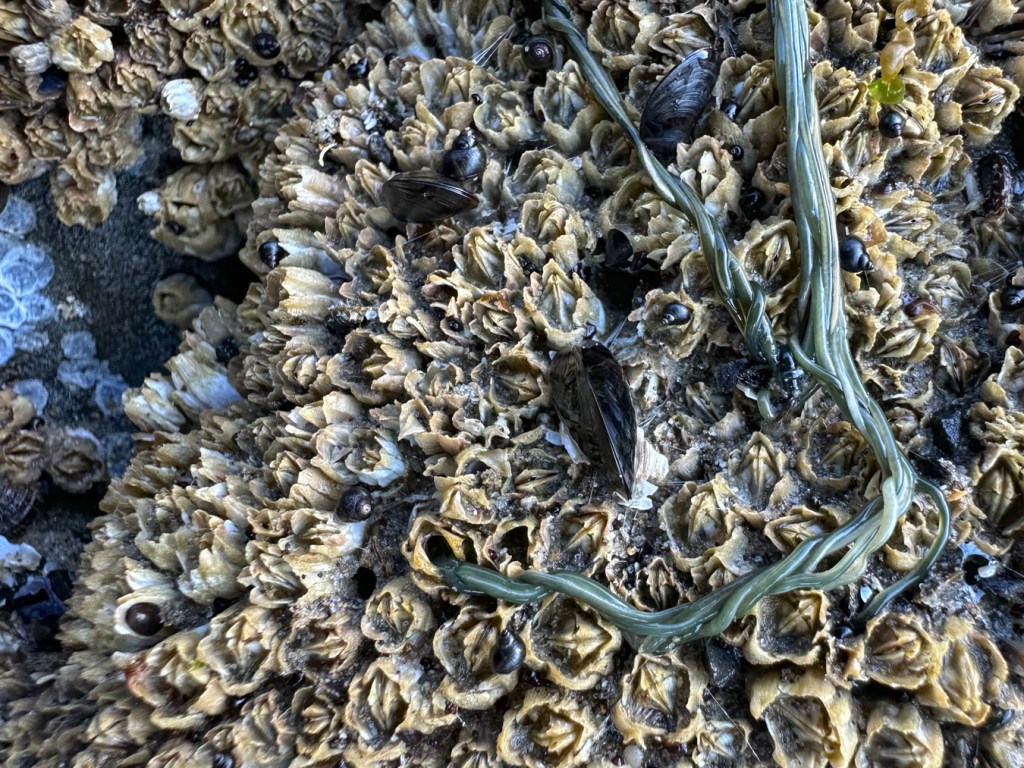
Ribbon worms can be hard to identify and the examples below are not an exception. Expect to see green-colored ribbon worms during low light and high moisture conditions in and around the mussel beds and maybe particularly among barnacles, as seen below. Color may not be the best identification starting point. (However, several local ribbon worms owe their common name to their color.) Still, without much else besides its size and habitat the examples shown below could be Emplectonema, maybe Emplectonema viride (E. gracile in some of the references at the bottom of this page). It’s worth taking a look at the iNaturalist page on Emplectonema.

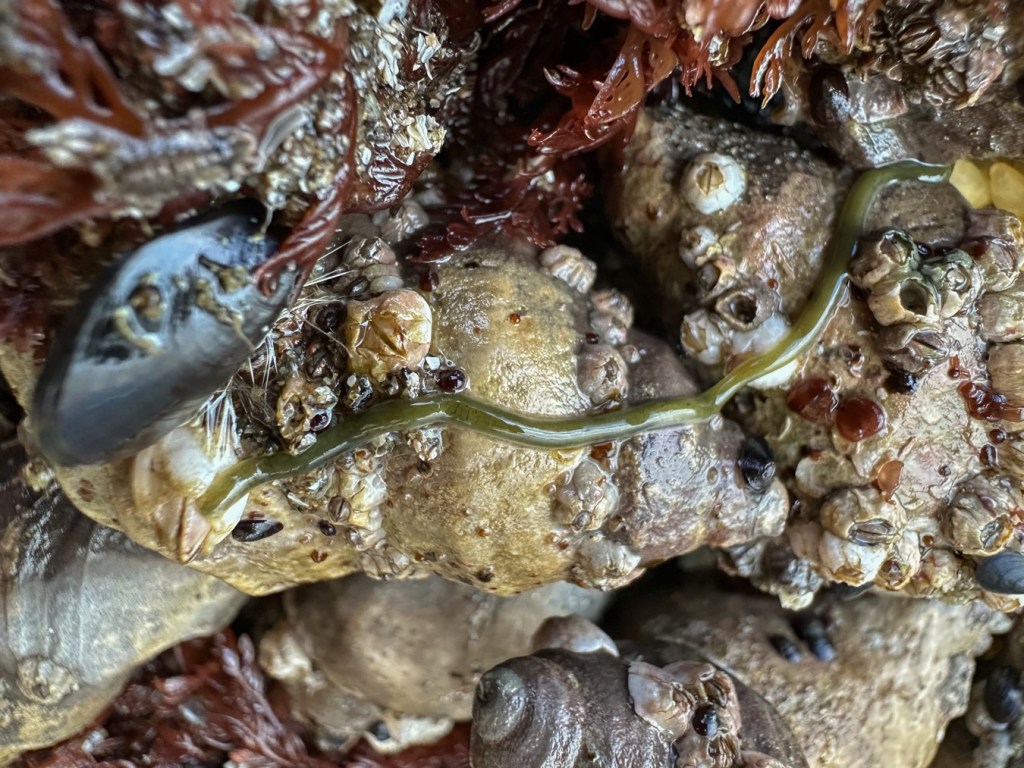
It’s not unusual to find up to several individuals twisted around each other.
This intertidal predator might be the ribbon worm Amphiporus, something like Amphiporus formidabilis. Whatever it is, it’s got decent length and is abundant in and around the mussel beds. They’re active on the surface when light levels are low, and conditions are cool and moist. It’s worth taking a look at the iNaturalist page on Amphiporus. Here’s a video of this ribbon worm exploring the rocks at low tide.
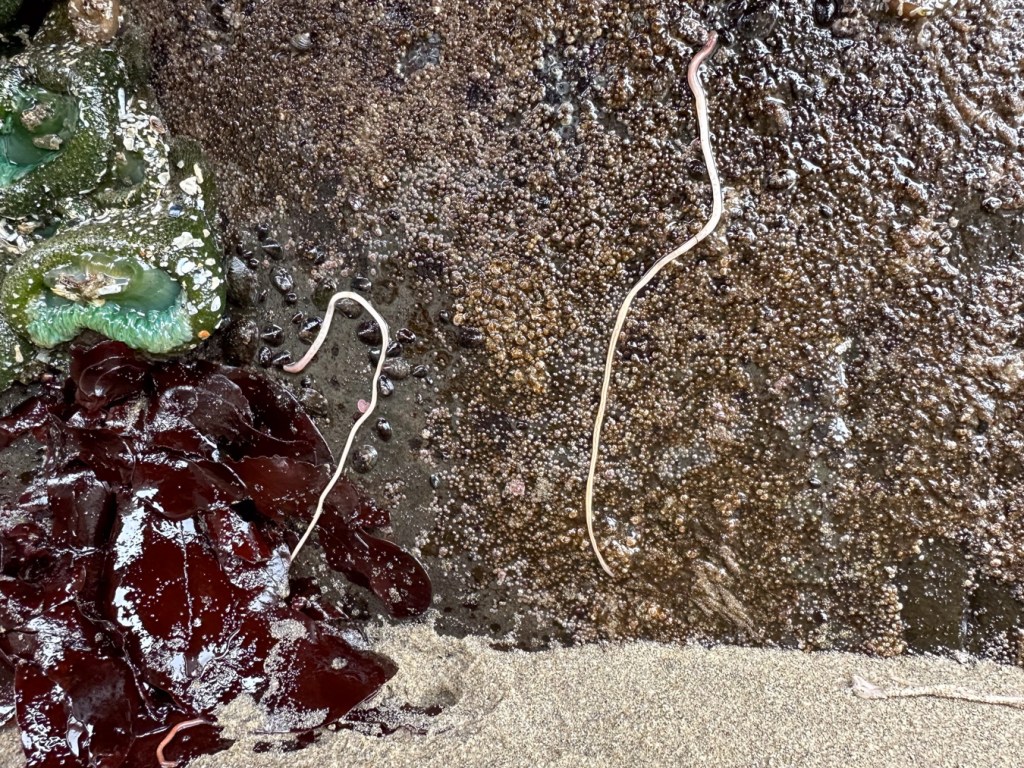

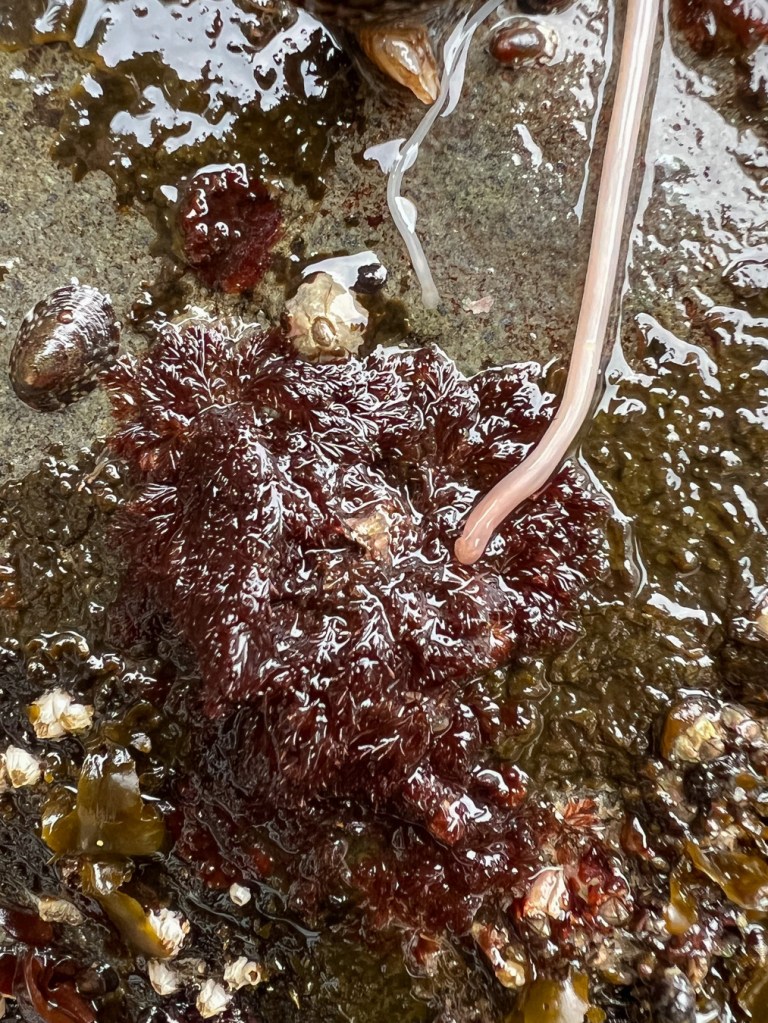

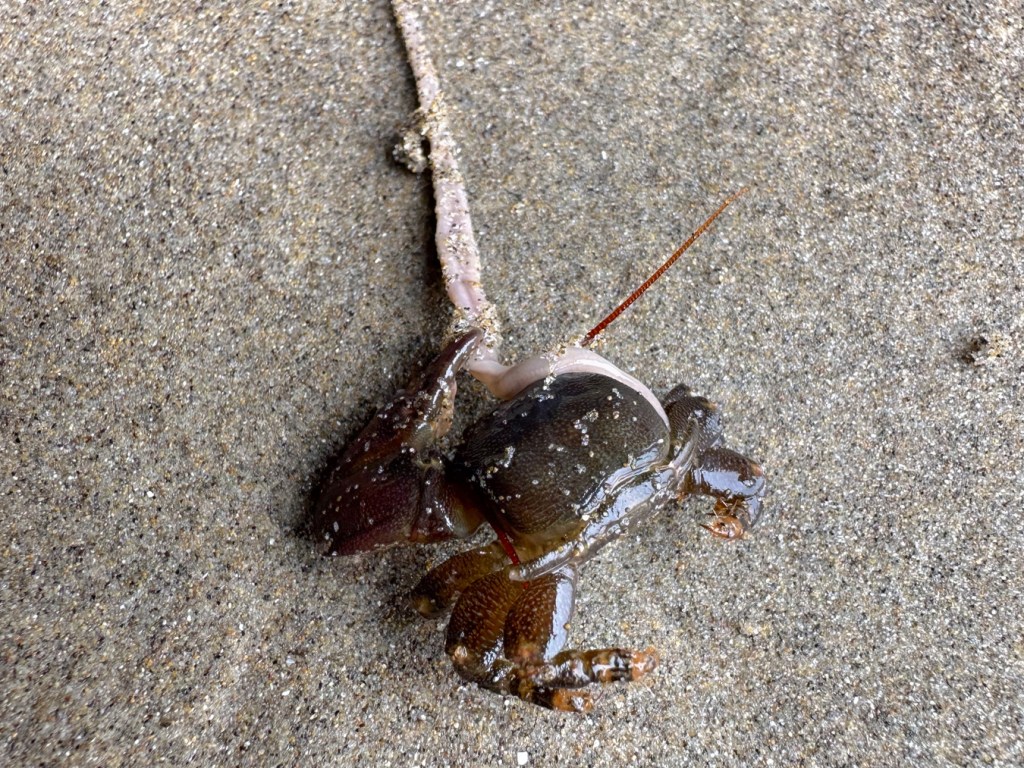
In a couple of instances, I’ve been lucky enough to see apparent cases of feeding—I’m not sure of the circumstances, but predation seems possible.

My impression on the beach was that this pair fell from the mussel bed onto the sand, where the worm proceeded to eat the porcelain crab, but that story’s open to alternative explanations.
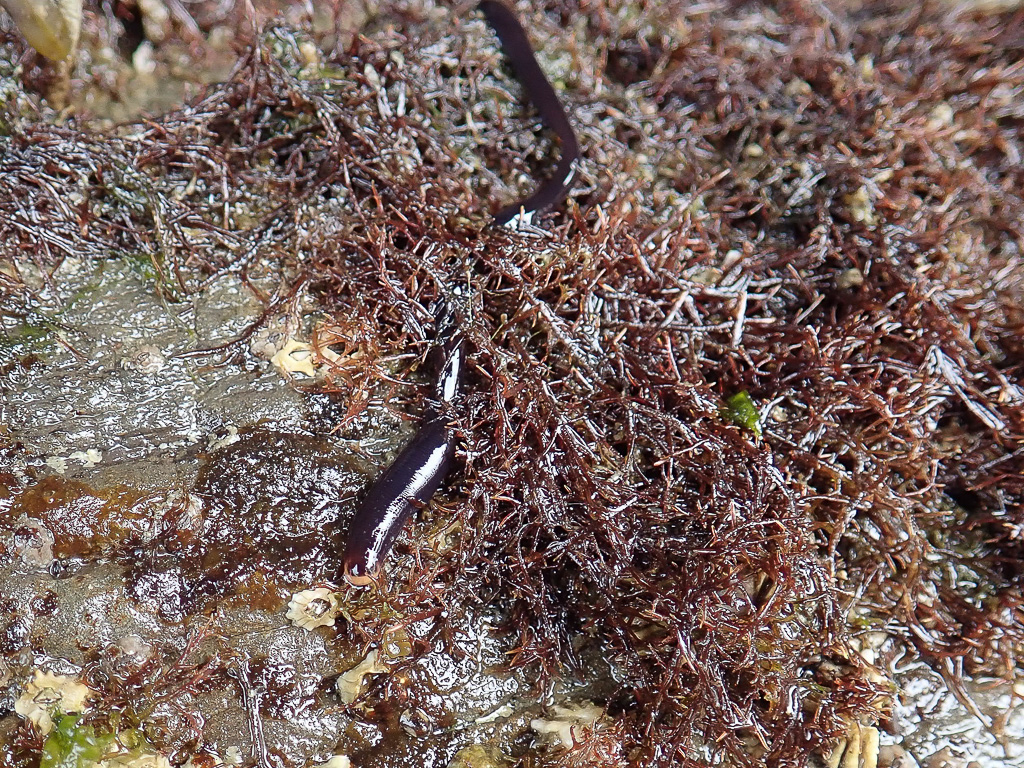
Another abundant and easy to find ribbon worm is purple, as shown below. I feel like there is a decent chance that some or all of these are Paranemertes peregrina or something similar.
Exploring shallow tidepools, they seem so curious.


Under the right conditions, they’re active and seemingly curious out of the water too. Is the bulge behind the head (visible in both panels) evidence of recent feeding?

Success! A small crustacean, I think, meets its match.


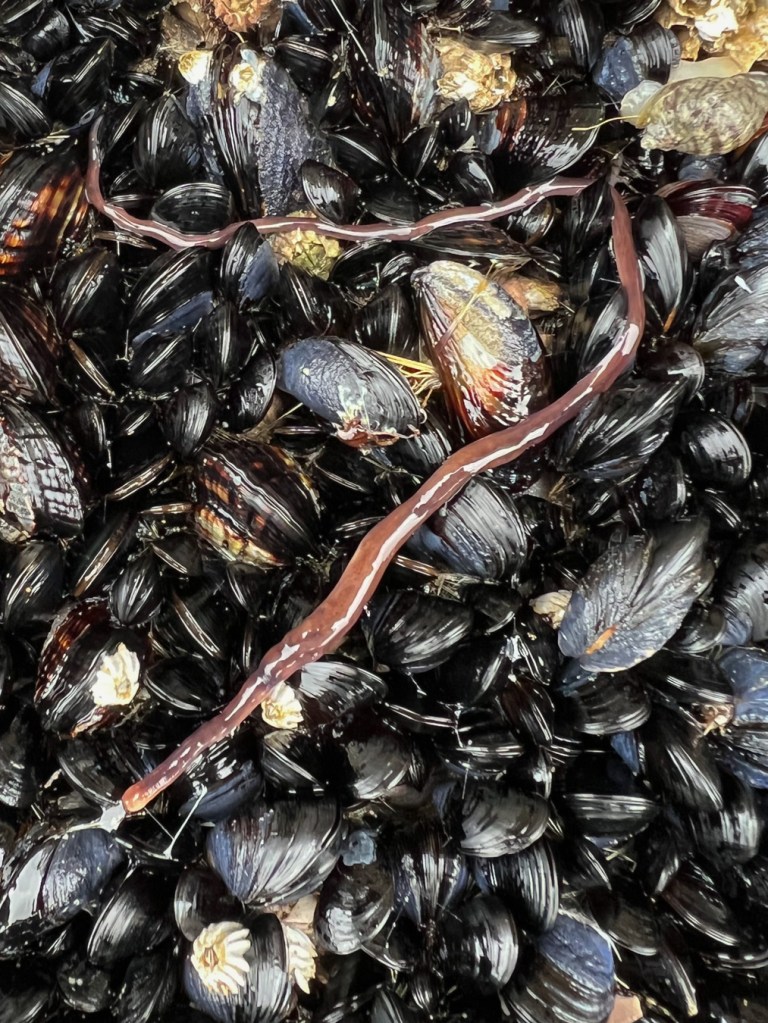
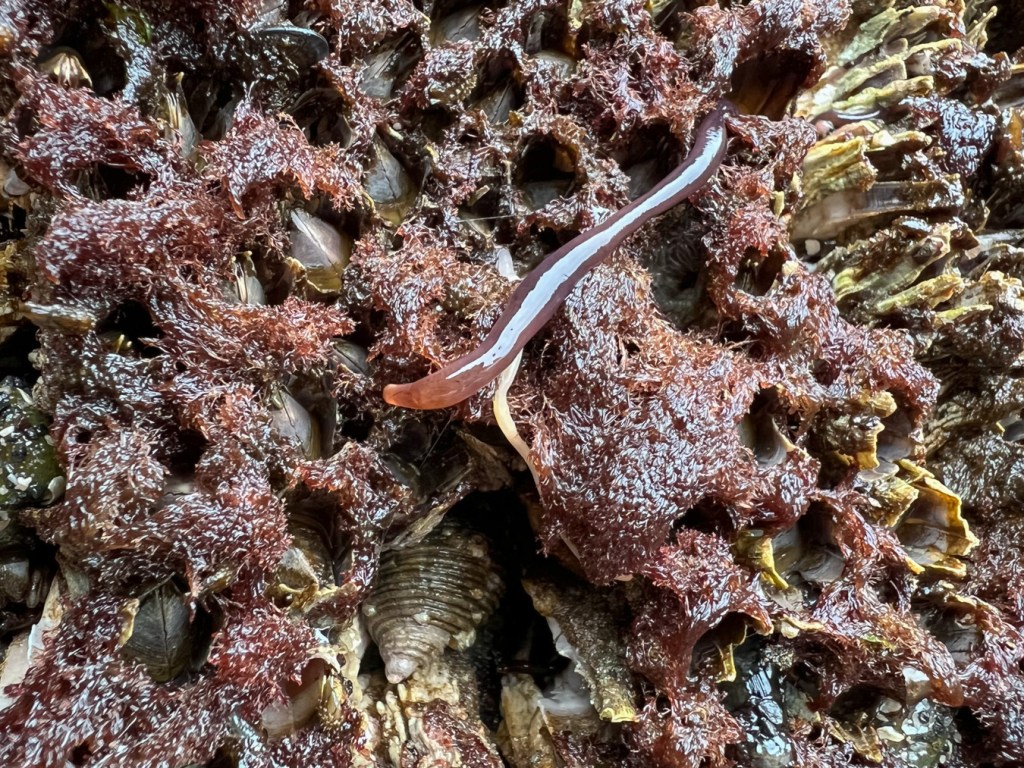
Orange ribbon worms are one of the brightest intertidal inhabitants. Those shown below might be Tubulanus polymorphus, but but just like with the other ribbon worms, I make no identification promises. For more examples, see the iNaturalist page on Tubulanus polymorphus.


Phascolosoma agassizii
This character was disturbed by mussel harvesters and fell out of the bed into a shallow pool to be left behind. The coloration and habitat suggest, at least to me, Phascolosoma agassizii, what some people call the Pacific peanut worm.
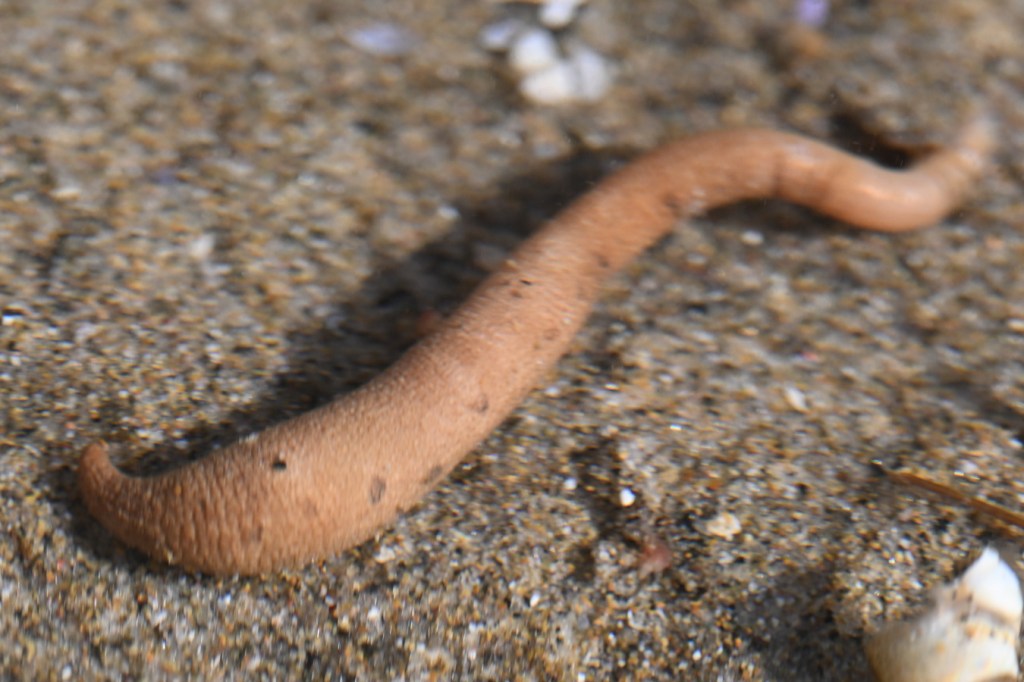
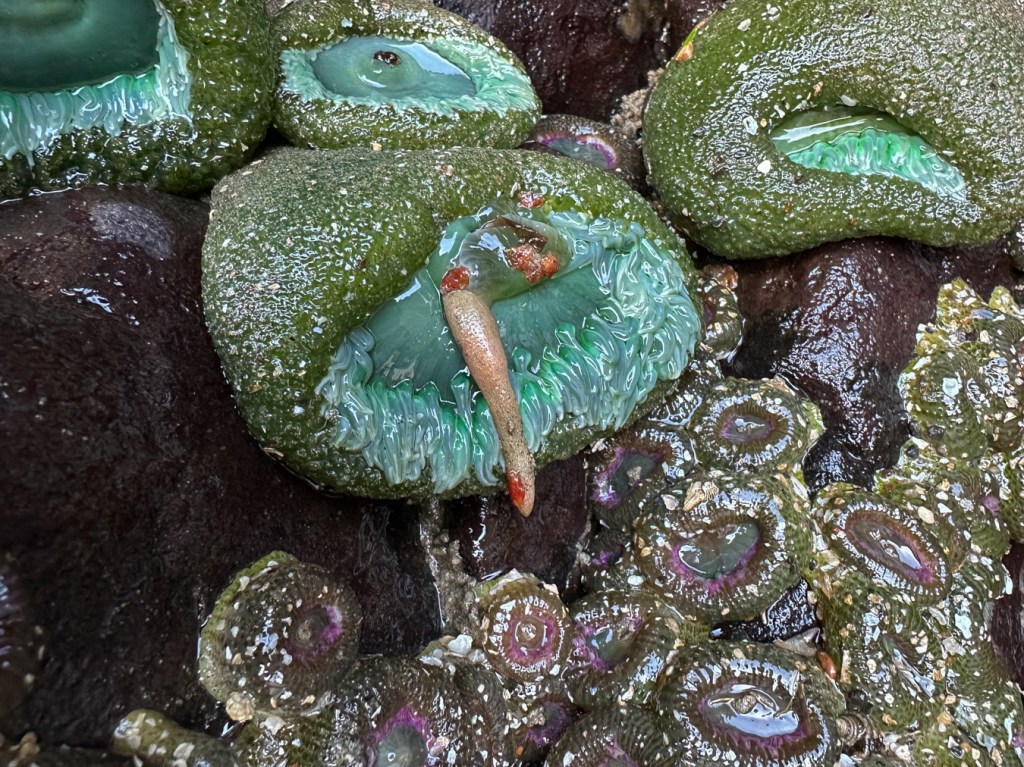
The worm featured below seemingly fell or was pulled out of the mussel bed, where I found it disappearing inside a giant green anemone residing below the bed. (The prior circumstances will forever remain a mystery.)
The left-hand panel, below, shows the scene as I found it. The right-hand panel shows both the worm and anemone after I retrieved the worm for a better look. (Ironically, I didn’t get a better look because the characters I was hoping to see disappeared when both the anemone and the worm contracted at my touch.) But it’s a peanut worm, something I don’t see out in the open too often.

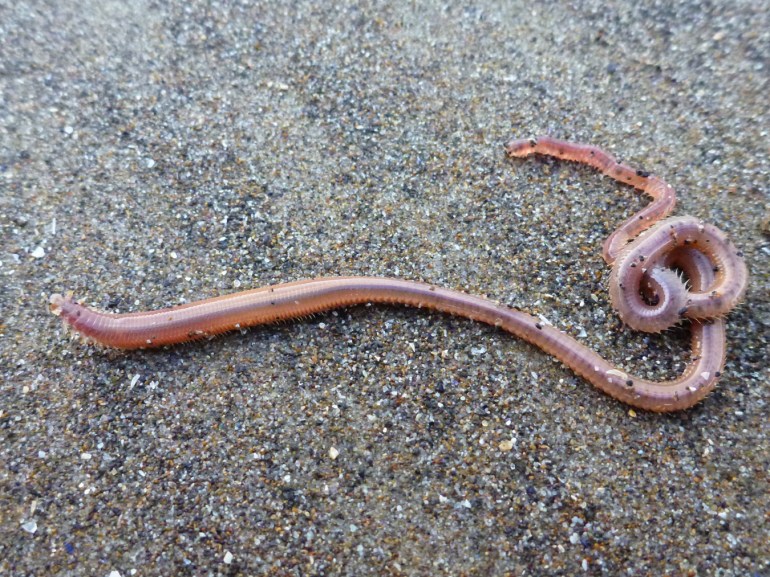
I’ve seen this beauty (a bit fragile down toward the tail) a few times when it appeared on the surface of exposed sandy beaches early in the morning during low tides. The upper right image in this set shows four jaws, a trait Glycera is known for, so that’s a good starting place for determining what it is. In that spirit, the iNaturalist page on Glycera offers excellent browsing.


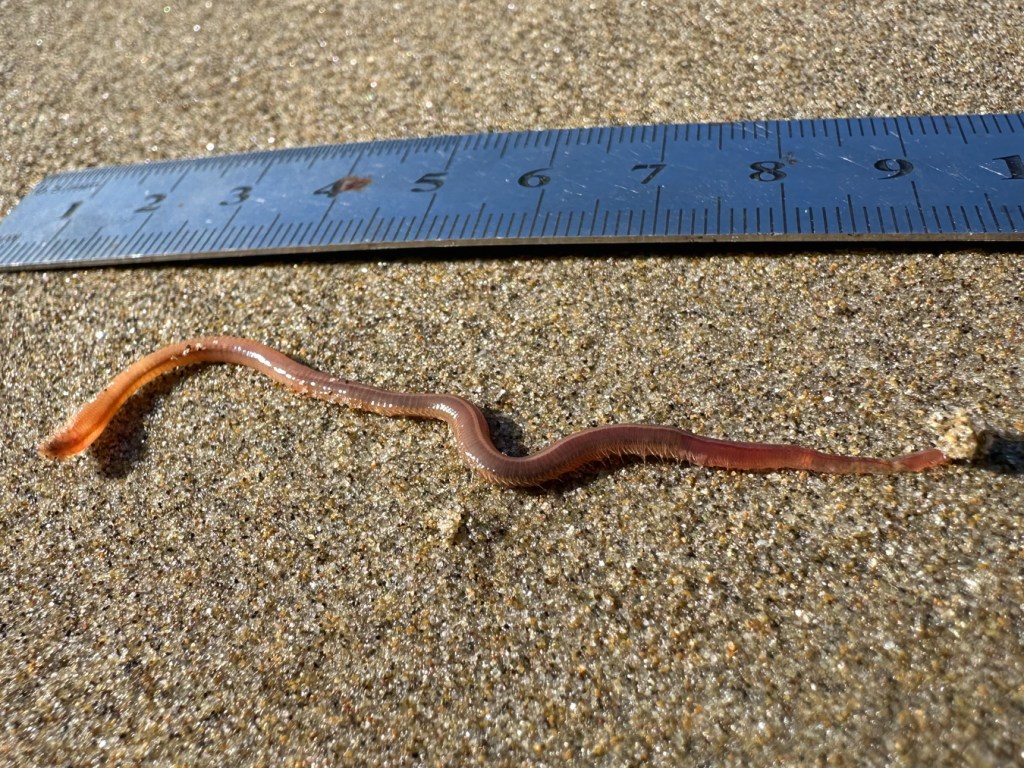
The worm in the set below (same individual in all three panels—just some different looks and a rule for scale) emerged early in the morning from the hole seen at the tip of its tail. These scenes are from the central Oregon shore.


Below, the same worm in both panels, is another one I found emerging from a hole in the sand. (The hole is hidden under the plug of sand at the tail in the top image). One thing I have noticed about this sand-dweller is they writhe when exposed on the sand’s surface. The lower panel in this set illustrates writhing and seemingly ineffective movement on the sand’s surface.
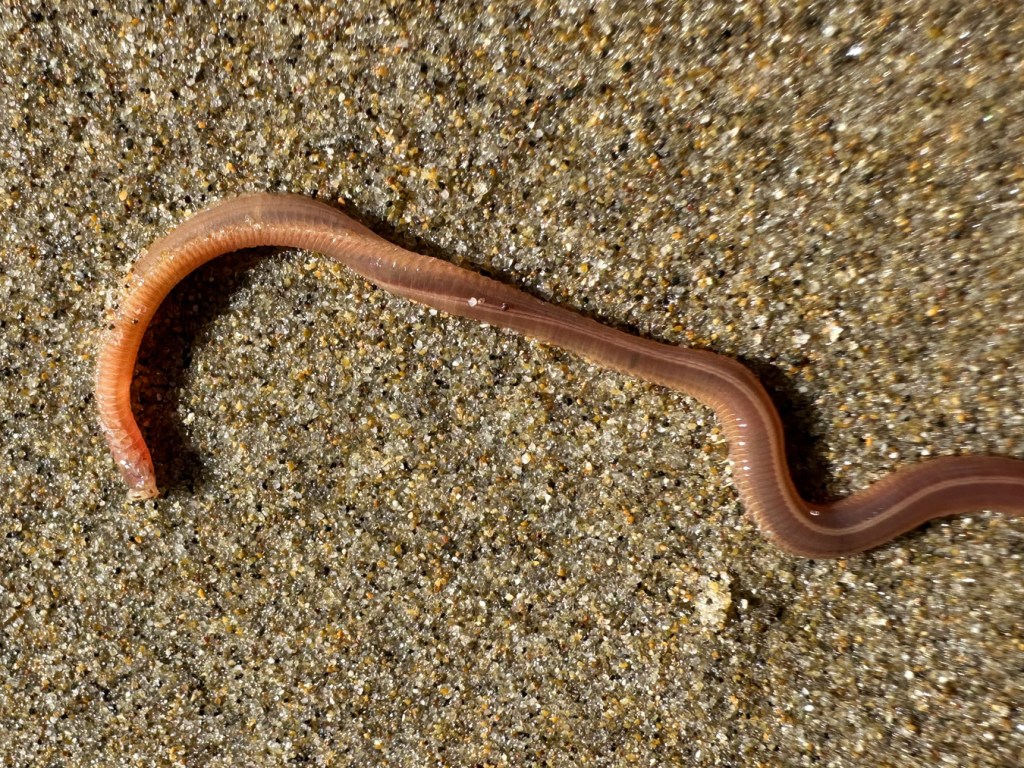
Here’s a sequence with the worm going back down into the sand. The top panel shows the scene shortly after I encountered it. This sequence spans 41 seconds.

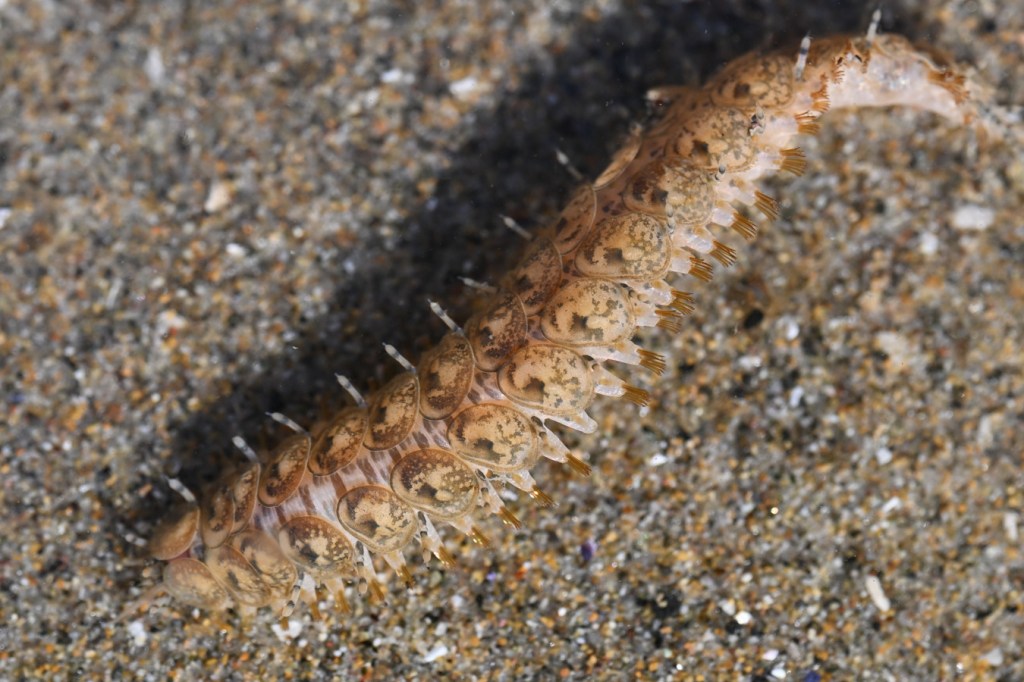
Halosydna brevisetosa Eighteen-Scaled Worm
This little scaleworm was disturbed by mussel harvesters and fell out of the bed into a shallow pool only to be left behind. The pattern on its scales, including eye-spots, is an 18-pair sight of beauty.
Nephtys
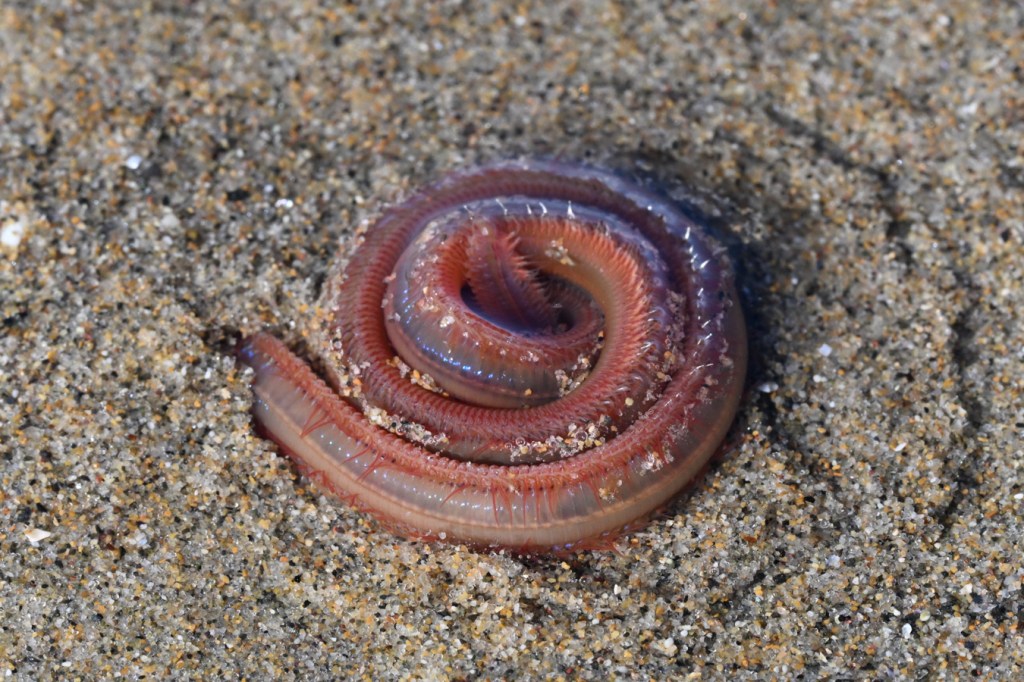
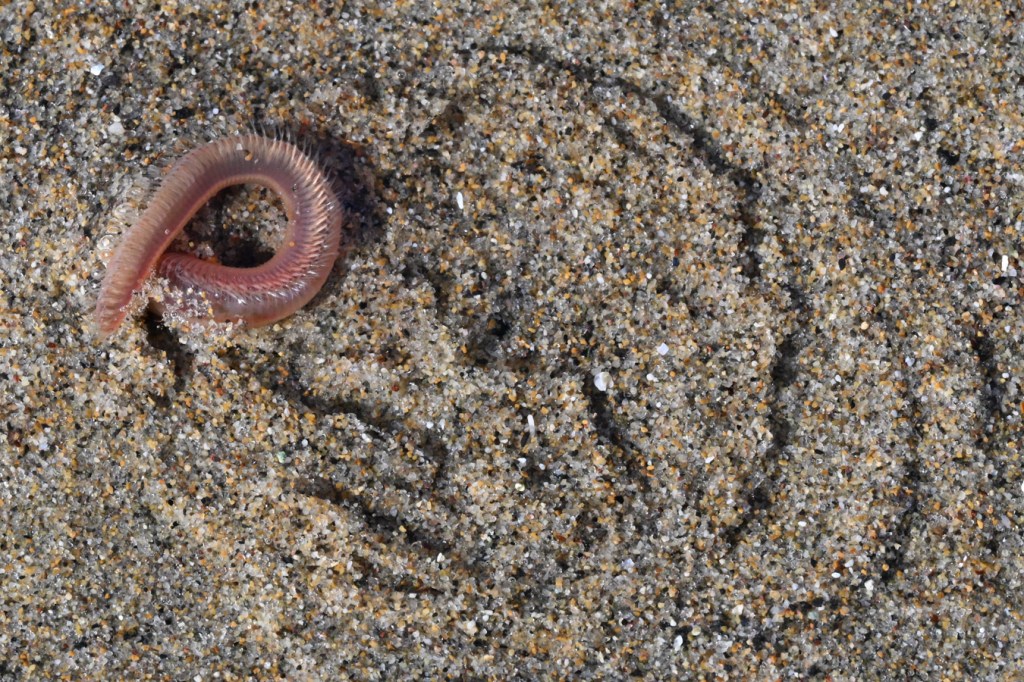
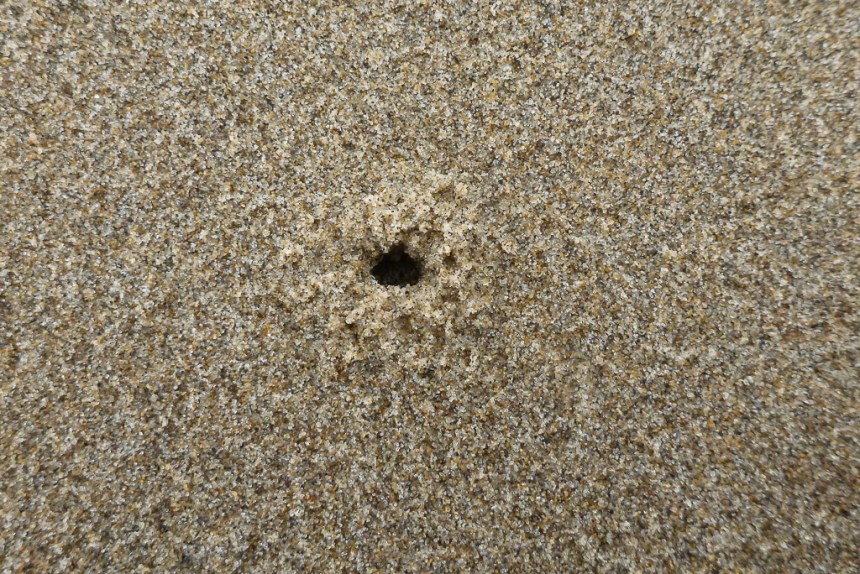
The four panels immediately below document me breaking my light-touch rule with a burrow excavation. I’ve always thought the robust worms like those in the top set set are Nephtys californiensis, supposedly the most substantial goddess worm you’ll find on sandy outer coast beaches. But Nephtys has some look-alike diversity on Pacific Northwest shores, so I’m not at all certain. And I should note, since several Nephtys examples are shown in this entry, more than one species may be represented. In any case, lively, wriggling Nephtys are somewhat iridescent.
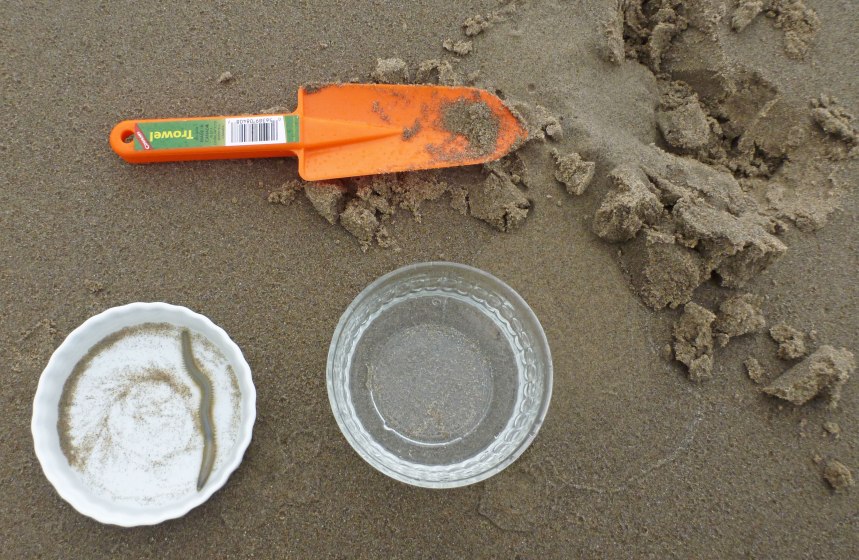
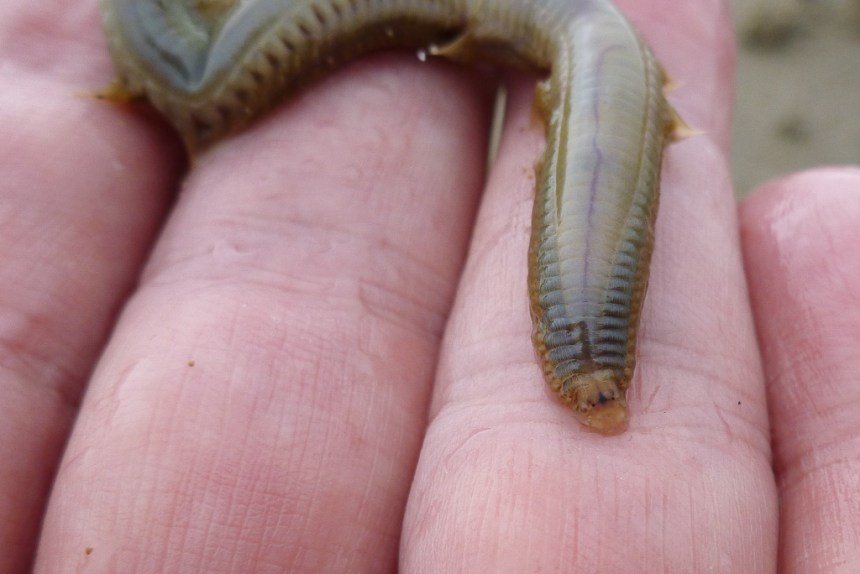

Rather than a burrow entrance, you might, at low tide, encounter Nephtys beneath a sinuous impression in the sand.
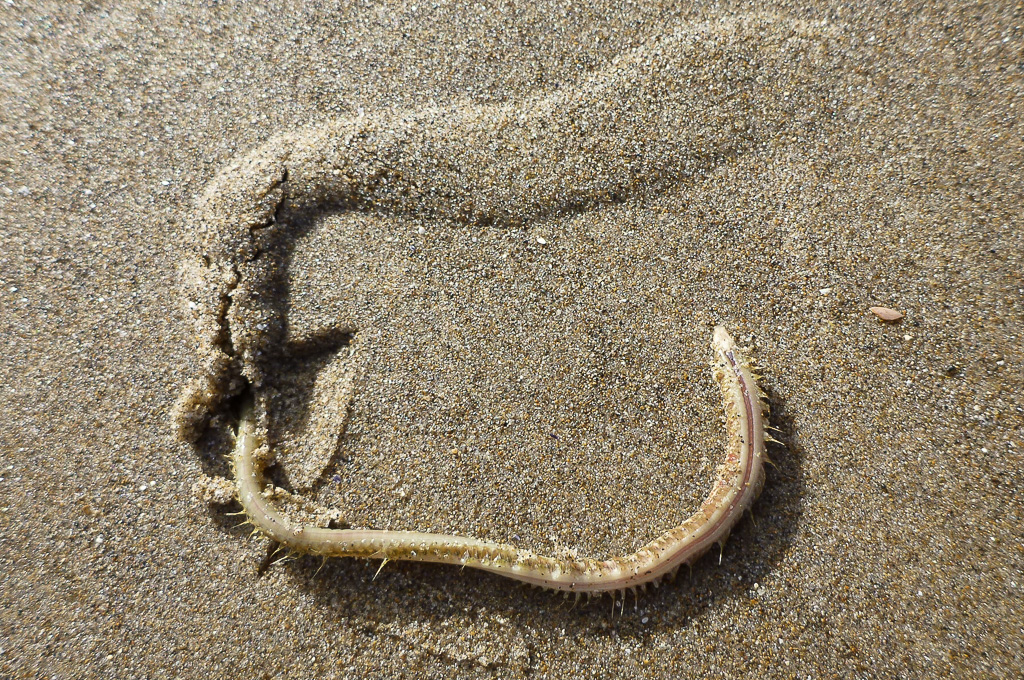
Here is a selection of worms I found out on the surface in close proximity to each other during a low summer tide.


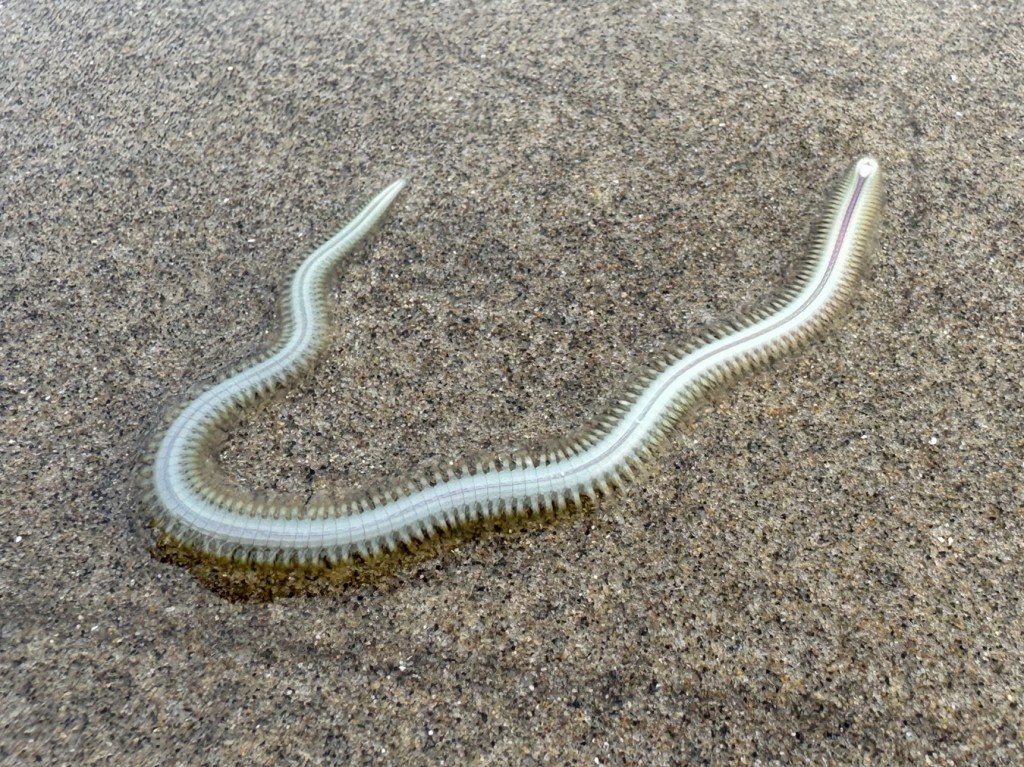
I really love this action shot, and if you do too, you’ll also love the video.

If you come across dead Nephtys on the beach you’ll probably find the beach hoppers have beaten you to it.

Nereis
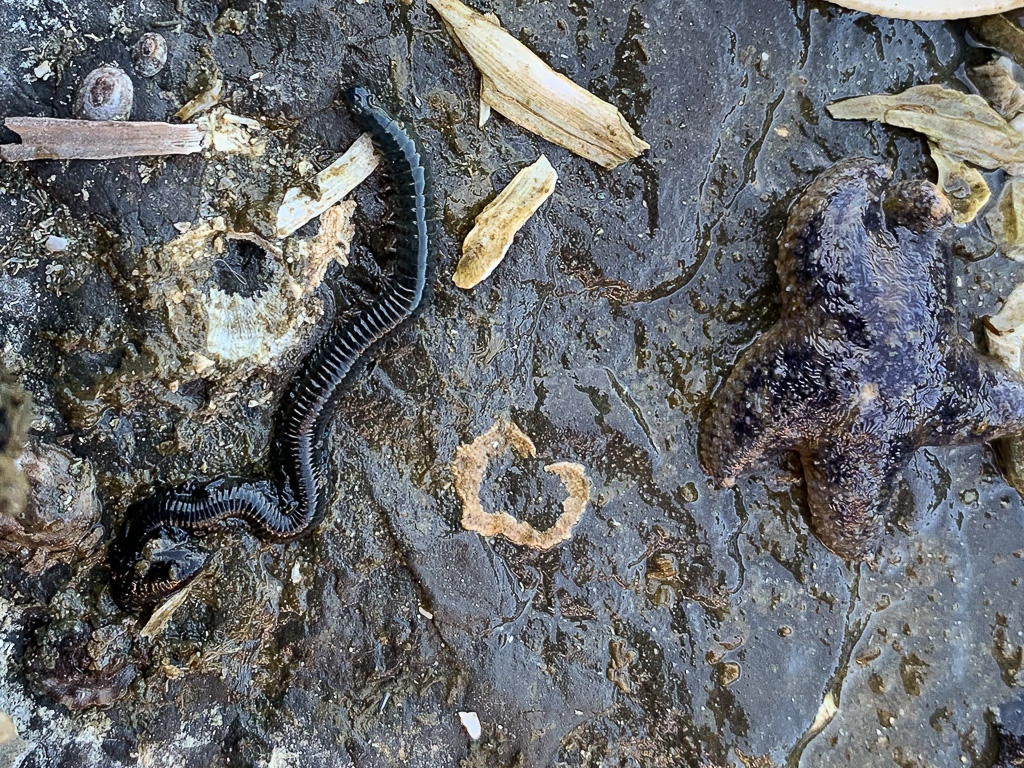
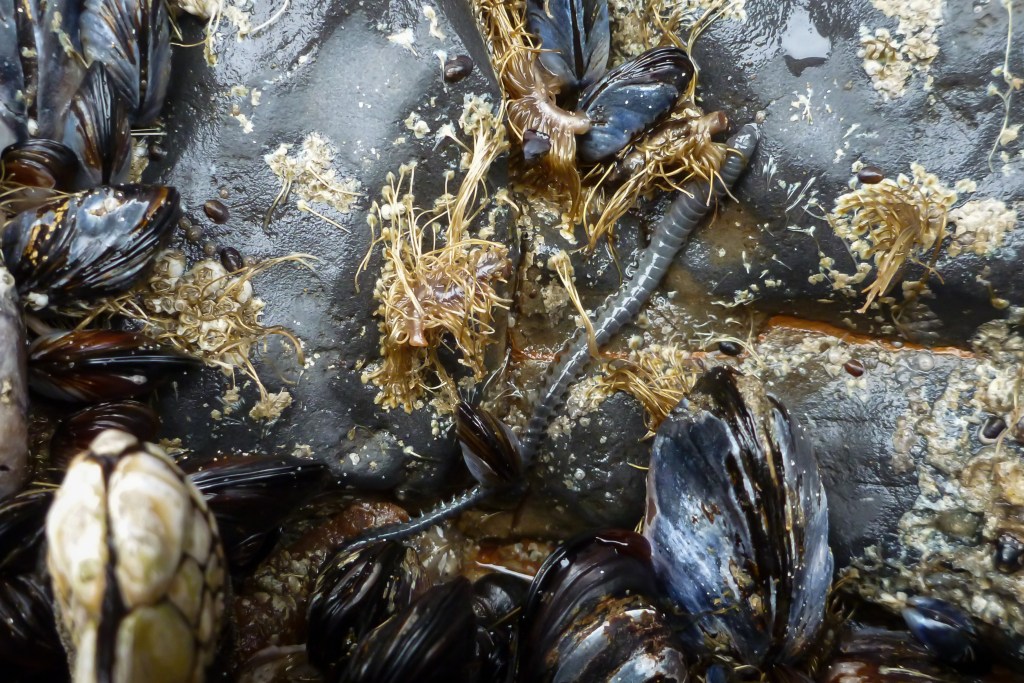
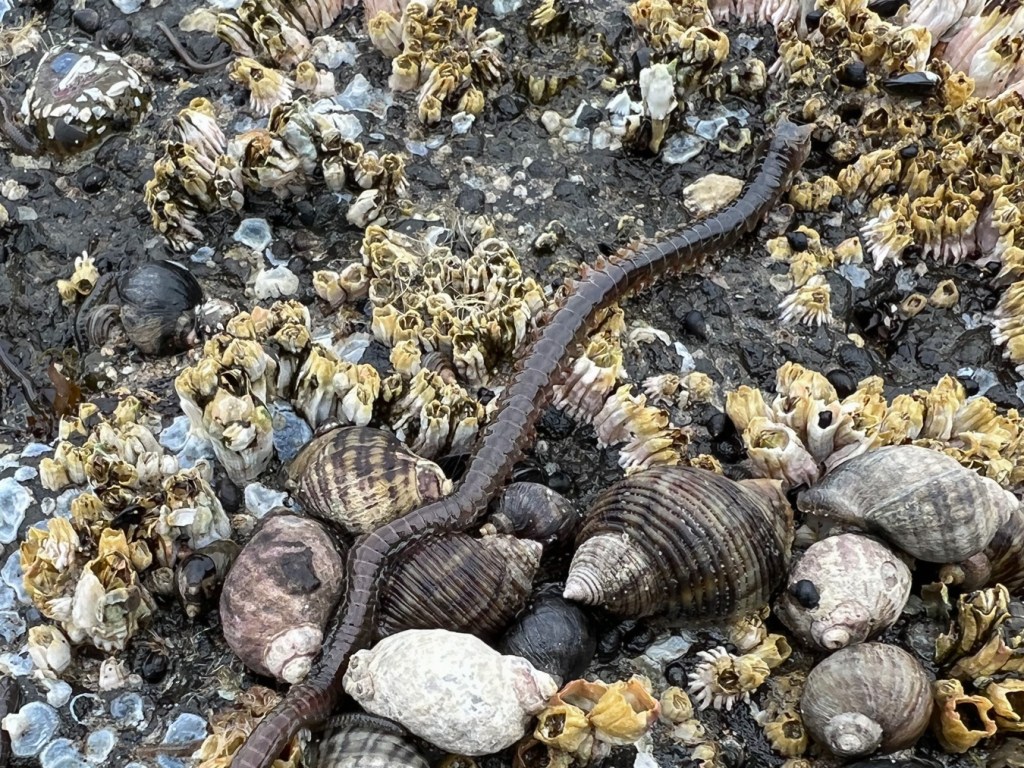
The nereids in this entry are probably Nereis vexillosa or something similar. Out on the mussel beds, especially if the light is low, they’re fairly uninhibited and you may see them on the surface abundantly, being their curious selves. I’ve also seen them out on the sand and in shallow sand-filled pools around the time of spring and summer low tides. Kozloff describes the swarming behavior of ripe adults (females are redder posteriorly than males—you’ll see some nice color, below in this entry).
Here are examples from the rocks in and around mussel beds where Nereis can be reliably found when the timing of the tides permits.
Below are examples of worms out and about on the sand, just a short distance from rocks that support mussel beds.


Examples from shallow sand-filled pools.
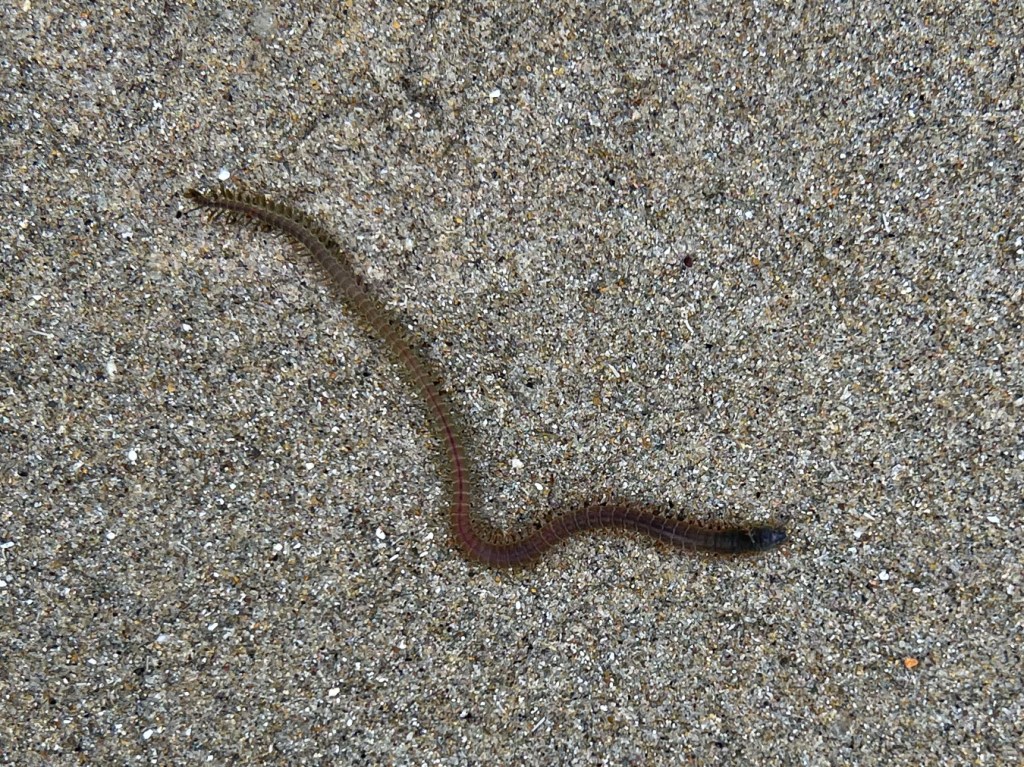


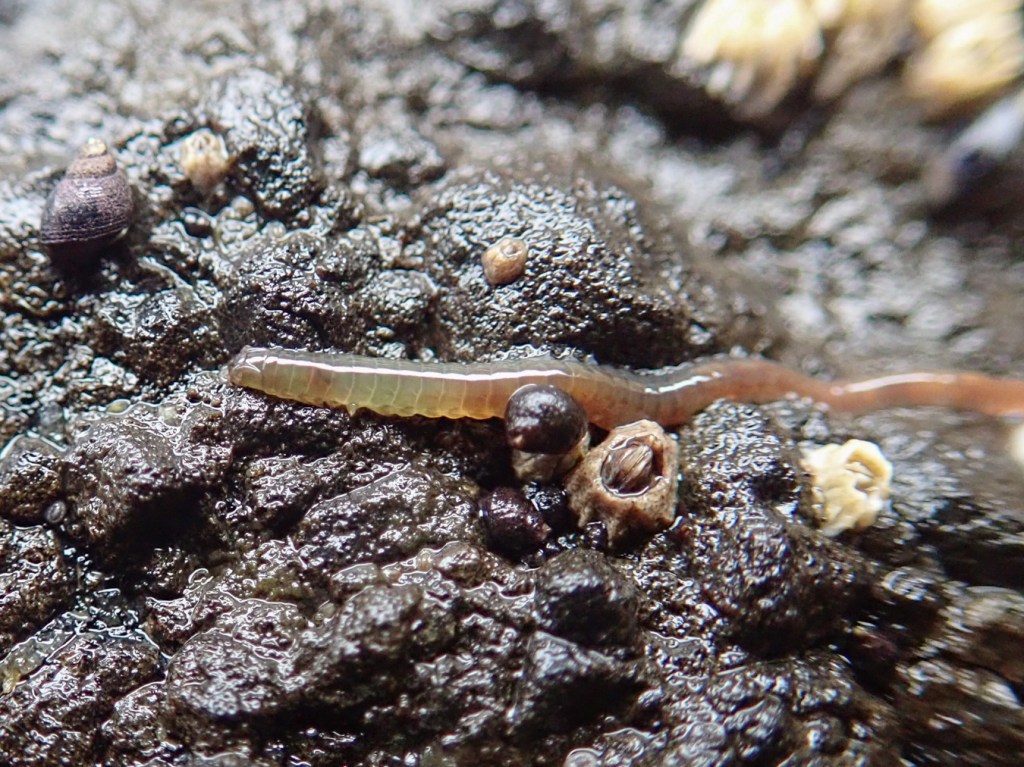
Assuming the tiny show-stopper below is a juvenile N. vexillosa, it was not yet a yearling when I found it in March, 2024. Here, it is just a fraction of adult size. If it survives, it will see a growth spurt in the months ahead.
Dodecaceria
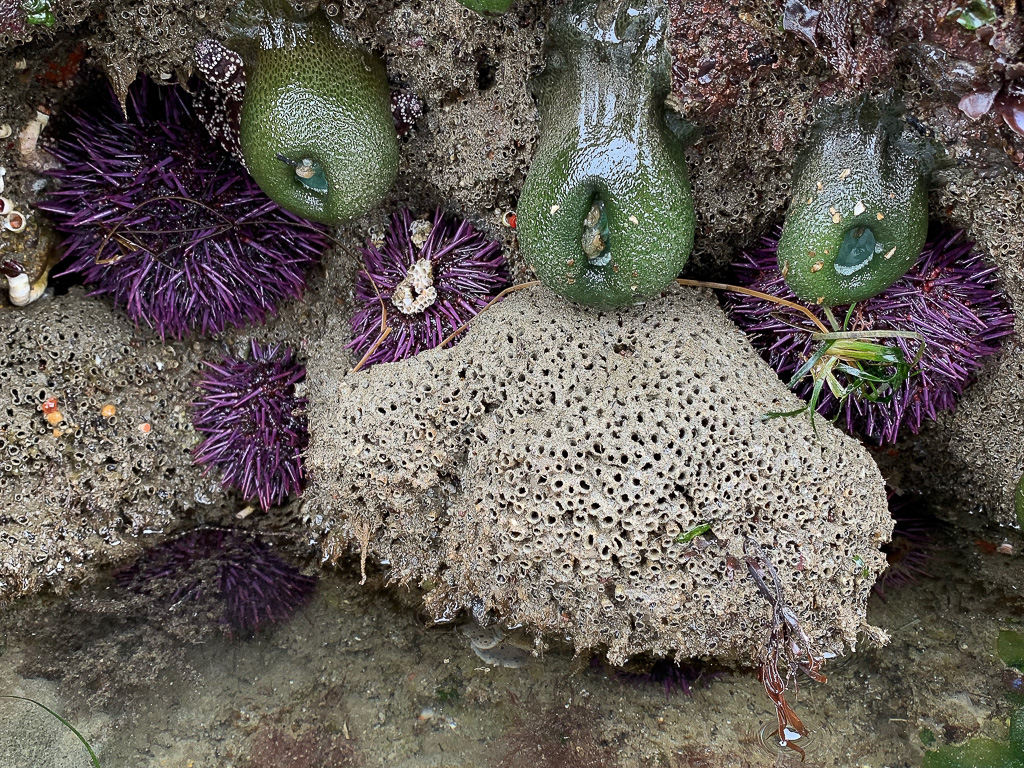
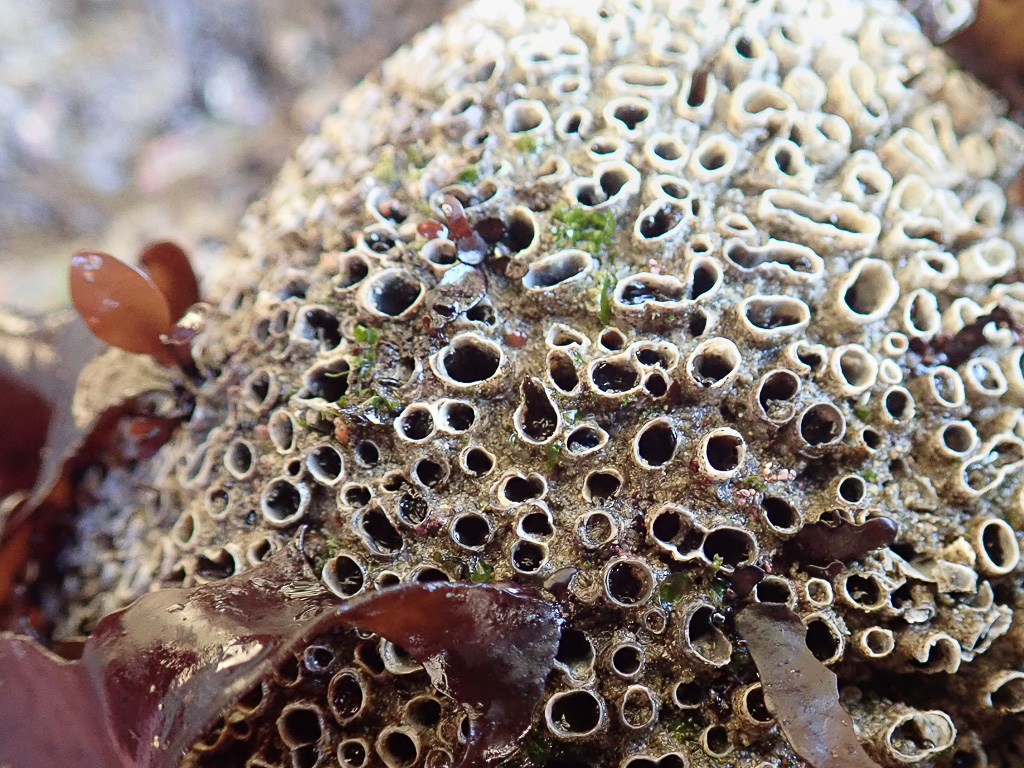
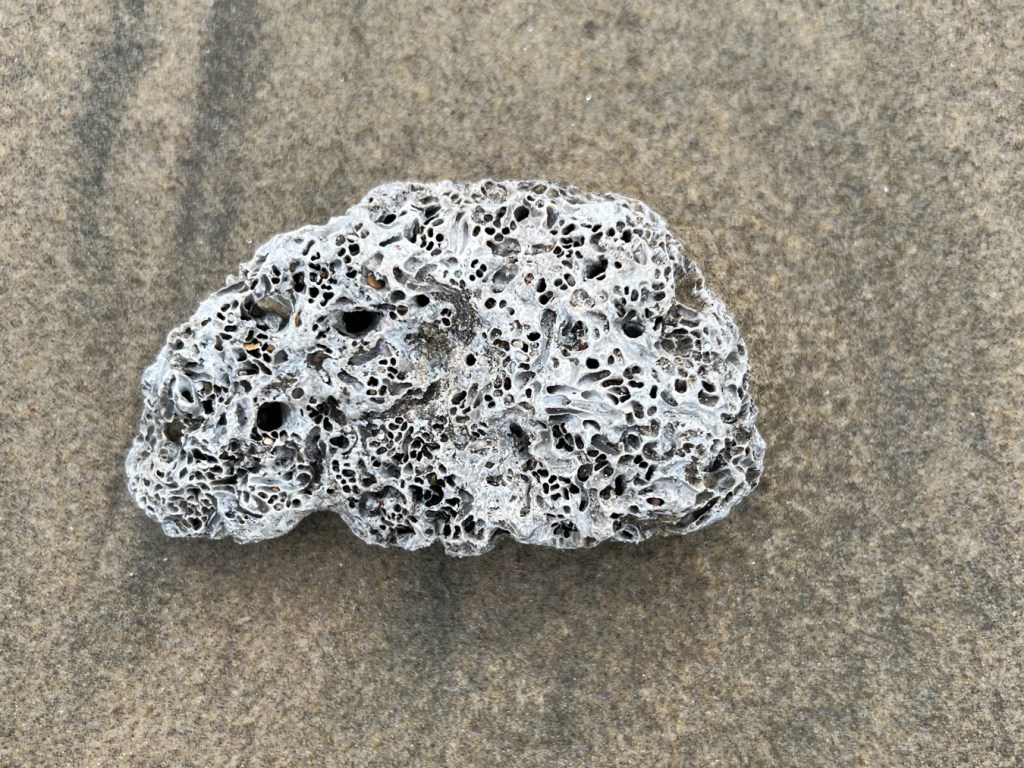
I’m pretty sure this colonial worm is Dodecaceria pacifica. If it is, you might know it as Dodecaceria fewkesi, but things change, and it now goes by Dodecaceria pacifica, at least in some circles. The first time I touched a mound, its rough hardness surprised me. Besides the worms within, the structures are composed of calcareous tubes embedded in cemented sand that can handle rough surf. Even so, most I’ve seen are set back slightly or located on indirect exposures. Colonies I’ve come across are mounted on vertical surfaces or, nearly so, either on big walls or the edges of tidepools. Eroded colony fragments, sometimes called false brain coral, are a treat to find washed up on the beach or among the cobbles.


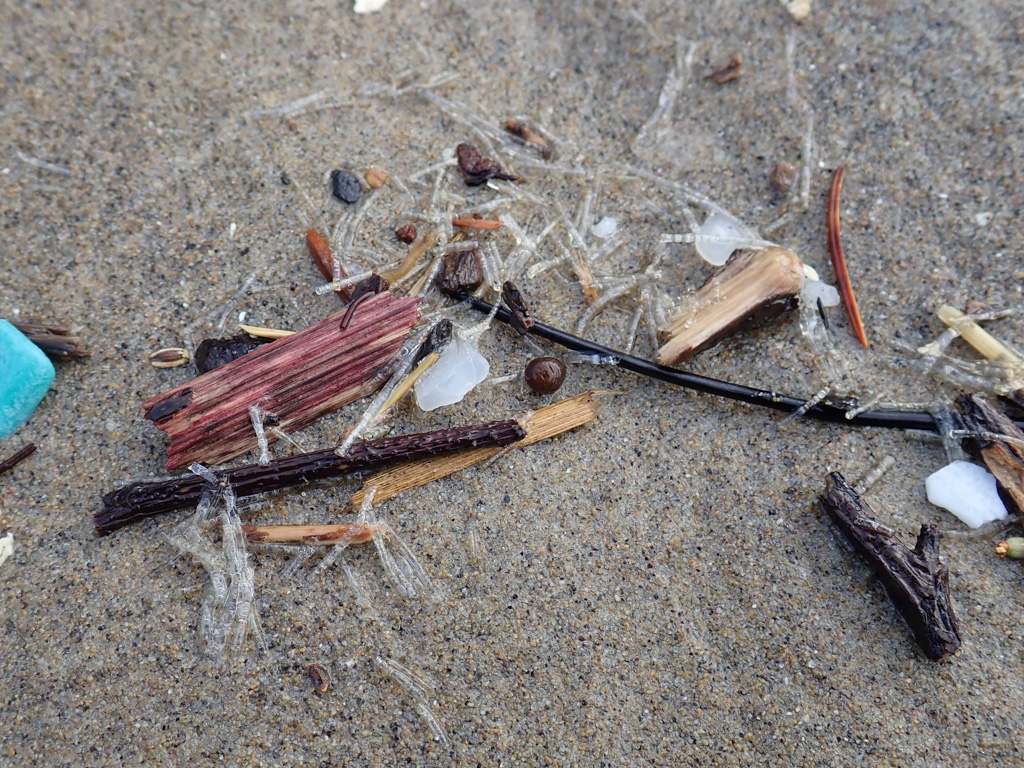
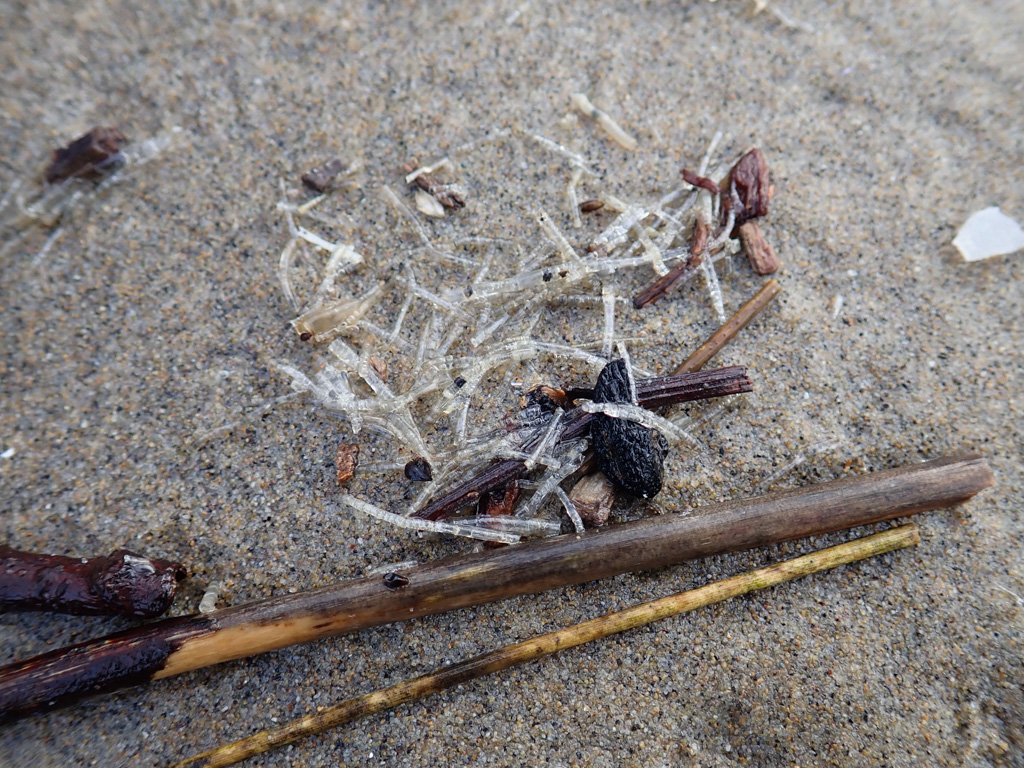
I only know the worm below from its clear tubes, which wash up abundantly, and I do mean abundantly, on exposed sandy beaches. When folks in my orbit call them cellophane tube worms, they refer to Spiochaetopterus costarum. Here’s a short Seagrant/Hatfield Visitor Center piece on them with a photo of the tubes and a bit of cheerleading for cellophane tube worm as a common name. If that’s what they are, Lamb and Hanby use jointed three-section tubeworm, and the iNaturalist crowd goes with glassy tubeworm. Whatever way you lean, look for the tubes among fresh wrack.

References
Harbo, R. M. 2011. Whelks to Whales: Coastal Marine Life of the Pacific Northwest. 2nd ed. Harbour Publishing Co.
Kozloff, E. N. 1993. Seashore Life of the Northern Pacific Coast. 3rd ed. University of Washington Press.
Lamb, A. and B. P. Hanby. 2005. Marine Life of the Pacific Northwest. Harbour Publishing.
Light, S. F., 2007. The Light & Smith Manual: Intertidal Invertebrates from Central California to Oregon. 4th ed., edited by J. T. Carlton. University of California Press.
Sept. J. D. 2019. The New Beachcomber’s Guide to the Pacific Northwest. Harbour Publishing.
Online Resources
Friends of Netarts Bay WEBS Worms page. Accessed September 11, 2025.
Pacific Northwest Shell Club’s Worms page. Accessed September 11, 2025.
It’s worth scrolling down to worms in Common Sea Life of Southeastern Alaska: A field guide by Aaron Baldwin & Paul Norwood. Accessed September 11, 2025.
Species Accounts
Cowles, D. (2002). Phascolosoma agassizii Keferstein, 1867. Invertebrates of the Salish Sea. Rosario Beach Marine Laboratory. Accessed September 11, 2025.
Cowles, D. (2004). Tubulanus polymorphus Renier, 1804. Invertebrates of the Salish Sea. Rosario Beach Marine Laboratory. Accessed January 21, 2024.
Cowles, D. (2005). Nephtys ferruginea Hartman, 1940. Invertebrates of the Salish Sea. Rosario Beach Marine Laboratory. Accessed January 21, 2024.
Cowles, D. (2009). Nereis vexillosa Grube, 1851. Invertebrates of the Salish Sea. Rosario Beach Marine Laboratory. Accessed January 21, 2024.
Cowles, D. (2009). Paranemertes peregrina Coe, 1901. Invertebrates of the Salish Sea. Rosario Beach Marine Laboratory. Accessed July 4, 2024.
Cowles, D. (2018). Glycera americana Leidy, 1855. Invertebrates of the Salish Sea. Rosario Beach Marine Laboratory. Accessed September 11, 2025.
Cowles, D. (2018). Halosydna brevisetosa Kinberg, 1855. Invertebrates of the Salish Sea. Rosario Beach Marine Laboratory. Accessed September 11, 2025.
Hiebert, T.C. 2015. Glycera robusta. In: Oregon Estuarine Invertebrates: Rudys’ Illustrated Guide to Common Species, 3rd ed. T.C. Hiebert, B.A. Butler and A.L. Shanks (eds.). University of Oregon Libraries and Oregon Institute of Marine Biology, Charleston, OR. Accessed September 11, 2025.
Hiebert, T.C. 2015. Nereis vexillosa. In: Oregon Estuarine Invertebrates: Rudys’ Illustrated Guide to Common Species, 3rd ed. T.C. Hiebert, B.A. Butler and A.L. Shanks (eds.). University of Oregon Libraries and Oregon Institute of Marine Biology, Charleston, OR. Accessed March 26, 2024.
I updated this page on September 11, 2025
 theoutershores