Below are a few examples of snails living on Oregon’s exposed rocky shores and, rarely, on the beaches. The photos are from northern Oregon unless noted. These are the easy-to-spot snails I’ve seen and photographed on the shores I’ve visited; they’re the ones you can find without turning rocks or creating disturbances. Organization-wise, I loosely follow Lamb and Hanby (2005). If I use common names, they’re my choice. Experts cover these examples and many more in the books, field guides, and identification resources listed at the bottom of the page.
Let the snails be upon you!
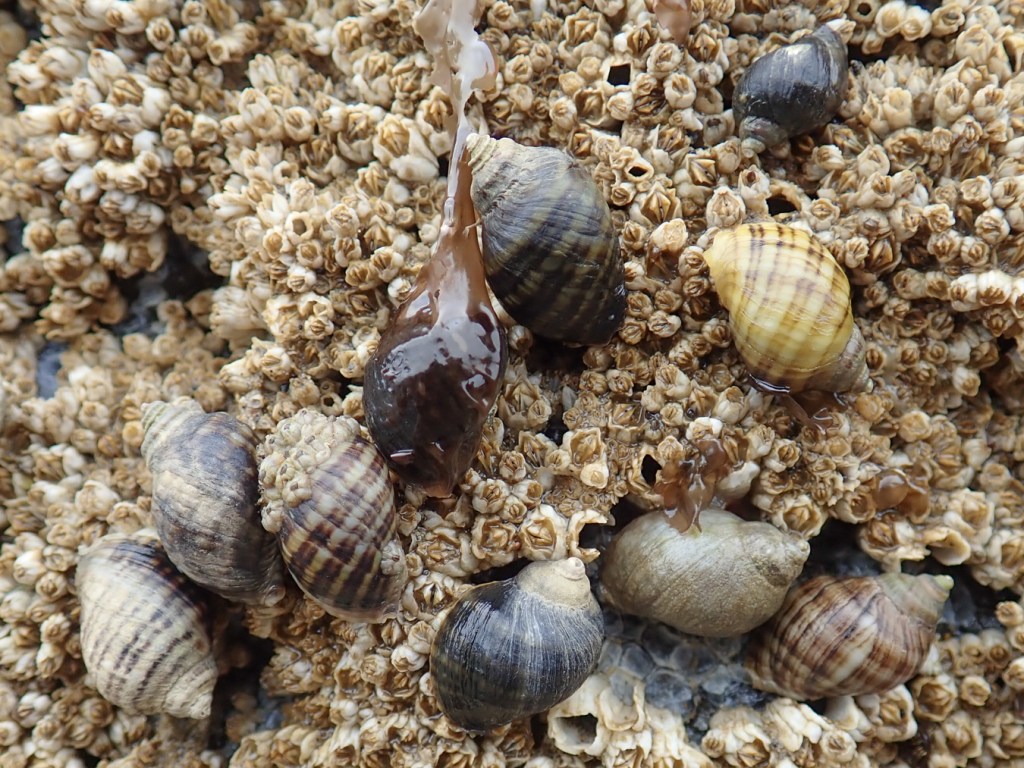
Nucella ostrina Northern striped dogwinkle
Nucella ostrina is most noticeable among the acorn barnacles Balanus glandula. They’re easy to find and, without question, one of the rocky intertidal snails I most enjoy.



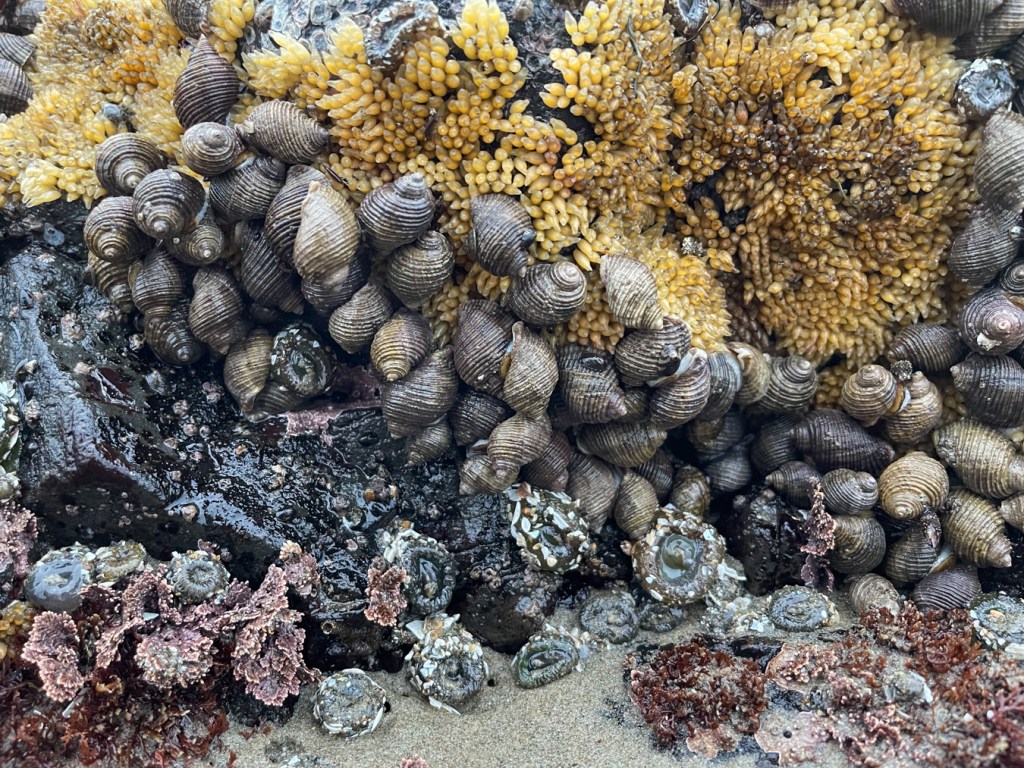
Nucella canaliculata Channeled dogwinkle

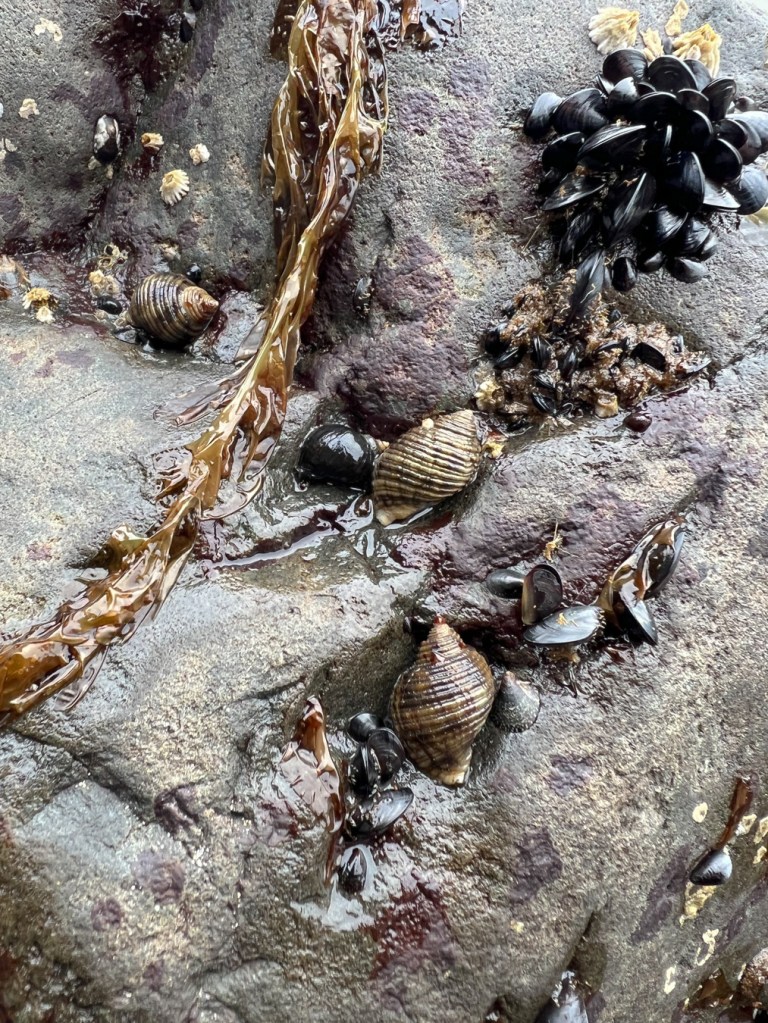
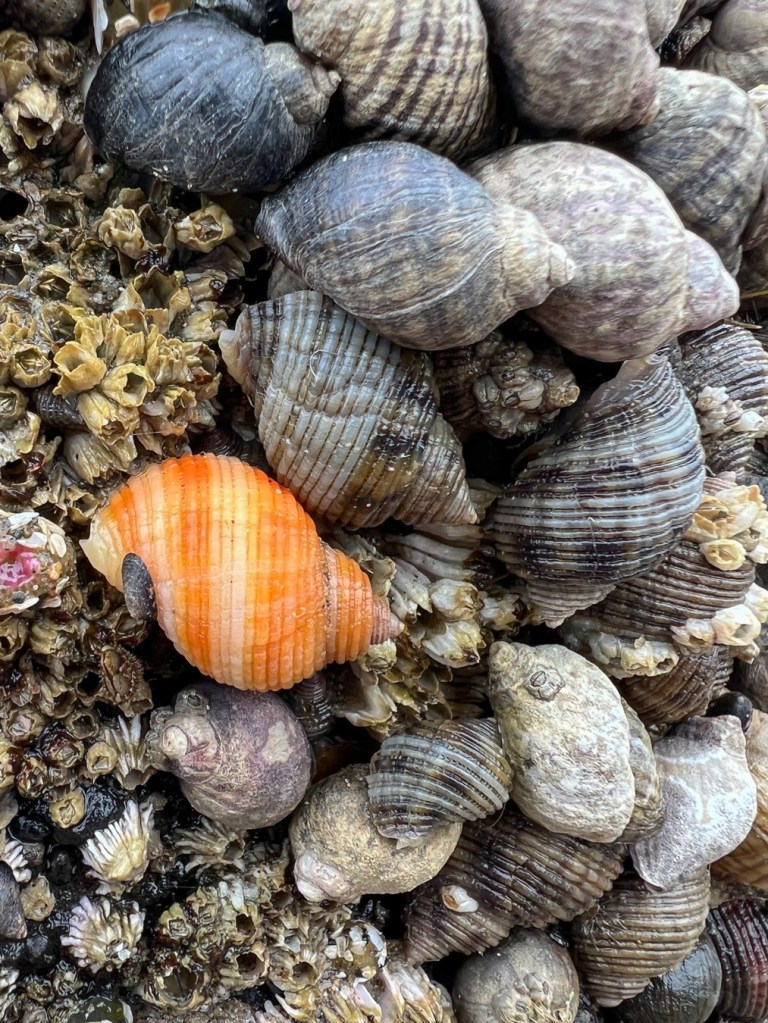
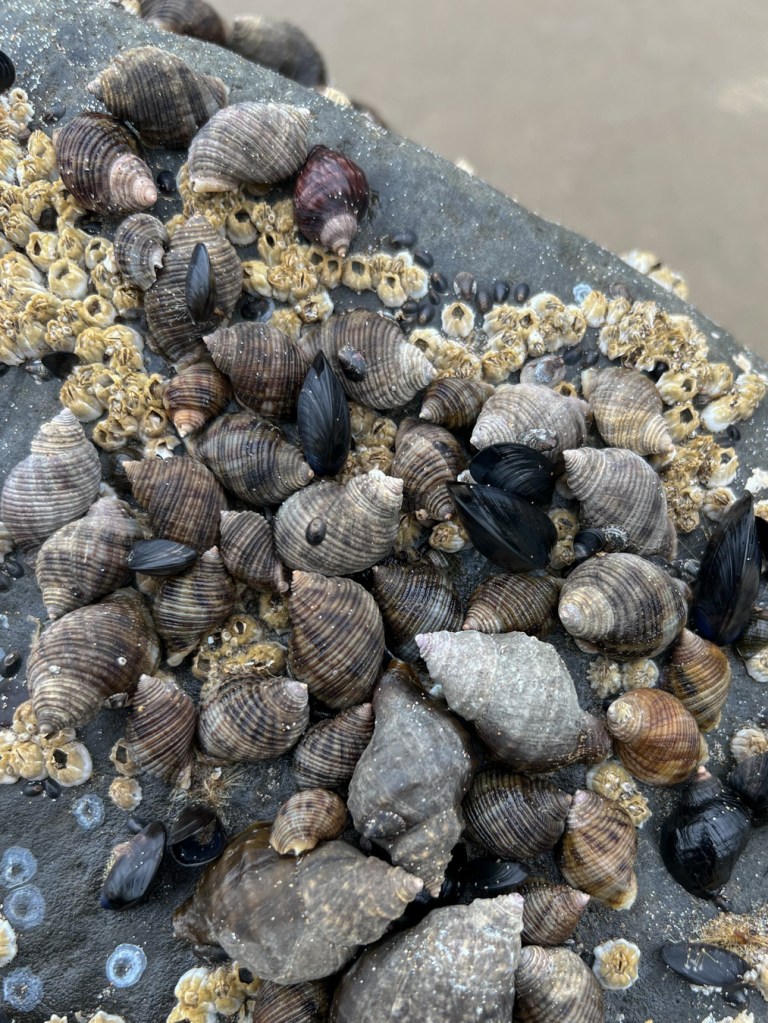

The shells’ ridges and the channels between them are a little variable and always captivating.

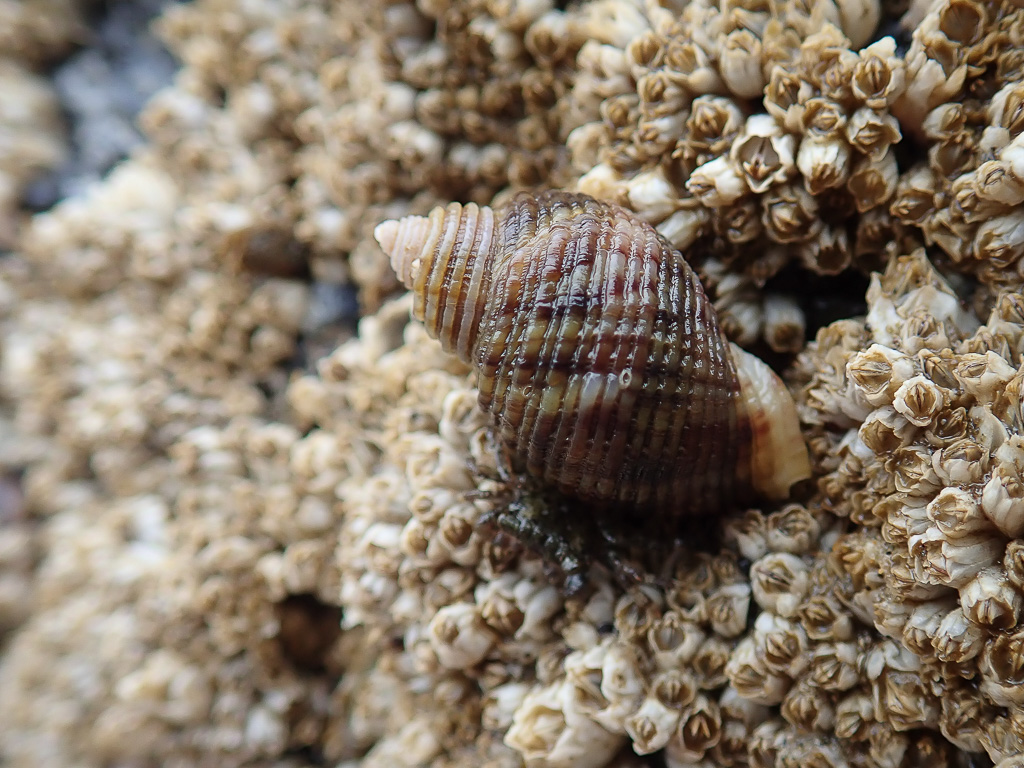

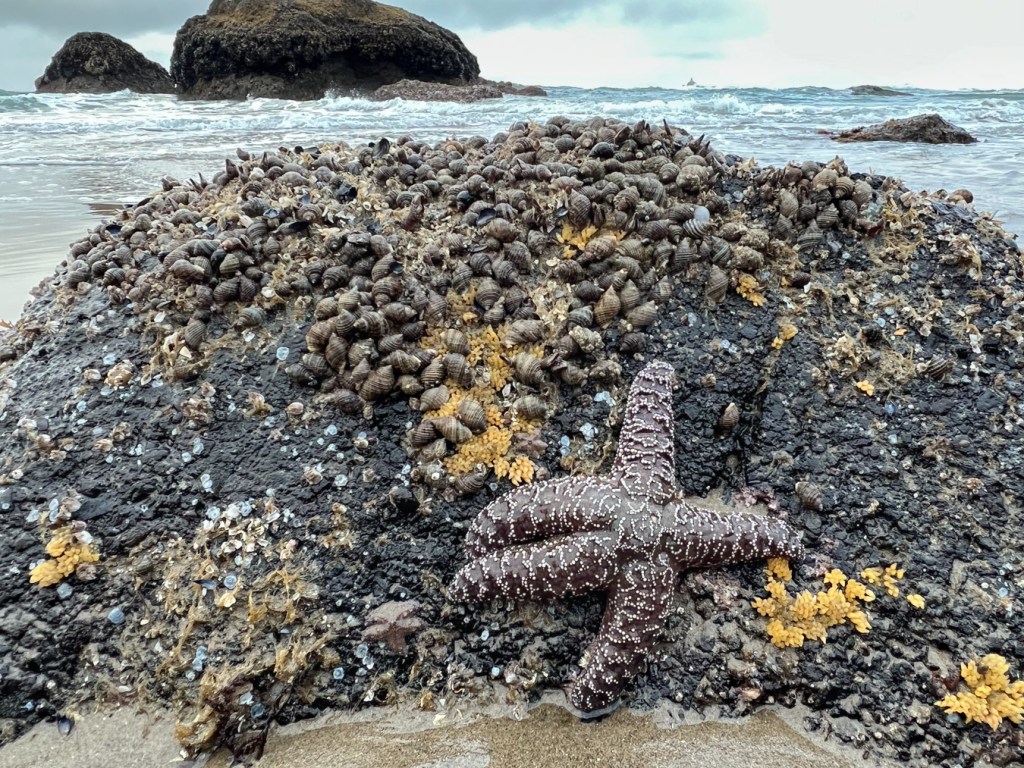
Dense aggregations occasionally materialize. The scenes below are from July.


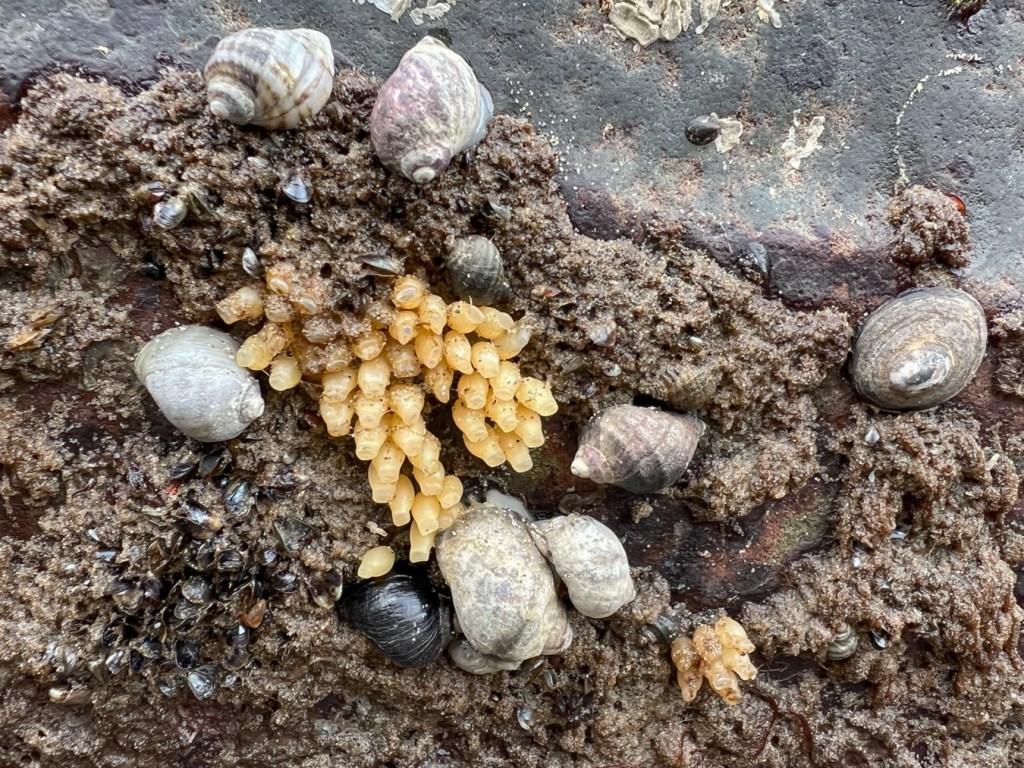
Spring and early summer are favorable for finding clusters of flask-shaped egg capsules. Early development is completed inside the capsules and juveniles emerge as miniature snails.

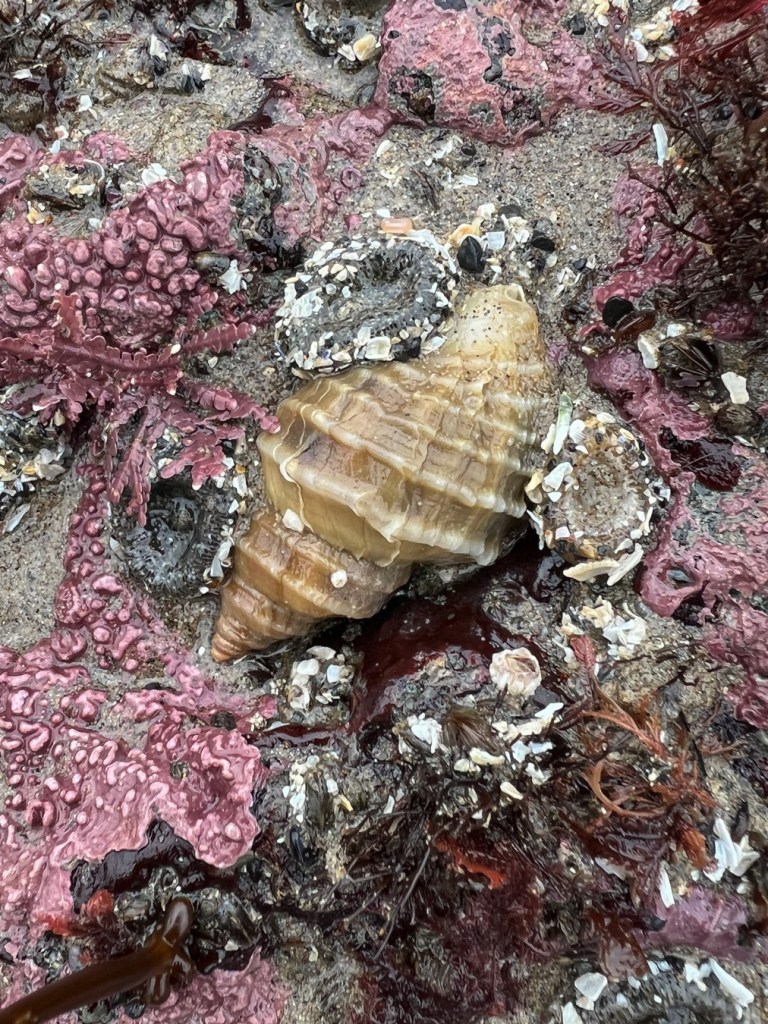
Nucella lamellosa Frilled dogwinkle
Nucella lamellosa shells tend to be brown, and dry eroded shells can be quite drab. Boldly banded shells and striking coloration aren’t particularly common on exposed Northern Oregon shores. Shell sculpturing, erosion, and degree of barnacle encrustation are variable.
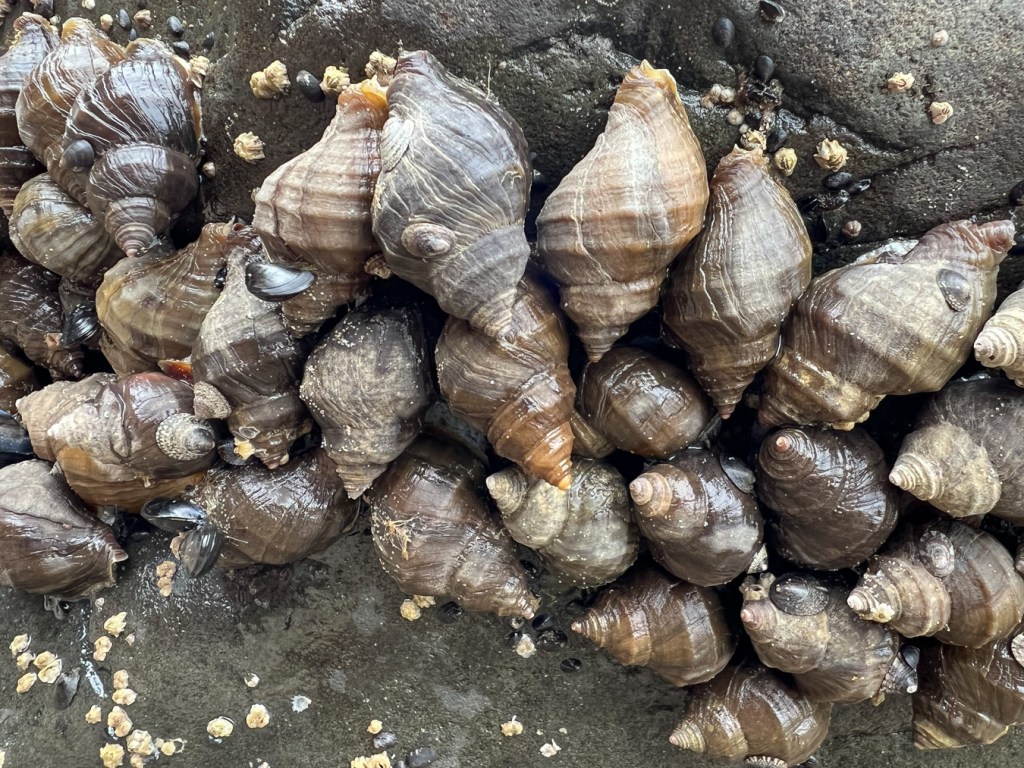
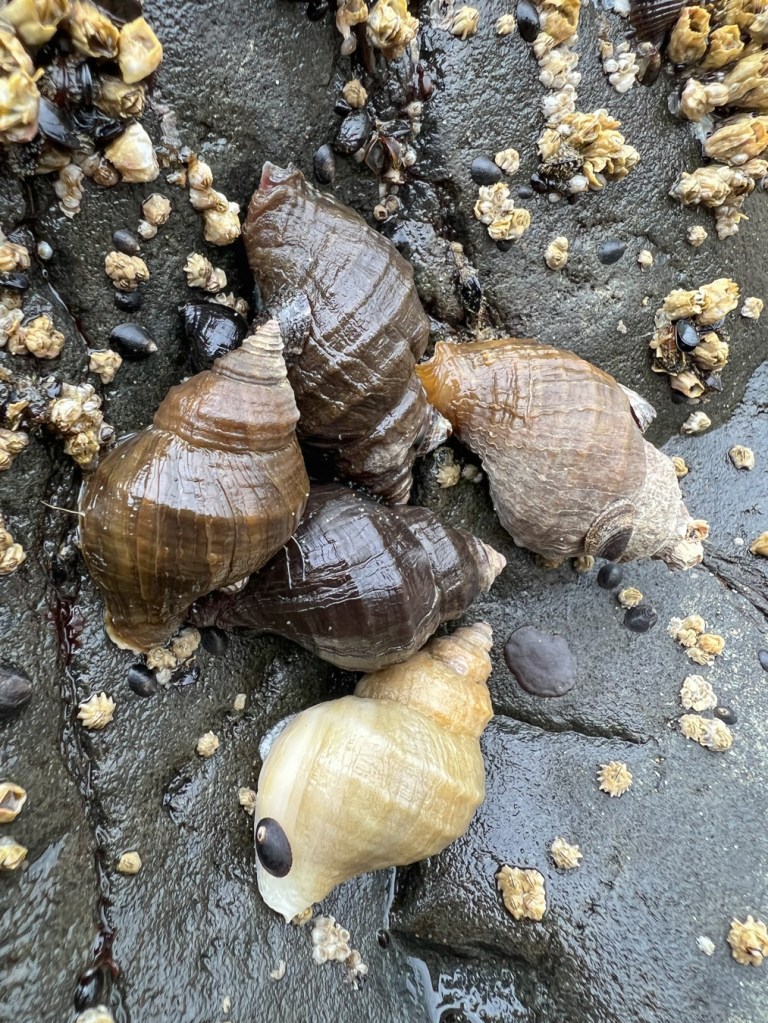
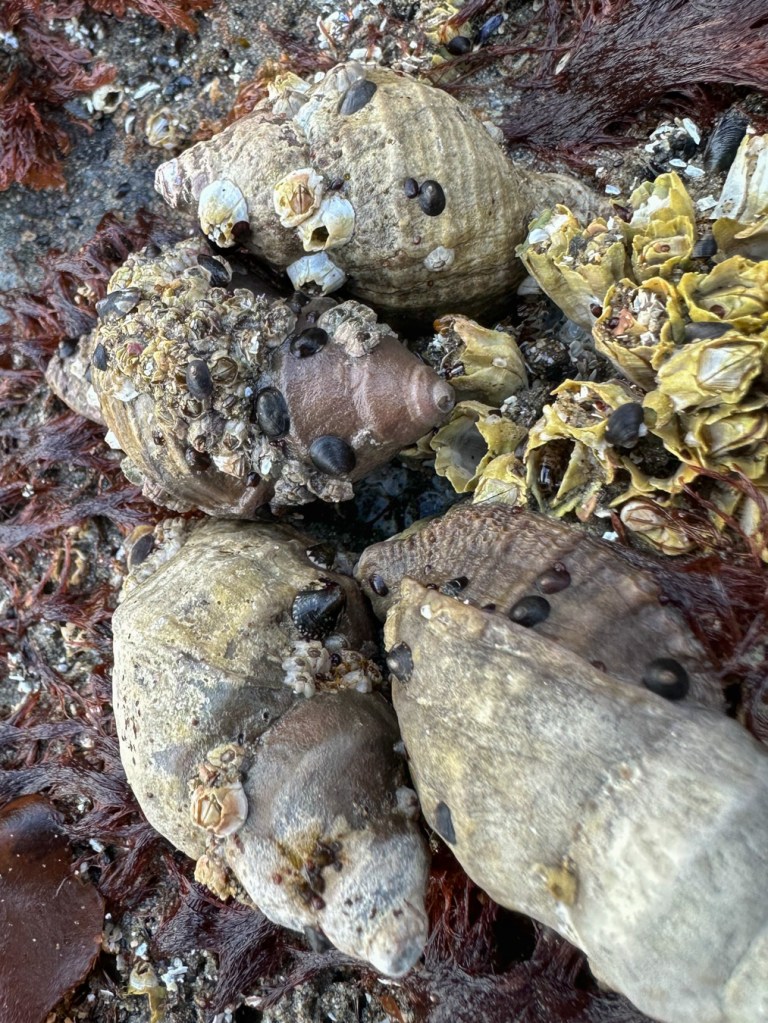


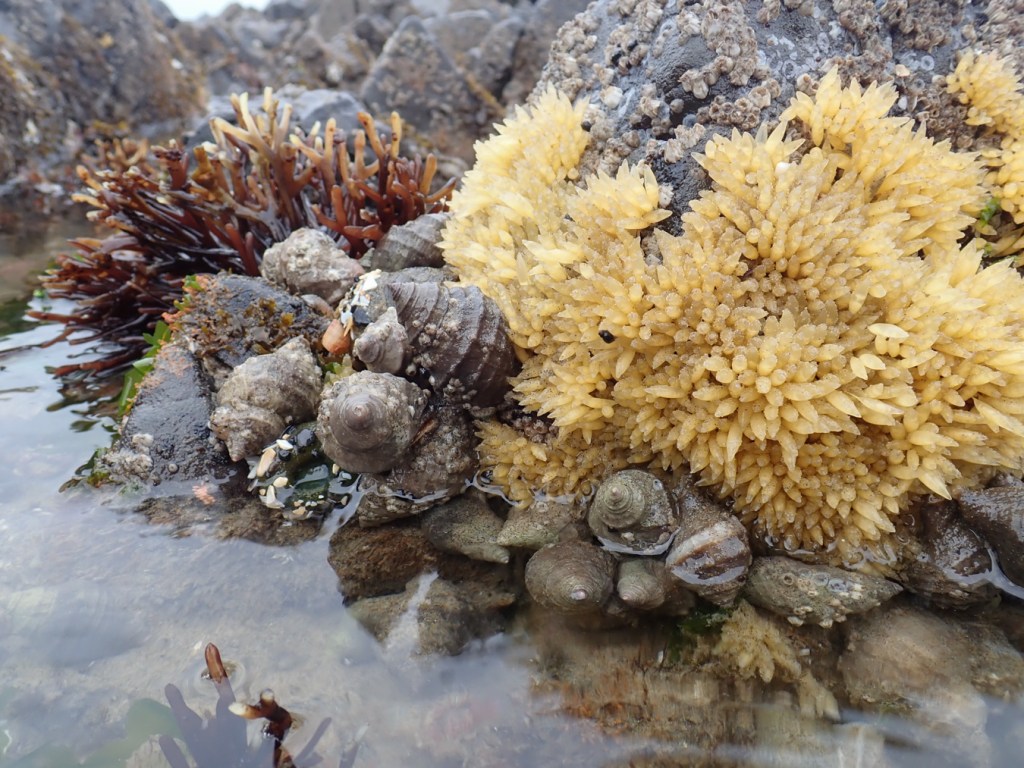
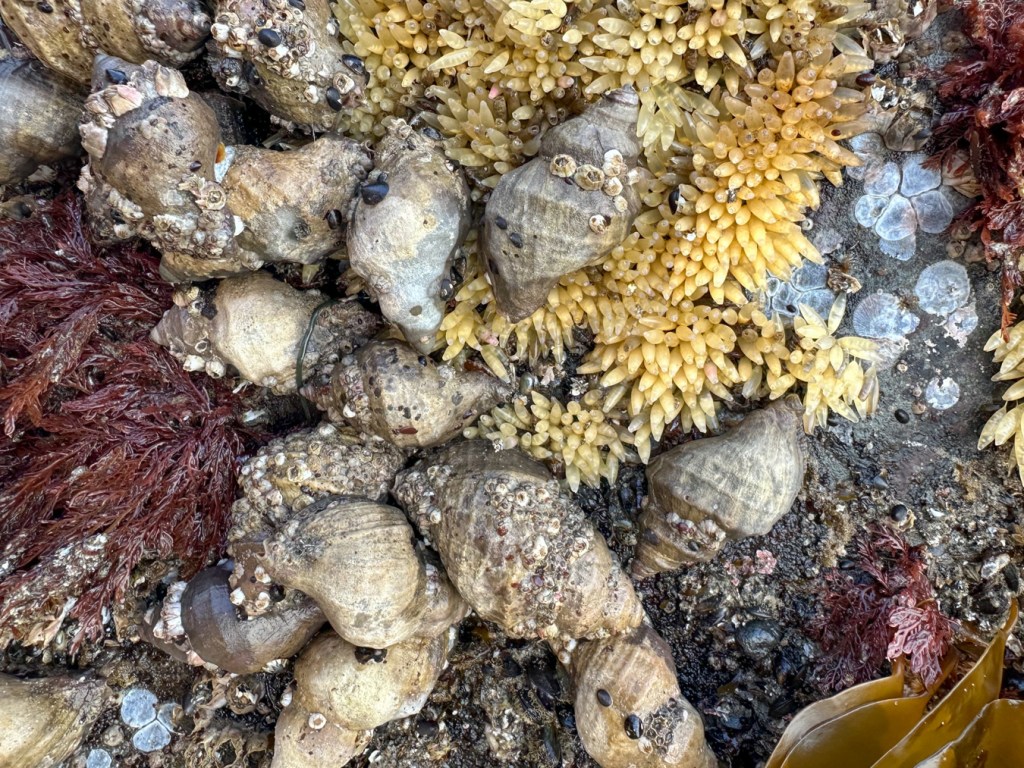
Spring is a good time to find masses of stalked, spindle-shaped egg capsules.

Expect aggregations of snails around masses of their egg capsules.
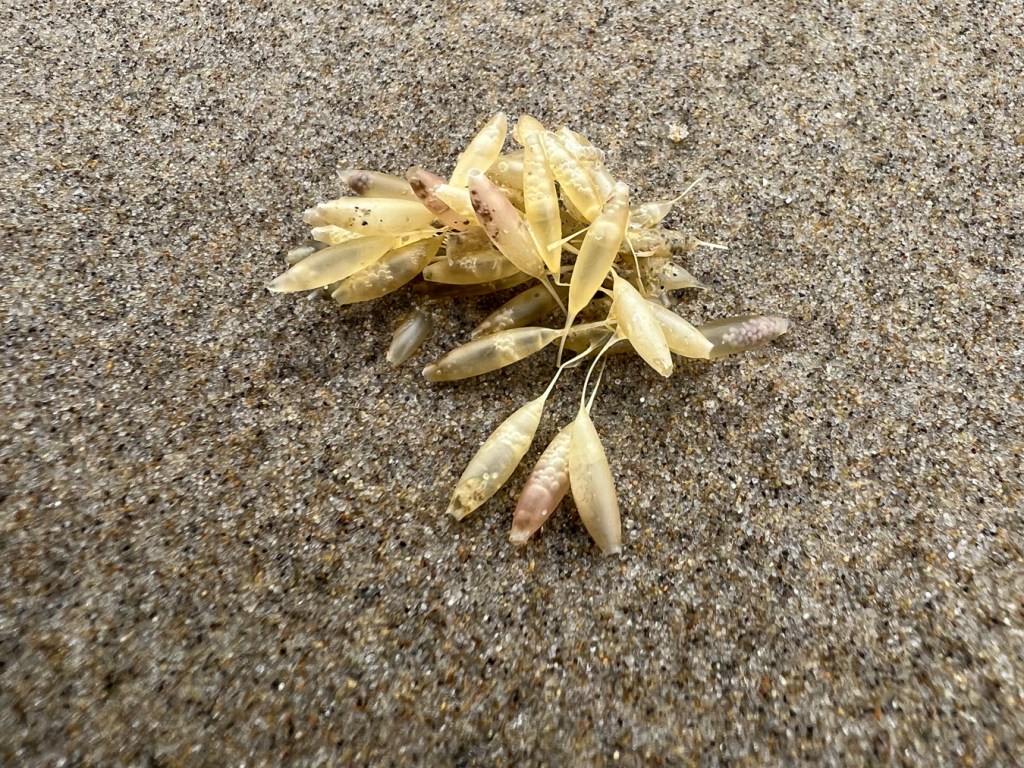
Small clusters of detached and drifted egg capsules are a common beachcombing find. Some people call the capsules sea oats.


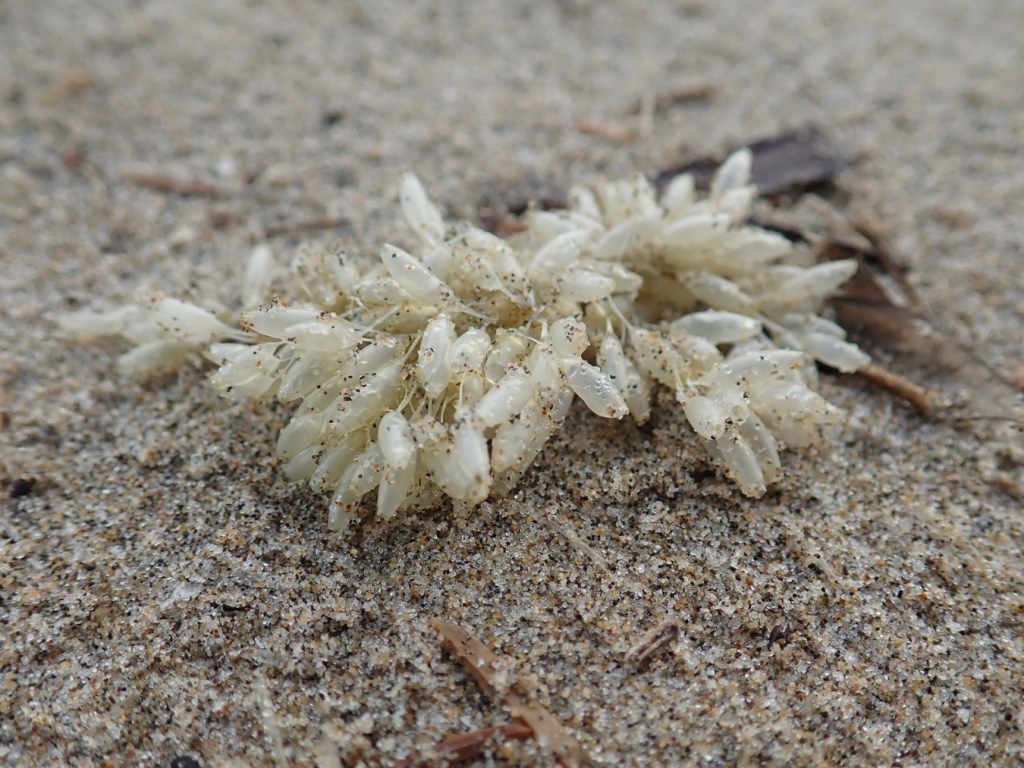
On exposed northern Oregon shores, Nucella lamellosa leans toward lower zones than N. ostrina and N. canaliculata, but it’s not too uncommon to find them together. (Another example of all three Nucella species clustered together on a rock can be seen in the Nucella canaliculata entry, above.)

Amphissa columbiana
The examples shown below are probably the wrinkled amphissa Amphissa columbiana.
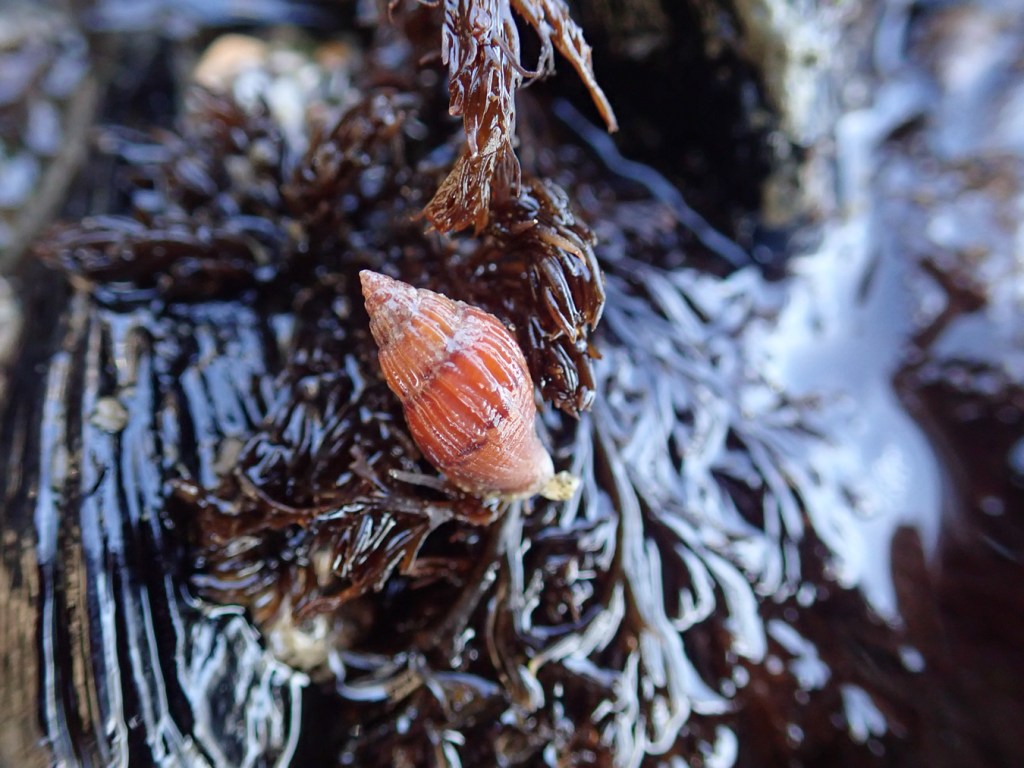

This image is kind of interesting because of the other mussel bed inhabitants that also appear.
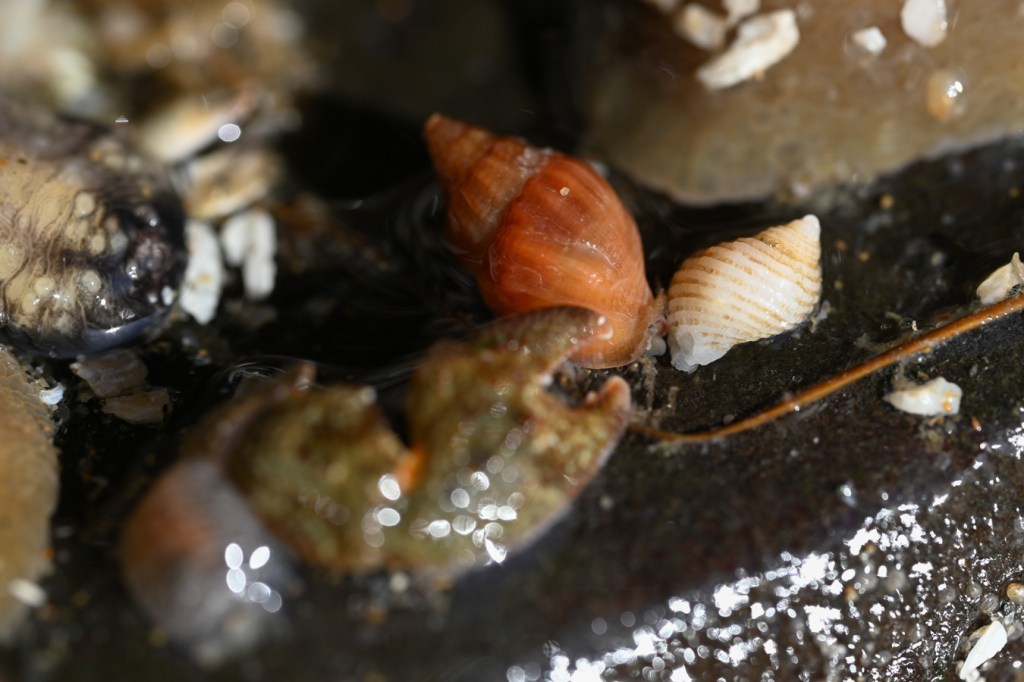
Littorina Periwinkles
Identifying periwinkles from photos like mine is tricky, but I’m pretty sure this entry includes a mix of checkered periwinkles Littorina scutulata and L. plena.


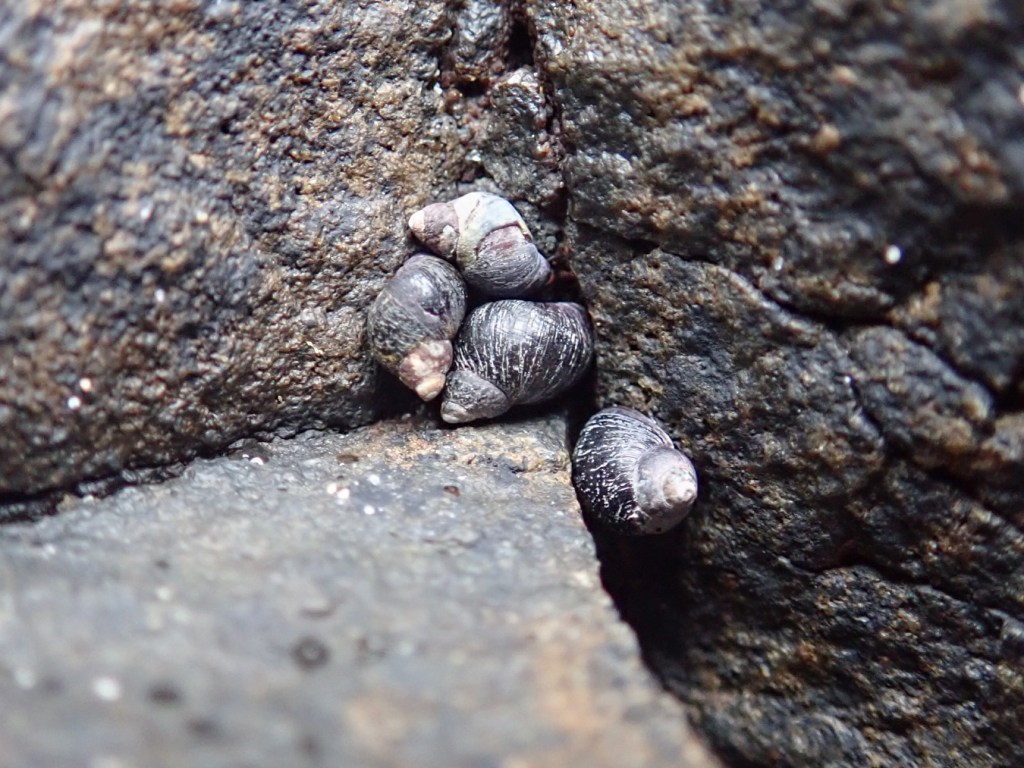

Periwinkles are shy about showing off their tentacles, but they sometimes cooperate when the light is low and moisture high. Tiny and beautifully patterned, Littorina tentacles are something of a mystery because they’re usually withdrawn before you can get close enough for a peek or a photograph. They are a treat to behold when the opportunity presents itself, as they did in the image below.
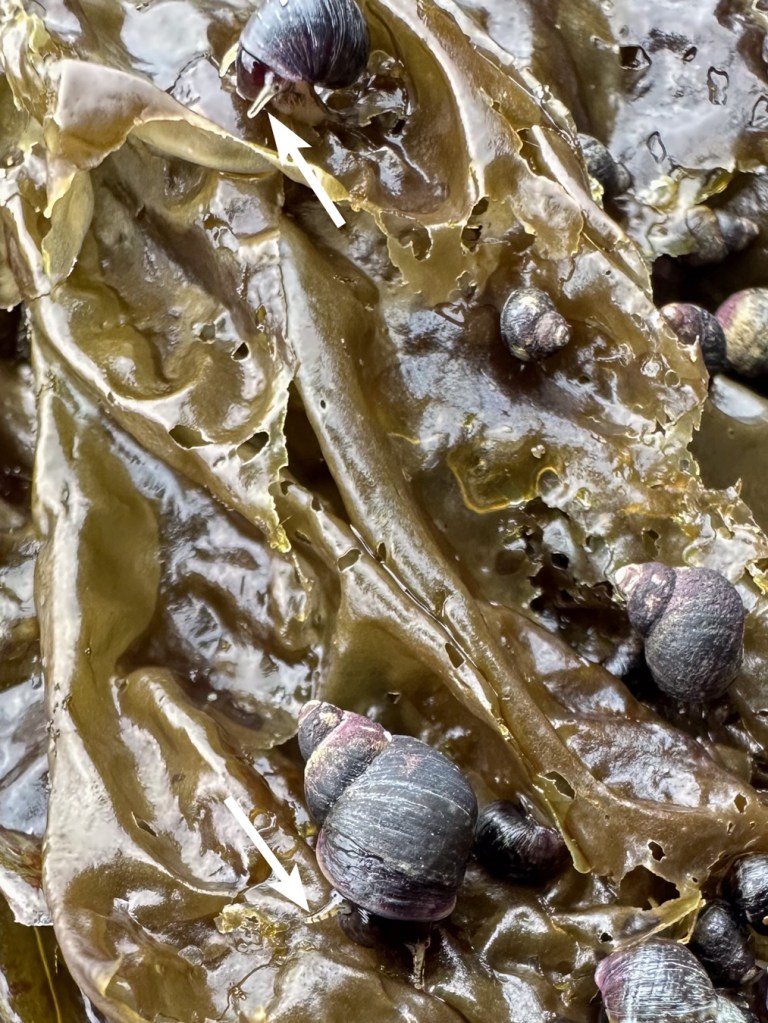
A tale of checkered periwinkle tentacles
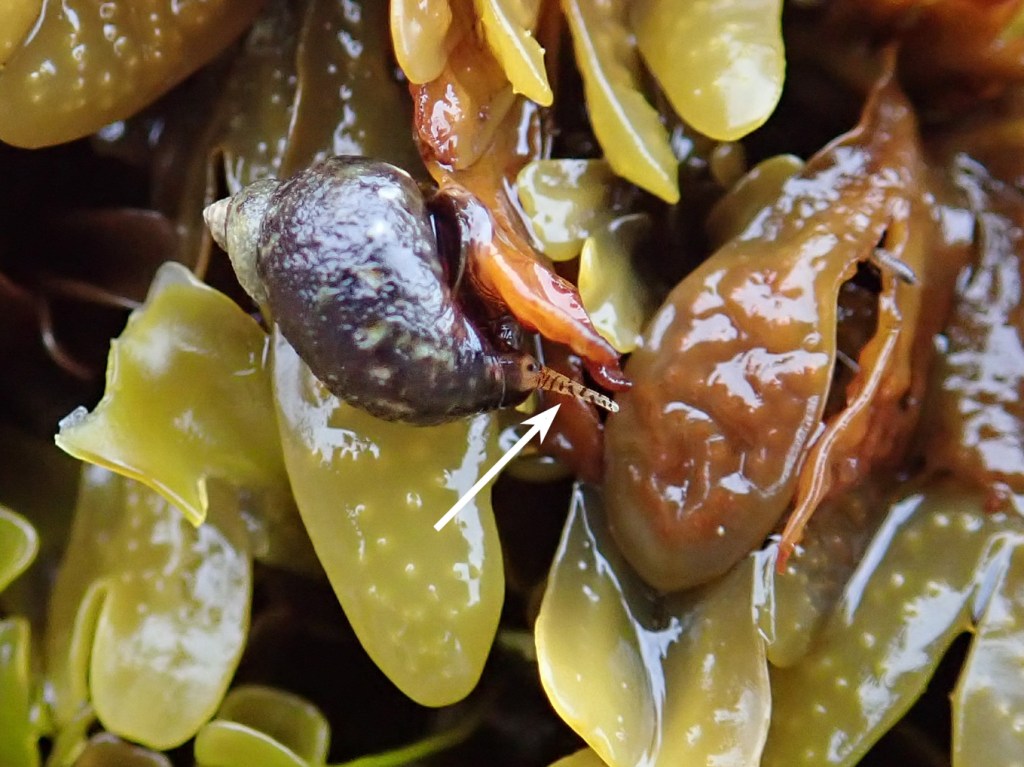
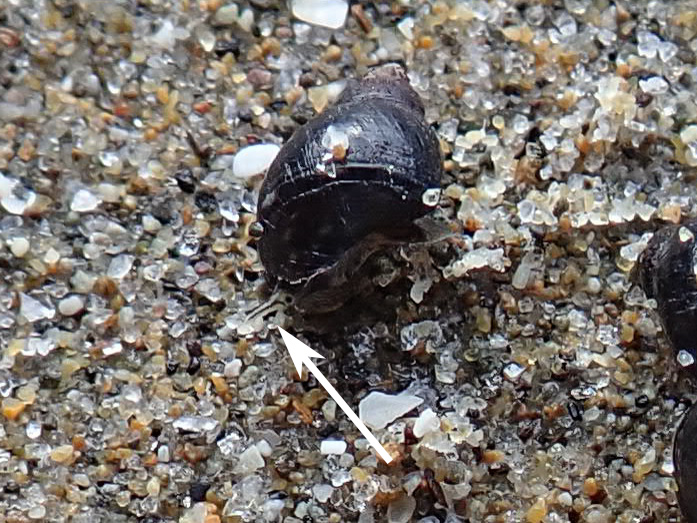
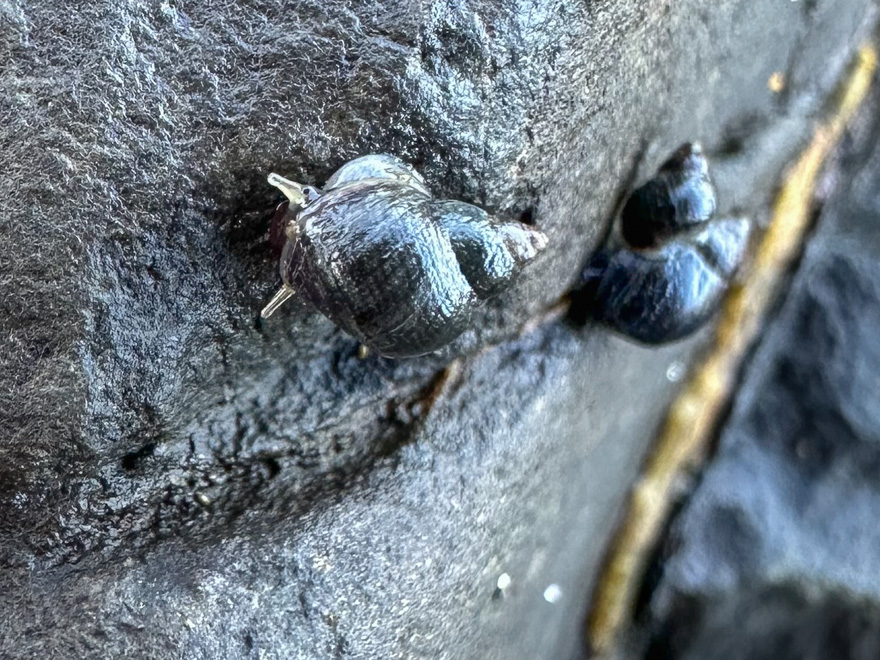
I devote time to tentacles because Sept (see references at the bottom of this page) and others have noted that tentacle pattern is one of the more reliable characteristics for checkered periwinkle identification. Incompletely-banded and speckled patterns are most associated with Littorina scutulata, while Littorina plena tentacles are adorned with an unbroken longitudinal stripe, sometimes with bands, or they can be uniformly dark. It’s been my good fortune to photograph a few checkered periwinkles with their tentacles extended. Below, I’ve organized a few examples in a pair of galleries for comparison.
Checkered periwinkles with incompletely-banded and speckled tentacles.



For comparison, checkered periwinkles whose tentacles have an unbroken longitudinal stripe.


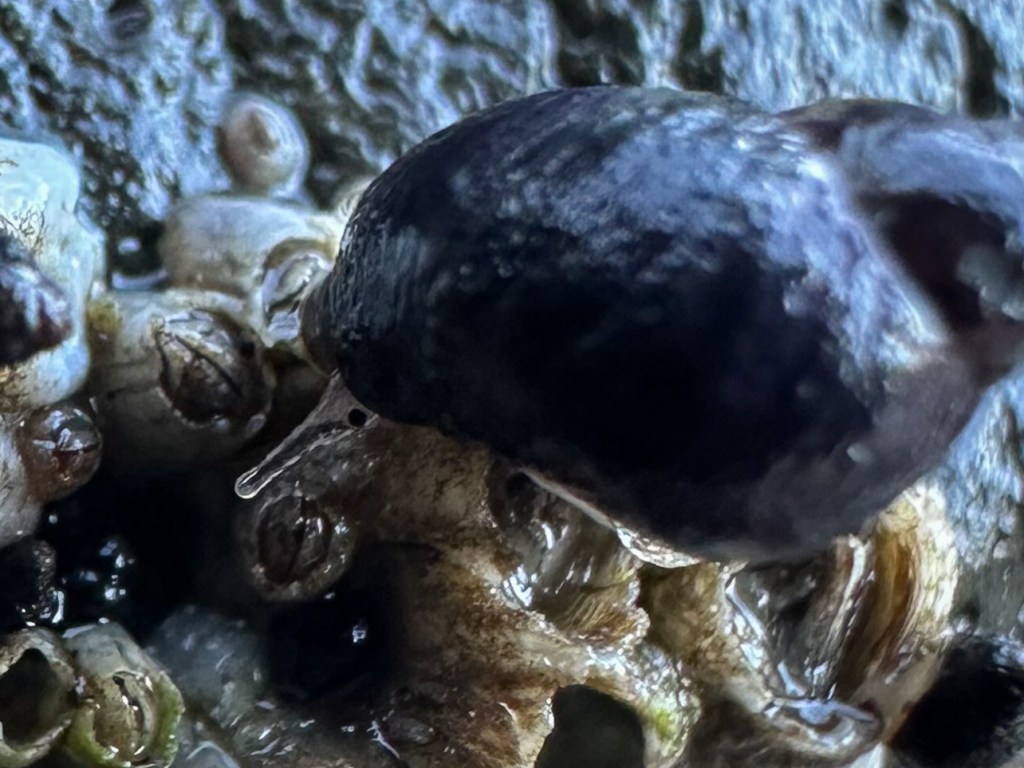
Leaving identification behind, here are some scenes from the life of Littorina. One of the things to notice about periwinkles is that they live together in close association.
Gatherings on seaweeds

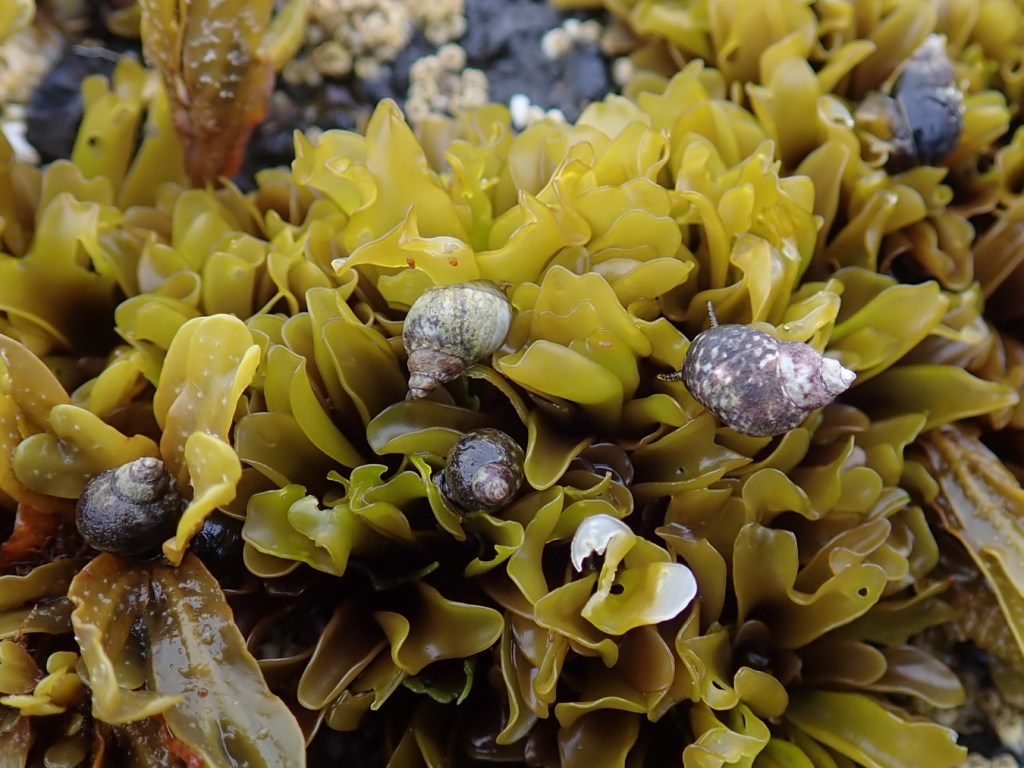

Biding time together in the crevices


Together on a bed of barnacles


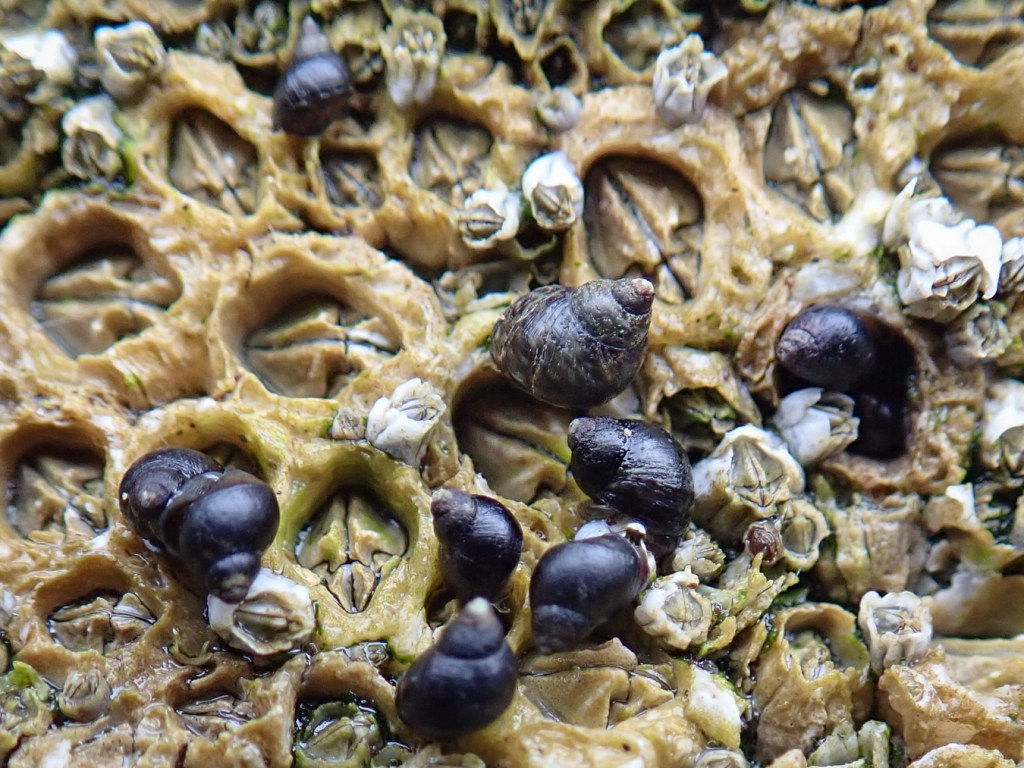
Hitchhiking is a group activity
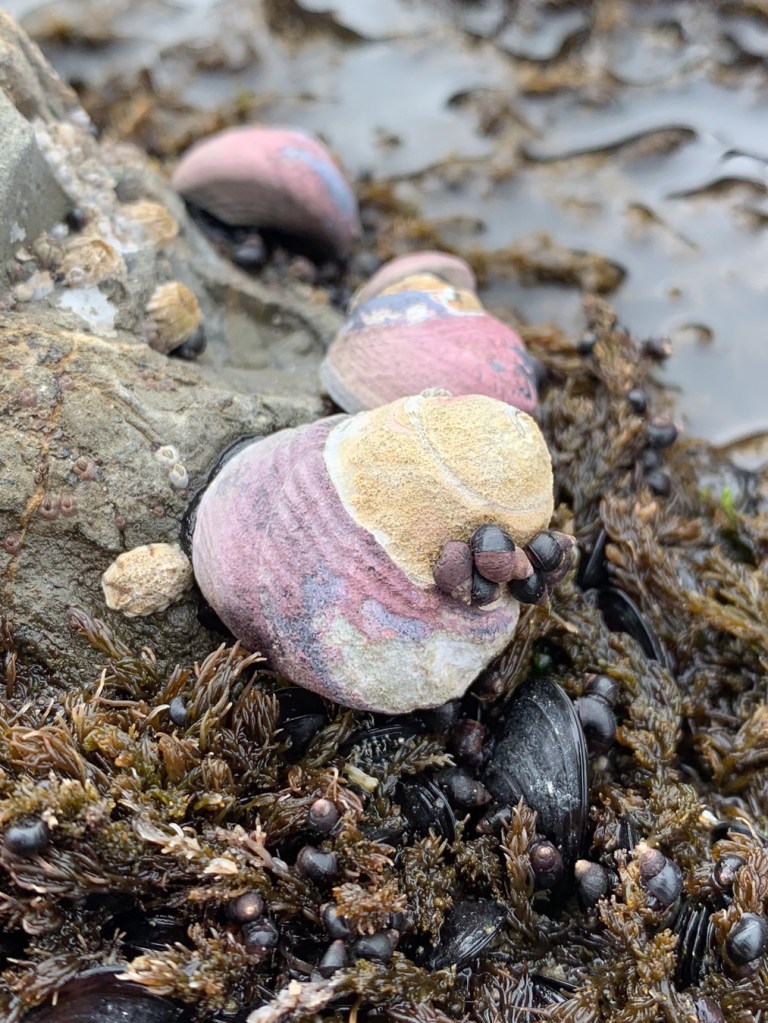
It wouldn’t be too big a surprise to find them out on the sand. They make mass movements at times. Notice that the snails in the scene below (except for a few caught messing around) are headed in the same direction.

Travelling with purpose. In the pair of scenes below, from Oregon’s central coast, single file columns of Littorina are on the move. In the left-hand panel, the snails are moving away from their rock. In the right-hand panel, their movement is from the rock at the bottom of the frame to the rock at the top.


Periwinkles are well-known trail followers.


Exodus
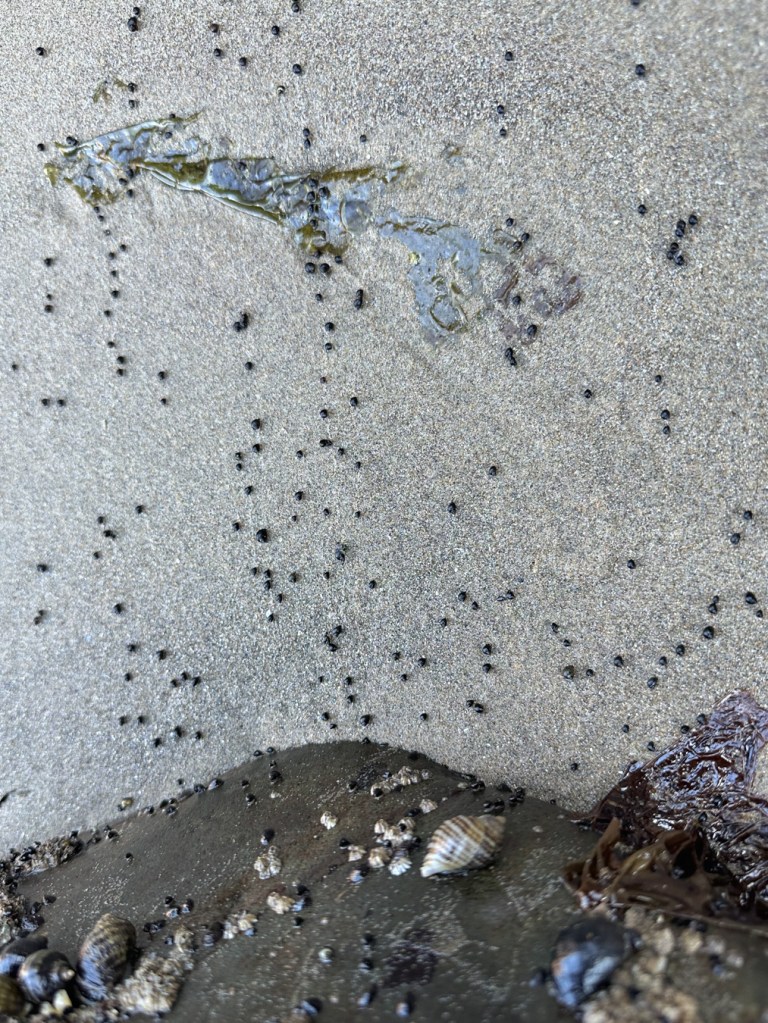
Limpets will move along the same trails.


Nassarius fossatus Channeled basket snail
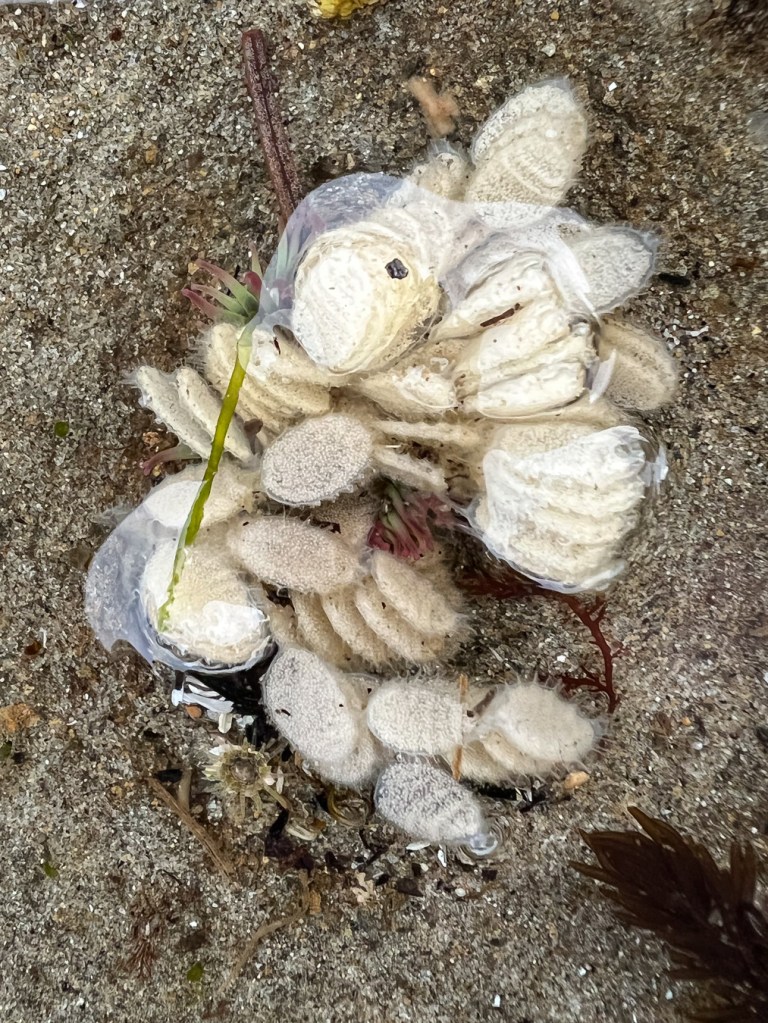
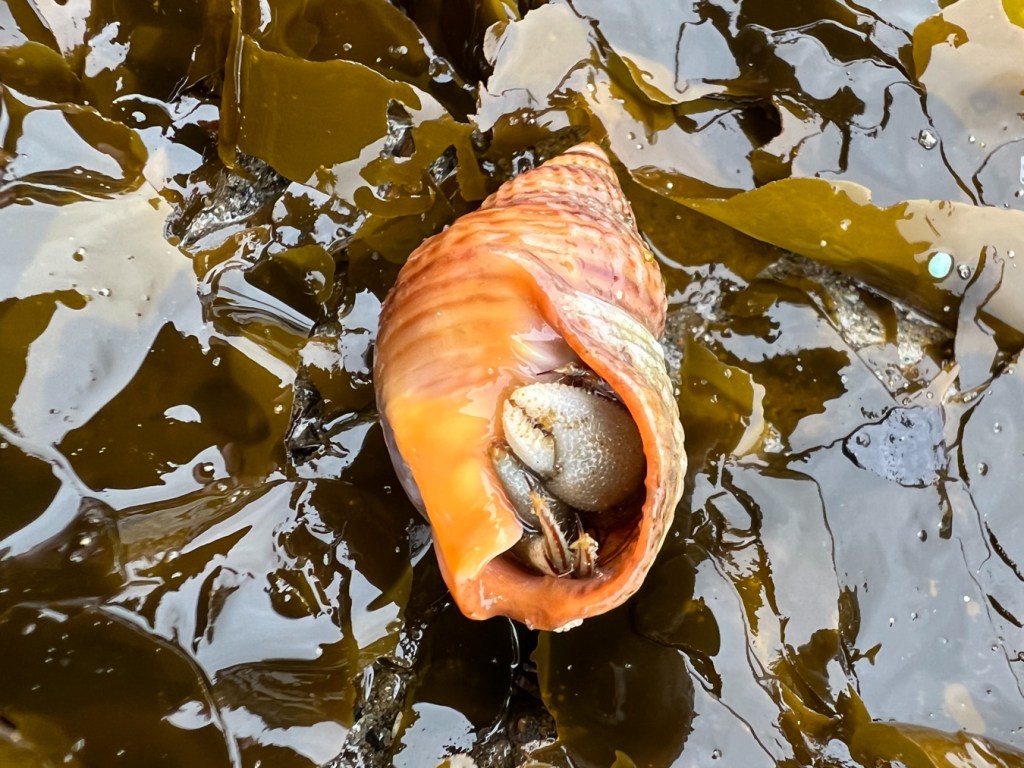
Channeled nassas, as they are also known, apparently don’t overlap much with me in the northern Oregon intertidal. I don’t recall coming across a live one. Empty nassa shells, however, can be abundant, and hermit crabs frequently occupy them. Although I think the egg cases shown below are those of N. fossatus, I haven’t seen deposition, only drifted cases.

Tegula funebralis Black turban
Black turbans are conspicuous and abundant. They seem more numerous on the central coast than in most northern Oregon locations.


Callianax biplicata Purple olive
On exposed beaches, up your odds of finding purple olives by walking out toward the swash on a pretty low tide. When things are just right, and I don’t know exactly what that looks like, they can be startlingly abundant. But you won’t find them on every stretch of the beach; maybe try a beach with large protruding boulders, stacks, or a contoured shoreline that gives a little shelter.

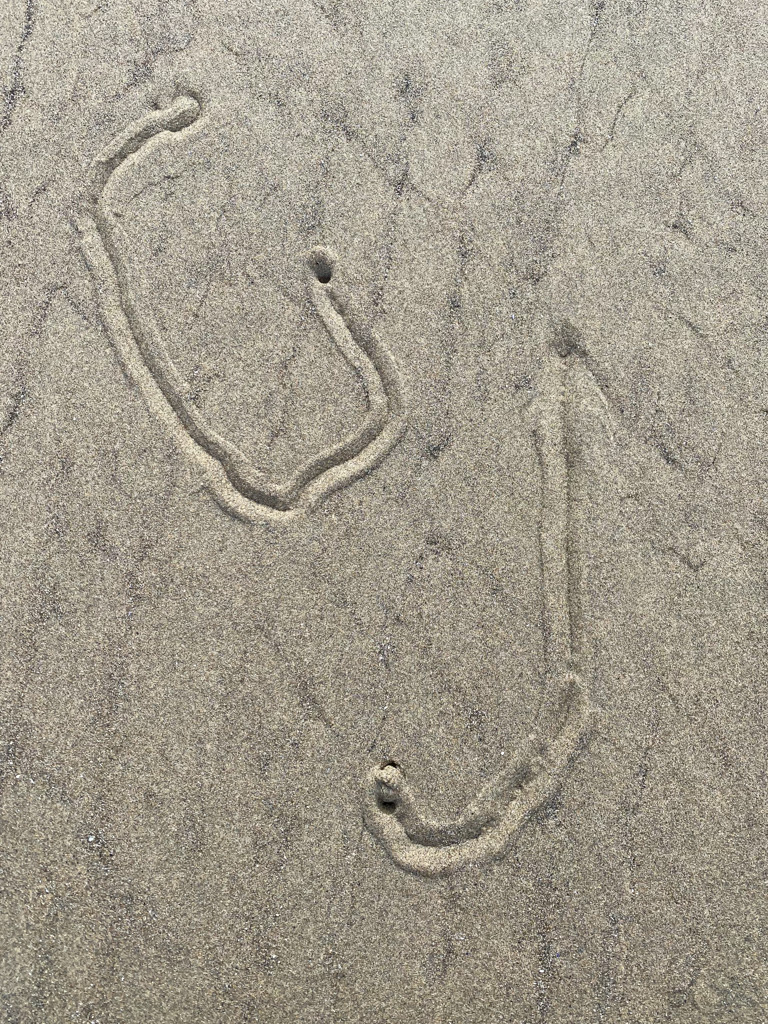

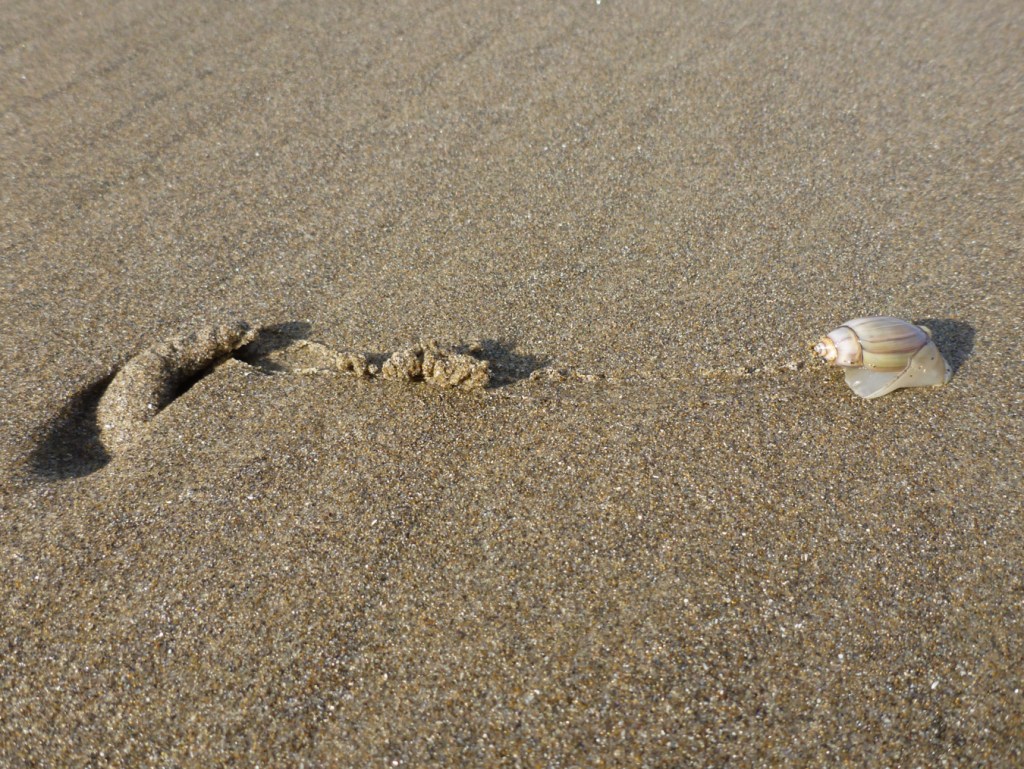

Below is a collection of traces left by purple olives. It’s worth knowing what you’re looking at so you don’t have to dig them up to find what made them.
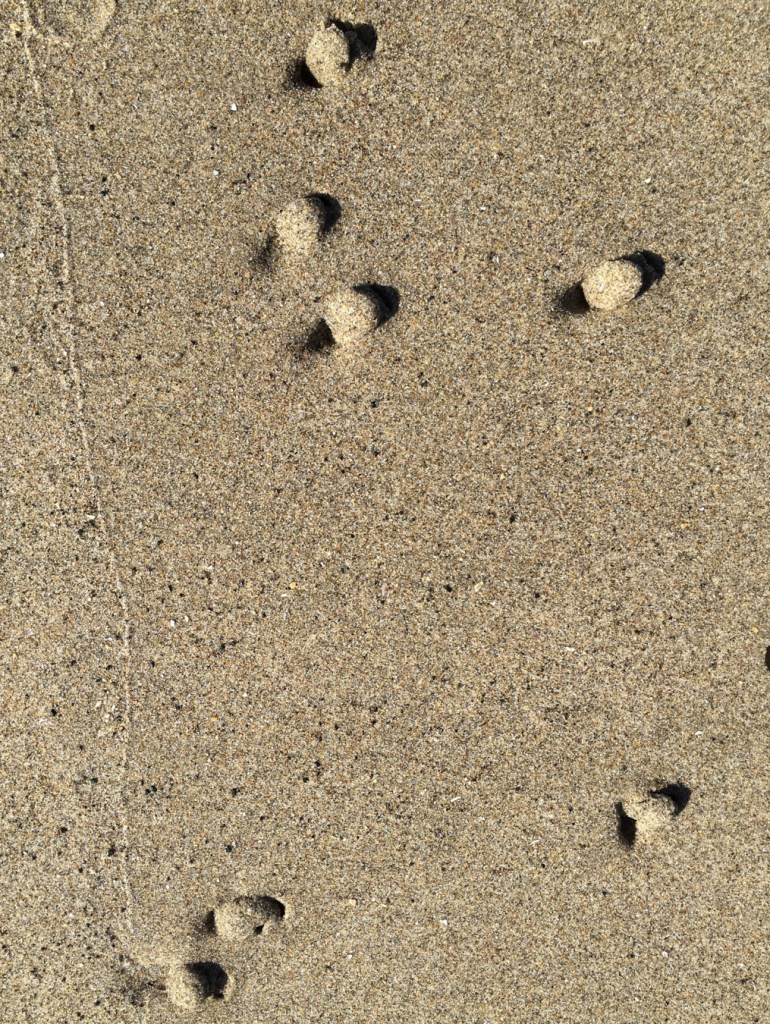

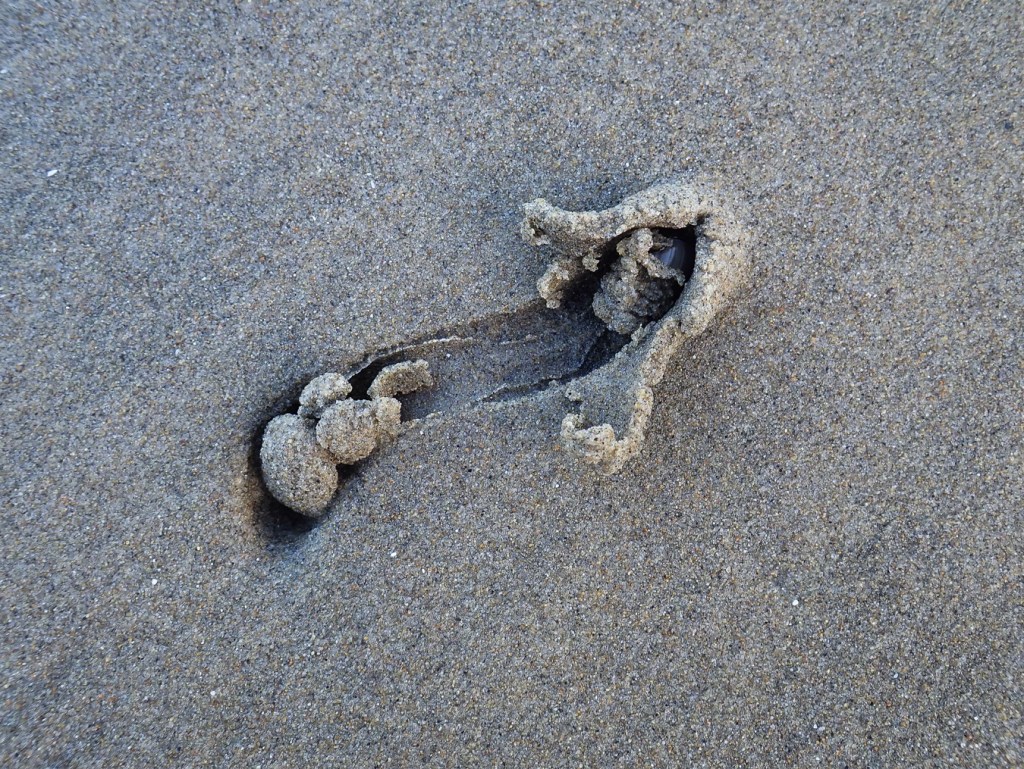
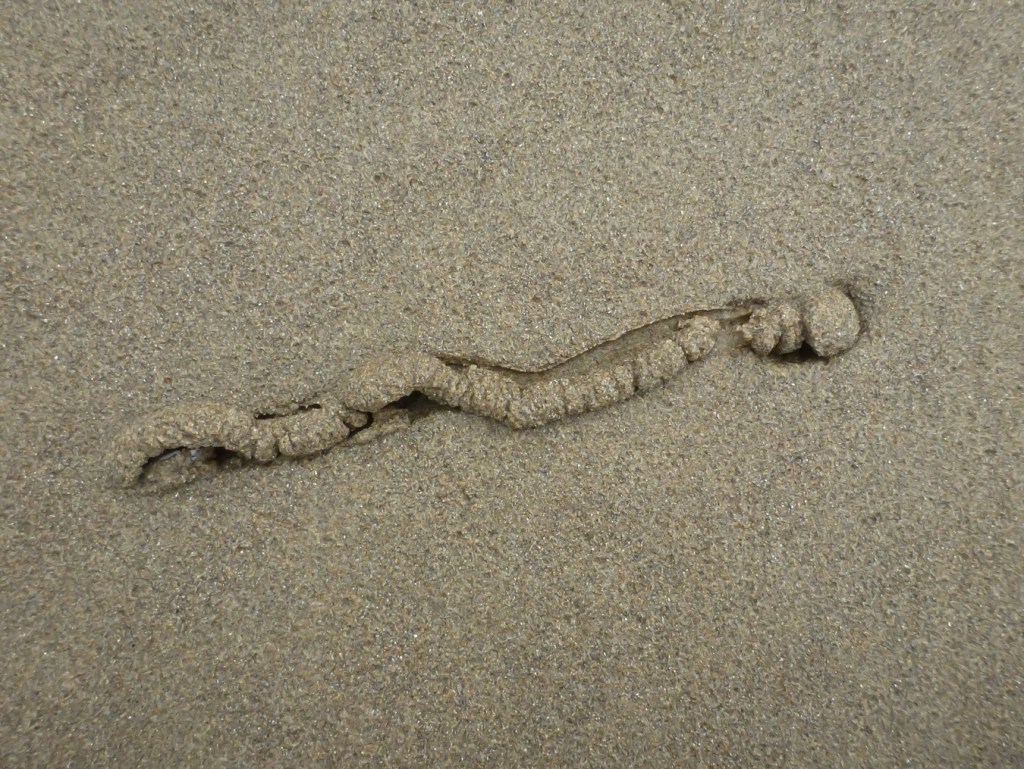

Onchidella Leather Limpet
Leather limpets blend in splendidly, making them easy to miss, and I don’t think I’m alone when I say that finding one, or several, tends to elicit a sense of gratitude and a genuine smile. Known for their stalked eyes, they’re pretty cute. (Below, the head is pointing down and you can see the eyes on their short stalks.)

The image below, from atop an inaccessible rock, shows a scene bursting with high intertidal invertebrate life. (An interesting bit of information is that, as noted, I couldn’t access the top of the rock. To solve the problem and soothe my curiosity, I held my camera as high as I could and took the photo. As it turned out, there was a lot going on up there!) Can you pick out two leather limpets?
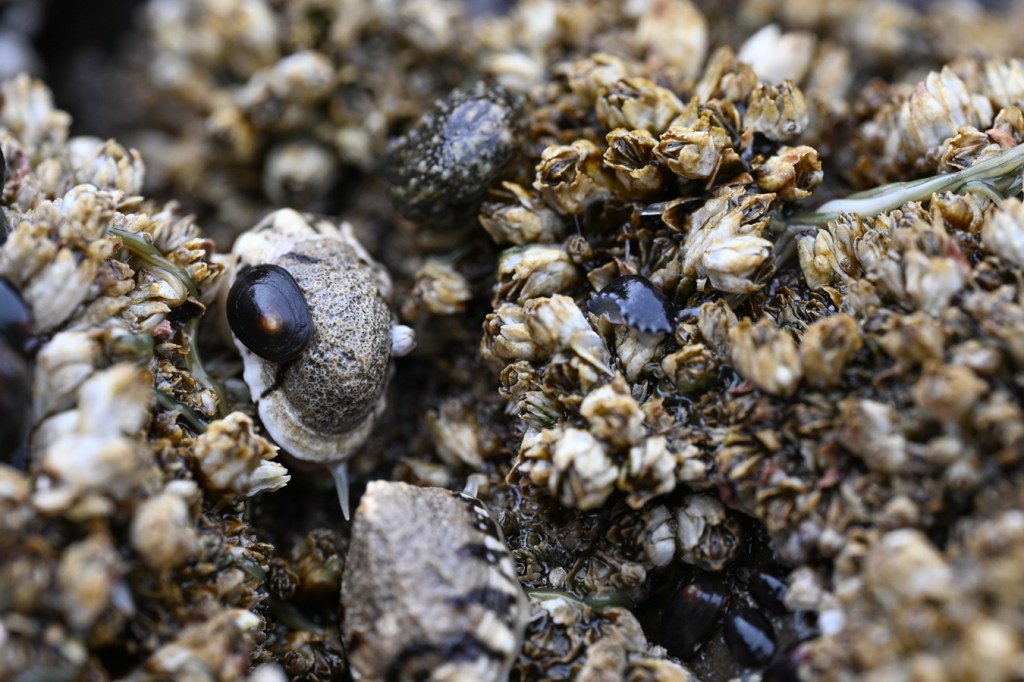
As far as I know, Pacific Northwest leather limpets are Onchidella carpenteri, but you may see some references to O. borealis.
References
Gotshall, D. W. 2005. Guide to Marine Invertebrates, Alaska to Baja California 2nd Edition (Revised). Shoreline Press.
Harbo, R. M. 2011. Whelks to Whales: Coastal Marine Life of the Pacific Northwest. 2nd ed. Harbour Publishing Co.
Kozloff, E. N. 1993. Seashore Life of the Northern Pacific Coast. 3rd ed. University of Washington Press.
Lamb, A. and B. P. Hanby. 2005. Marine Life of the Pacific Northwest. Harbour Publishing.
Sept. J. D. 2019. The New Beachcomber’s Guide to the Pacific Northwest. Harbour Publishing.
Online Resources
Friends of Netarts Bay WEBS Mollusks page. Accessed March 20, 2025.
It’s worth scrolling down to Gastropoda in Common Sea Life of Southeastern Alaska: A field guide by Aaron Baldwin & Paul Norwood. Accessed March 20, 2025.
Species Accounts
Bering, N., T. Hext and E. Parker. 2017. Nucella ostrina. In: Oregon Estuarine Invertebrates: Rudys’ Illustrated Guide to Common Species, 3rd ed. T.C. Hiebert, B.A. Butler and A.L. Shanks (eds.). University of Oregon Libraries and Oregon Institute of Marine Biology, Charleston, OR. Accessed March 20, 2025.
Charbonneau, N., Helmstetler, H., and Cowles, D. (2009). Nucella ostrina (Deshayes, 1839). Invertebrates of the Salish Sea. Rosario Beach Marine Laboratory. Accessed March 20, 2025.
Cowles, D. (2004). Chlorostoma funebralis (A. Adams, 1855). Invertebrates of the Salish Sea. Rosario Beach Marine Laboratory. Accessed March 20, 2025.
Cowles, D. (2004). Littorina scutulata Gould, 1849. Invertebrates of the Salish Sea. Rosario Beach Marine Laboratory. Accessed March 20, 2025.
Cowles, D. (2005). Nucella canaliculata (Duclos, 1832). Invertebrates of the Salish Sea. Rosario Beach Marine Laboratory. Accessed March 20, 2025.
Cowles, D. (2006). Nassarius fossatus (Gould, 1850). Invertebrates of the Salish Sea. Rosario Beach Marine Laboratory. Accessed March 20, 2025.
Cowles, D. (2006). Callianax biplicata (Sowerby, 1825). Invertebrates of the Salish Sea. Rosario Beach Marine Laboratory. Accessed October 7, 2025.
Cowles, D. (2007). Amphissa columbiana Dall, 1916. Invertebrates of the Salish Sea. Rosario Beach Marine Laboratory. Accessed December 31, 2025.
Cowles, D. (2007). Onchidella borealis Dall, 1871. Invertebrates of the Salish Sea. Rosario Beach Marine Laboratory. Accessed March 20, 2025.
Valley, J. and T.C. Hiebert. 2015a. Littorina plena. In: Oregon Estuarine Invertebrates: Rudys’ Illustrated Guide to Common Species, 3rd ed. T.C. Hiebert, B.A. Butler and A.L. Shanks (eds.). University of Oregon Libraries and Oregon Institute of Marine Biology, Charleston, OR. Accessed March 20, 2025.
Valley, J. and T.C. Hiebert. 2015b. Littorina scutulata. In: Oregon Estuarine Invertebrates: Rudys’ Illustrated Guide to Common Species, 3rd ed. T.C. Hiebert, B.A. Butler and A.L. Shanks (eds.). University of Oregon Libraries and Oregon Institute of Marine Biology, Charleston, OR. Accessed March 20, 2025.
I updated this page on March 20, 2025.
 theoutershores