
Below are examples of anemones I’ve seen living on Oregon’s exposed rocky intertidal. Compared to what you could find, it’s a limited sample, just the most obvious common forms I’ve been lucky enough to find and photograph on the shores I visit without committing too much disturbance. The photos are from northern Oregon unless noted. Organization-wise, I follow Lamb and Hanby (2005). If I use common names, they’re my choice. Experts cover the anemones shown below and many more in the books, field guides, and identification resources listed at the bottom of the page.
Let there be anemones!
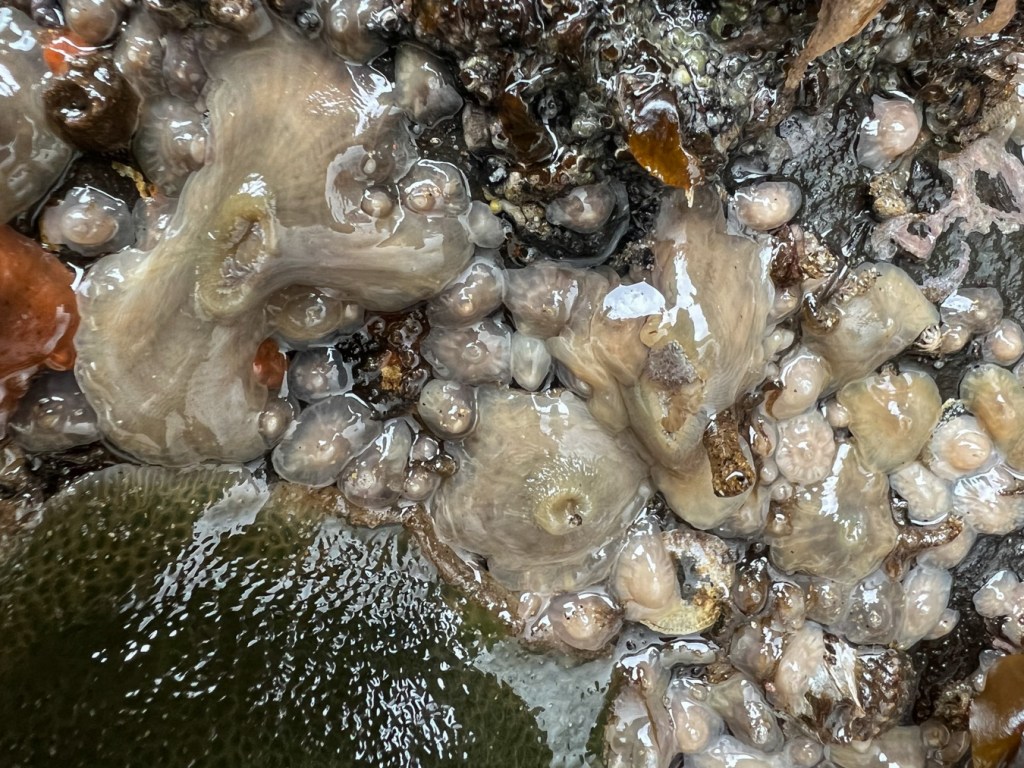
Metridium senile Short plumose anemone
Underwater, with its tentacles extended, it’s a beautiful anemone. Unfortunately, I’ve only rarely experienced that beauty on exposed Oregon shores I’ve visited. The few times I have discovered them on the exposed coast, the places where they established themselves (e.g., the protected backsides of vertical walls or boulders in surf-swept settings) were inaccessible except at the lowest tides. Colonies can unexpectedly vanish without a trace.
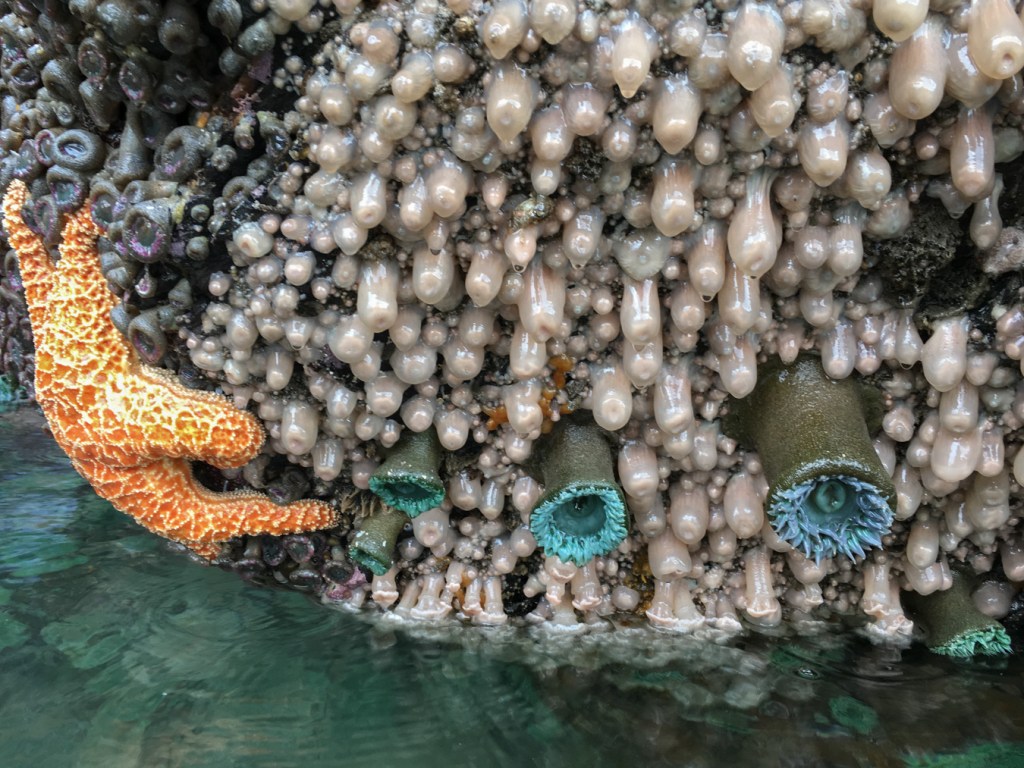
Metridium senile can reproduce quickly through budding which might explain the multiple size classes seen in these images.
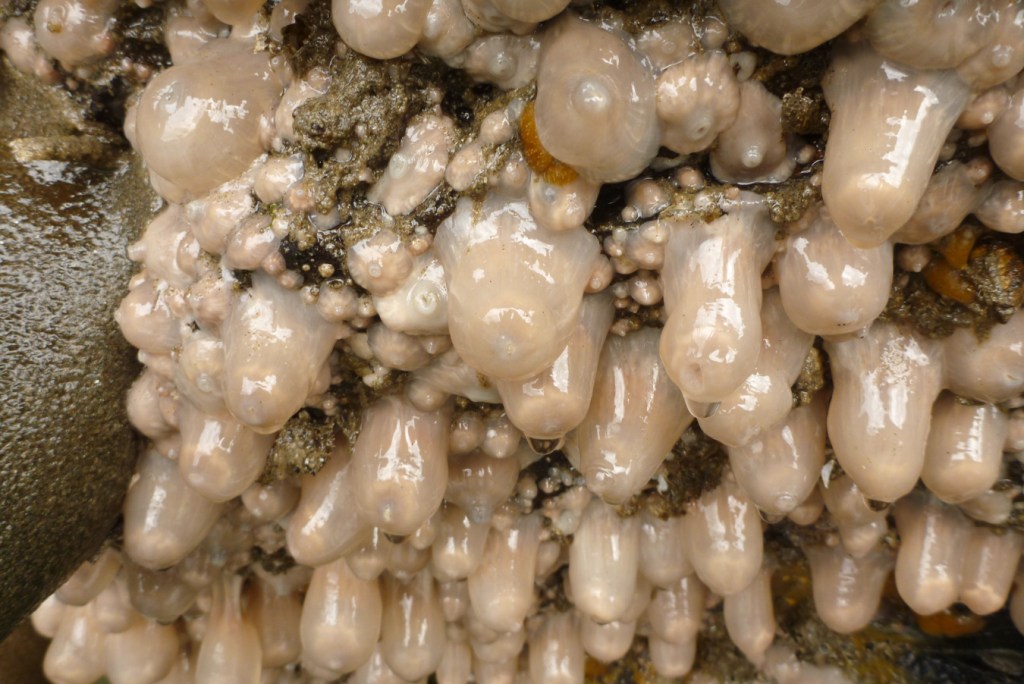
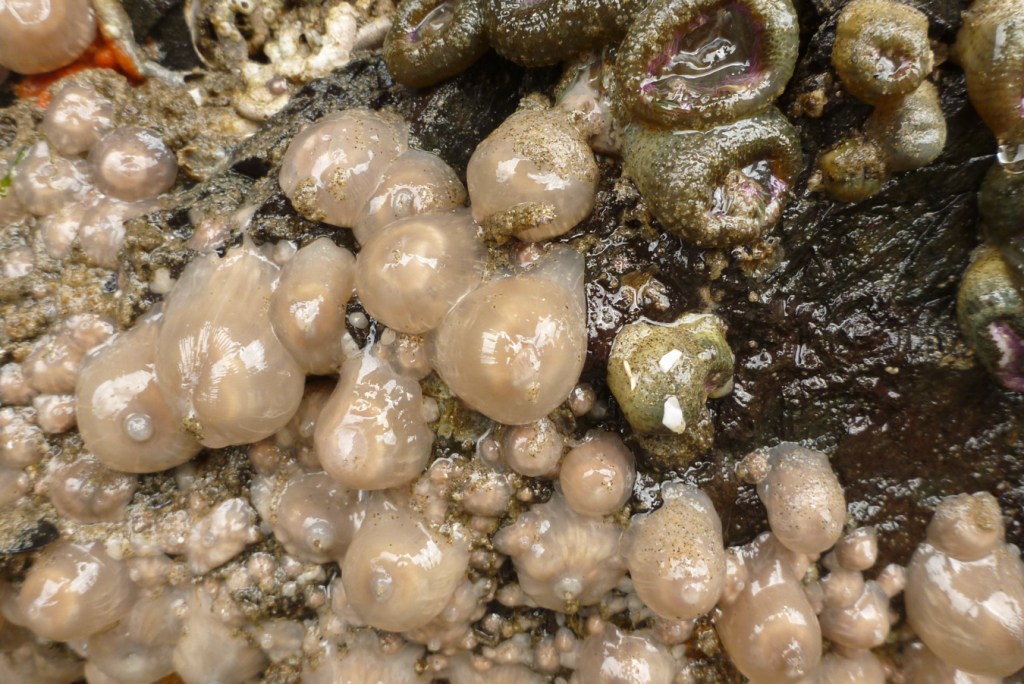
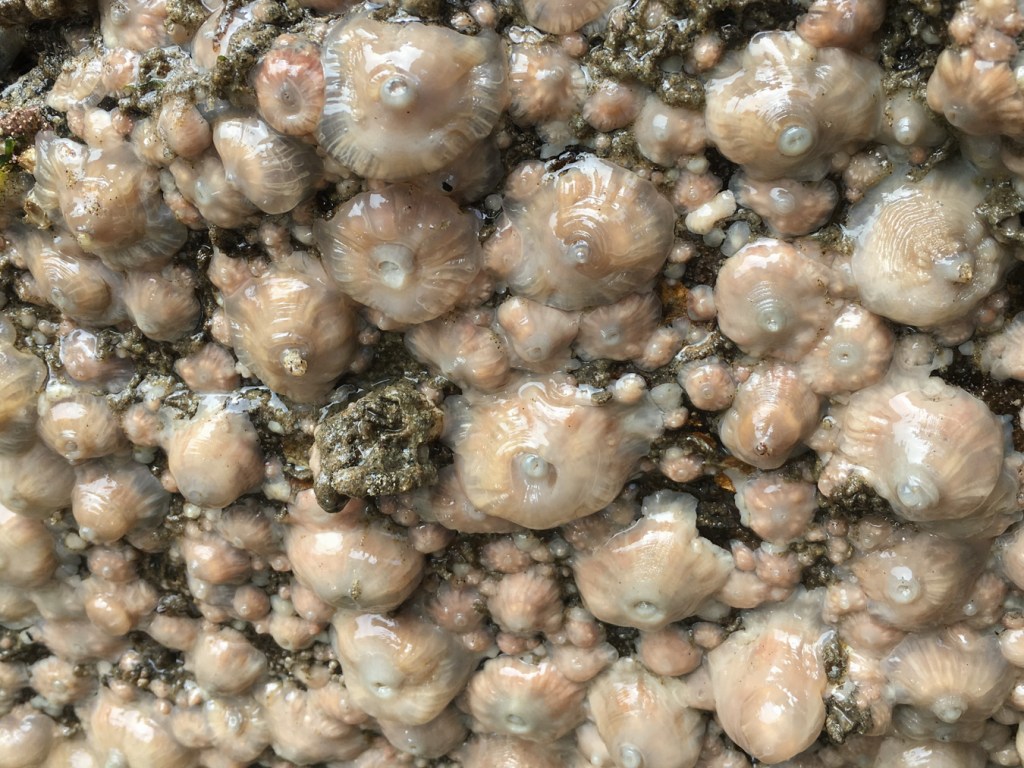
Exposed by low tides, Metridium senile can retract not only its tentacles, but its body column too.
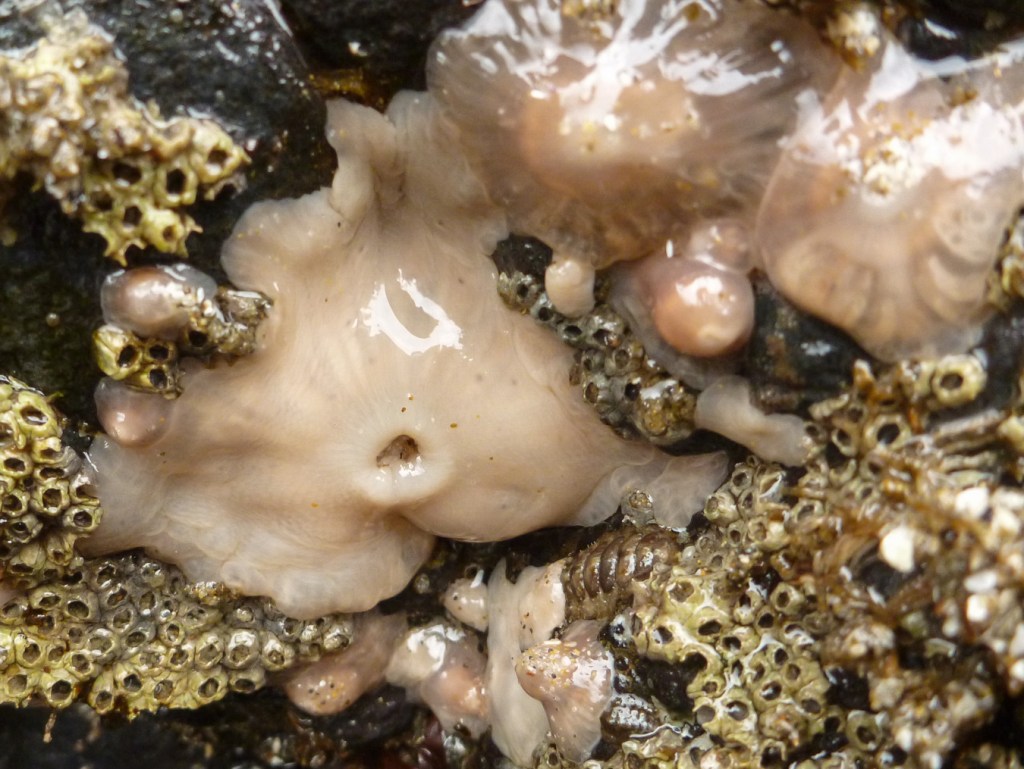
On the backside of a large surf-swept rock, the vertical wall shown below briefly hosted a mix of orange and gray Metridium senile.
Urticina grebelnyi Painted anemone
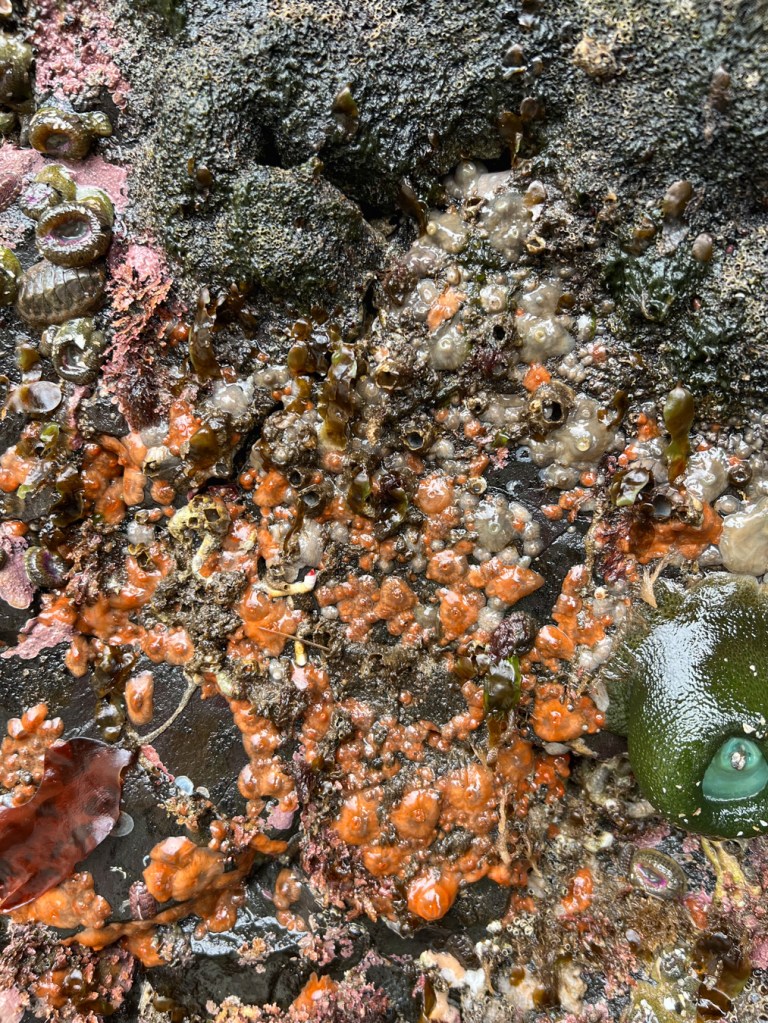
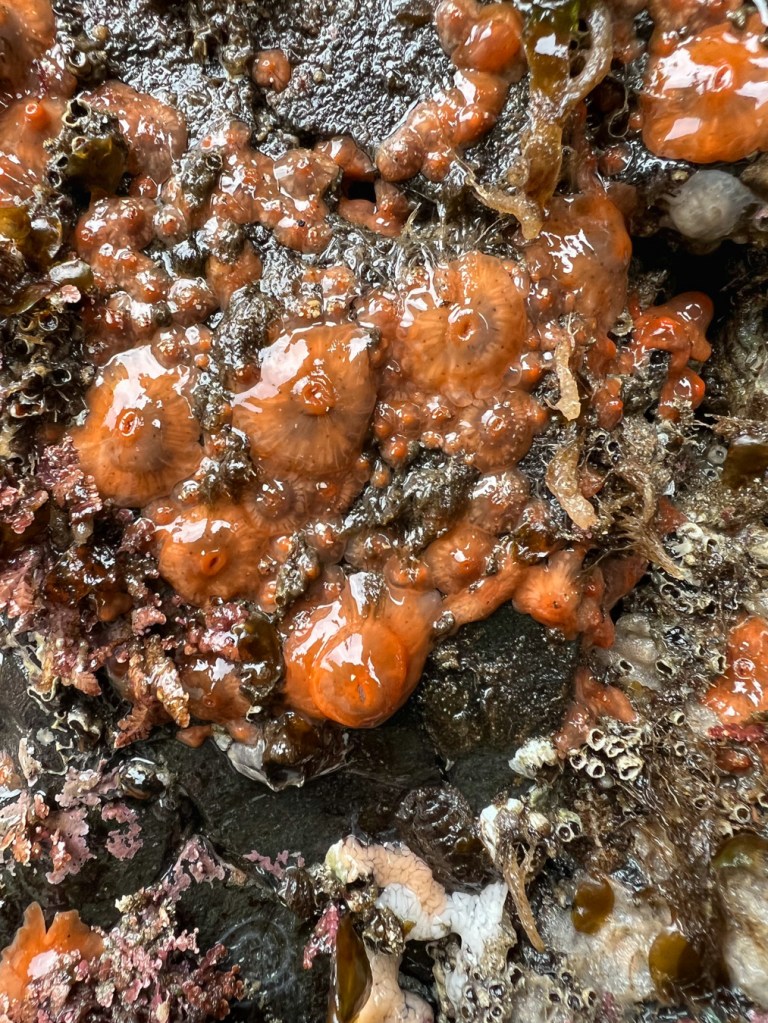
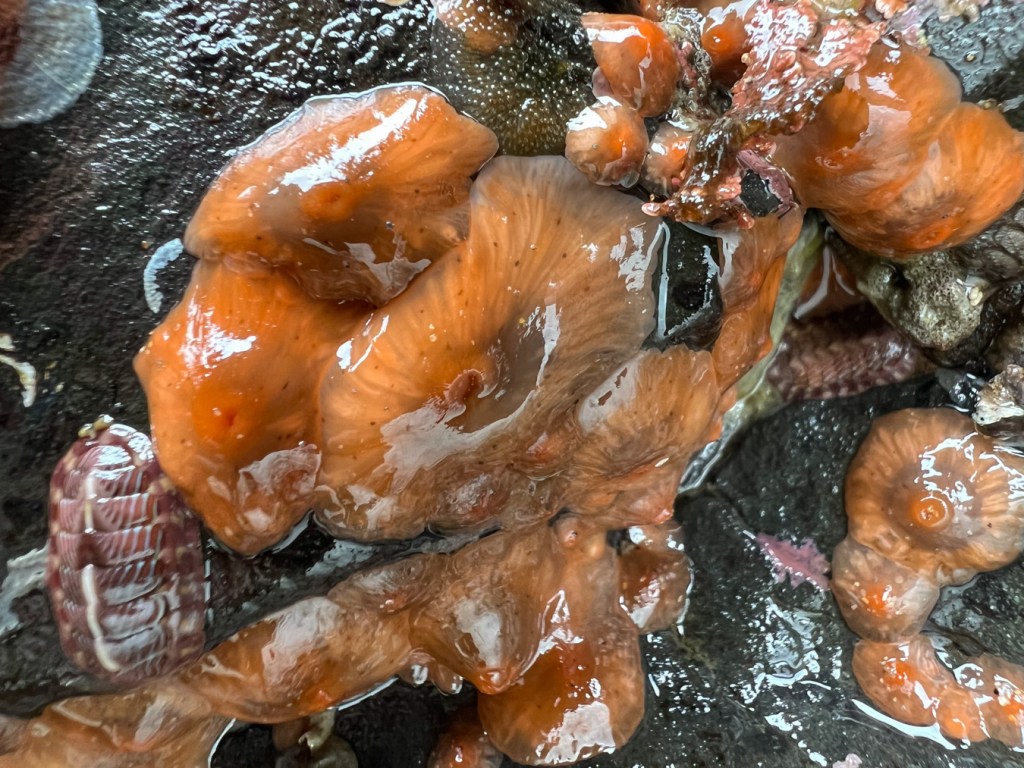
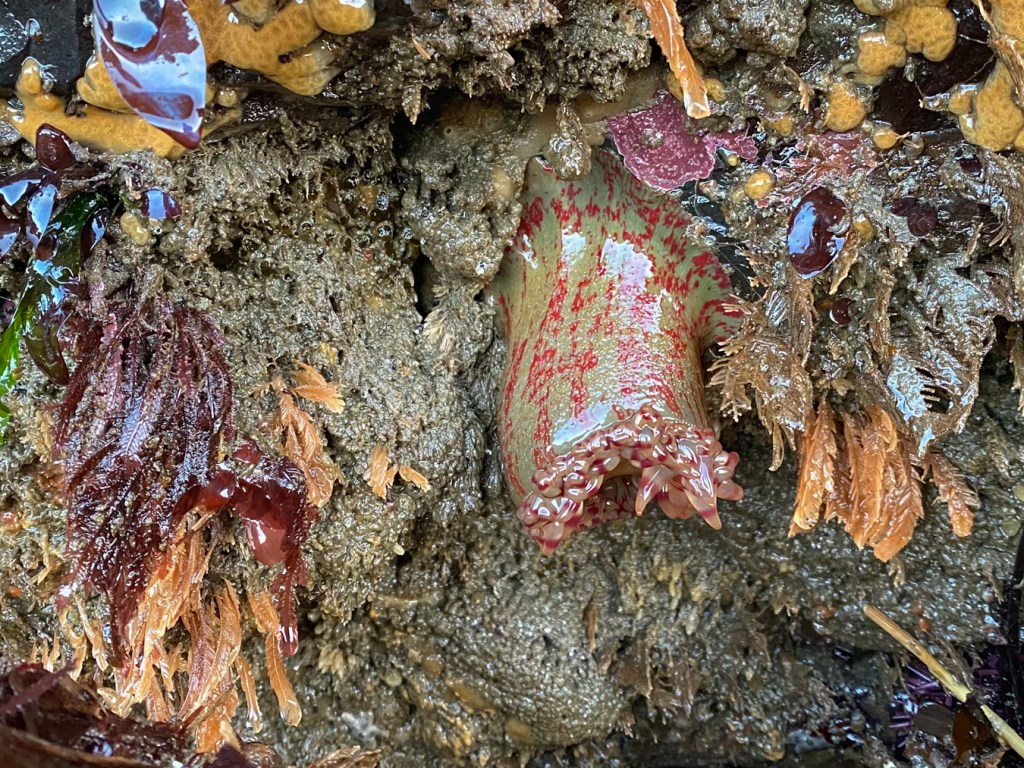
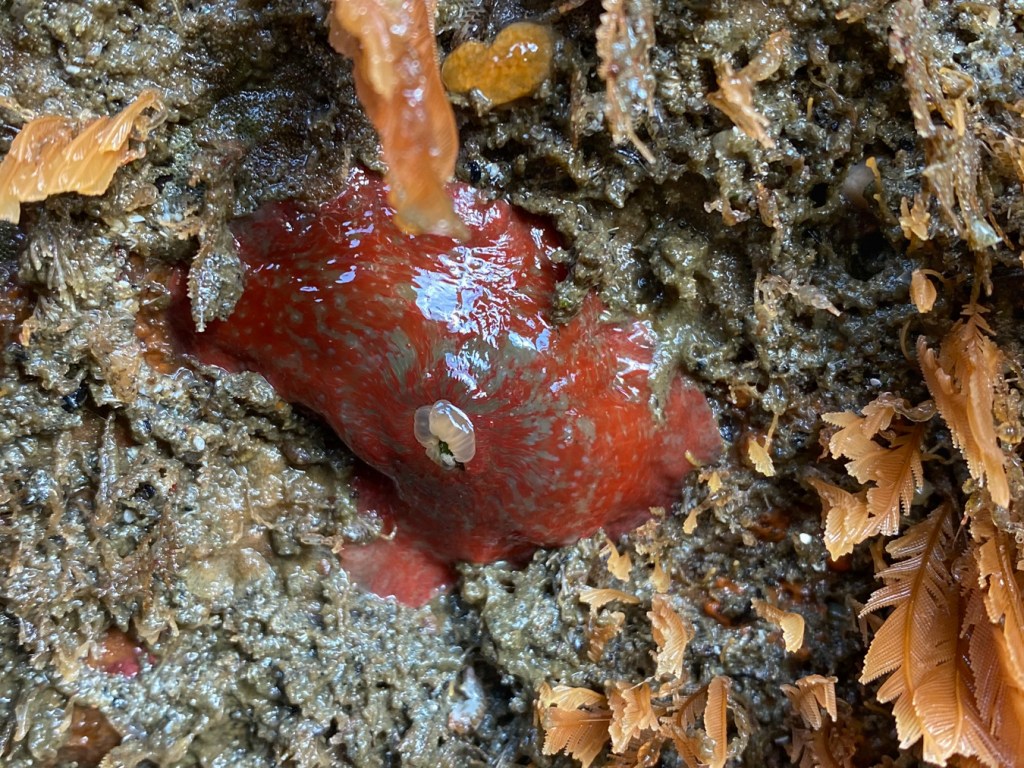
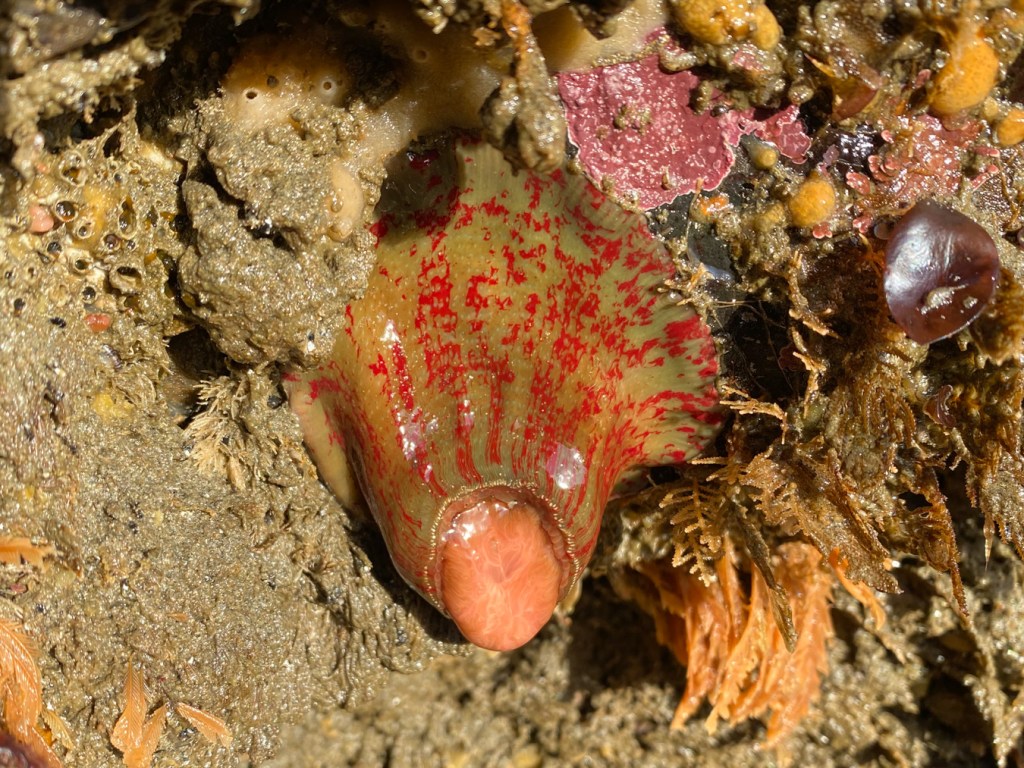
I think the anemones shown in the set below, all from protected niches on the exposed southern Oregon shore, are painteds. However, I can’t claim much experience with Urticina nor much in the way of anemone identification skills, so there is uncertainty. Either way, this good-sized anemone is a low intertidal beauty. Their color and pattern variation is striking.
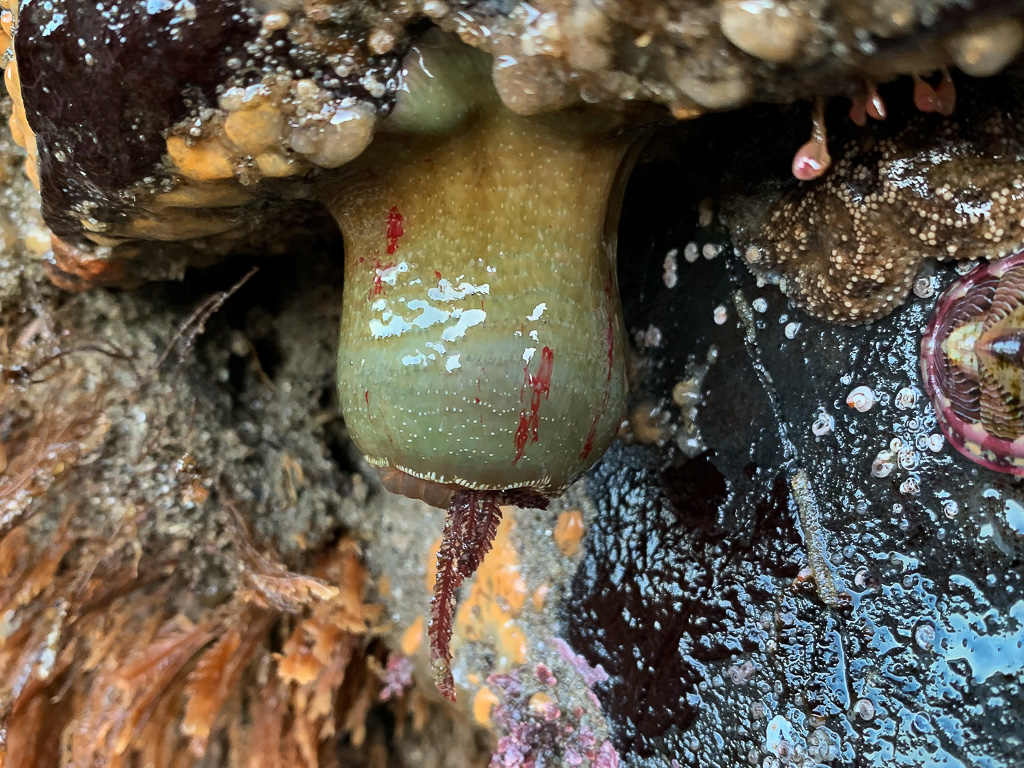

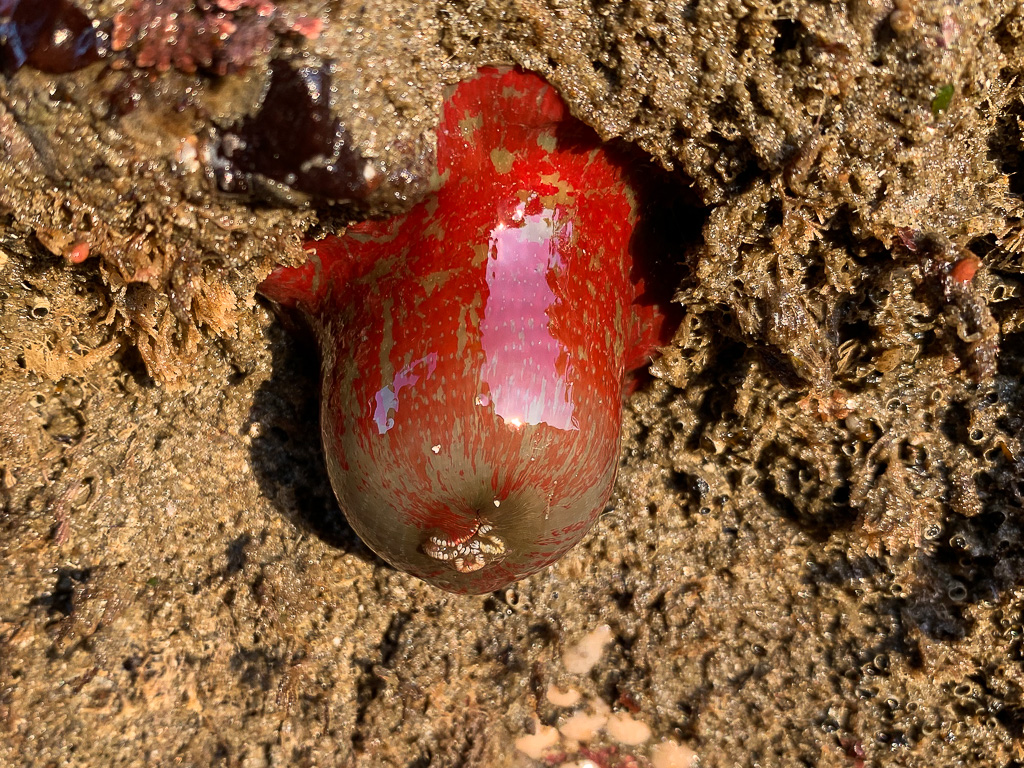
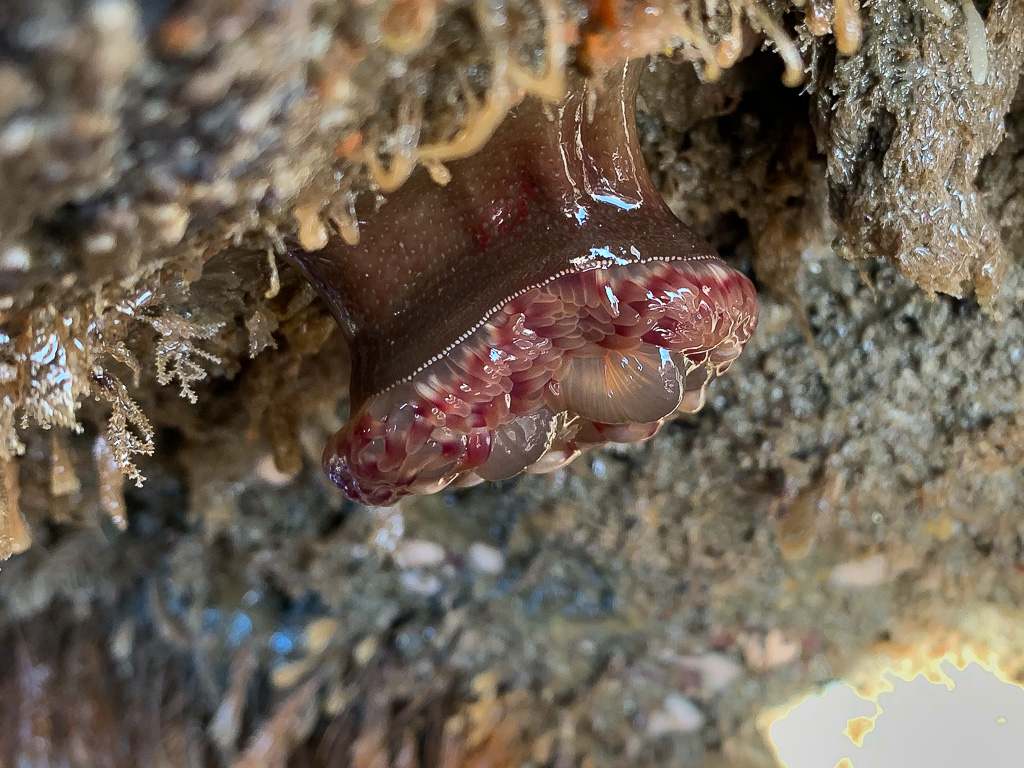
Painteds, at least those I’ve encountered, are very much at home attached to vertical walls and overhangs. On these perches, exposed by low tides, and remember, these are large anemones, hanging down is just the way it is going to be. Of this, Kozloff says “…the way it hangs down limply when the tide is out is fascinatingly obscene.”
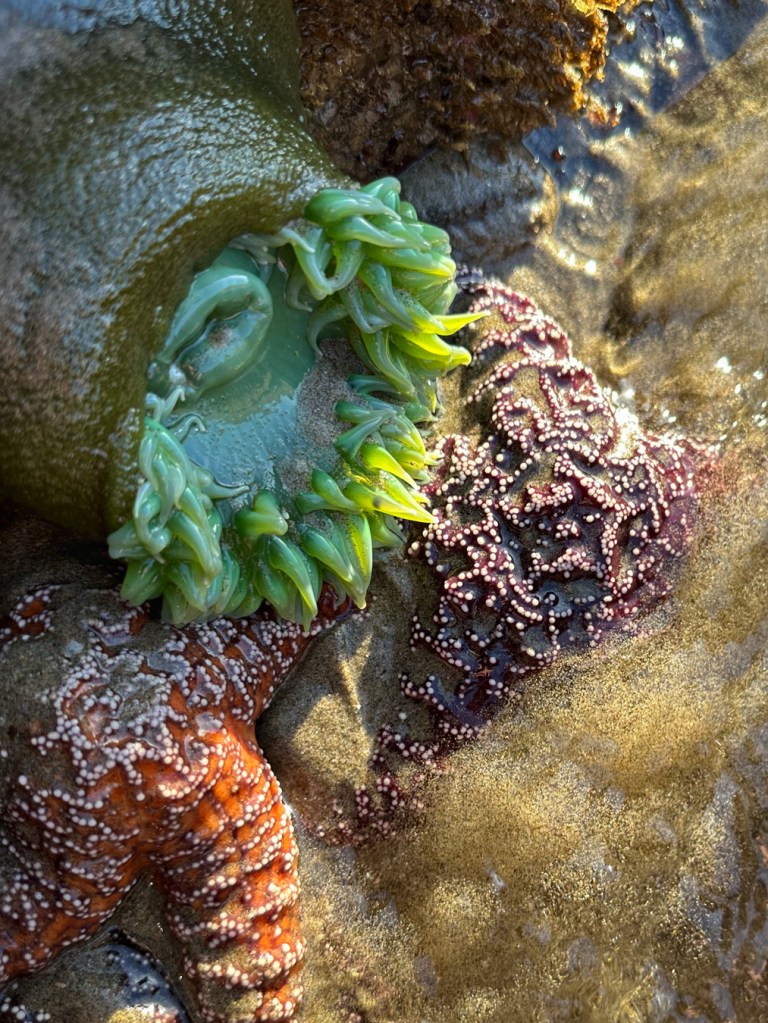
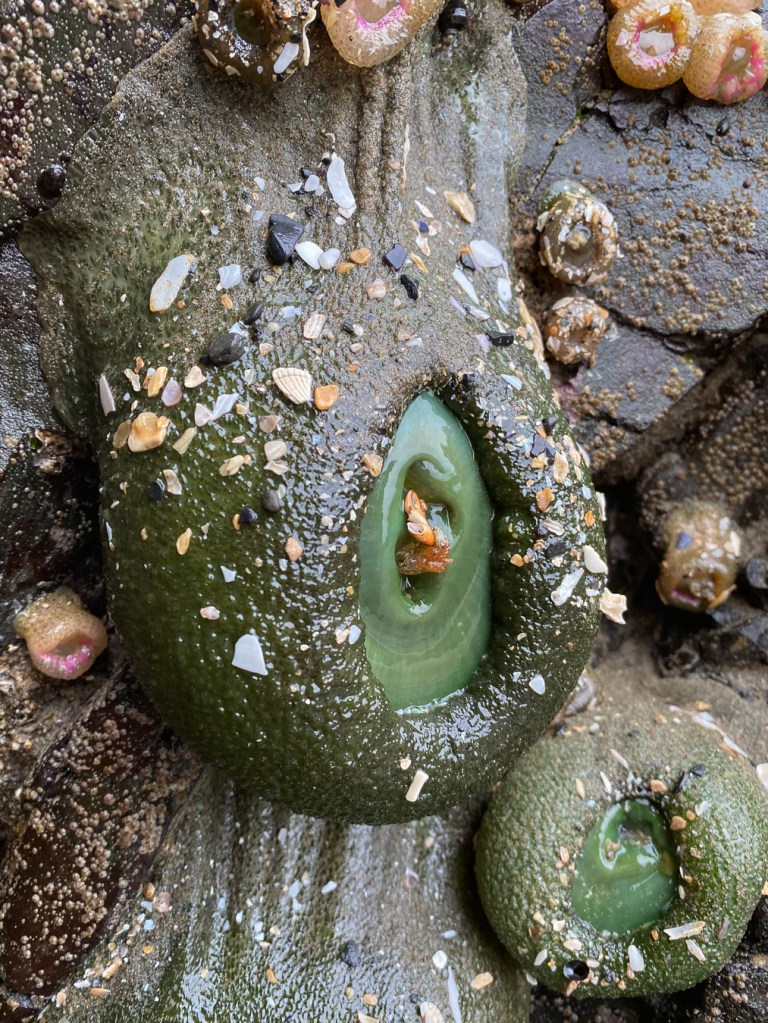
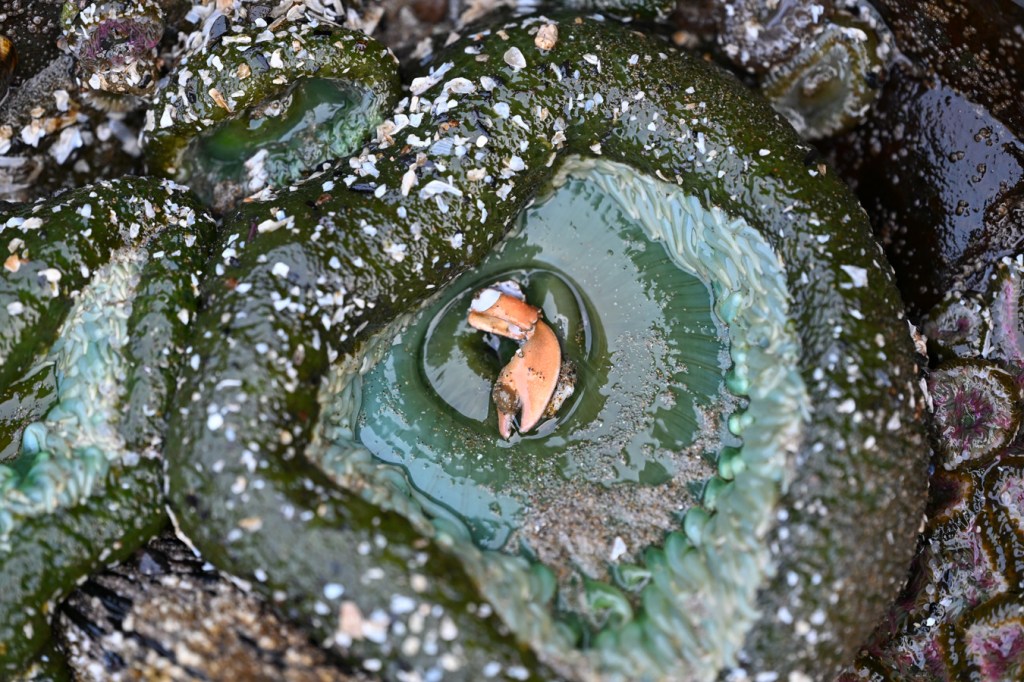
Anthopleura xanthogrammica Giant green anemone
Giant greens have been honored with one of the all-time best scientific names and with their accessibility, size, and beauty, they are tidepool superstars.
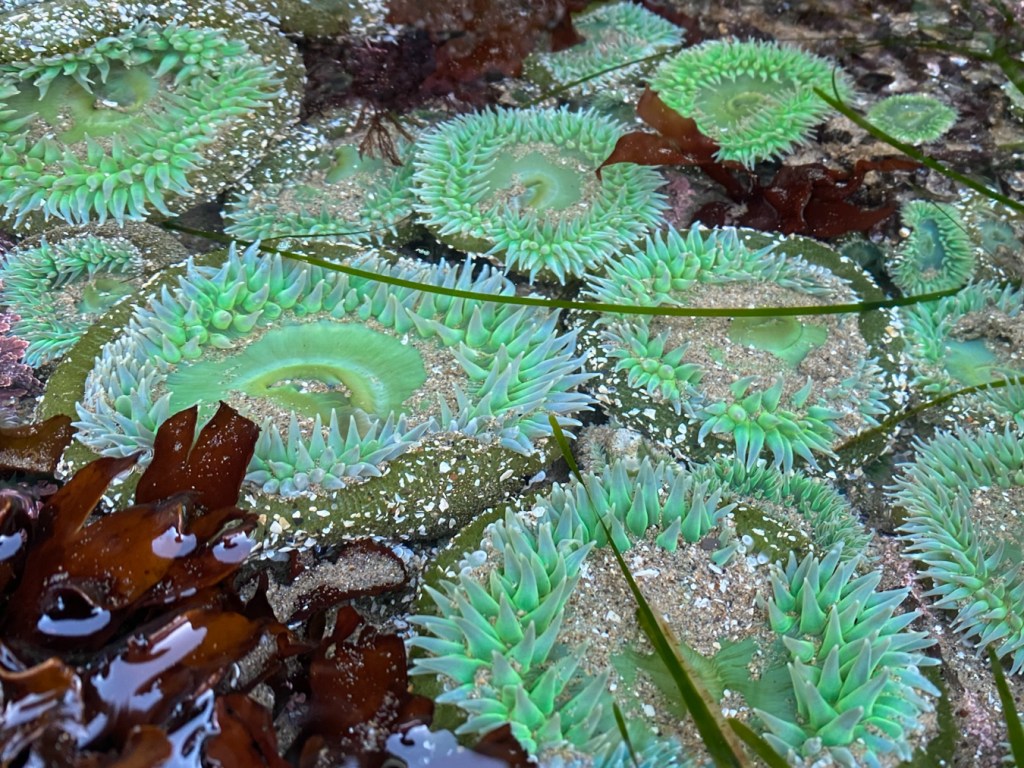
In a still pool, giant greens are a never-ending source of wonder.

From beyond the tidepools



The Daily Catch



Anthopleura elegantissima
This anemone carries around a lot of common names, the most familiar of which, at least to me, are aggregating and pink-tipped green. They’re beauties in and out of the tidepools and you don’t have to wait for a super low tide to find them. Instead, they’re abundant in mid-intertidal pools and on the rocks.
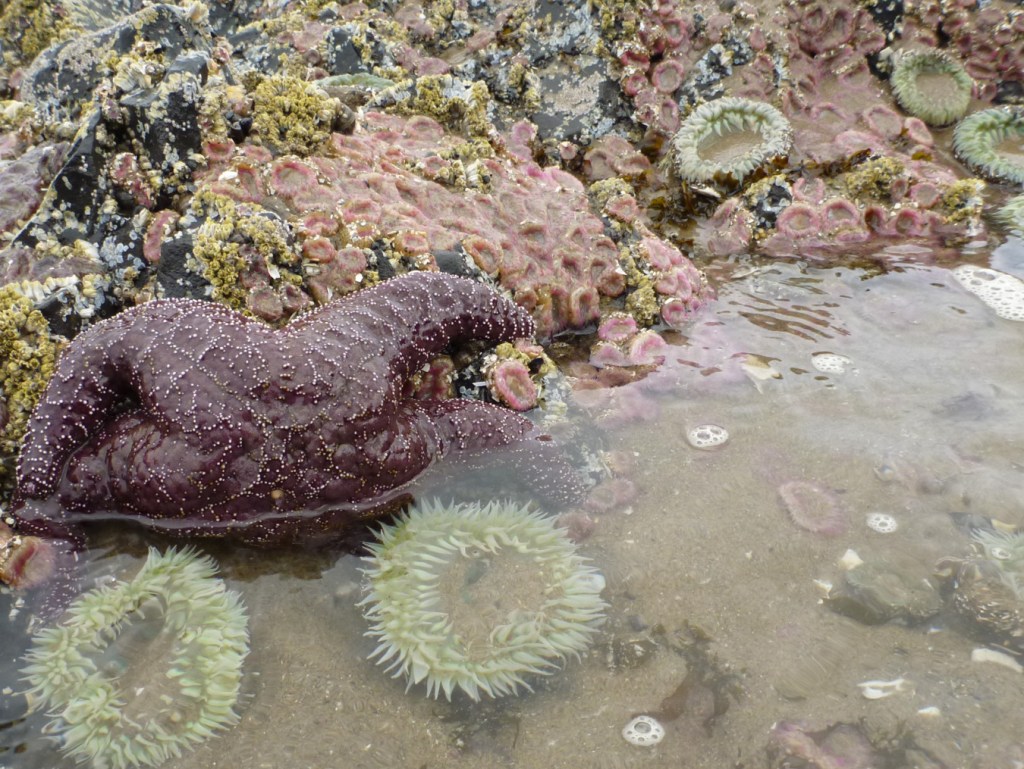
When it comes to intertidal beauty, Anthopleura elegantissima delivers.

When you encounter Anthopleura elegantissima there’s likely to be a crowd.

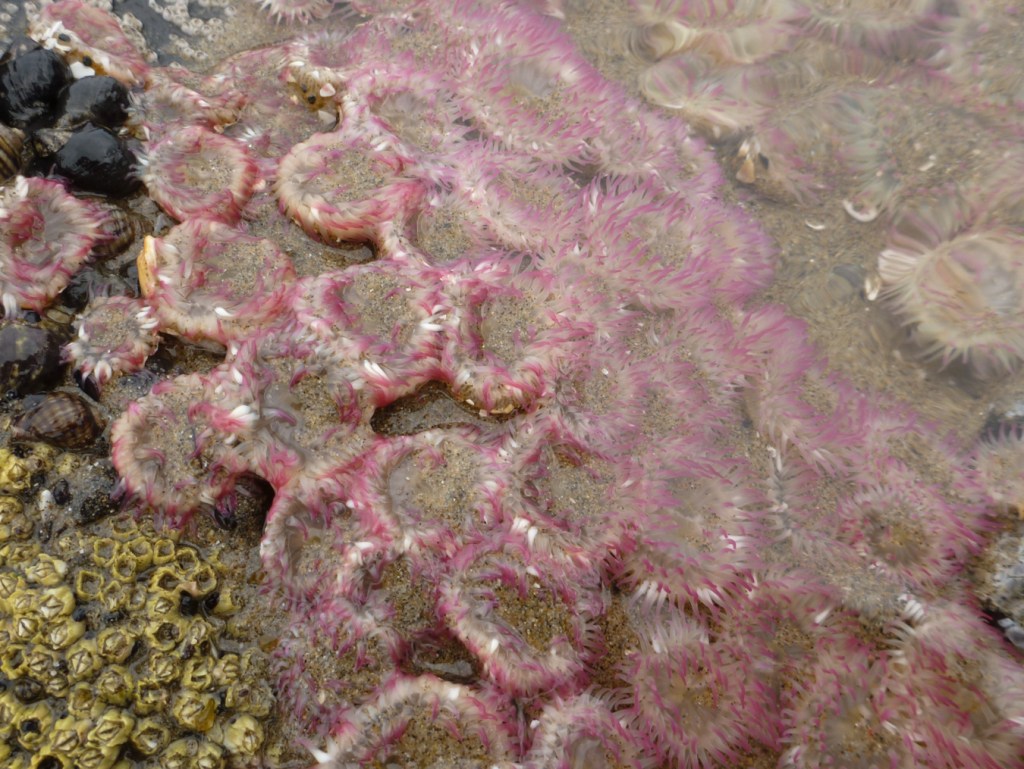

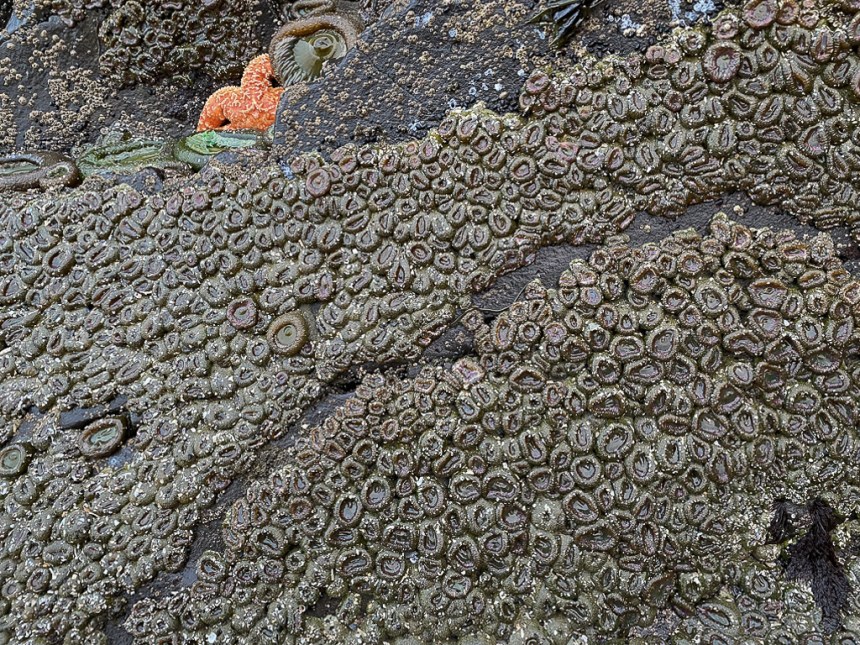
Be on the lookout for thin bands of open ground between aggregations.


Anthopleura artemisia, moonglow anemone
On the exposed outer coast, you’ll almost always find moonglows where sand meets rock.


References
Gotshall, D. W. 2005. Guide to Marine Invertebrates, Alaska to Baja California 2nd Edition (Revised). Shoreline Press.
Harbo, R. M. 2011. Whelks to Whales: Coastal Marine Life of the Pacific Northwest. 2nd ed. Harbour Publishing Co.
Kozloff, E. N. 1993. Seashore Life of the Northern Pacific Coast. 3rd ed. University of Washington Press.
Lamb, A. and B. P. Hanby. 2005. Marine Life of the Pacific Northwest. Harbour Publishing.
Sept. J. D. 2019. The New Beachcomber’s Guide to the Pacific Northwest. Harbour Publishing.
Online Resources
Friends of Netarts Bay WEBS Sea Anemonies, Hydroides, Jellies (Phylum Cnideria) and Comb Jellies (Phylum Ctenophora) page. Accessed January 8, 2026.
It’s worth scrolling down to anemones in Common Sea Life of Southeastern Alaska: A field guide by Aaron Baldwin & Paul Norwood. Accessed January 8, 2026.
Species Accounts
Cowles, D. (2004, as edited). Anthopleura artemisia (Pickering in Dana, 1848). Invertebrates of the Salish Sea. Rosario Beach Marine Laboratory. Accessed January 8, 2026.
Cowles, D. (2005, as edited). Metridium senile subsp. fimbriatum (Verrill, 1865) [Harbo, 1999 says Linnaeus, 1767]. Invertebrates of the Salish Sea. Rosario Beach Marine Laboratory. Accessed January 8, 2026.
Cowles, D. (2005). Urticina crassicornis (O. F. Muller, 1776). Invertebrates of the Salish Sea. Rosario Beach Marine Laboratory. Accessed January 8, 2026.
Piazzola, C.D. and T.C. Hiebert. 2015. Metridium senile. In: Oregon Estuarine Invertebrates: Rudys’ Illustrated Guide to Common Species, 3rd ed. T.C. Hiebert, B.A. Butler and A.L. Shanks (eds.). University of Oregon Libraries and Oregon Institute of Marine Biology, Charleston, OR. Accessed January 8, 2026.
Piazzola, C.D. and T.C. Hiebert. 2015. Anthopleura artemisia. In: Oregon Estuarine Invertebrates: Rudys’ Illustrated Guide to Common Species, 3rd ed. T.C. Hiebert, B.A. Butler and A.L. Shanks (eds.). University of Oregon Libraries and Oregon Institute of Marine Biology, Charleston, OR. Accessed January 8, 2026.
White, B. (2002 as edited). Anthopleura xanthogrammica, Brandt (1835). Invertebrates of the Salish Sea. Rosario Beach Marine Laboratory. Accessed January 8, 2026.
White, B. (2002 as edited). Anthopleura elegantissima (Brandt, 1835). Invertebrates of the Salish Sea. Rosario Beach Marine Laboratory. Accessed January 8, 2026.
I updated this page January 9, 2026
 theoutershores