Below are a few examples of bivalves that live on Oregon’s exposed shores or their shells that have washed ashore there. Some, like California mussels Mytilus californianus, live on intertidal rocks, while others, like Pacific razor clams Siliqua patula, are abundant in beach sand. Other bivalves shown don’t live on the exposed coast, but we see them because their empty shells wash ashore after lives led in sister ecosystems. Gaper clams Tresus are an excellent example of that. These are the easy-to-spot bivalves I’ve seen and photographed on the shores I’ve visited.
Regarding live clams in their shells, my set is limited. I try to keep my touch light by not turning rocks or digging, so most of the shells I show are empty and drifted. If I offer an image of a live bivalve disturbed by me or someone else, I note it. Organization-wise, I loosely follow Lamb and Hanby (2005). If I use common names, they’re my choice. Experts cover the bivalves shown below and many more in the books, field guides, and identification resources listed at the bottom of this page. My photos are from northern Oregon unless noted.
Mytilus californianus California mussel
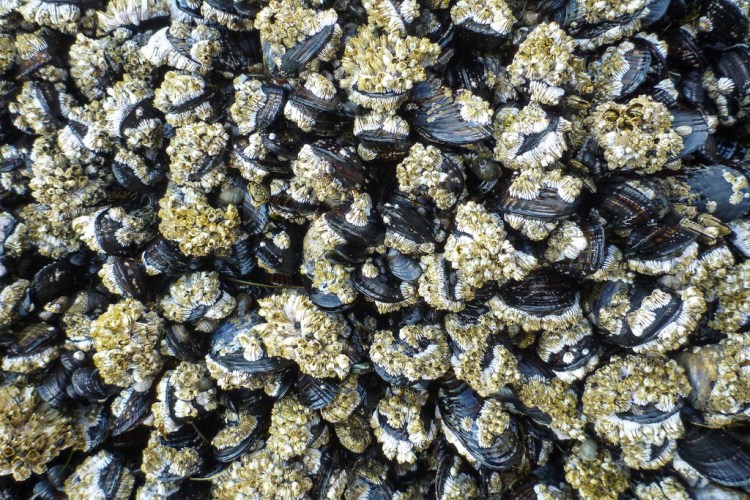
The mussel beds of the exposed coast’s intertidal rocks are a joy. Here are looks at a few of the many sides of California mussels. You’ll find more images and a few words about M. californianus at The Curves and Colors of California Mussels.



Adula Date mussel, Pea pod
These are probably Adula californiensis. Empty shells can be abundant on beaches near sediments suitable for burrowing.


Chlamys
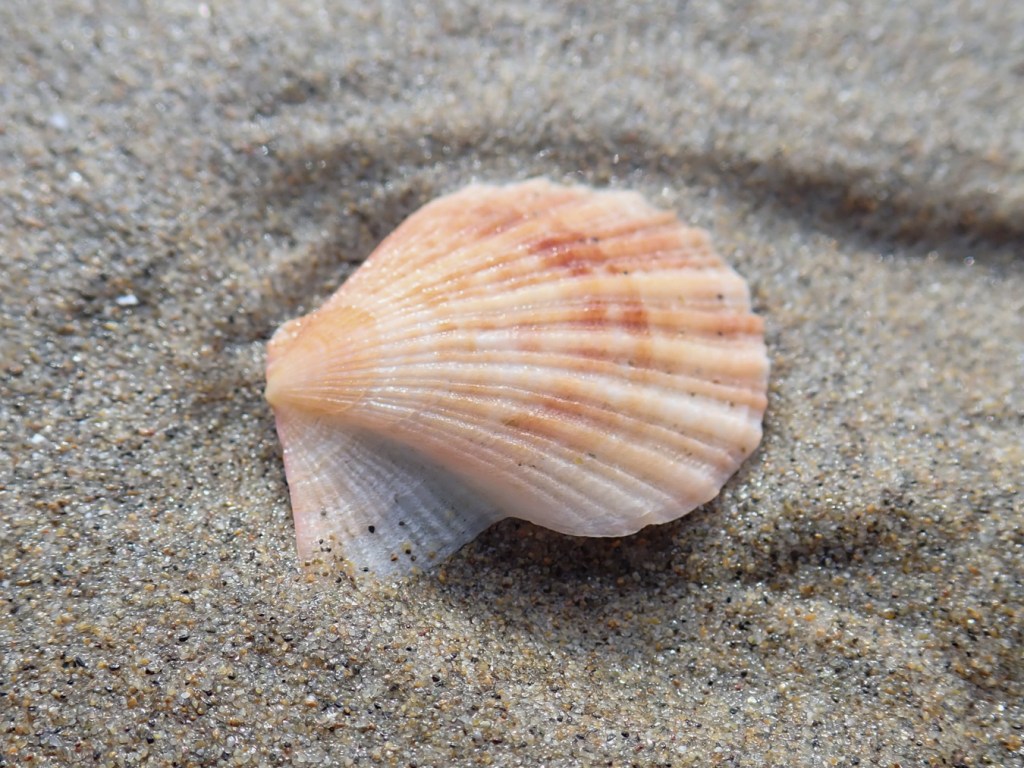
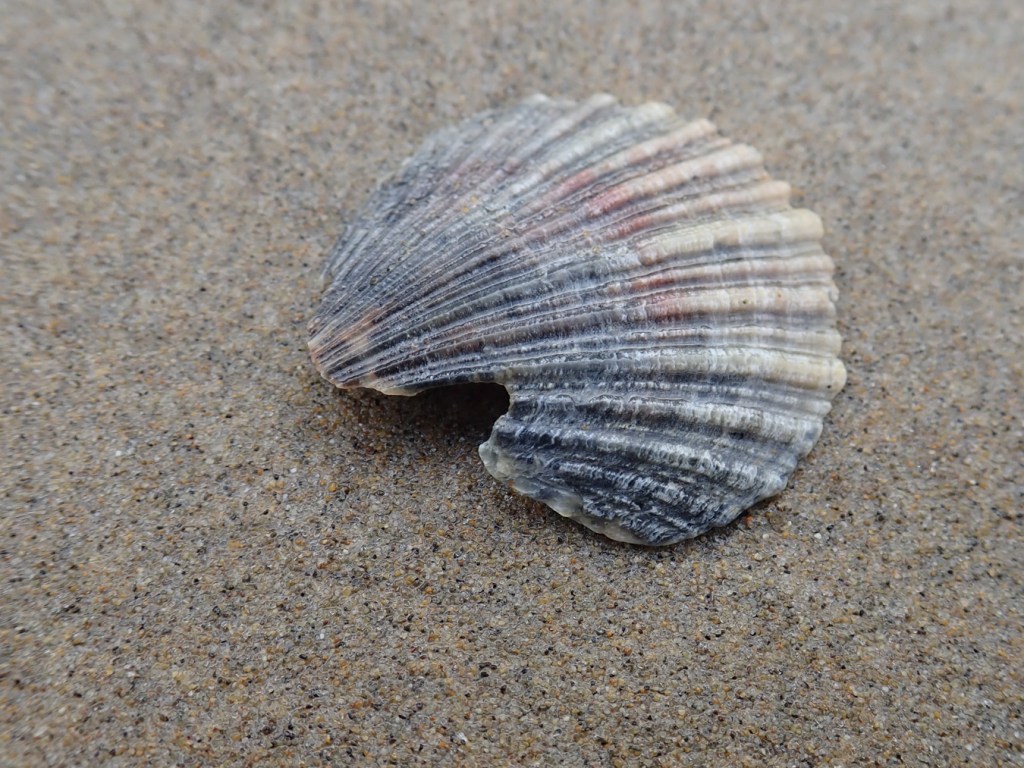
Empty and drifted scallop shells Chlamys occasionally wash up on surf-swept beaches. I’ve always assumed the examples shown here are spiny pinks C. hastata, but I’m not certain about that. (It’s a call for experts.) Either way, they can be a spot of color and delicate beauty on the beach.


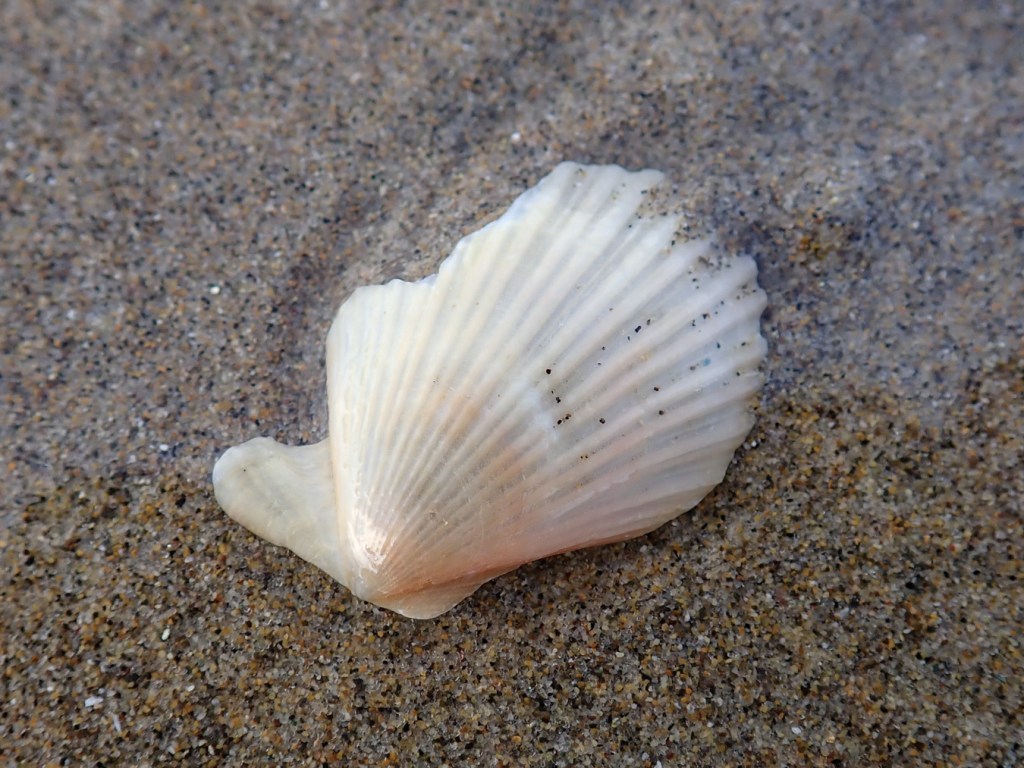
I flipped this shell over to expose its interior surface.


Every once in a while, a drifted shell stained dark will turn up.

Crassadoma gigantea Rock Scallop
Drifted unattached valves, which I’m guessing are left valves (Kozloff says the right valve is attached), are not too uncommon in the drift. The exterior surface of older shells are pitted from the erosive forces of encrusting boring sponges and other encrusting and boring organisms.
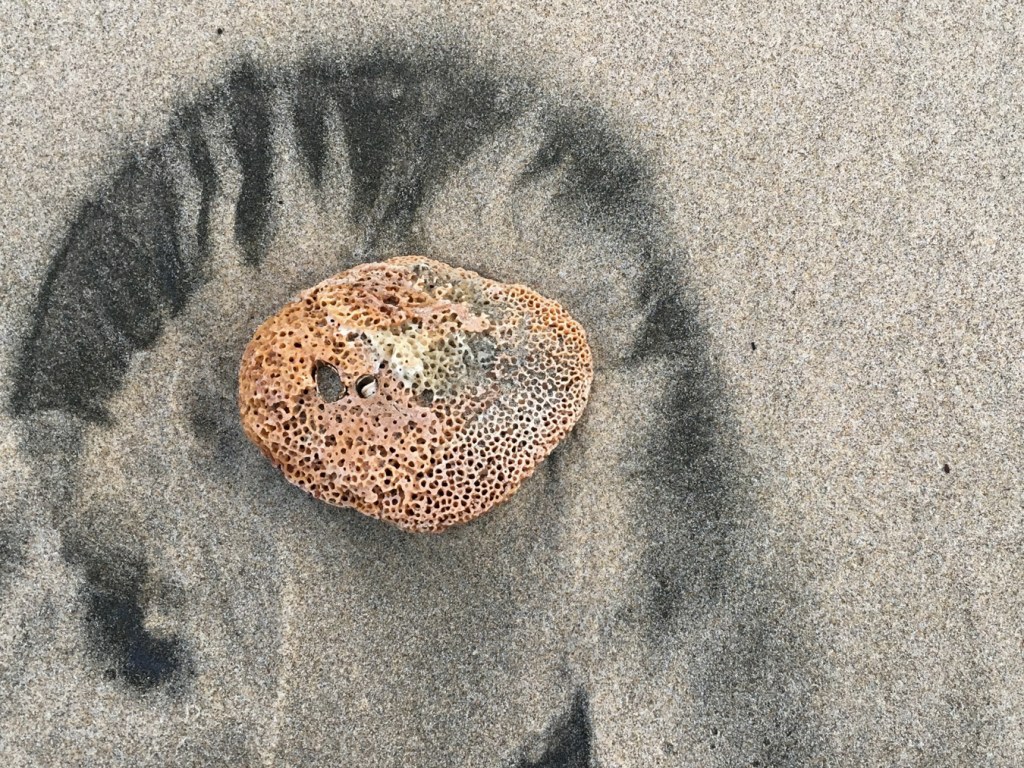
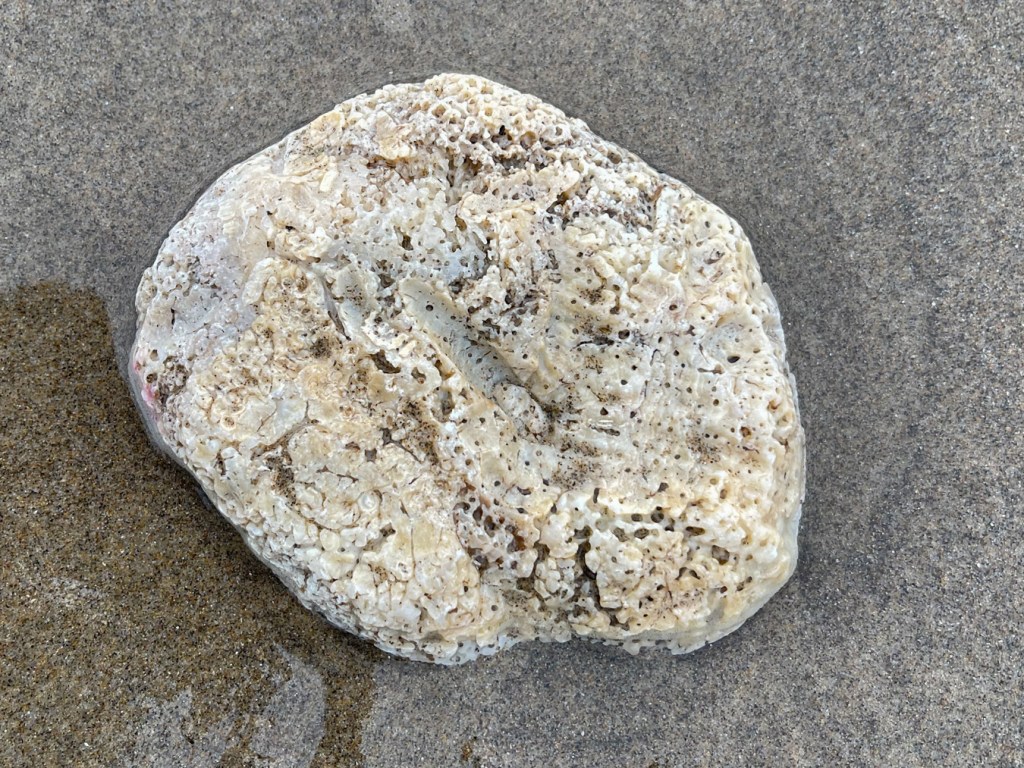
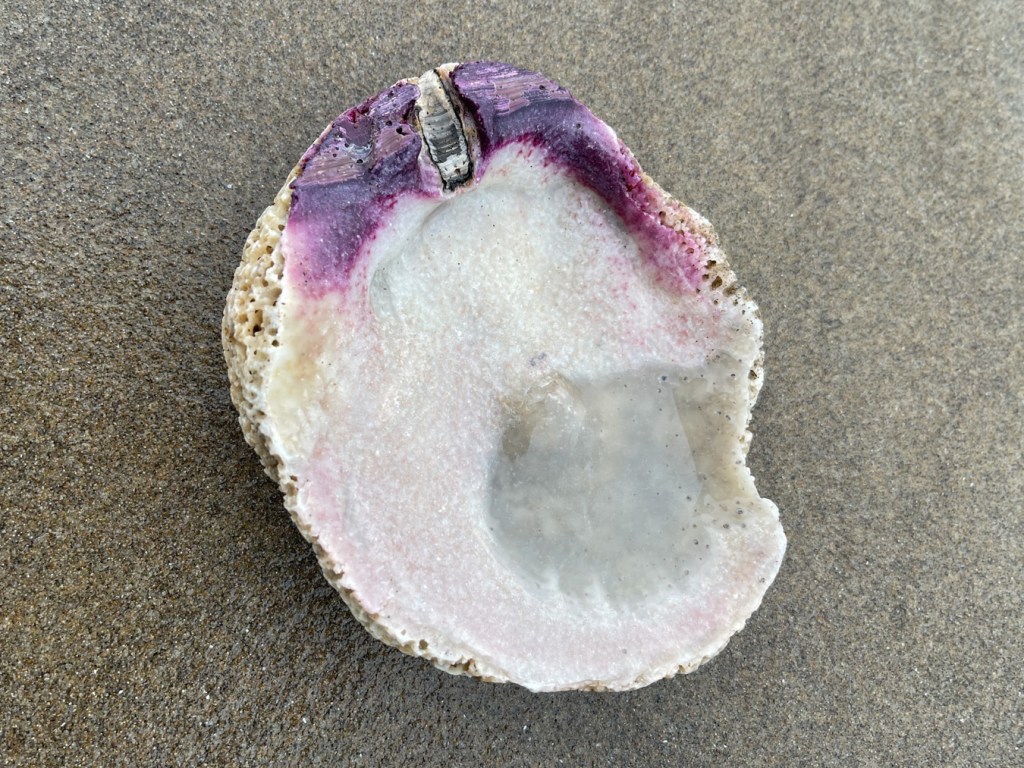


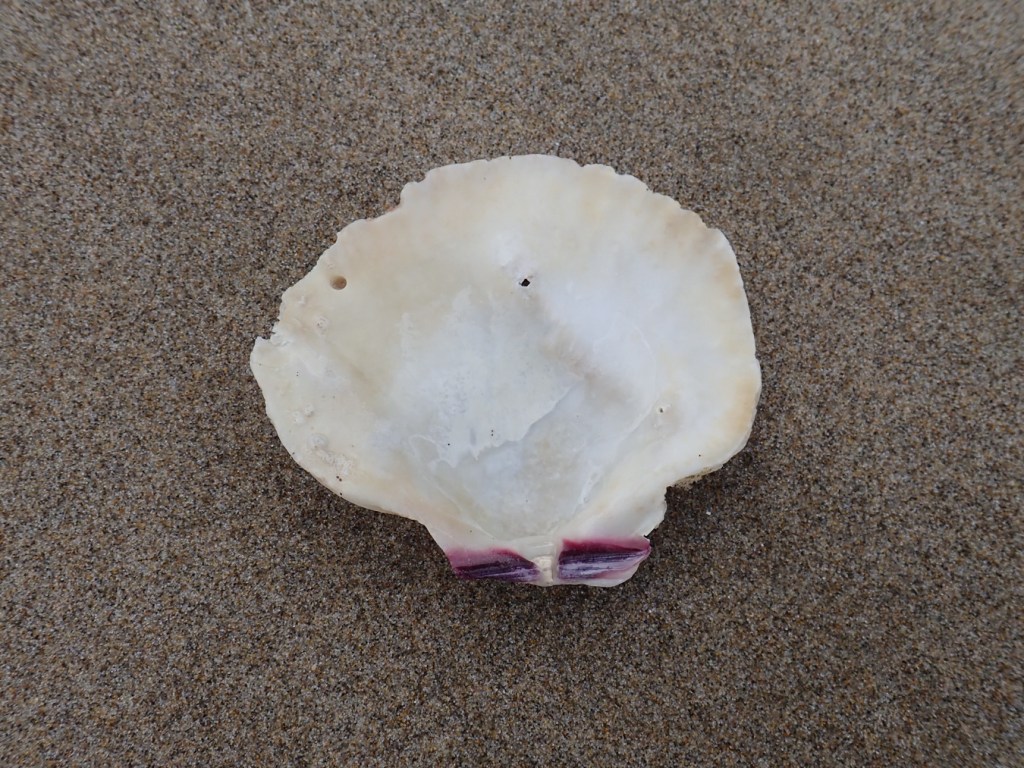
Smaller, presumably younger, examples with less exterior shell erosion. On the interior, the purple coloration at the hinge is a constant.


The purple color is pretty amazing. It’s found on the interior surface at the hinge, the thickest part of shell; thus, it is the fragment you’ll most often encounter on the beach, and one reason the alternative common name, purple-hinged rock scallop, makes sense.

Speaking of color, occasional drifted valves are darkly stained.


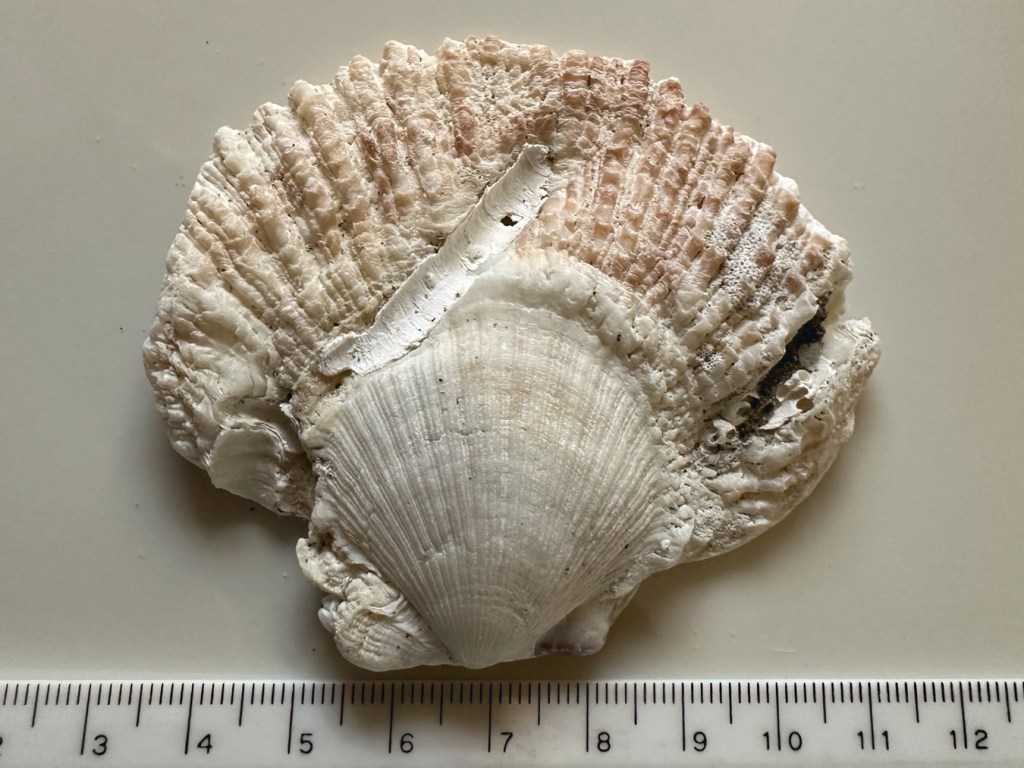
When I first saw the drifted valve below, I didn’t have much in the way of expectations, but when I washed it off and took a closer look, I found that it was an informative find.
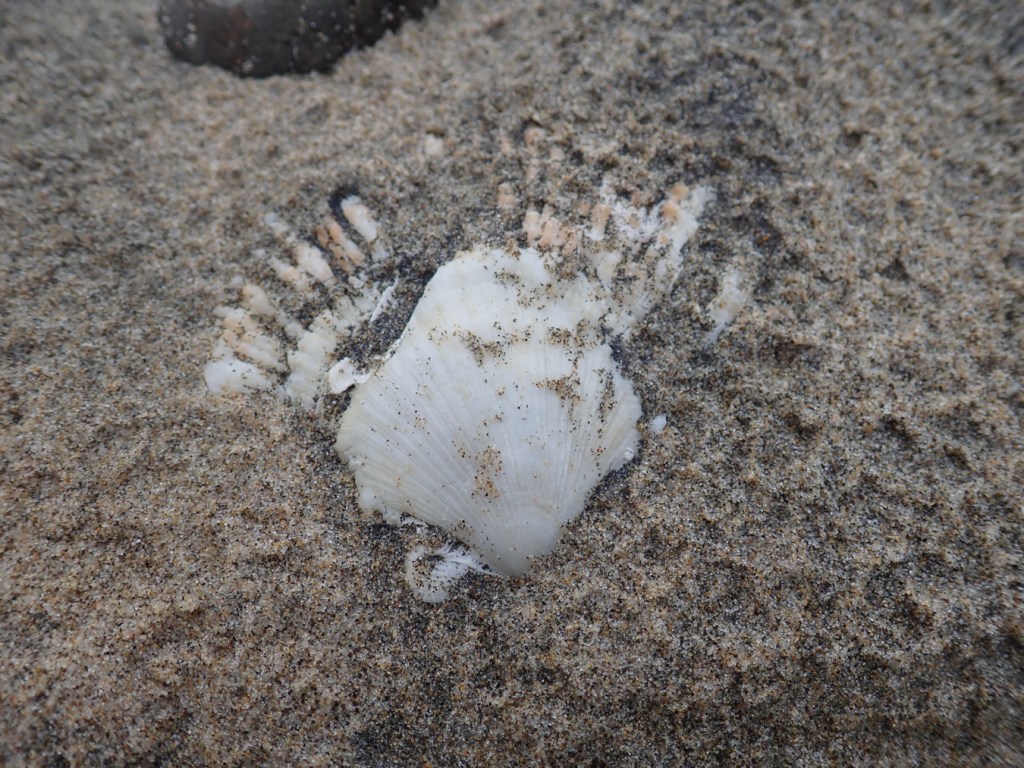
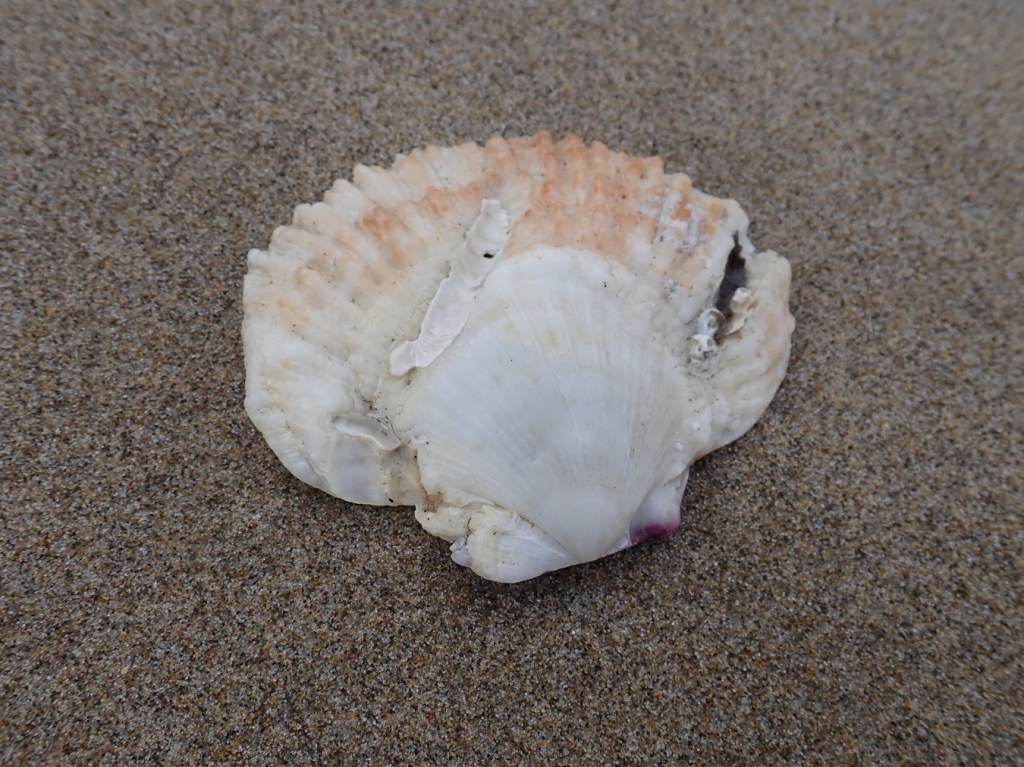
A closeup of the same valve shows a nice impression of the smaller, younger scallop before permanent attachment and then some post-attachment growth.
Oysters
Oysters occasionally appear on exposed Northern Oregon shores when they arrive on lost floats and buoys. (I think all the oysters shown in this entry are the Pacific oyster Magallana gigas but others are possible.)
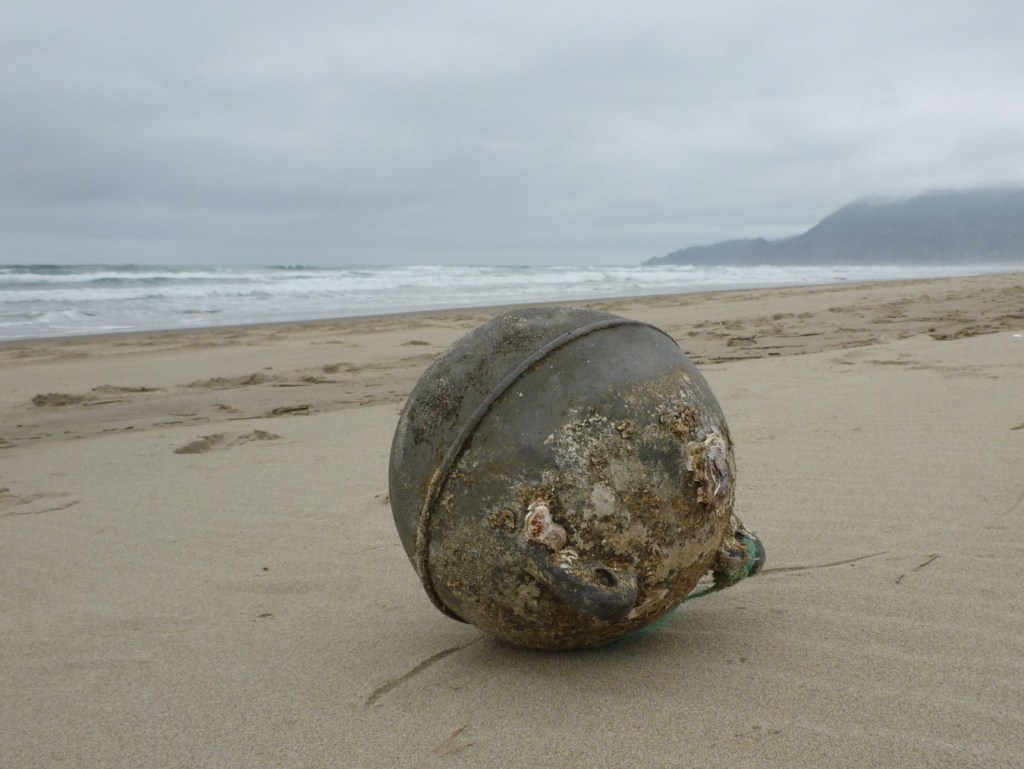
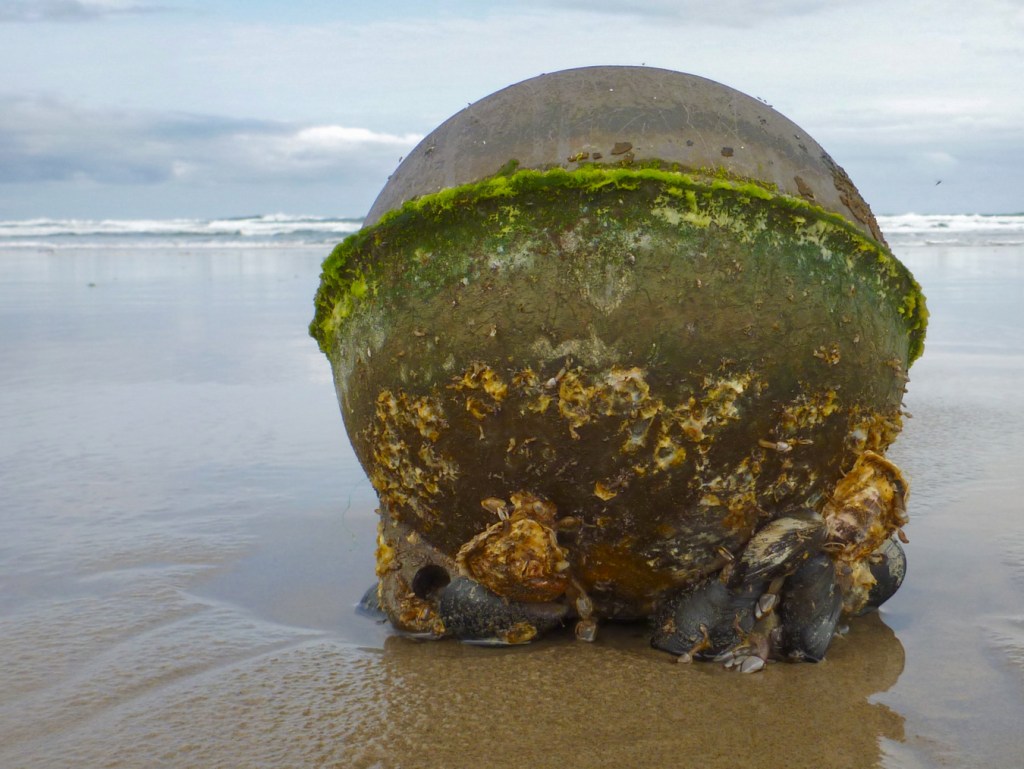

It’s unusual to find empty drifted shells on exposed Northern Oregon beaches. When I’ve come across them, I’ve always assumed that people carried them, they drifted from nearby oyster farming operations, or they arrived on lost buoys as described above, but there could be other explanations.

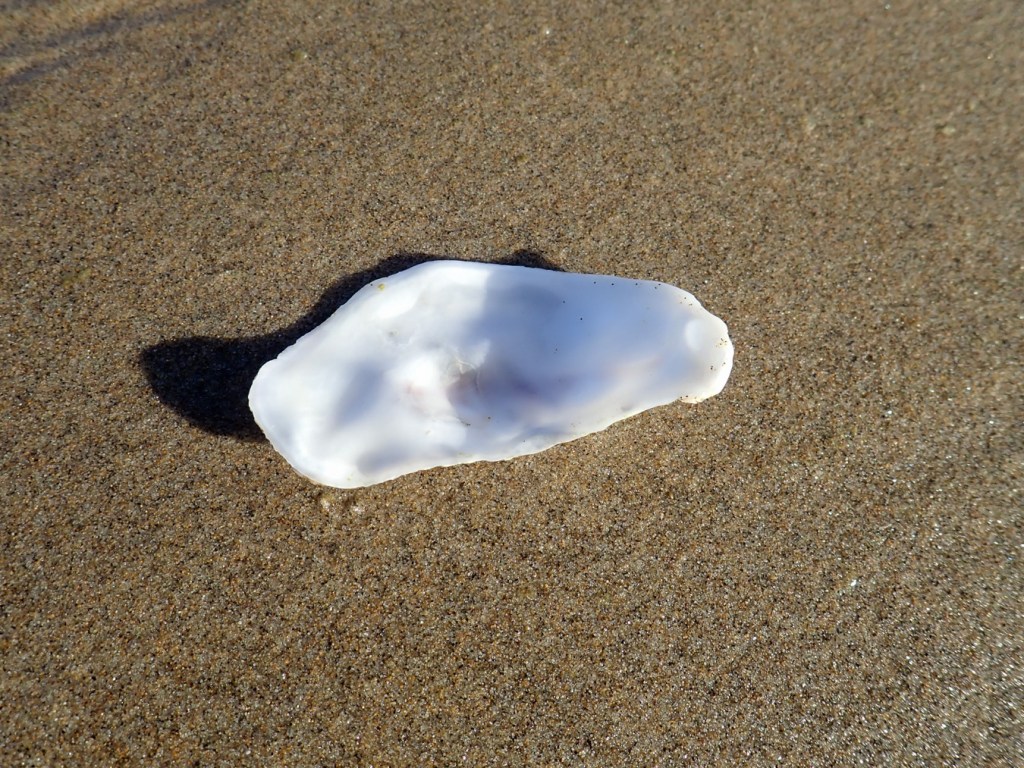
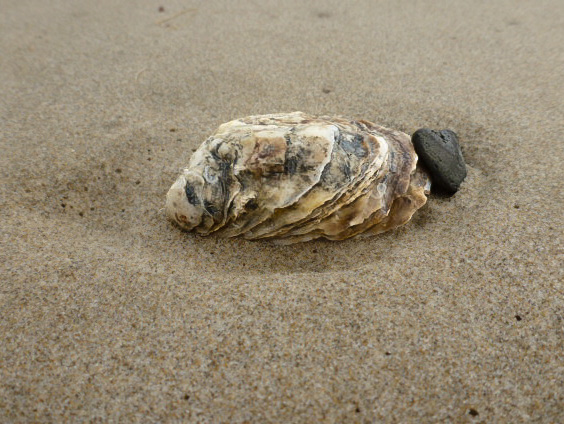
The set below shows what are probably Magallana gigas from quieter waters.
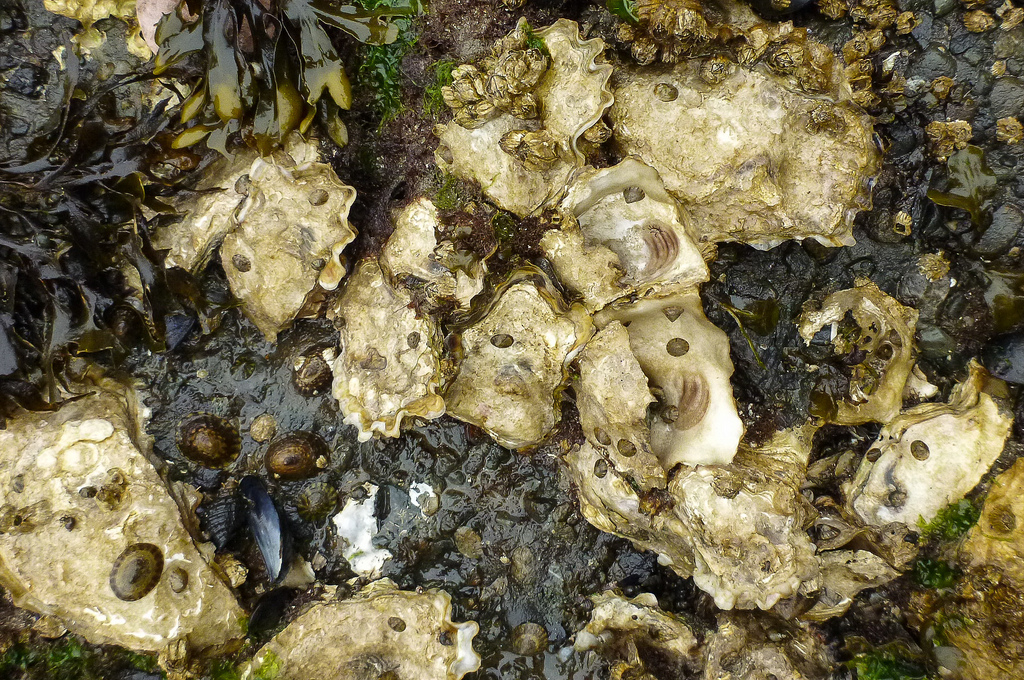

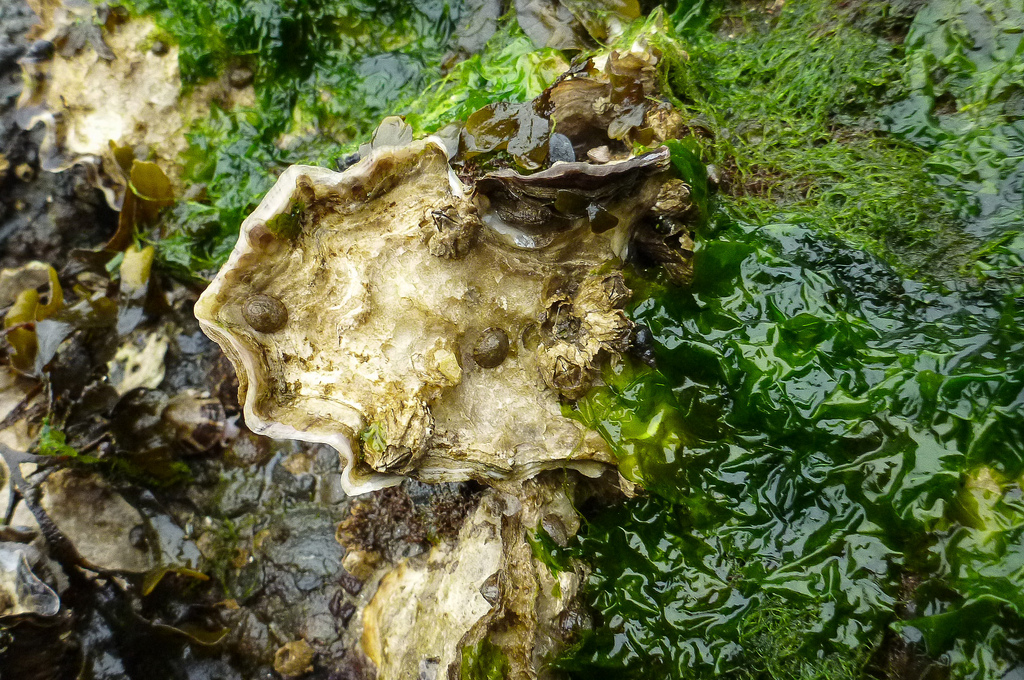

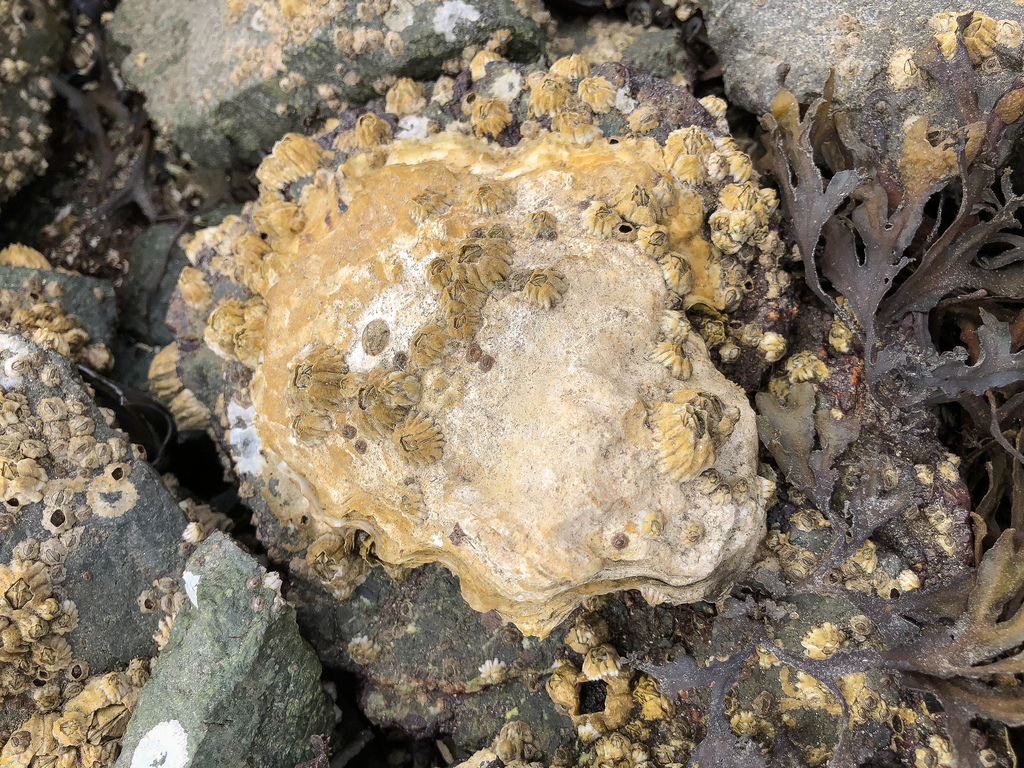
Pododesmus macroschisma Green false-jingle
It’s not too uncommon to find small empty shells washed up on the beach. The shell shown in the top panels has experienced quite a bit of erosion.
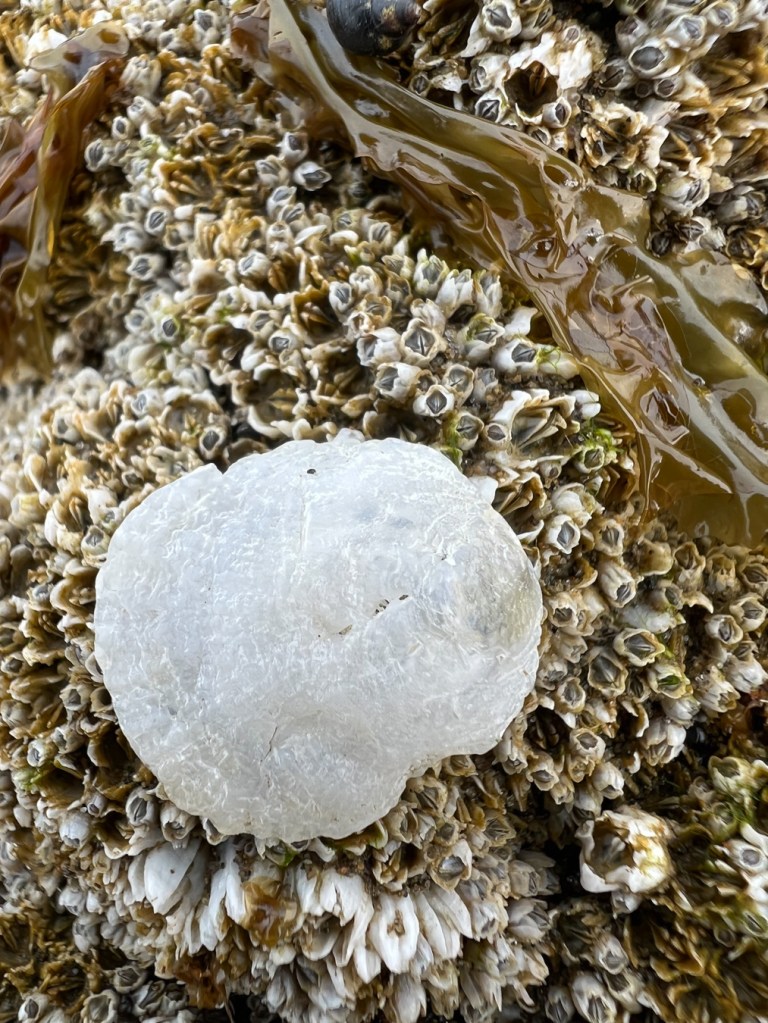
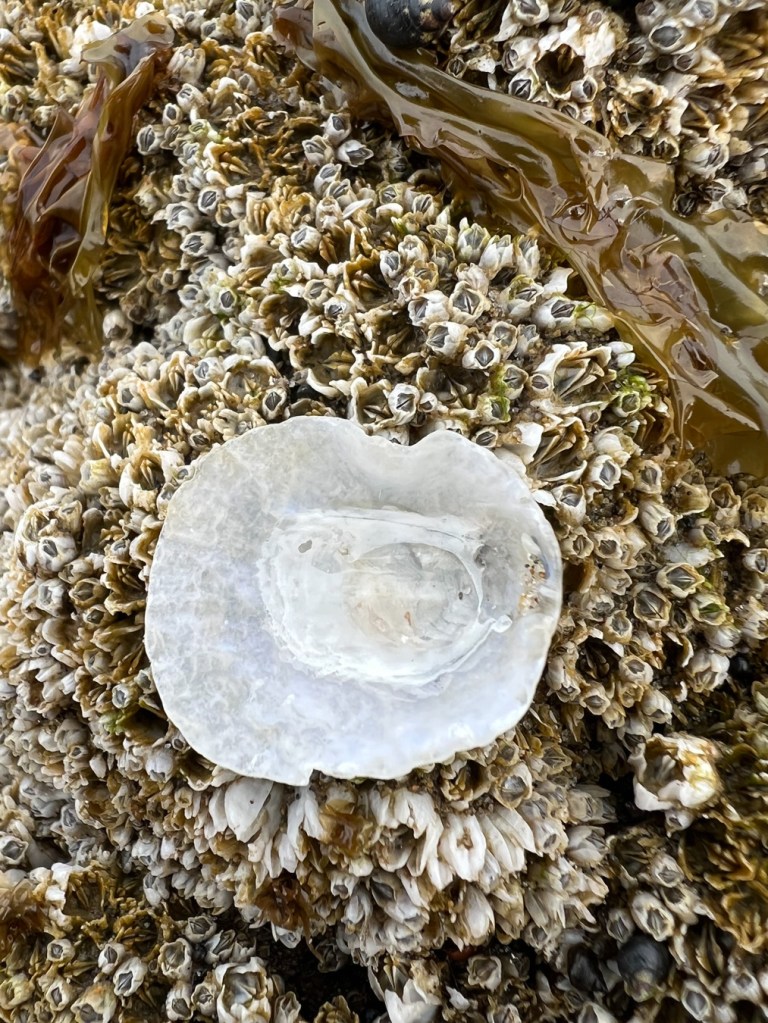
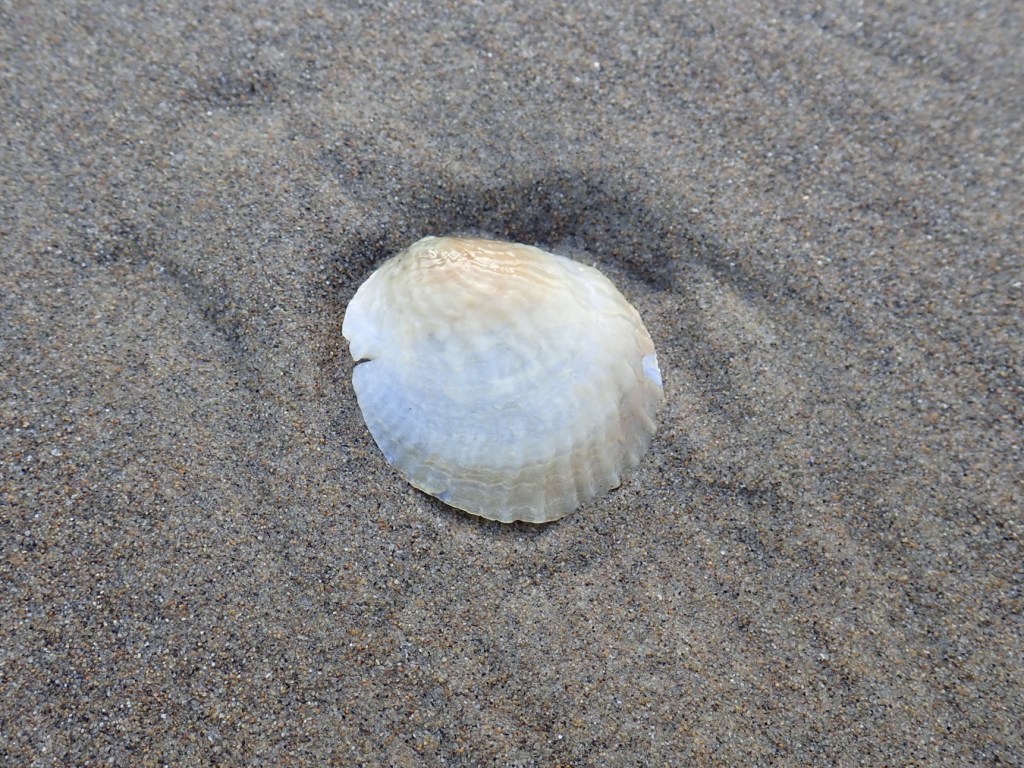
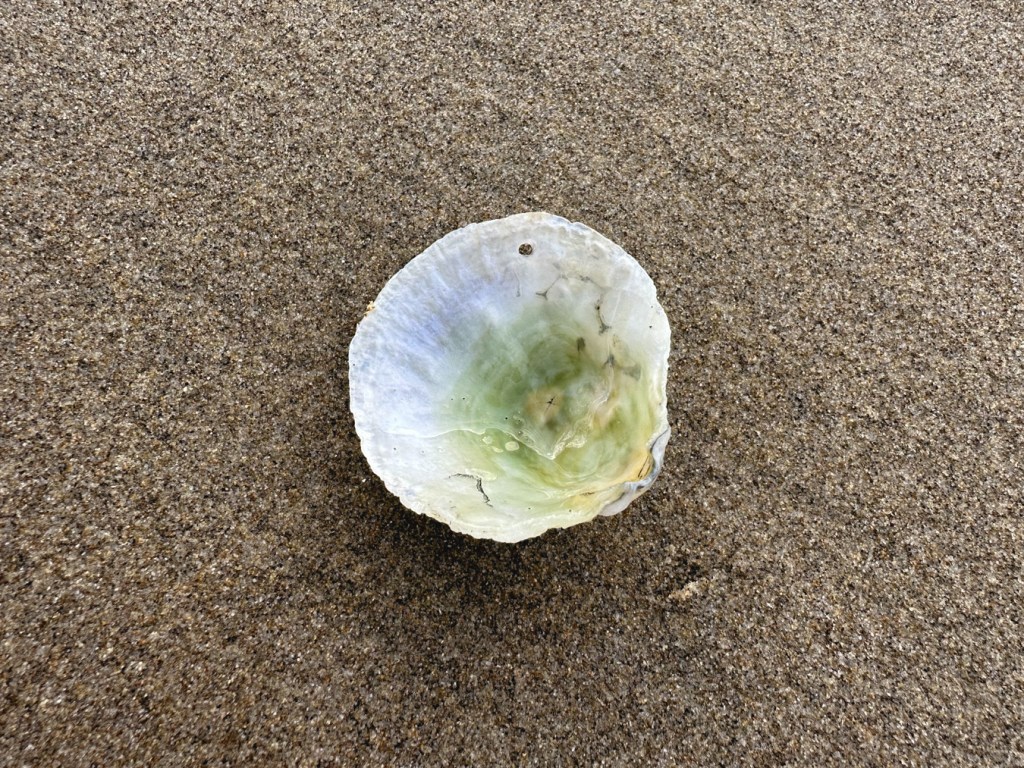
For the set below, which is the same shell flipped over, I moved the shell from the swash to drier sand so I could show it off.

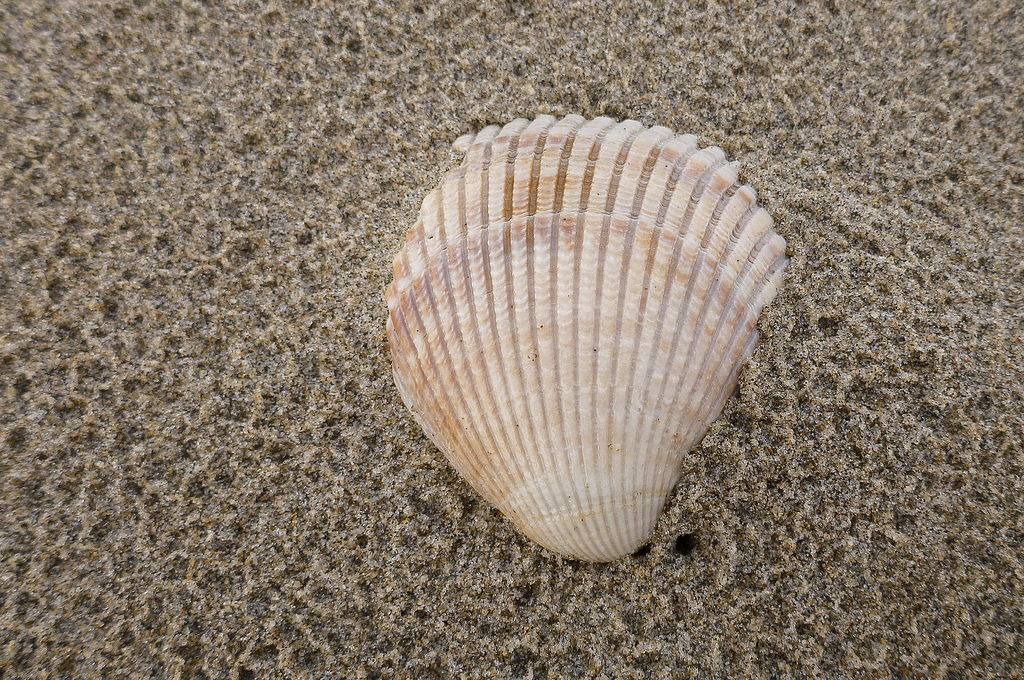
Clinocardium nuttallii Heart cockle, Nuttall’s cockle
There is a good chance the empty shells and shell fragments so common on some exposed surf-swept beaches arrived via drift.



Corbicula fluminea
Shells of this invasive freshwater (and perhaps sometimes brackish water) clam sometimes wash ashore on the northern Oregon coast.

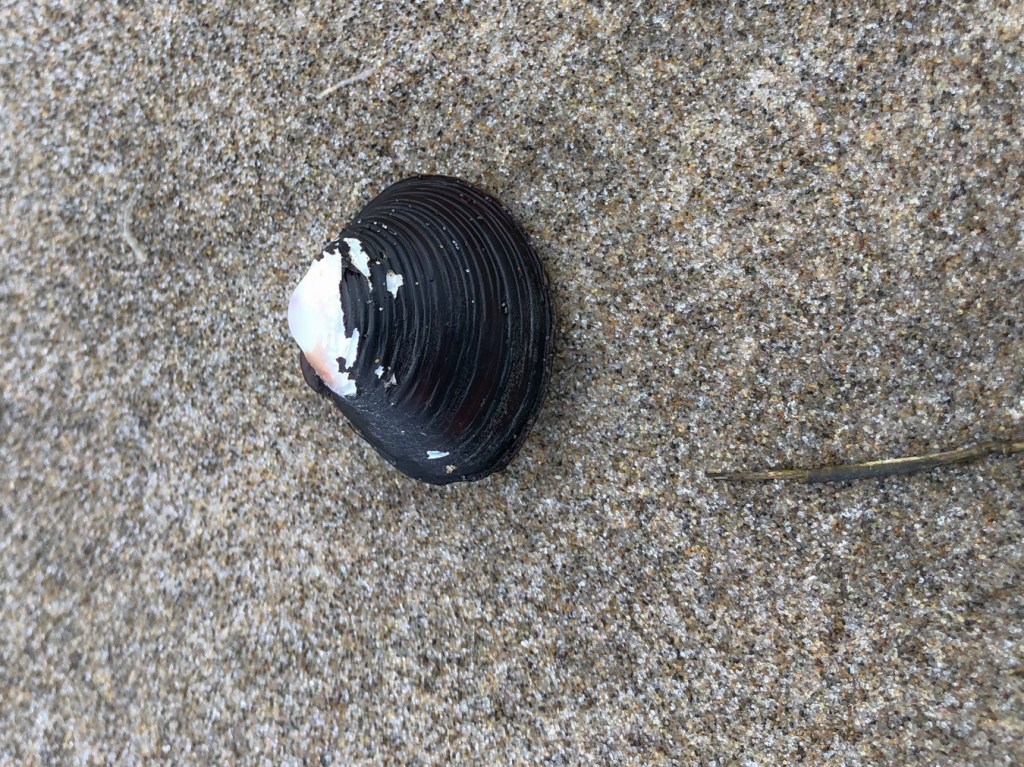

Tresus capax Fat gaper
Bleached fat gaper shells can be abundant on exposed beaches. I’ve examined and measured a bunch of shells on the beaches I’ve visited, but as far as I know, in those locations, I’ve yet to come across the other gaper in our area, Tresus nuttallii.


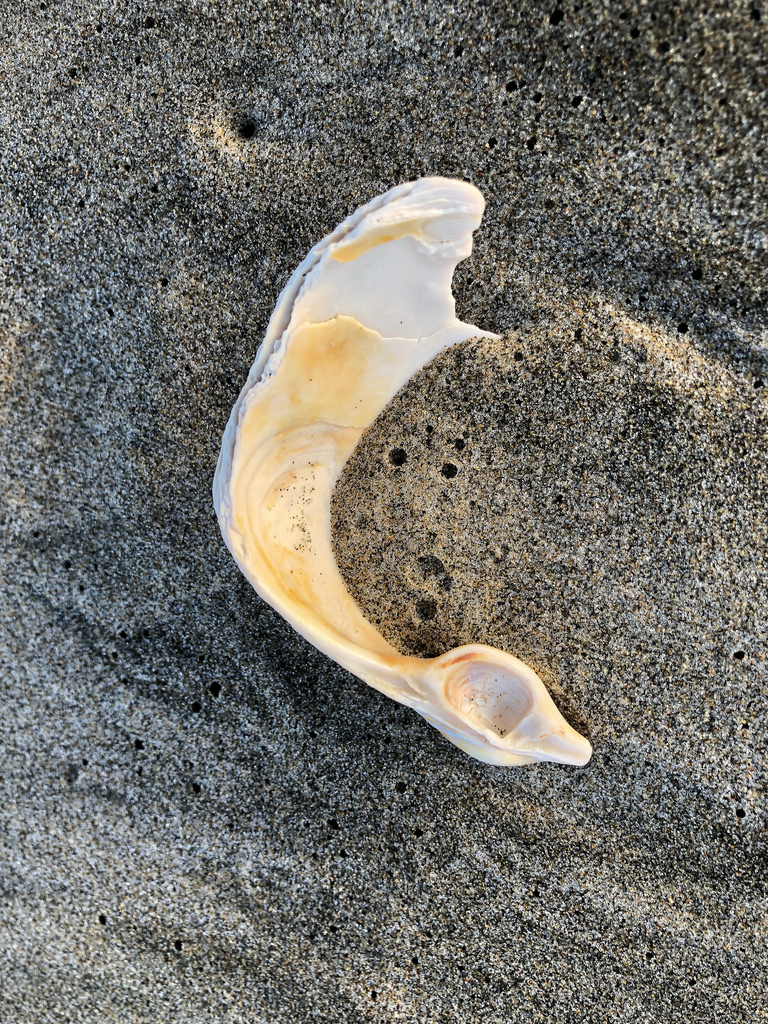

Siliqua patula Pacific razor clam
Northern Oregon has well-known razor clam beds, and empty shells are abundant on most beaches.
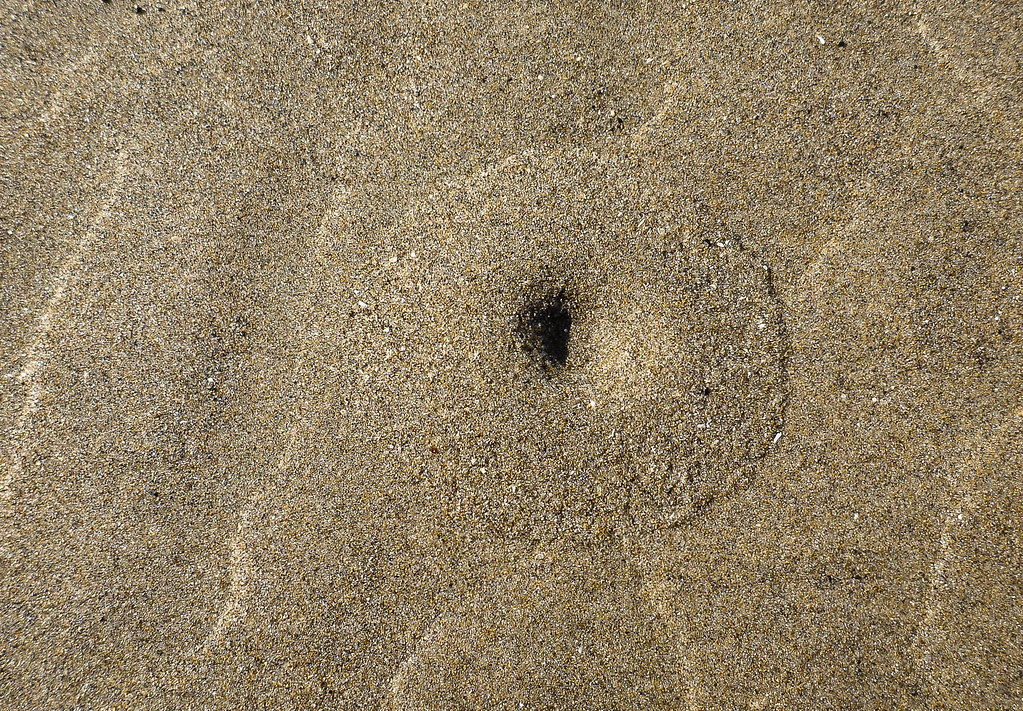


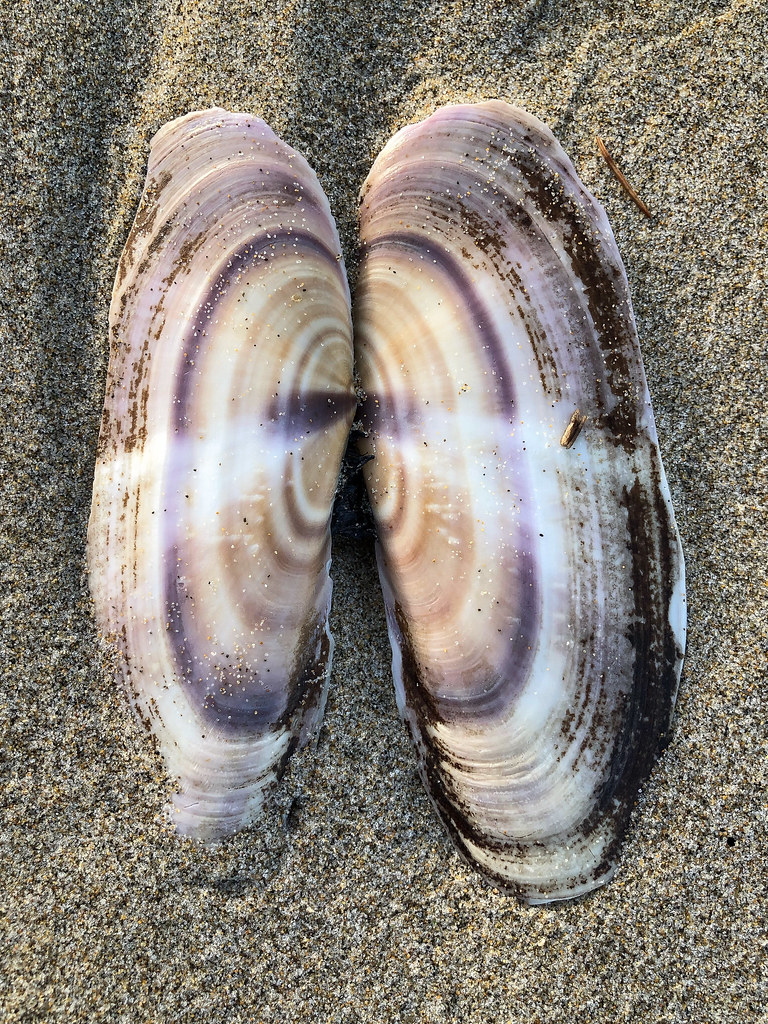

Tellins
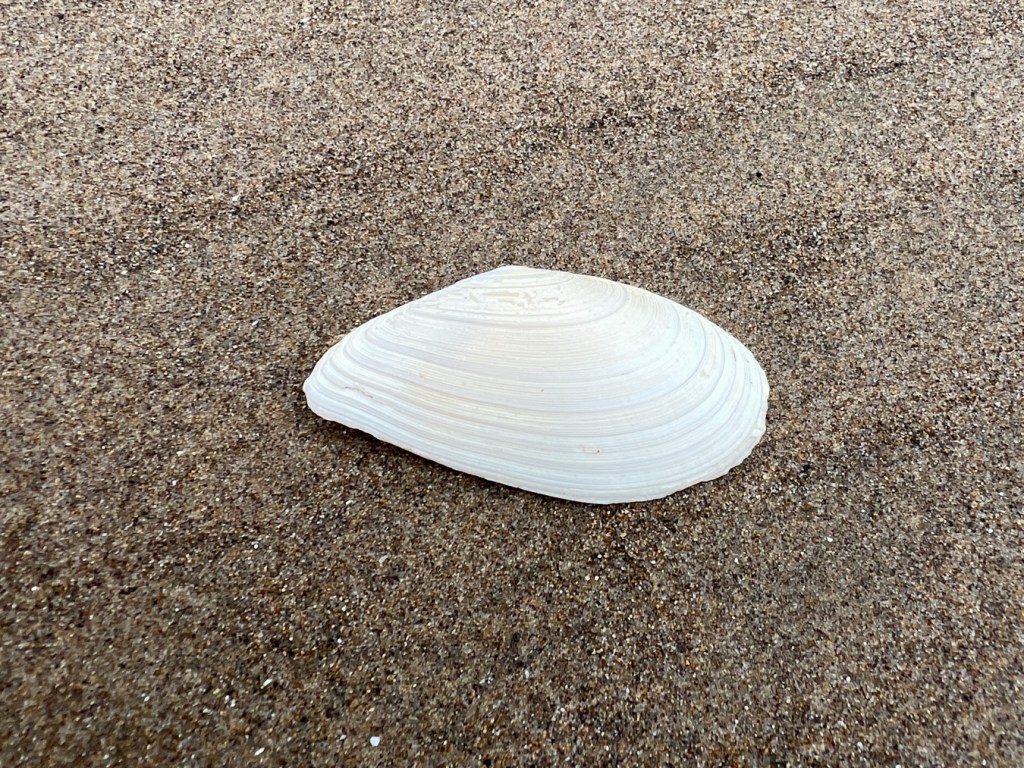
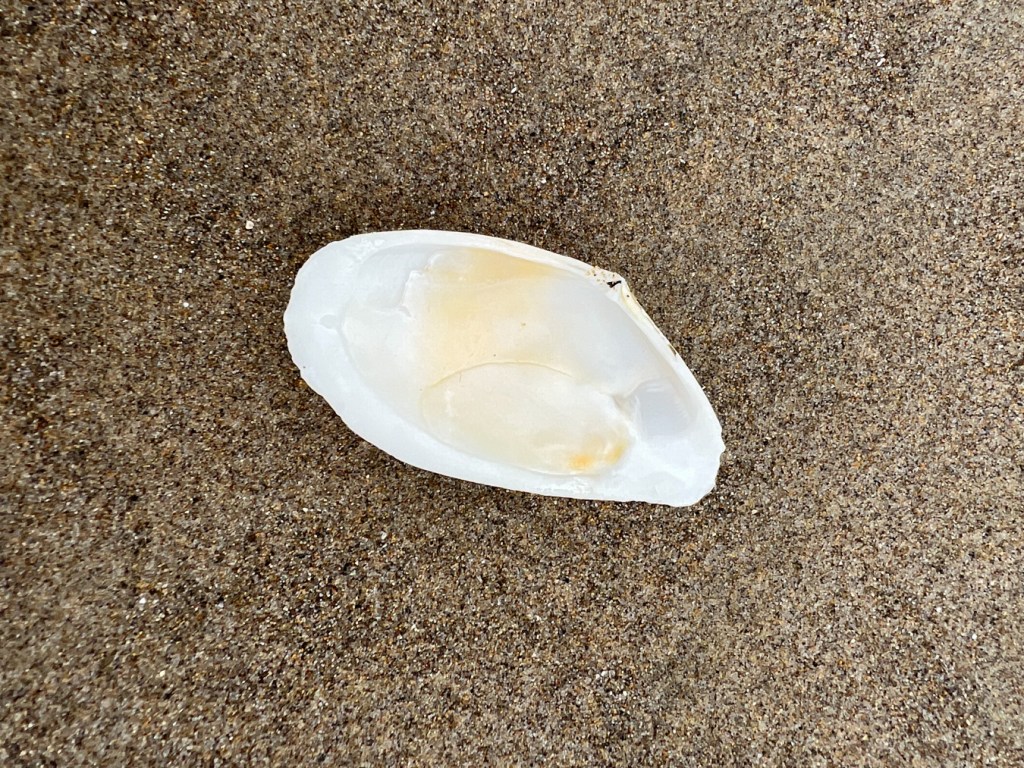
I have always assumed any large elongate tellin I find are Bodega tellins Megangulus bodegensis. By some accounts Bodegas are bay clams, but Kozloff says their habitat is clean sand at the mouth of bays that open onto the exposed coast, and Cowles says exposed sandy shores. Whatever their habitat in life, I show empty drifted shells found on exposed northern Oregon beaches.

Attractive concentric rings on the exterior surface of Bodega shells are a marvel.
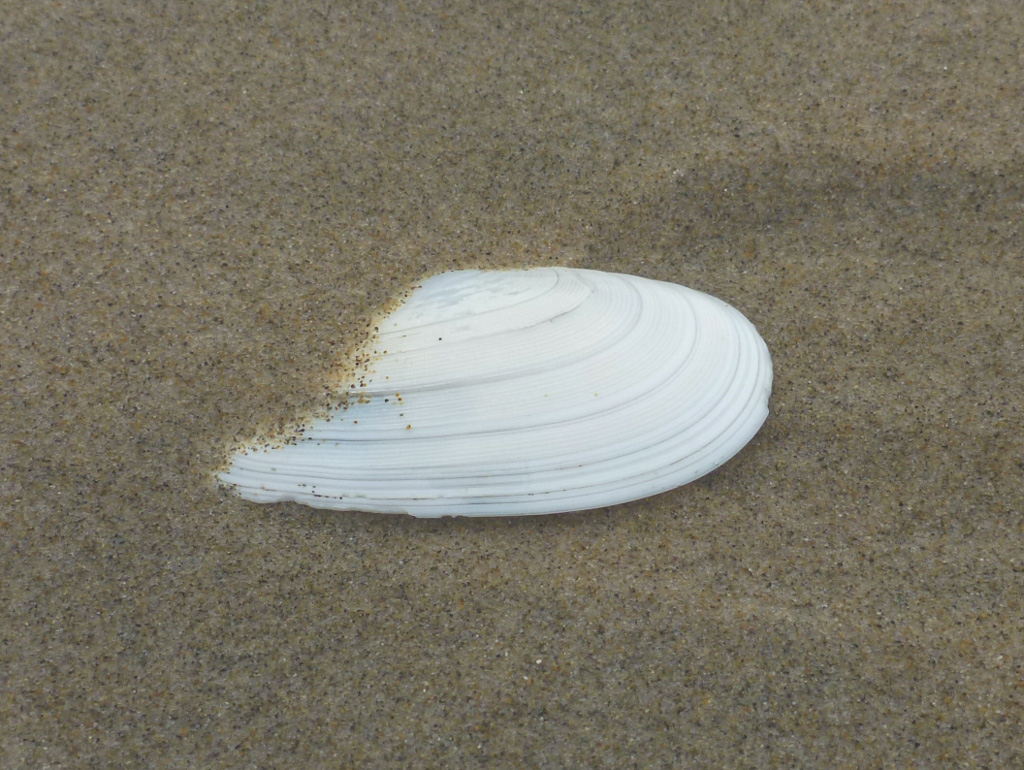
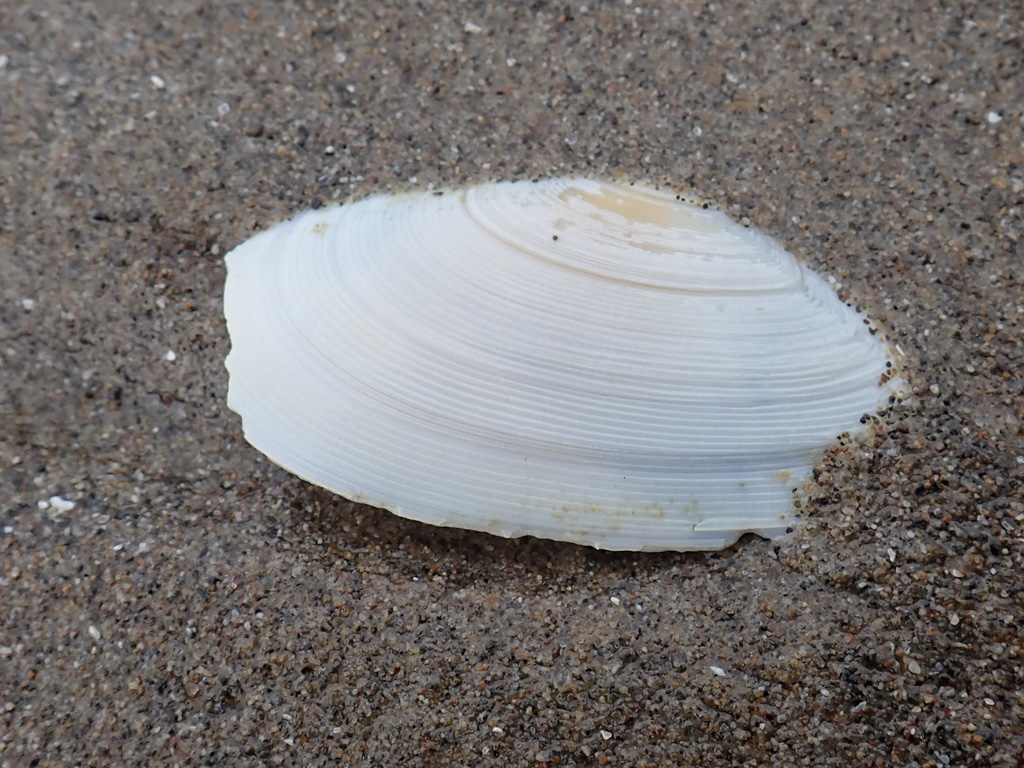
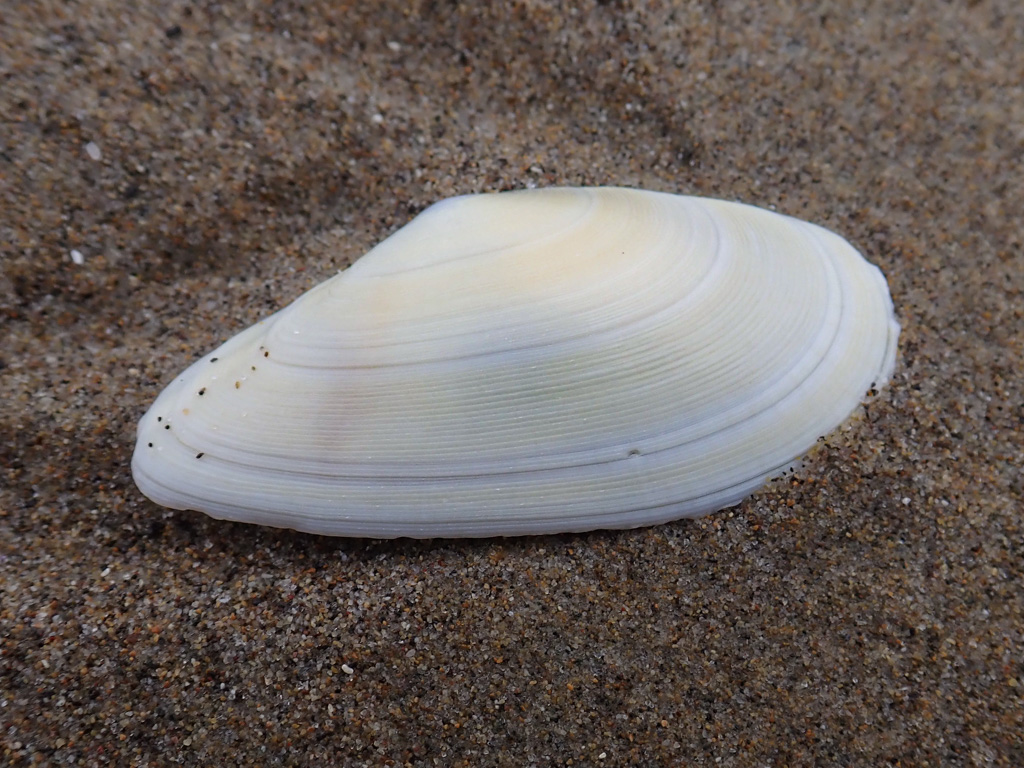


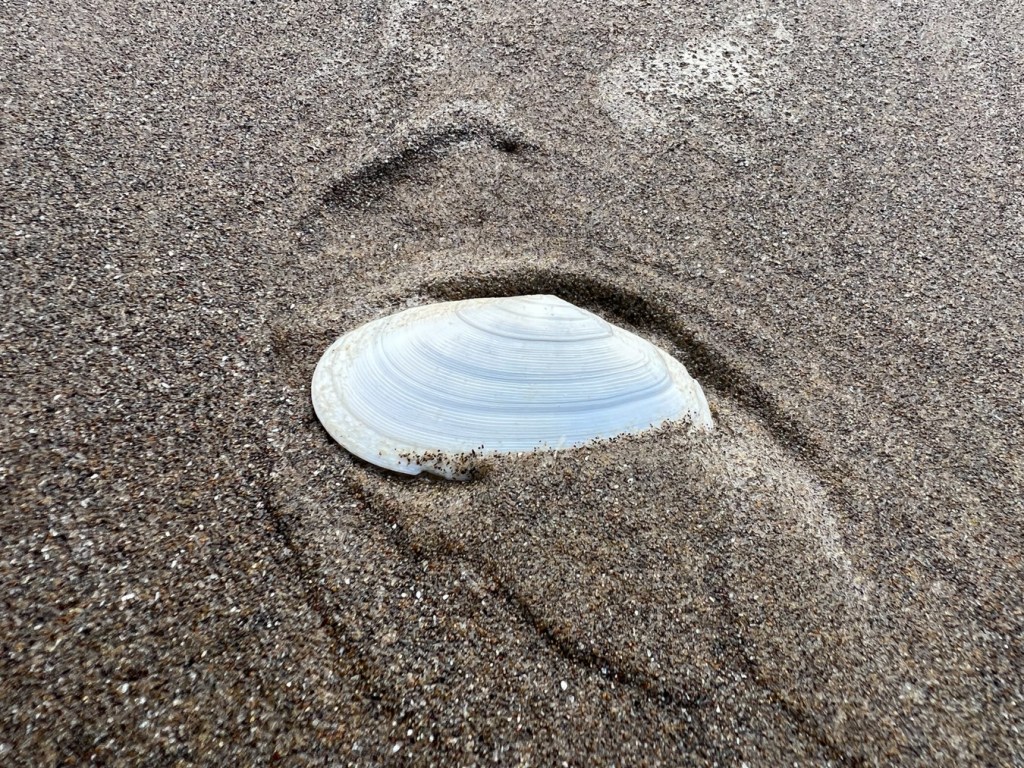


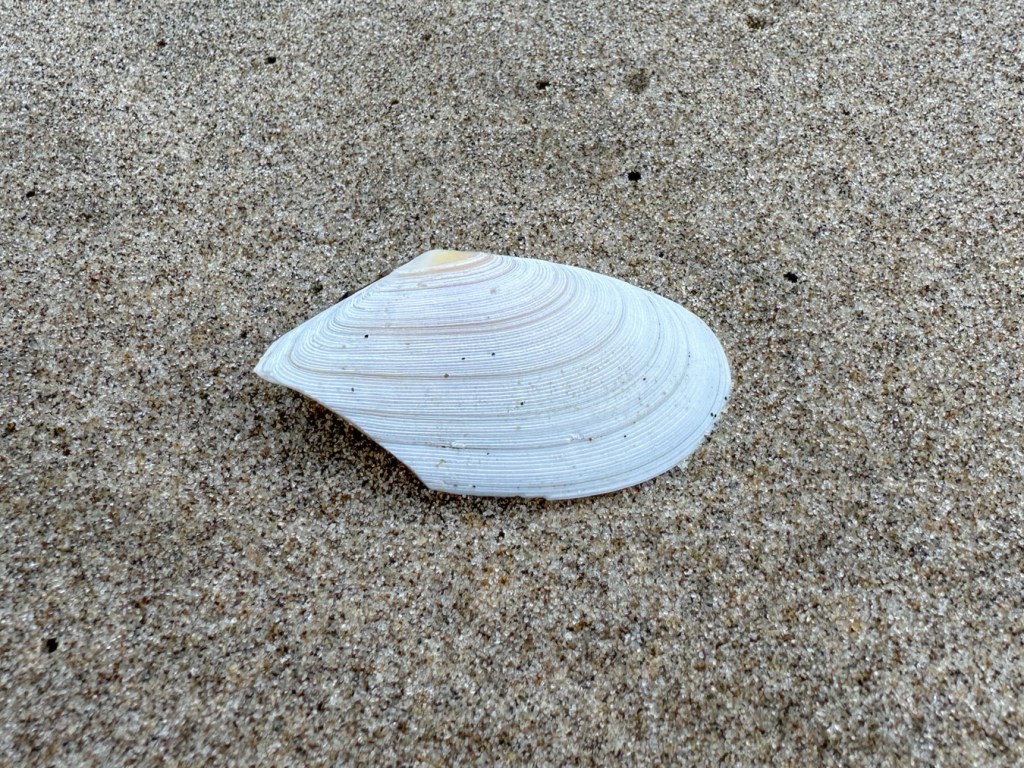
I rinsed off a couple shells and laid them out for views of both surfaces (If I’ve got my valves down, it’s a right vale in the top two panels and a left valve in the bottom two panels). A yellowish stain is pretty common on the interior of either valve.


Macomas
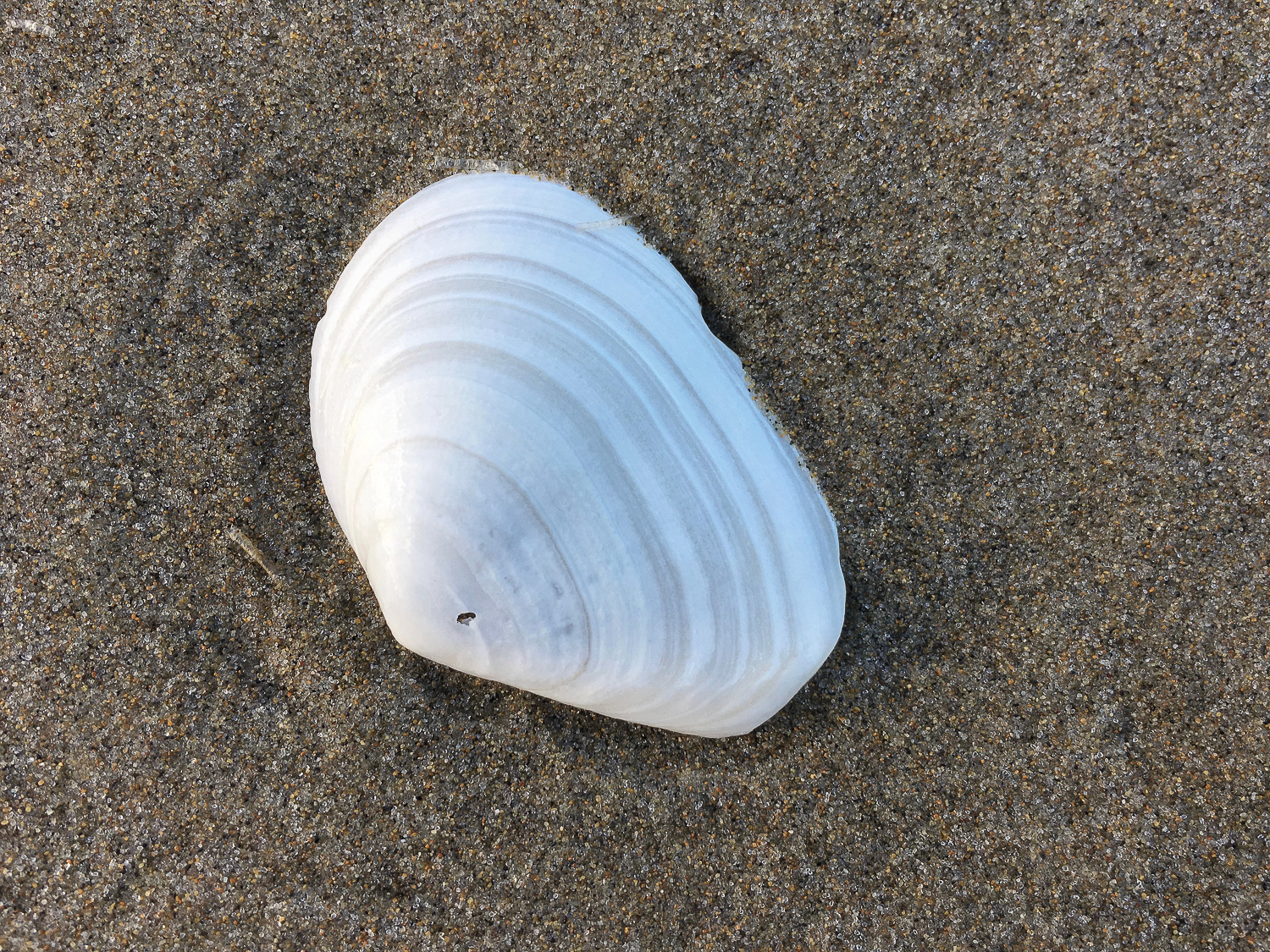
Any macoma I’ve found on exposed beaches has been a a drifted shell. There are lots of species. Some are bay clams and others live on exposed sandy shores with pounding surf. I haven’t tried my hand at identifying macomas, so I’ll leave it at that. The drifted shells are usually completely bleached, and not too common on my home beaches.

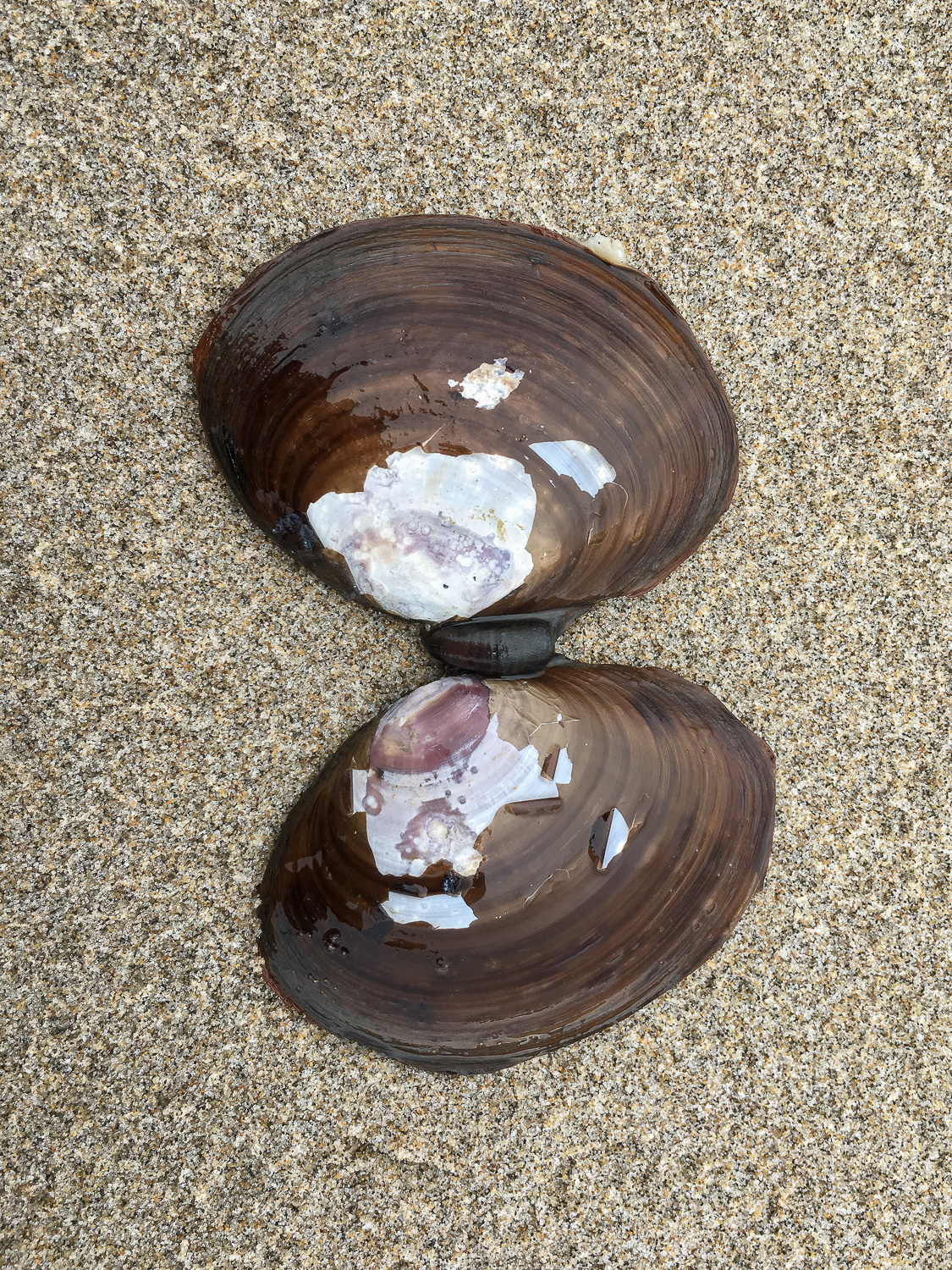
Nuttallia obscurata Purple varnish clam
In northern Oregon, this introduced clam is a bay clam. Any shells you find on exposed beaches have drifted there, or humans have carried them.
Saxidomus gigantea Butter clam
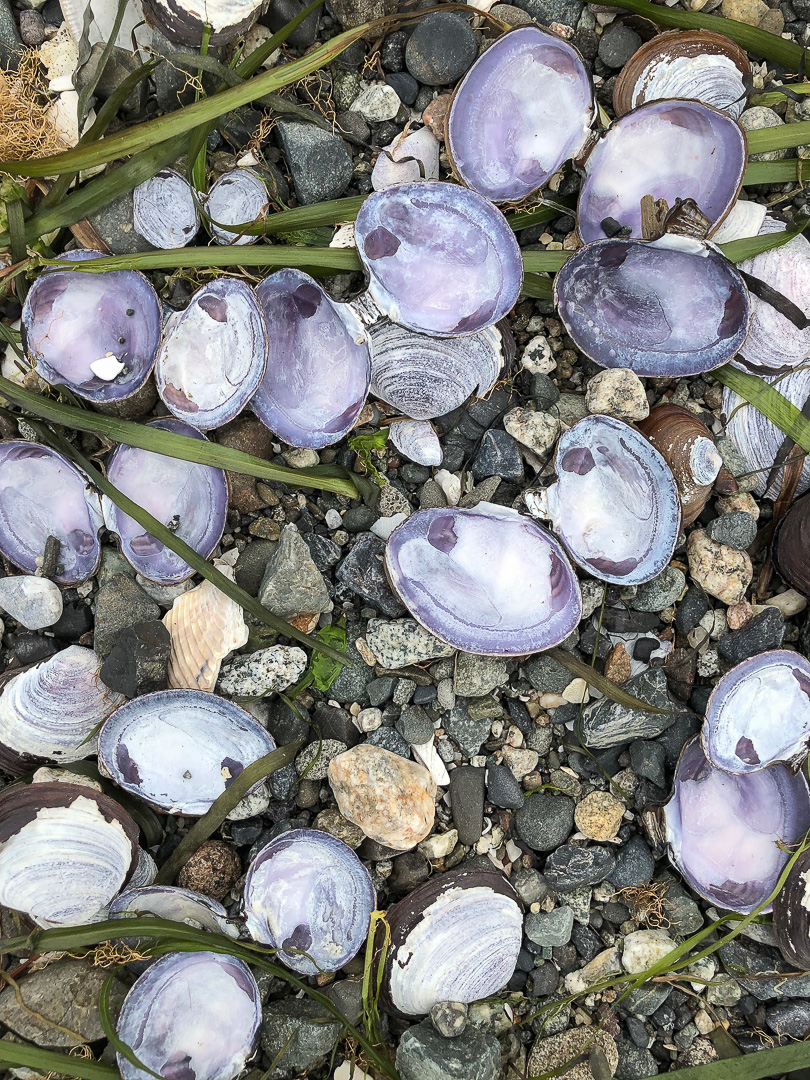
In northern Oregon, folks, and I’m one of them, think of butter clams as bay clams. (Maybe they live elsewhere, but I’m not familiar with those places if they exist. Drifted shells aren’t too common on exposed beaches. I’ve seen live butter clams and empty shells in a sand-gravel-shell mix on quiet Salish Sea shores, where I took two of the images below. Butter clams are large, like gapers, but they lack chondrophores, so you won’t confuse the empty shells.


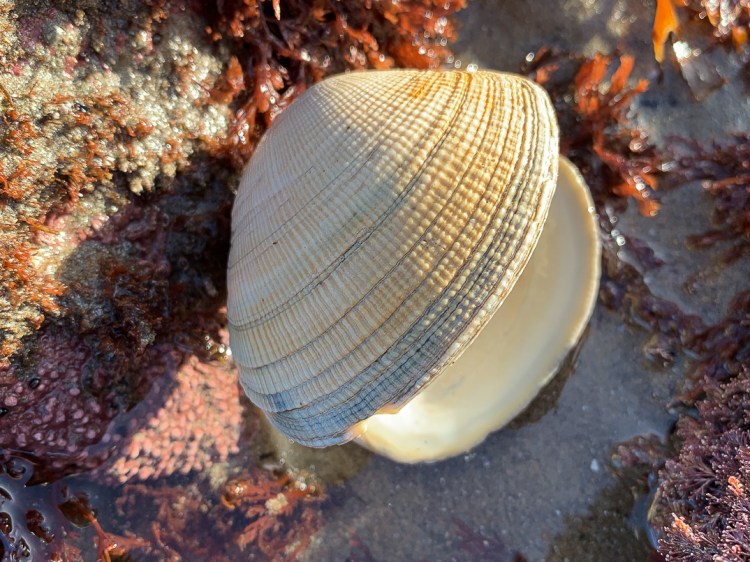
Leukoma staminea Pacific littleneck clam
Widely known as a bay clam in Oregon, littlenecks can also be found intertidally in sheltered settings on the open coast. In such places, empty shells are easy to find, as the two below were.

Mya arenaria Soft-shelled clam
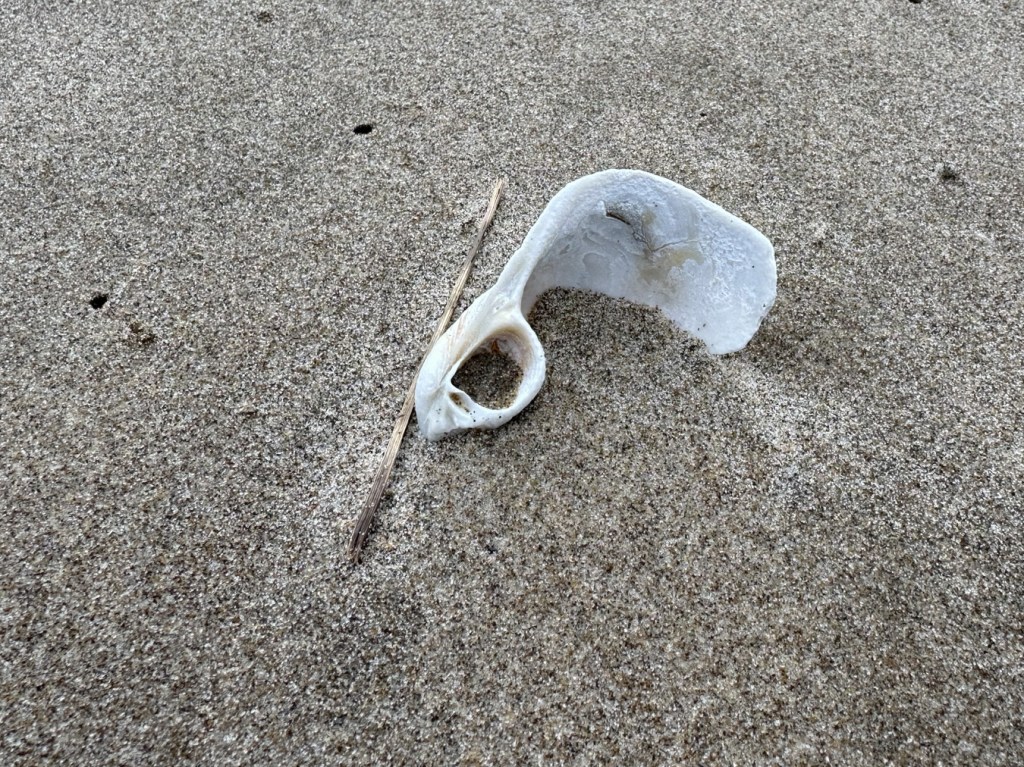
Shells you find on exposed northern Oregon beaches have likely drifted there, or humans have carried them.


Mya arenaria isn’t the only large clam shell with a notable chondrophore—gaper clams also have a beauty, so let’s compare chondrophores. I found the examples below on an exposed beach resting just a few feet apart.

A Sampling of Nestlers
Recognizing the existence of similar alternatives, the nestlers featured below may be something like Hiatella arctica or Petricola carditoides, or maybe both. (If they have orange-red siphon tips, which, incidentally, aren’t too hard to see up close in the wild, that will point to H. arctica.)
The number of living clams and empty shells in some holey substrates is astounding, and in some cases, like the rock in the right-hand panel, it’s easy to pass them by without noticing.


Below are just some closeups of a variety of substrates and settings.


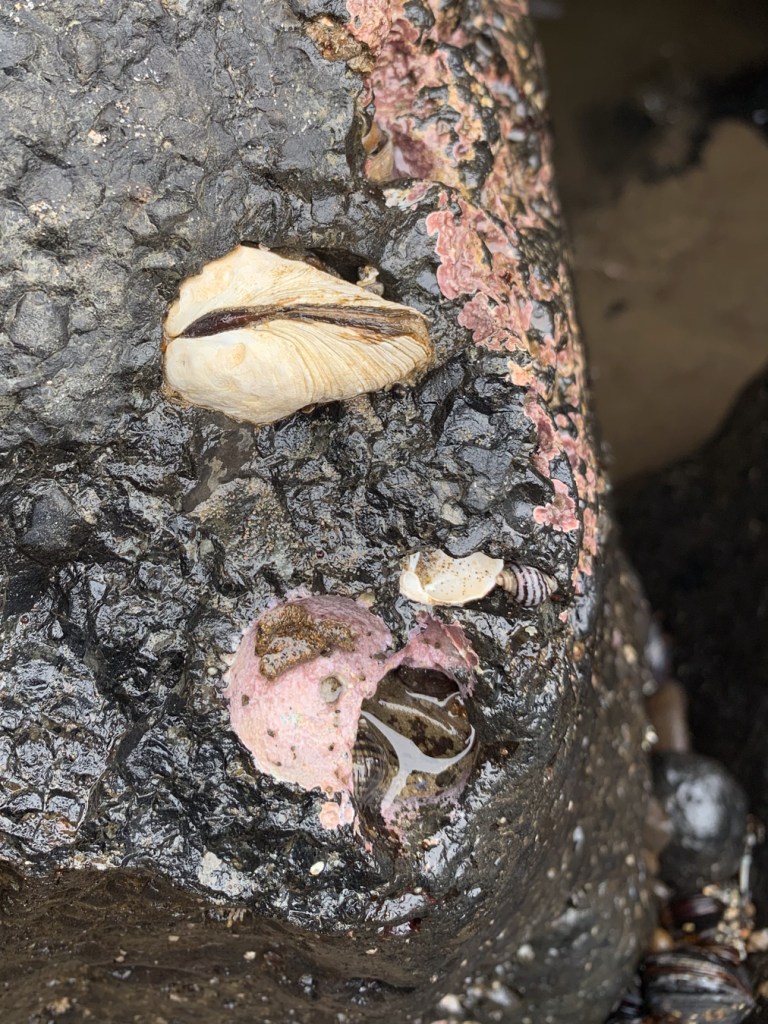
Kozloff describes the succession of nestlers inside the shells of predecessors, and when I looked for myself it was easy to find examples. I count a series of four clam shells in the upper left-hand panel! (And you can see the orange-red siphon tips of the current occupant.)

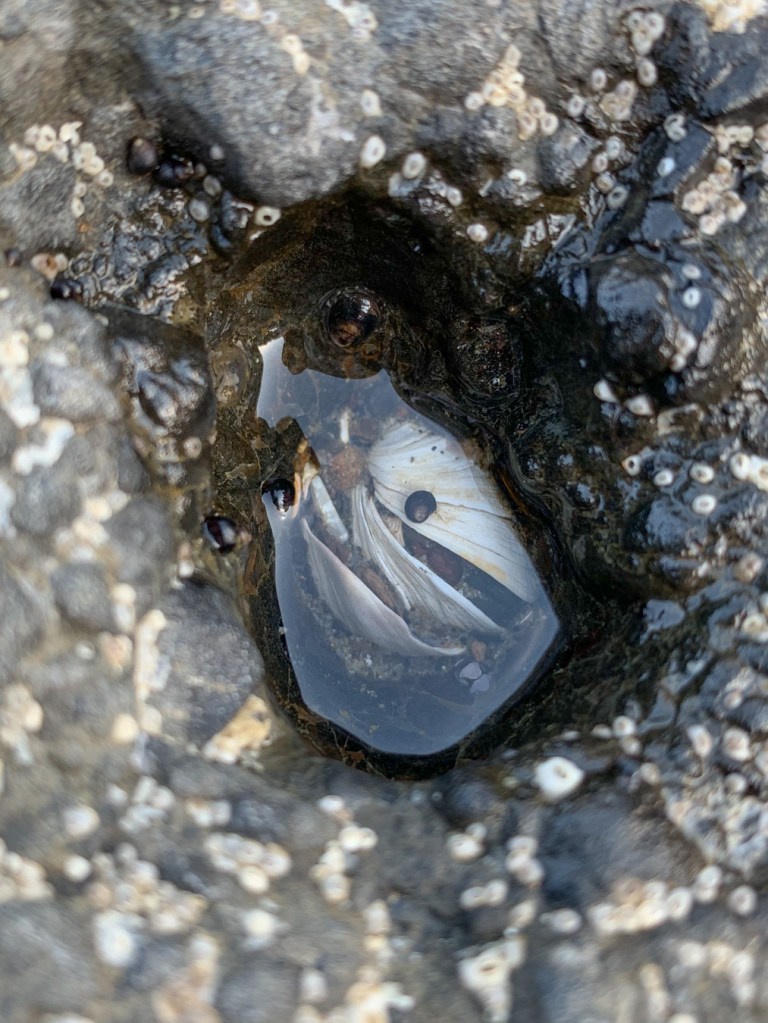
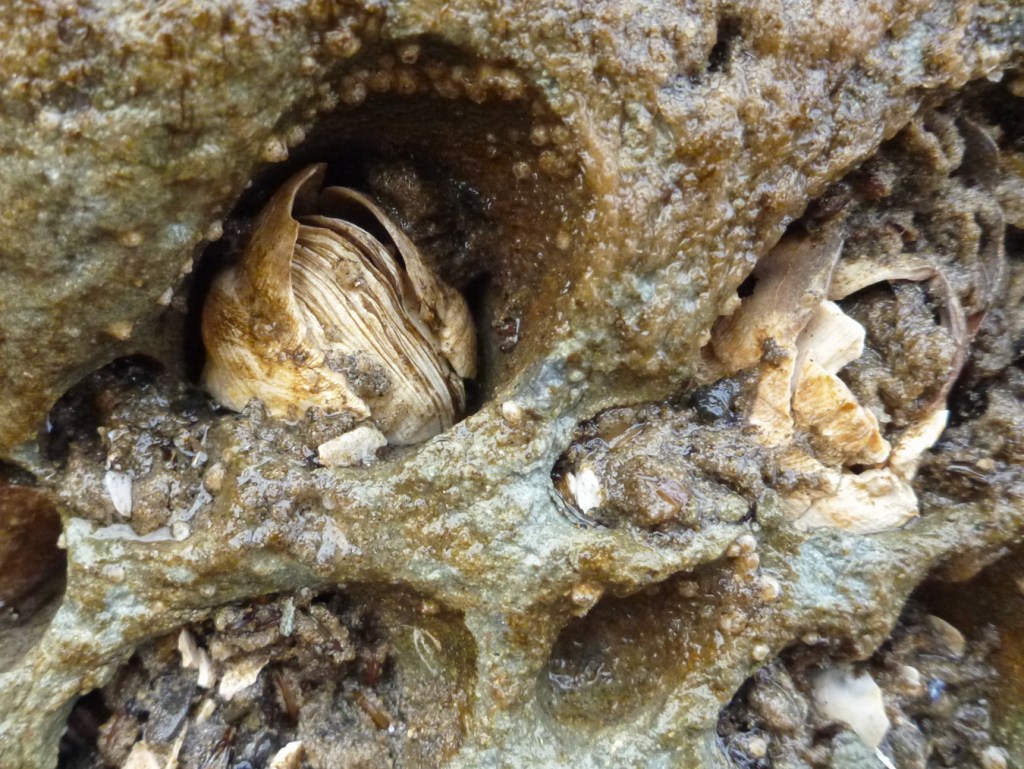
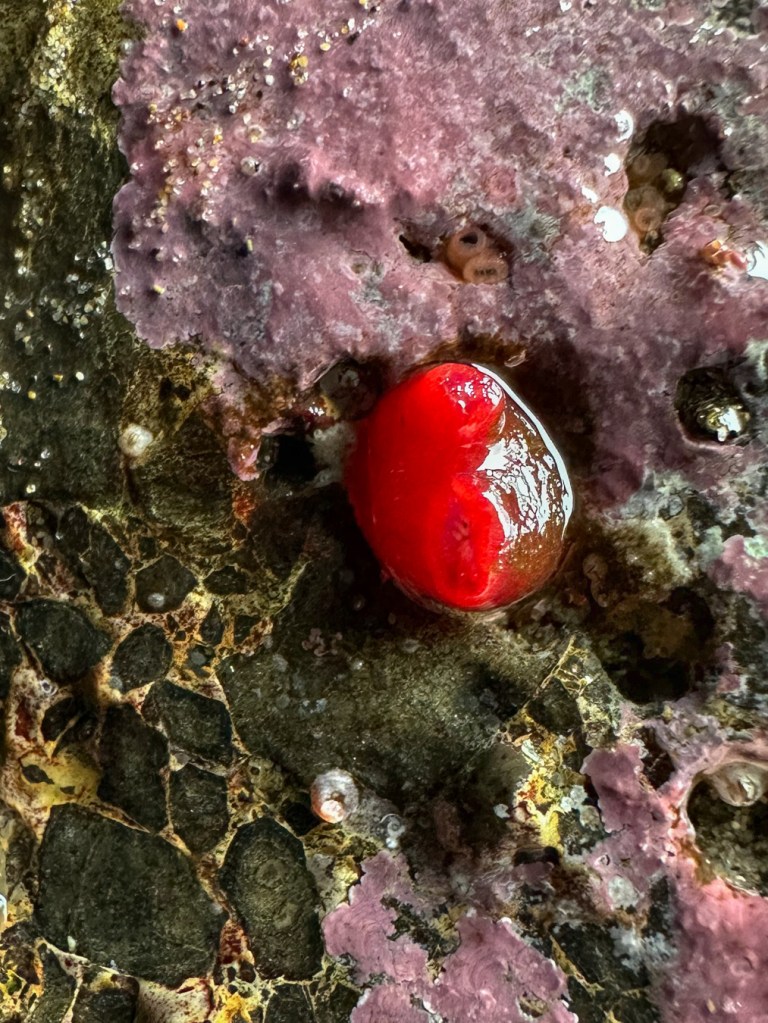
The siphon tips shown below are pretty stunning. (I guess I include Hiatella arctica and Entodesma navicula among the nestlers with red siphon tips, but Kozloff says those of Hiatella are crimson, and these certainly qualify as crimson.) It’s not too unusual to see exposed red siphon tips like these in small rock crevices during low tides. (Lamb and Hanby mention that siphon openings can be mistaken for those of tunicates. I don’t think I’ve done that here; it’s possible, but I’m pretty sure I could see the shells. Either way, it’s something to be aware of.)

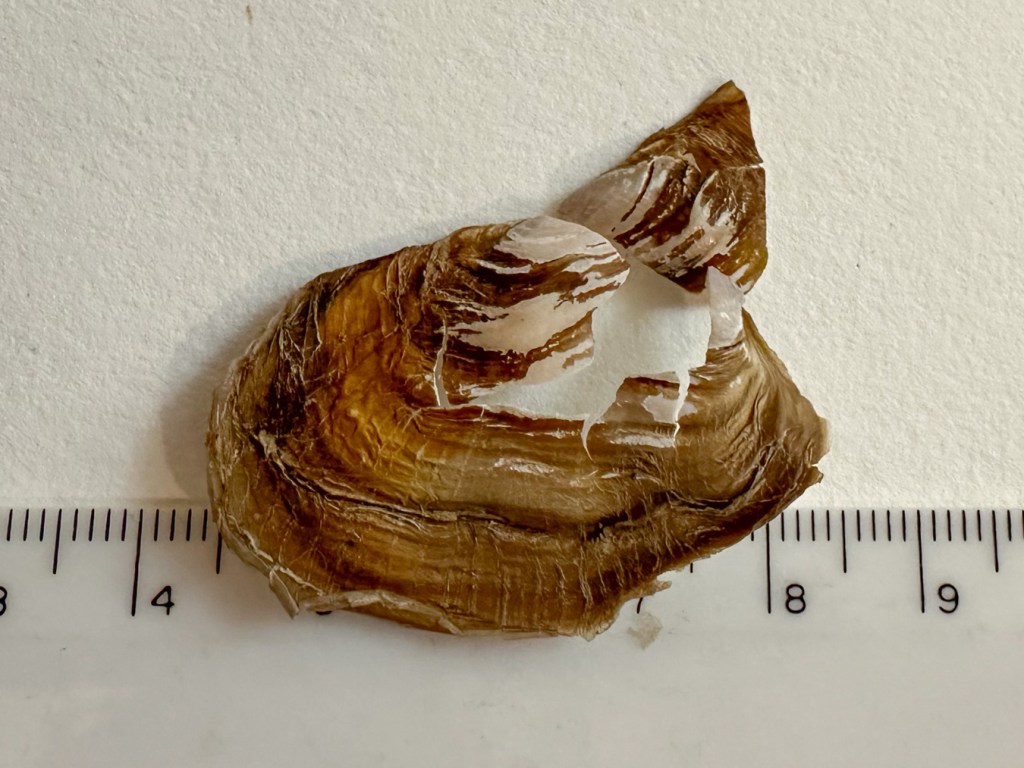
Another nestler you may encounter is Entodesma. Shown below is a drifted shell I found washed up on the beach. (I didn’t know then that the shells are prone to cracking once they dry.)

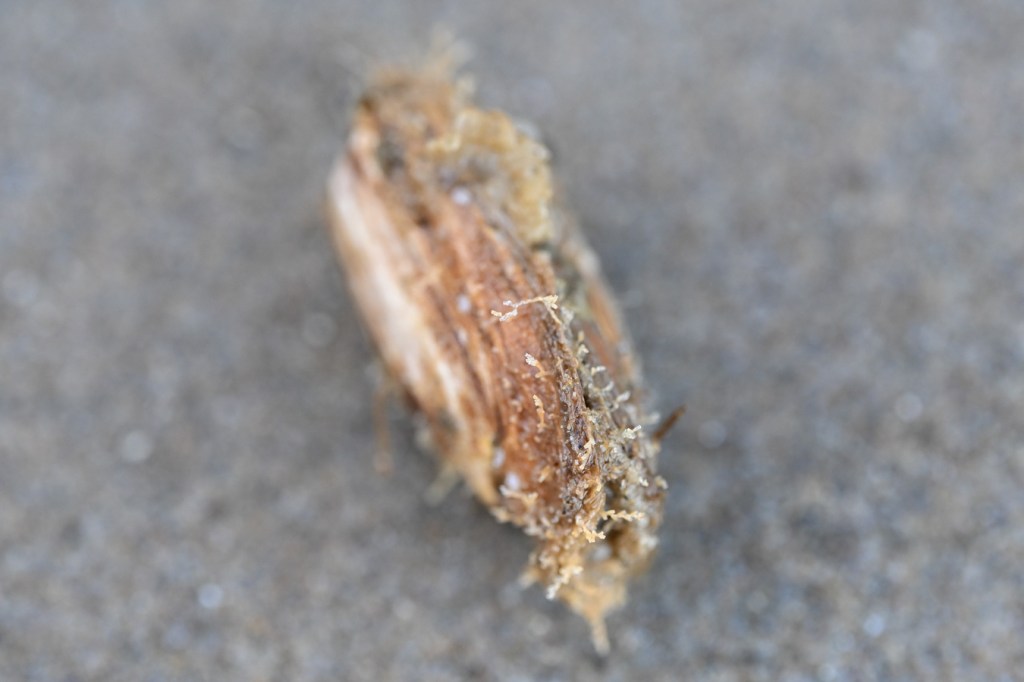
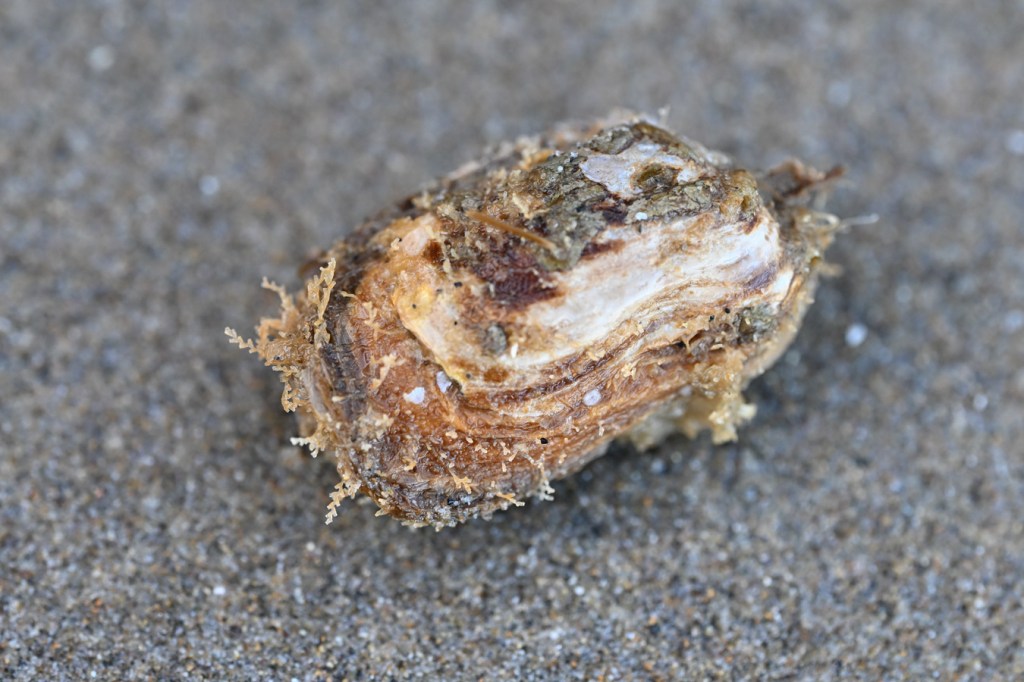
The clam shown below, which has the Entodesma look, was nestled deep among the mussels in a well-developed bed until it was disturbed and discarded by harvesters. (These are different views of the same clam.)

Penitella penita Flat-tip piddock
Empty shells can be abundant on beaches near sediments suitable for burrowing.


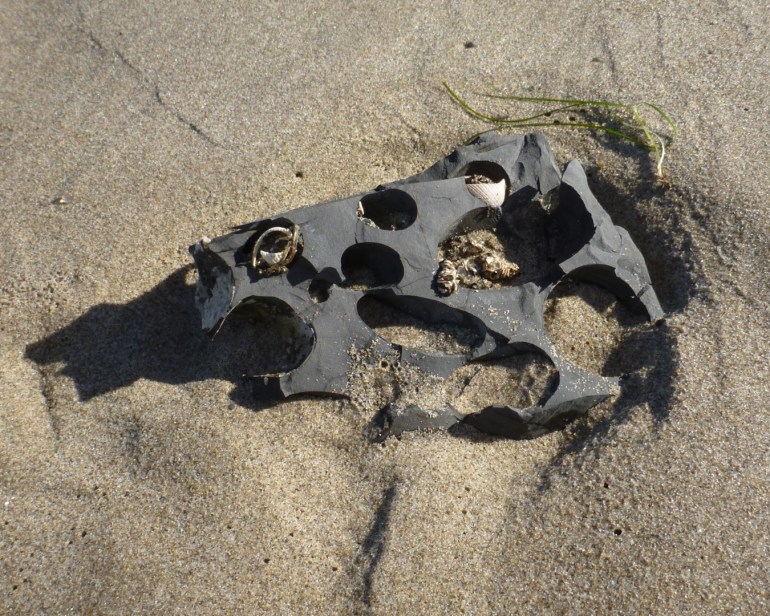
Cobbles and small boulders with piddock workings appear on beaches, where, sometimes at least, they have been dragged, hitching a ride on drifting Nereocystis.


References
Gotshall, D. W. 2005. Guide to Marine Invertebrates, Alaska to Baja California. 2nd Edition (Revised). Shoreline Press.
Harbo, R. M. 2011. Whelks to Whales: Coastal Marine Life of the Pacific Northwest. 2nd ed. Harbour Publishing Co.
Kozloff, E. N. 1993. Seashore Life of the Northern Pacific Coast. 3rd ed. University of Washington Press.
Lamb, A. and B. P. Hanby. 2005. Marine Life of the Pacific Northwest. Harbour Publishing.
Sept. J. D. 2019. The New Beachcomber’s Guide to the Pacific Northwest. Harbour Publishing.
Online Resources
Netarts Bay Today’s Mollusks page. Accessed June 15, 2023.
It’s worth scrolling down to Bivalvia in Common Sea Life of Southeastern Alaska: A field guide by Aaron Baldwin & Paul Norwood. Accessed June 15, 2023.
Online Species Accounts
Cowles, D. (2002). Mytilus californianus (Conrad, 1837). Invertebrates of the Salish Sea. Rosario Beach Marine Laboratory. Accessed June 15, 2023.
Cowles, D. (2005). Adula californiensis (Philippi, 1847). Invertebrates of the Salish Sea. Rosario Beach Marine Laboratory. Accessed June 15, 2023.
Cowles, D. (2005). Chlamys (Chlamys) hastata (Sowerby, 1843). Invertebrates of the Salish Sea. Rosario Beach Marine Laboratory. Accessed June 16, 2023.
Cowles, D. (2005). Chlamys (Chlamys) rubida (Hinds, 1845). Invertebrates of the Salish Sea. Rosario Beach Marine Laboratory. Accessed June 17, 2023.
Cowles, D. (2005). Clinocardium nuttallii (Conrad, 1837). Invertebrates of the Salish Sea. Rosario Beach Marine Laboratory. Accessed July 21, 2023.
Cowles, D. (2005). Crassodoma gigantea (Gray, 1825). Invertebrates of the Salish Sea. Rosario Beach Marine Laboratory. Accessed July 21, 2023.
Cowles, D. (2005). Entodesma navicula A. Adams and Reeve, 1850. Invertebrates of the Salish Sea. Rosario Beach Marine Laboratory. Accessed October 26, 2024.
Cowles, D. (2005). Magallana gigas (Thunberg, 1793). Invertebrates of the Salish Sea. Rosario Beach Marine Laboratory. Accessed July 21, 2023.
Cowles, D. (2005). Pododesmus macroschisma (Gray, 1850). Invertebrates of the Salish Sea. Rosario Beach Marine Laboratory. Accessed July 24, 2023.
Cowles, D. (2005). Saxidomus gigantea Deshayes, 1839. Invertebrates of the Salish Sea. Rosario Beach Marine Laboratory. Accessed July 23, 2023.
Cowles, D. (2005). Siliqua patula (Dixon, 1788). Invertebrates of the Salish Sea. Rosario Beach Marine Laboratory. Accessed July 24, 2023.
Cowles, D. (2005). Tresus capax (Gould, 1850). Invertebrates of the Salish Sea. Rosario Beach Marine Laboratory. Accessed July 24, 2023.
Cowles, D. (2006). Nuttalia obscurata (Reeve, 1857). Invertebrates of the Salish Sea. Rosario Beach Marine Laboratory. Accessed July 23, 2023.
Cowles, D. (2006). Penitella penita (Conrad, 1837). Invertebrates of the Salish Sea. Rosario Beach Marine Laboratory. Accessed July 23, 2023.
Cowles, D. (2006). Petricola carditoides (Conrad, 1837). Invertebrates of the Salish Sea. Rosario Beach Marine Laboratory. Accessed June 15, 2023.
Cowles, D. (2007). Leukoma staminea (Conrad, 1857). Invertebrates of the Salish Sea. Rosario Beach Marine Laboratory. Accessed July 24, 2023.
Cowles, D. (2007). Mya (Arenomya) arenaria Linnaeus, 1758. Invertebrates of the Salish Sea. Rosario Beach Marine Laboratory. Accessed July 24, 2023.
Cowles, D. (2014). Tellina bodegensis Hinds, 1845. Invertebrates of the Salish Sea. Rosario Beach Marine Laboratory. Accessed June 15, 2023.
Hiebert, T.C. 2015. Entodesma navicula. In: Oregon Estuarine Invertebrates: Rudys’ Illustrated Guide to Common Species, 3rd ed. T.C. Hiebert, B.A. Butler and A.L. Shanks (eds.). University of Oregon Libraries and Oregon Institute of Marine Biology, Charleston, OR.
Hiebert, T.C. 2015. Hiatella arctica. In: Oregon Estuarine Invertebrates: Rudys’ Illustrated Guide to Common Species, 3rd ed. T.C. Hiebert, B.A. Butler and A.L. Shanks (eds.). University of Oregon Libraries and Oregon Institute of Marine Biology, Charleston, OR. Accessed July 24, 2023.
Hiebert, T.C. 2015. P. penita. In: Oregon Estuarine Invertebrates: Rudys’ Illustrated Guide to Common Species, 3rd ed. T.C. Hiebert, B.A. Butler and A.L. Shanks (eds.). University of Oregon Libraries and Oregon Institute of Marine Biology, Charleston, OR. Accessed July 24, 2023.
I updated this page on December 15, 2024
 theoutershores