Below are the jellies I’ve been lucky to find washed ashore on the northern Oregon beaches I’ve visited. I loosely use the organization followed by Lamb and Hanby (2005), common names are my choice, and all photos are from northern Oregon unless noted. Experts cover the jellies shown below and many more in the resources listed at the bottom of this page.
Let the jellies be upon you!
Lion’s mane
Most of the references listed at the bottom of this page below refer to our lion’s manes as Cyanea capillata, but C. ferruginea seems to be in favor. Either way, it’s an impressive jellyfish.
I open this entry with a pair of images from quieter shores where lion’s manes seem to be more abundant than on the exposed Oregon beaches I usually visit.
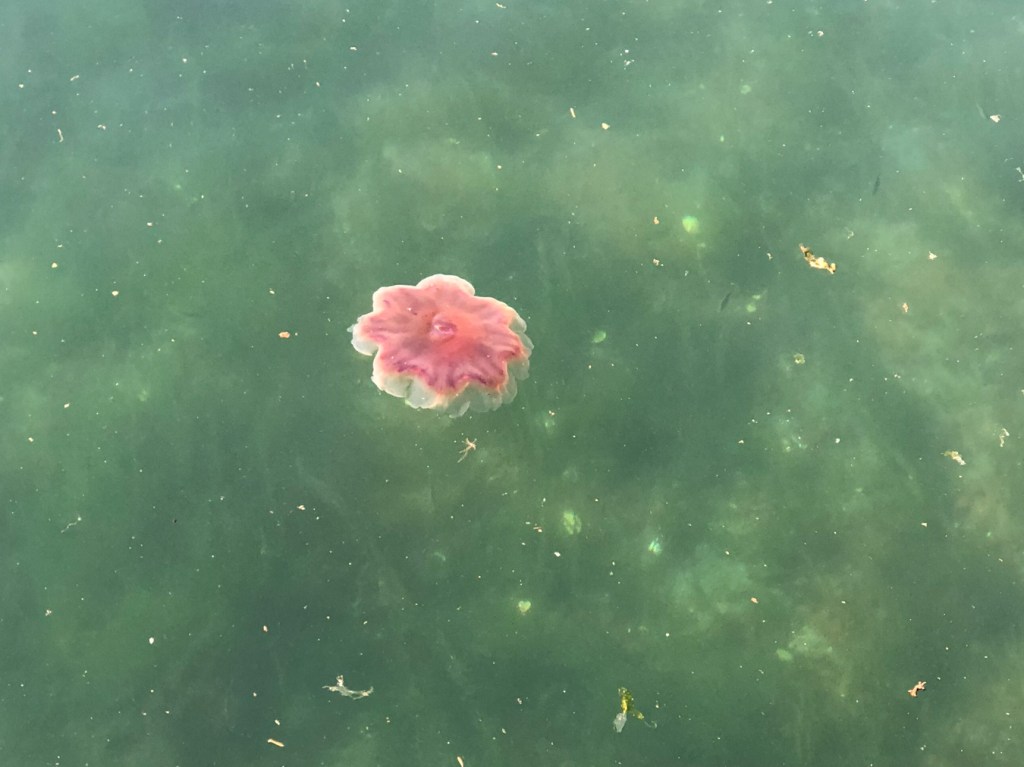
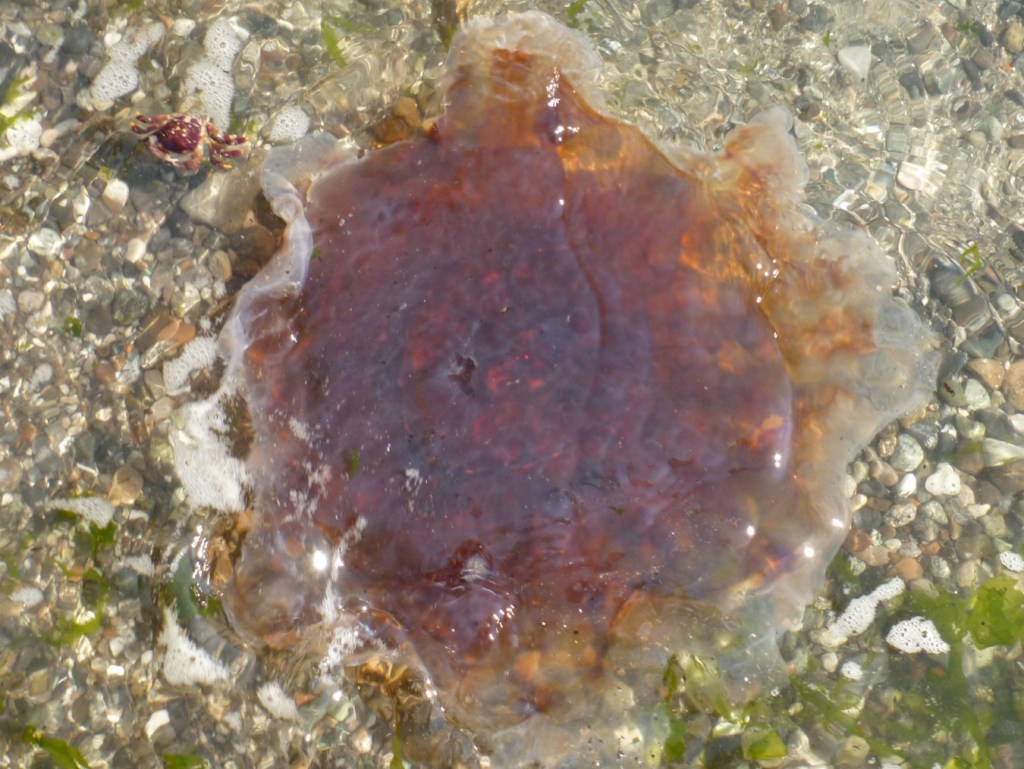
On exposed northern Oregon shores, you’re more likely to encounter tideline fragments than whole jellies, and even fragments aren’t too abundant most years.
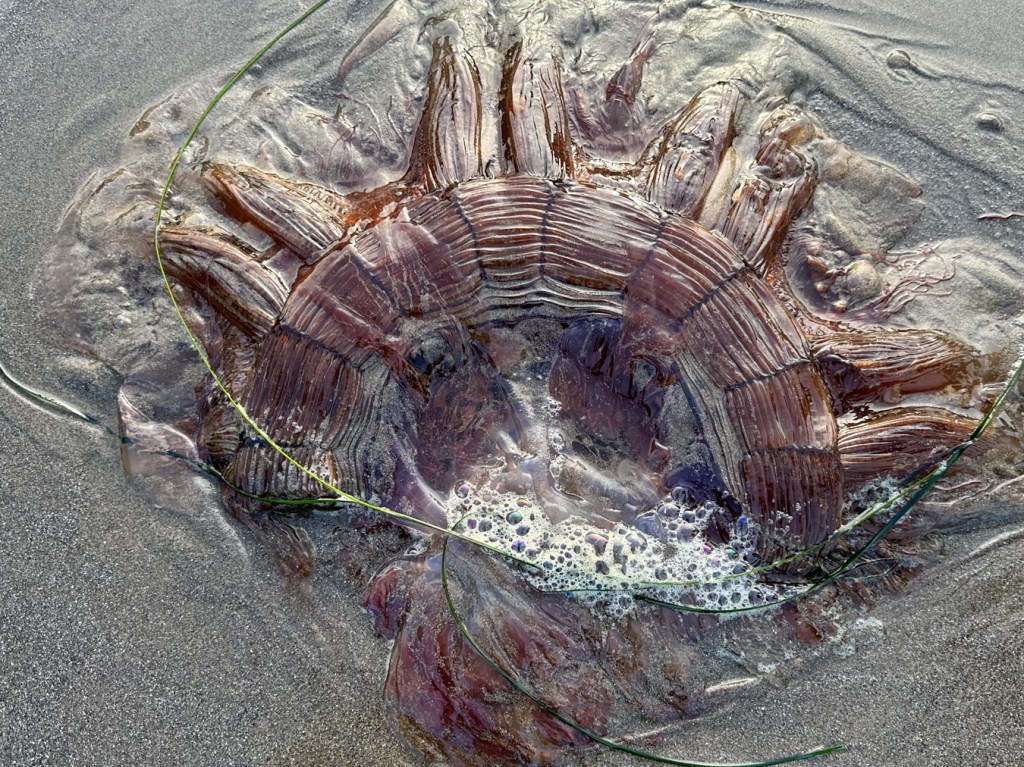

Beached lion’s manes and fragments seemed pretty abundant by fall of 2023 and seemed to remained abundant over summer and fall, 2024.
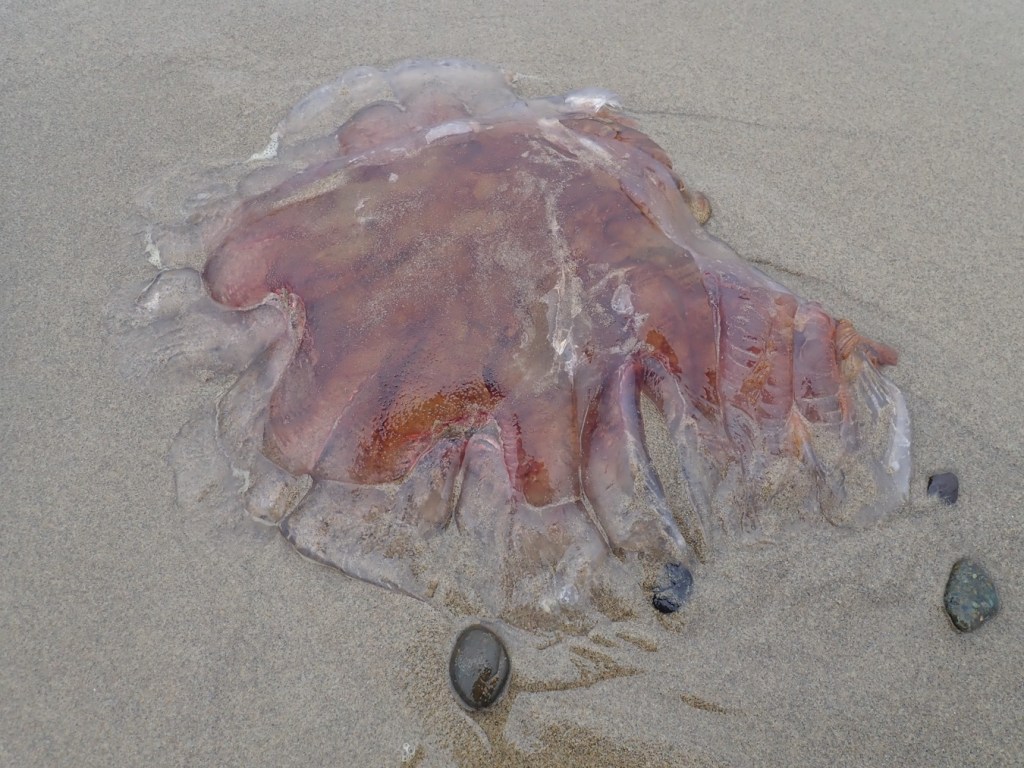

Phacellophora camtschatica Fried egg
I come across beached fried egg jellies only infrequently, and finding an intact or nearly intact specimen is a rarity. Dead and stranded on the shore, they might be confused with lion’s manes, but I think the examples shown below have more fried egg characteristics. No guarantees, though.


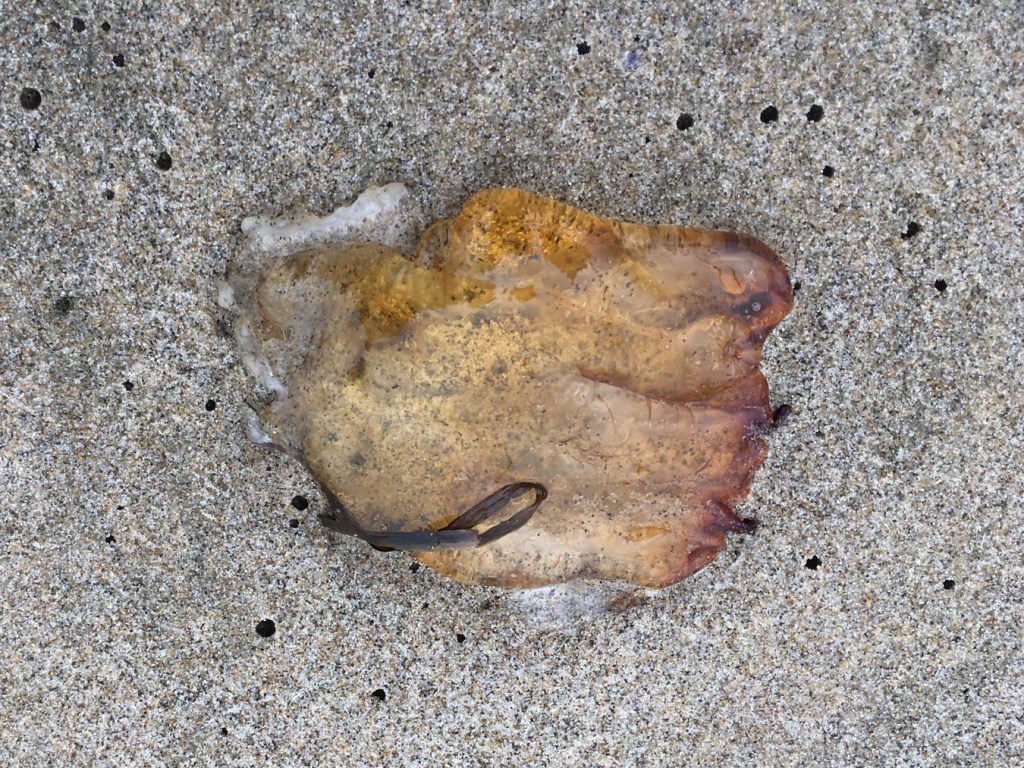
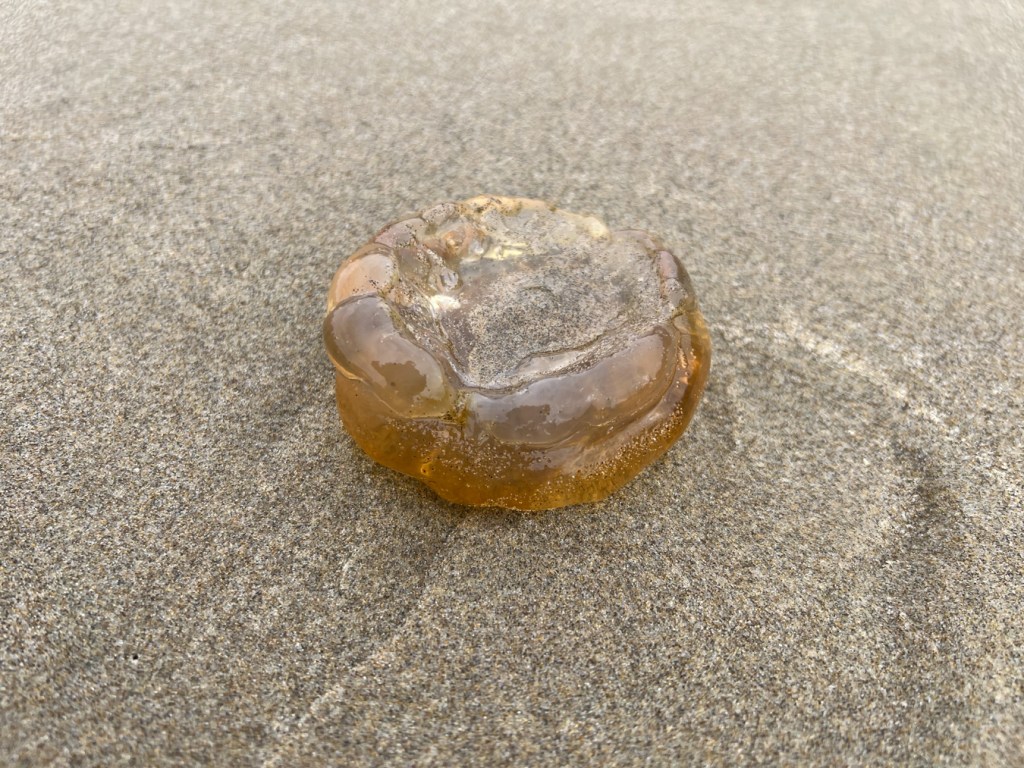
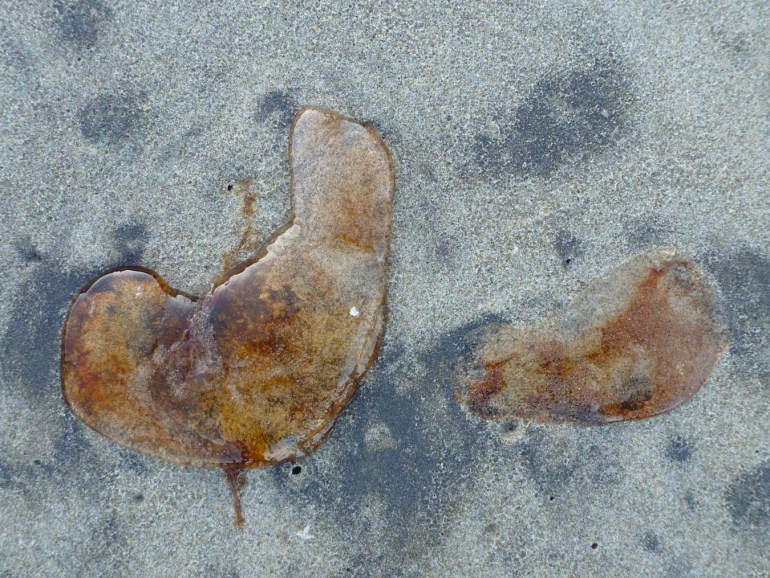
Chrysaora fuscescens Pacific sea nettle
Sea nettles are among the biggest and most common jellyfishes stranded on northern Oregon beaches. I’ve included several examples because freshly beached sea nettles will give you a lot of looks. (I think the examples below are all C. fuscescens, but it’s not a certainty with long-range drifters.)

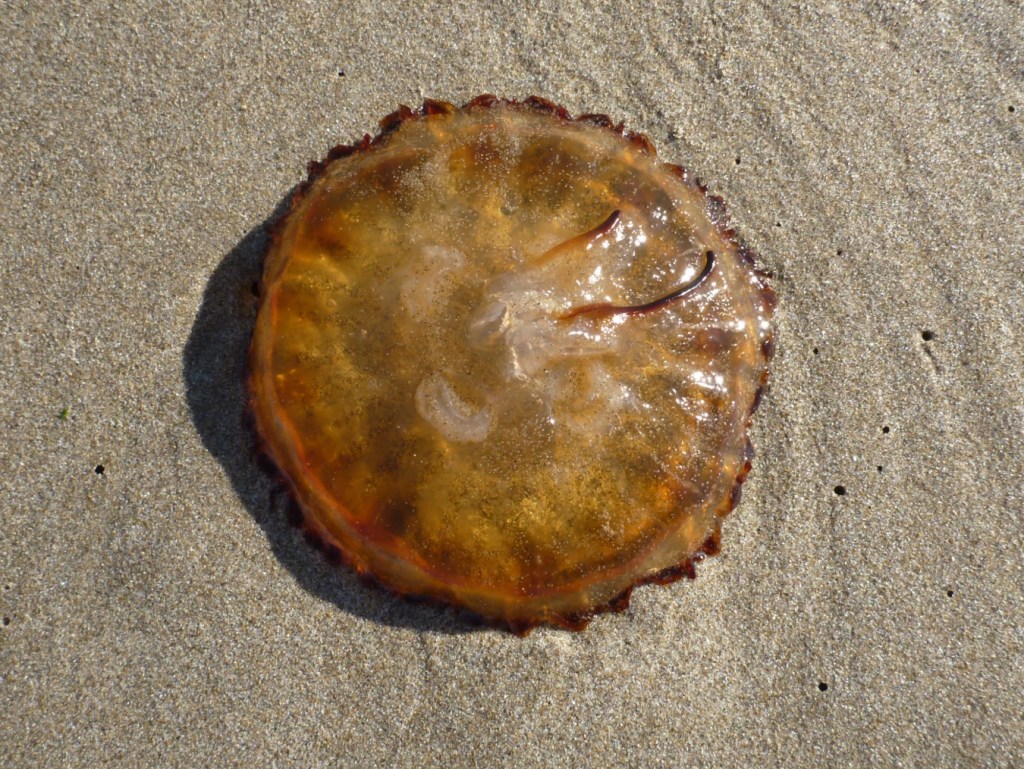

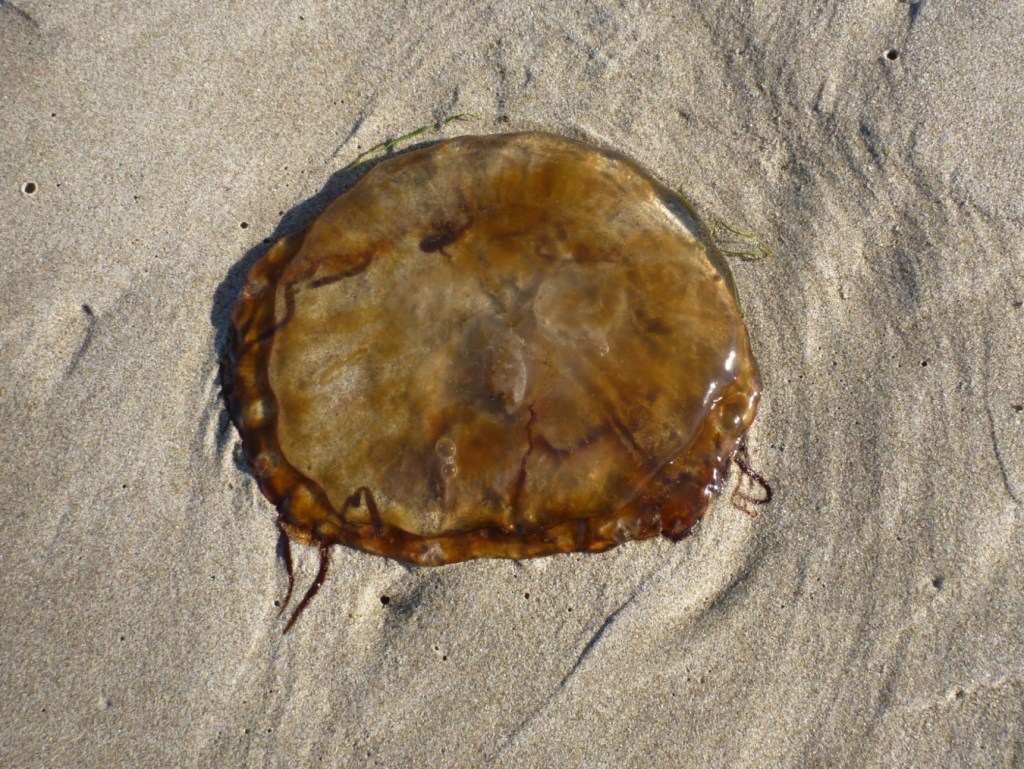

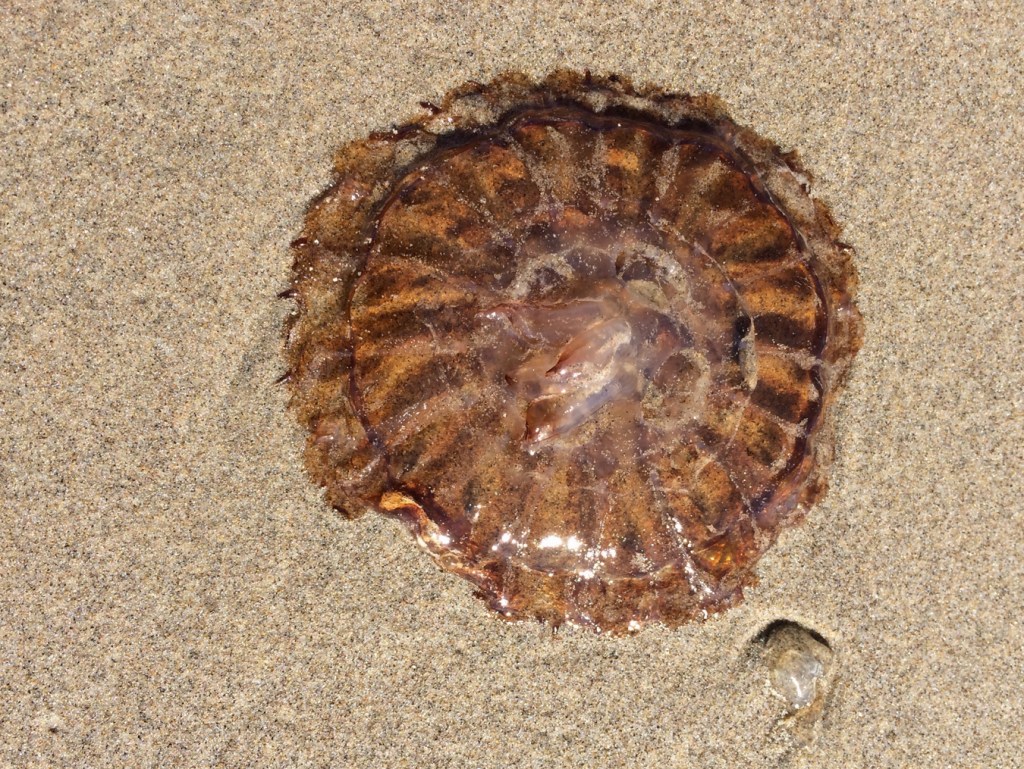
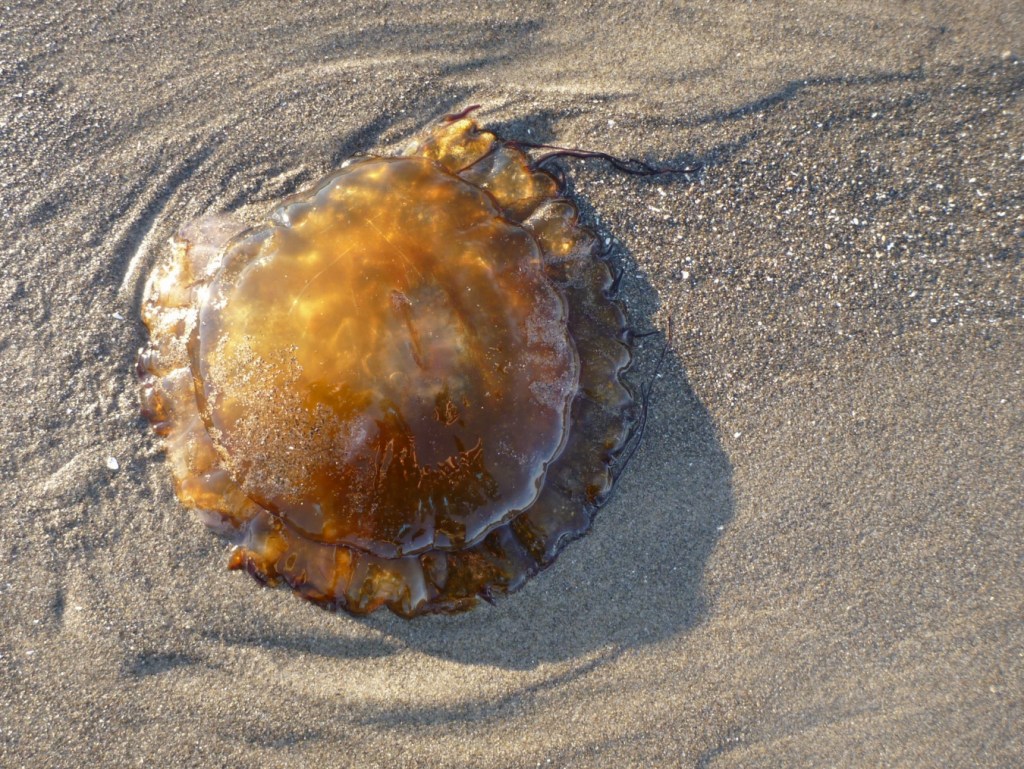

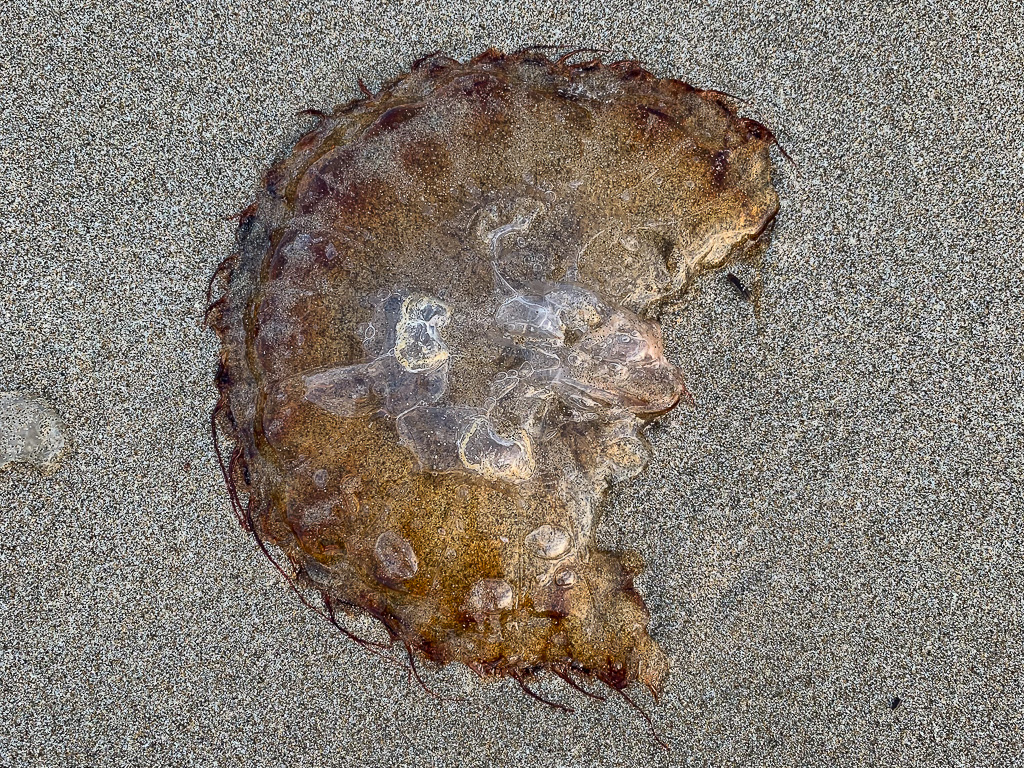
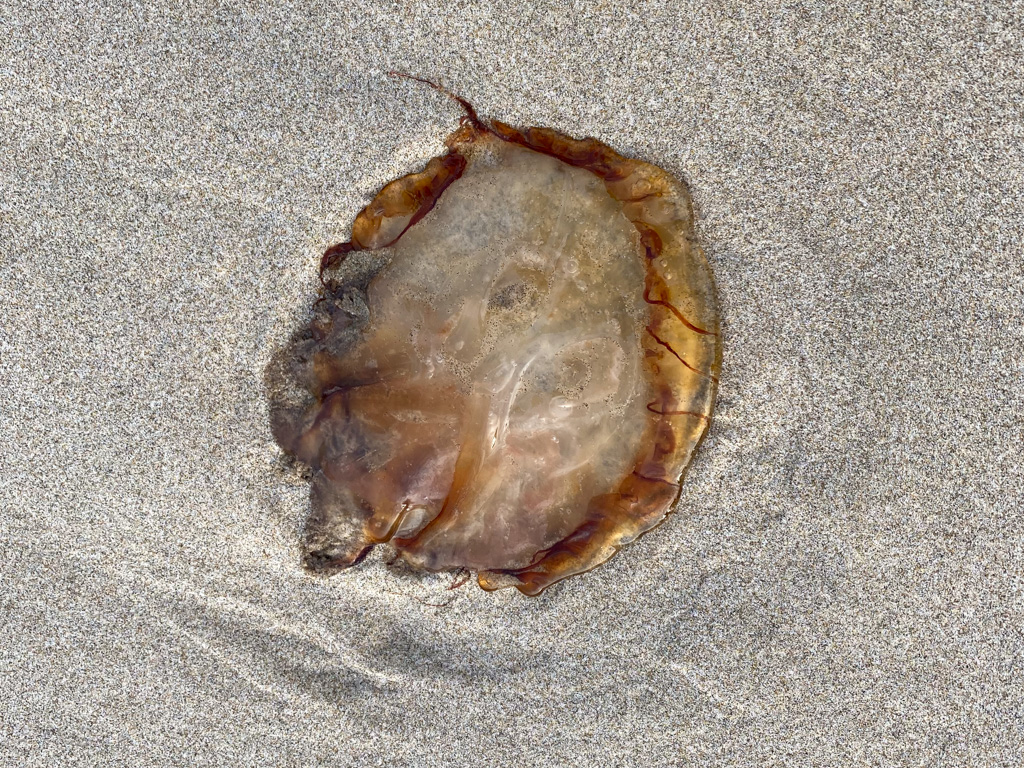

Alas, fragmented and tumbled remains are more common.
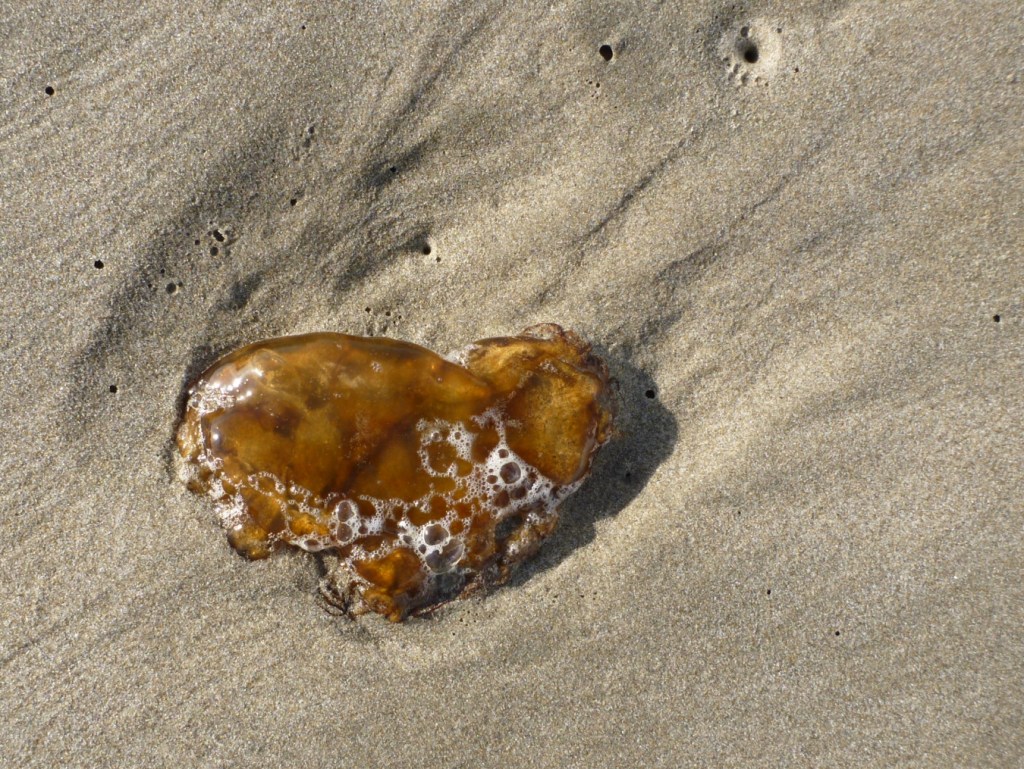

Chrysaora colorata Purple-striped sea nettle
An uncommon find in the northern Oregon drift line, purple-striped sea nettles usually have a limited range around Monterey Bay, California. However, I came across two near Cannon Beach, Oregon, in the spring of 2017.


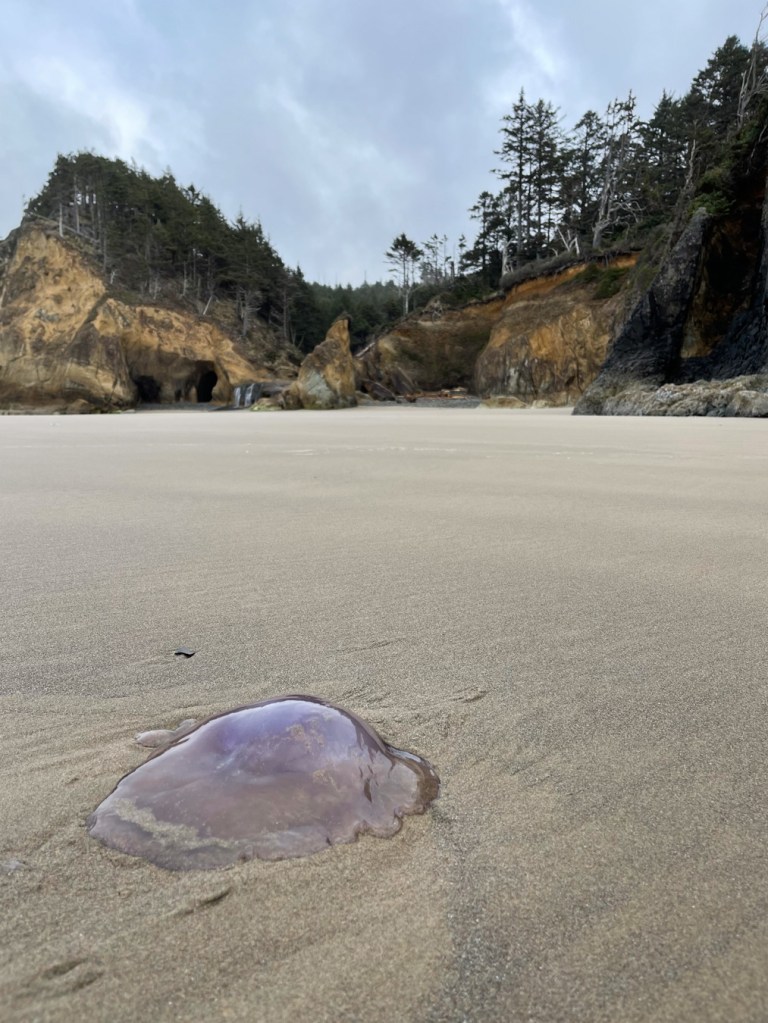
Aurelia labiata Moon jelly
Moon jellies, along with sea nettles Chrysaora fuscescens (above), are common large jellies frequently found cast up on northern Oregon beaches. Beached moons have a translucent look and often have a pink cast.
Look for four roundish gonads that can be, and often are, a beautiful purple color.


Beached moon jellies can add some pink to a walk on the shore.


A few more moons
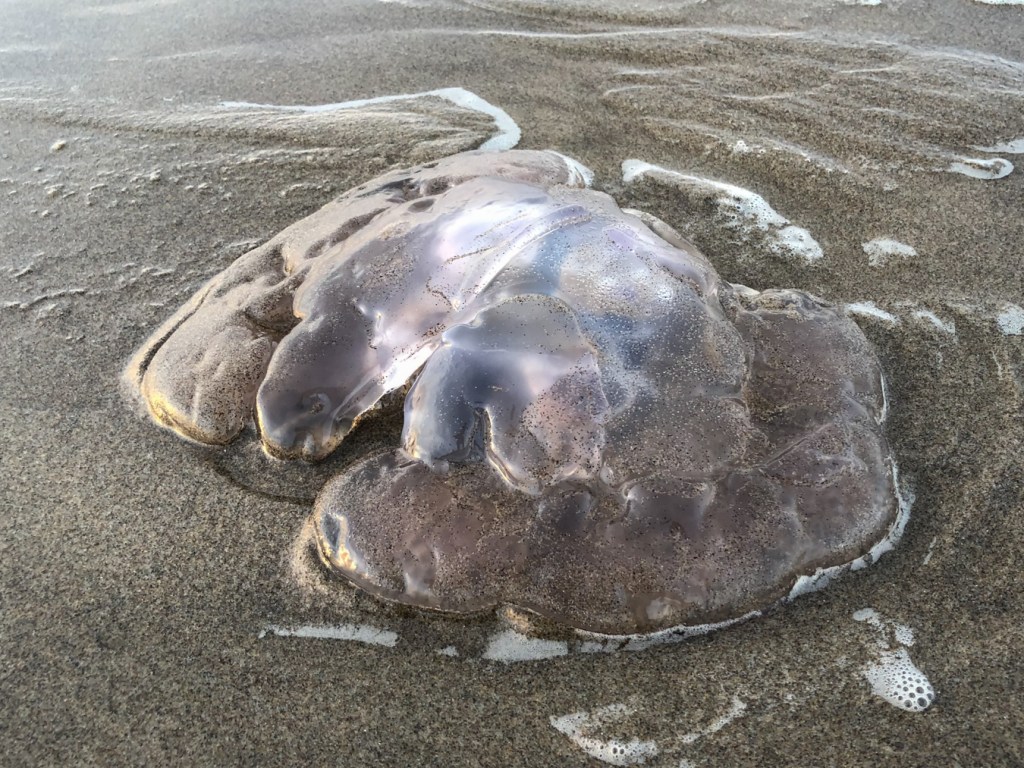
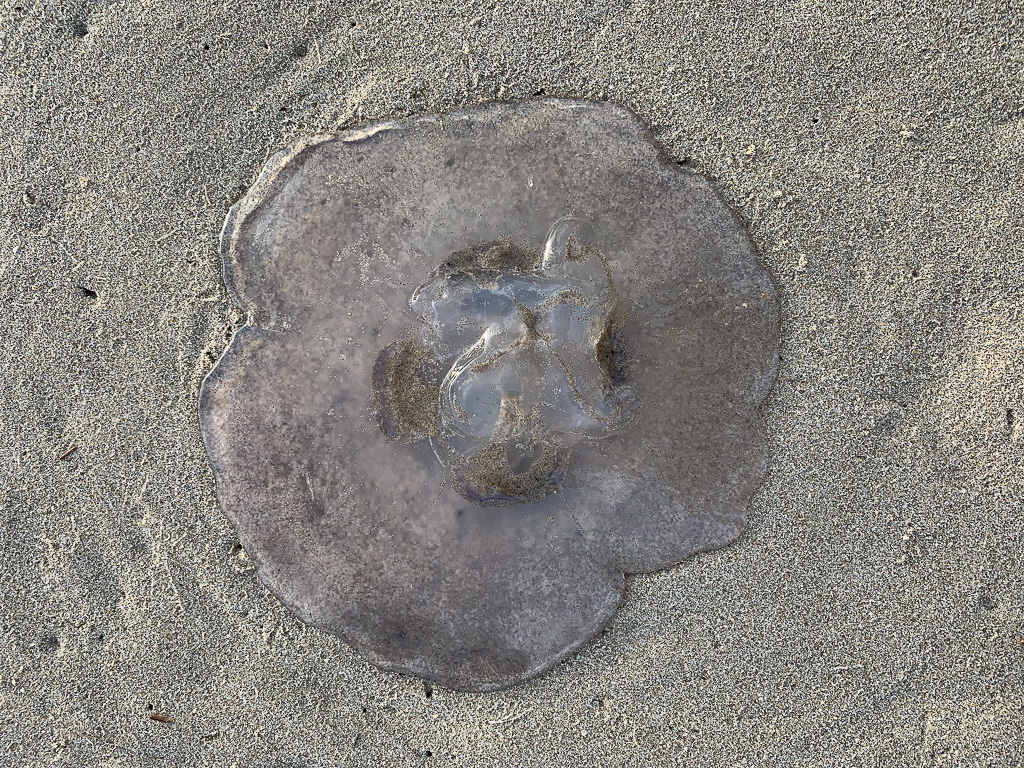


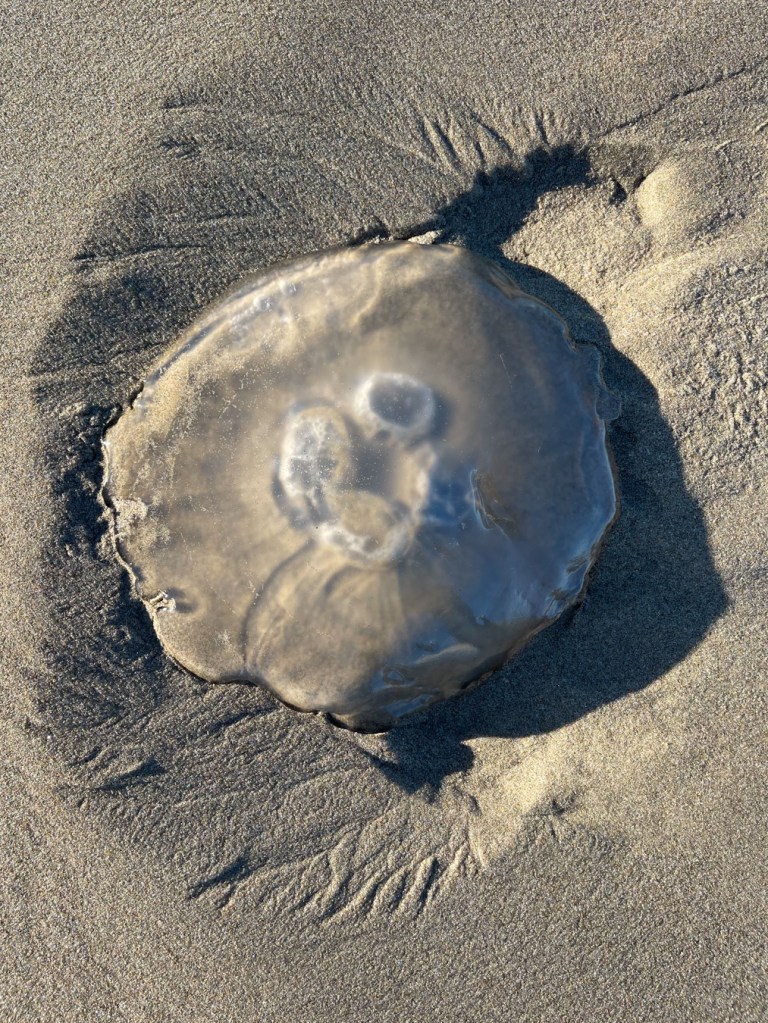

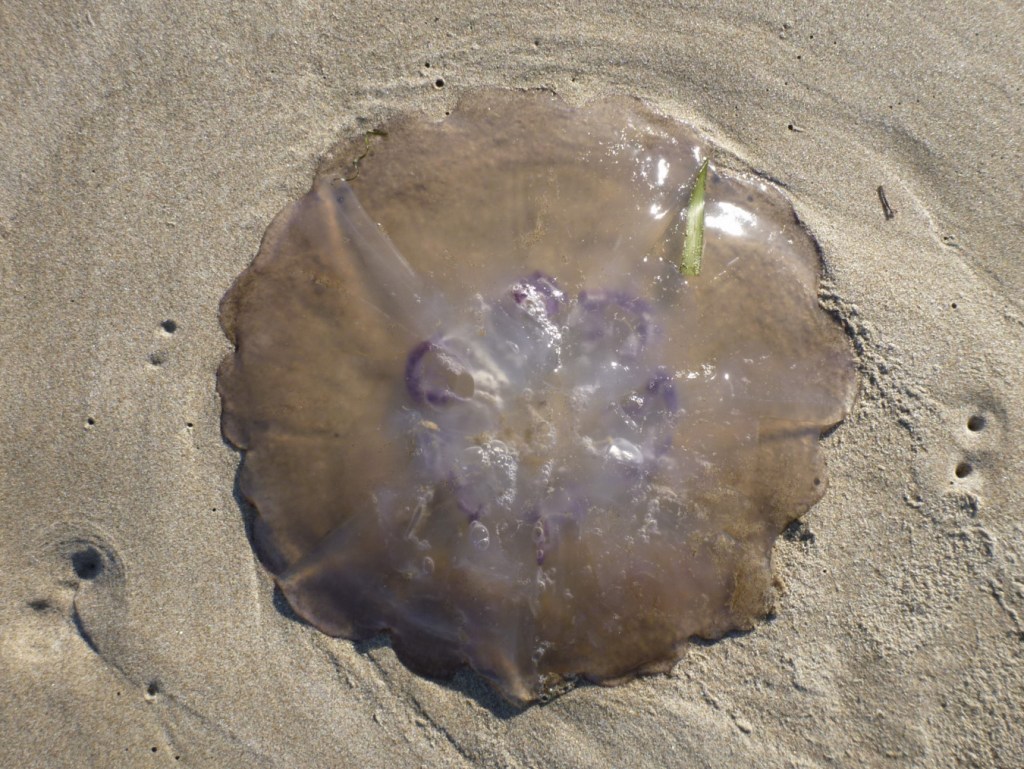
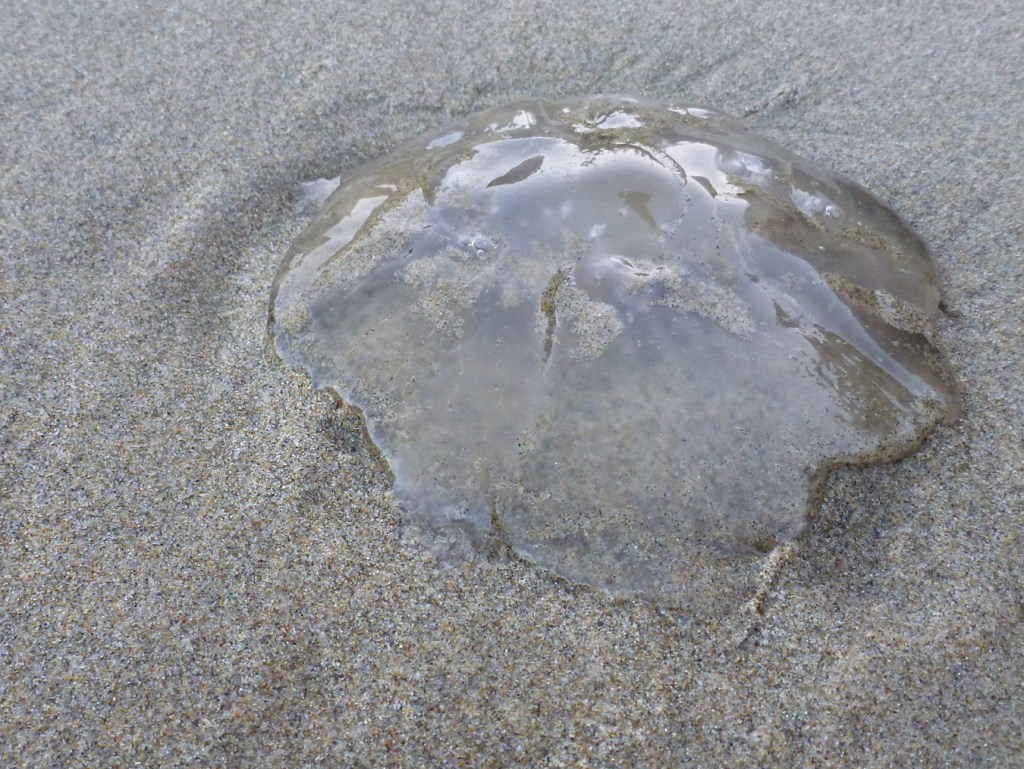
When moon jellies are present, there will be fragments cast about.
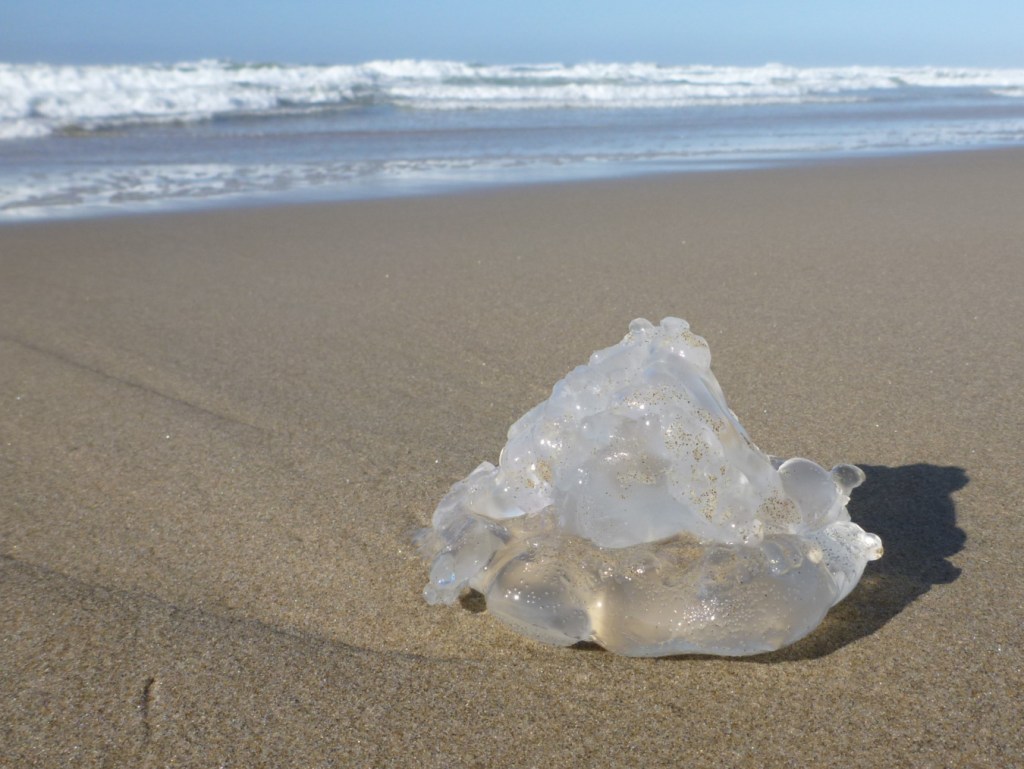

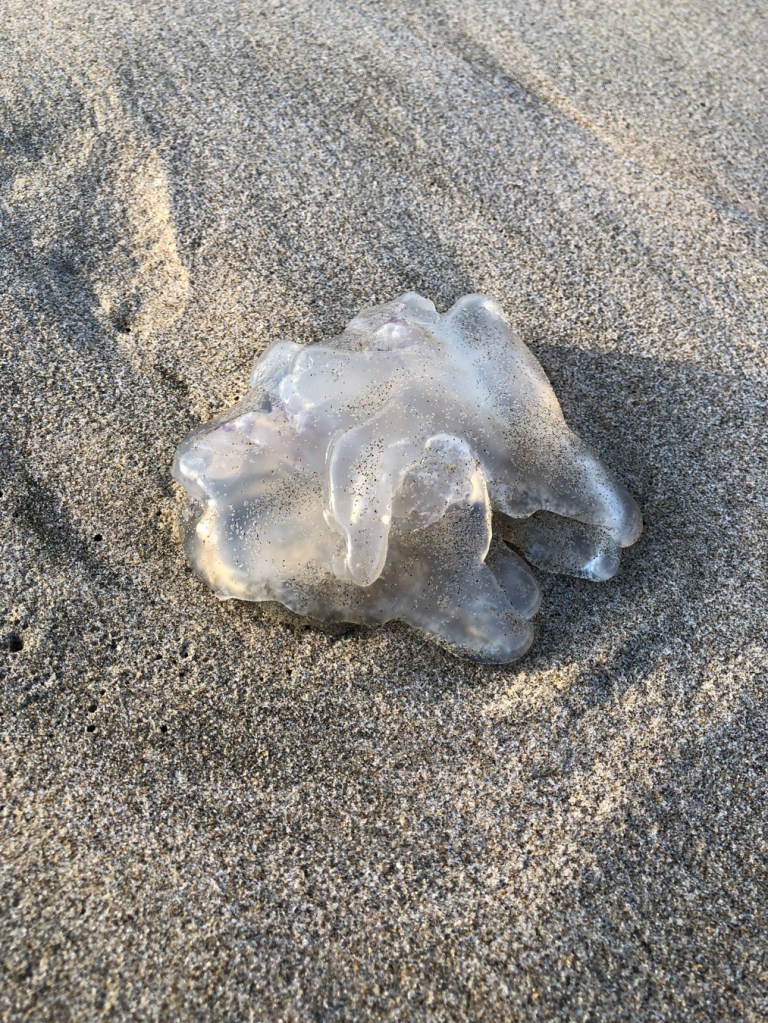


Beach cast moon jellies afford beach hoppers an opportunity to get right to their work.

Aequorea Crystal jelly, Water jelly
When Aequorea is around and getting washed ashore, there’s a decent chance you’ll find some more or less intact specimens.
The radial canals lay out like spokes on a bicycle wheel.

The Aequorea bell is stunningly clear (note the see-through center of this one), so it’s easy to understand the names crystal and water jelly.

The looks of beached Aequorea

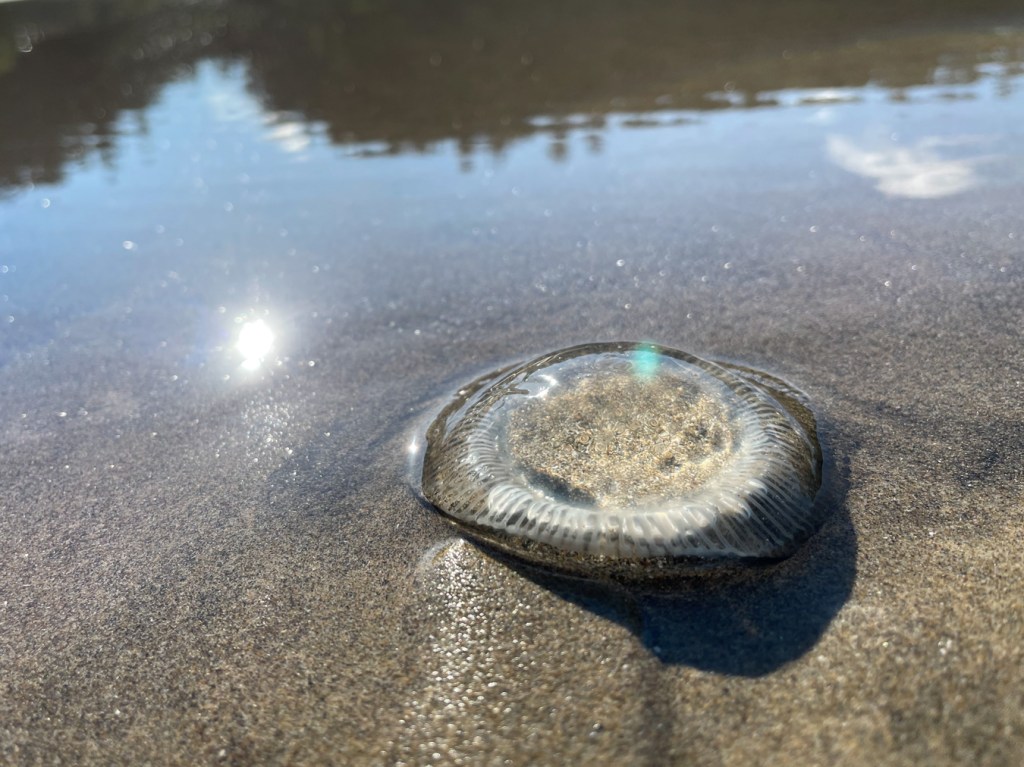
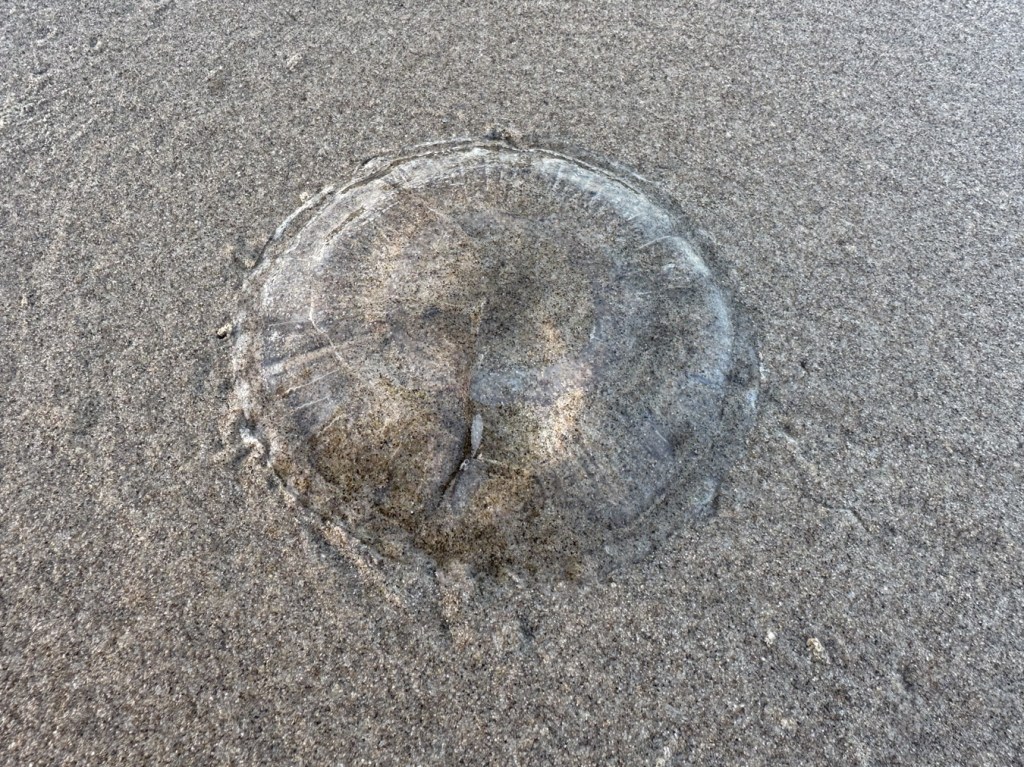
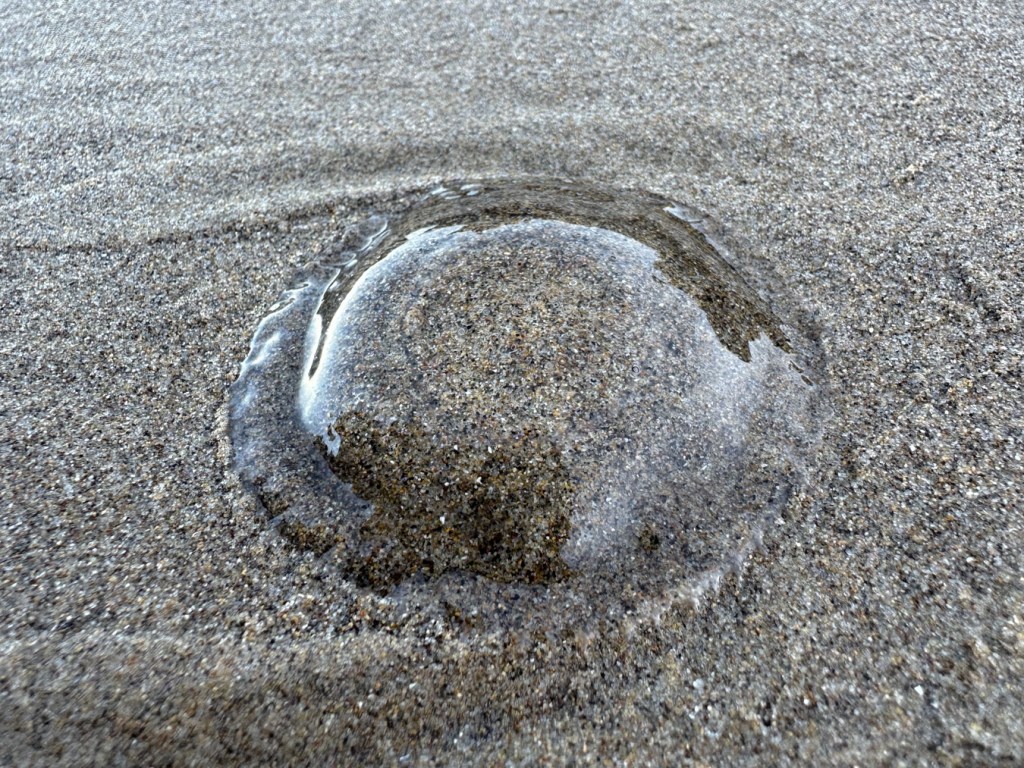

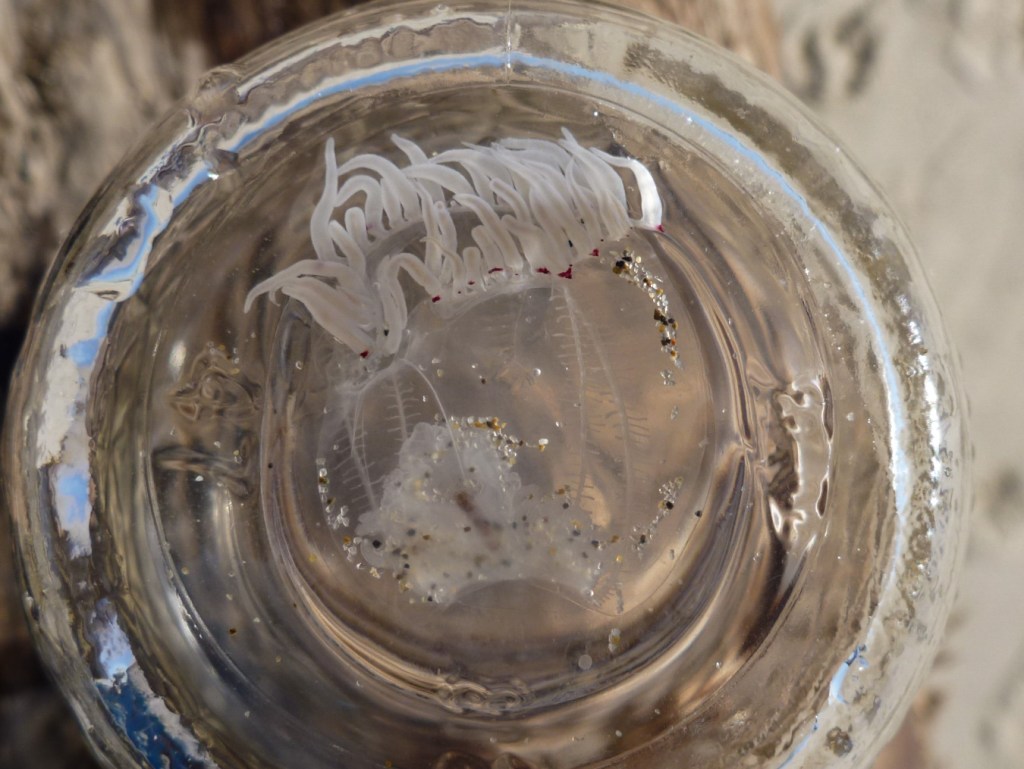
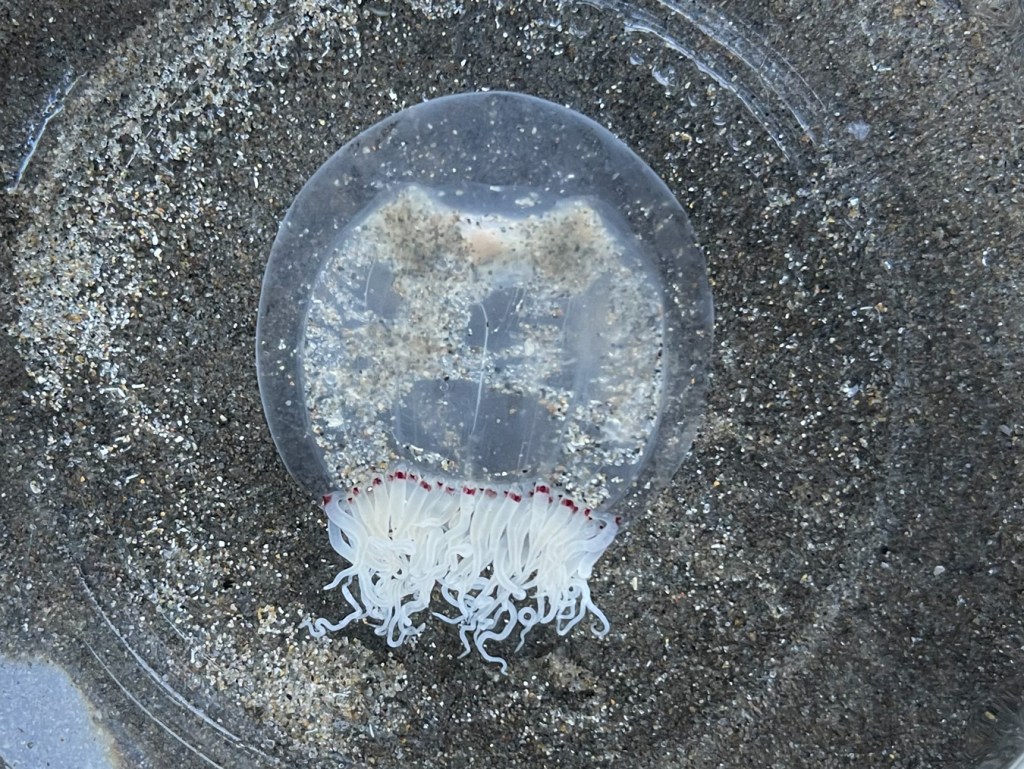
Stranded red-eye medusas, probably Polyorchis penicillatus, can be abundant, but they aren’t easily noticeable outside the swash zone. To get a good view, float them in a finger bowl (image on the right), or be creative and float it in the bottom of an upside-down half-pint canning jar (image on the left).
Halimedusa typus
Well, I think that’s what these little medusas are. I recall seeing them only in October 2022, when they washed ashore in large numbers. The iNaturalist page for Halimedusa typus shows a few other examples.


Velella velella By-the-wind sailor
Freshly arrived rafts of by-the-wind sailors are engrossing and a sight of beauty in the swash.
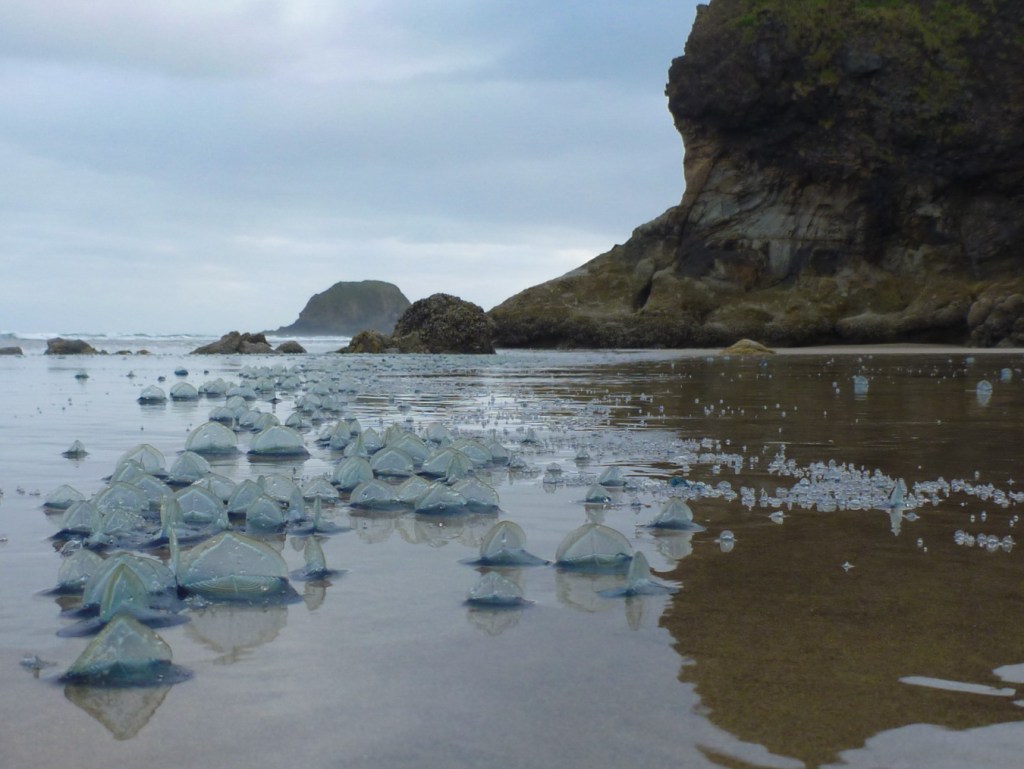
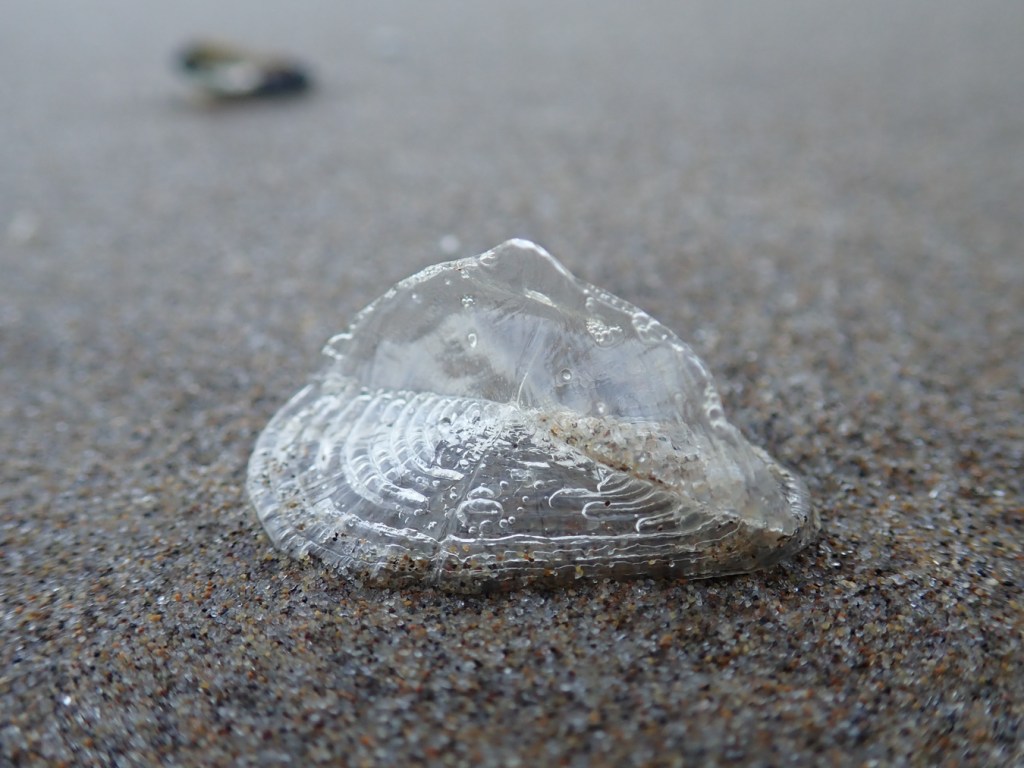
Beached Velella velella are an out-of-place curiosity, but it’s not too hard to imagine them sailing on the open ocean.


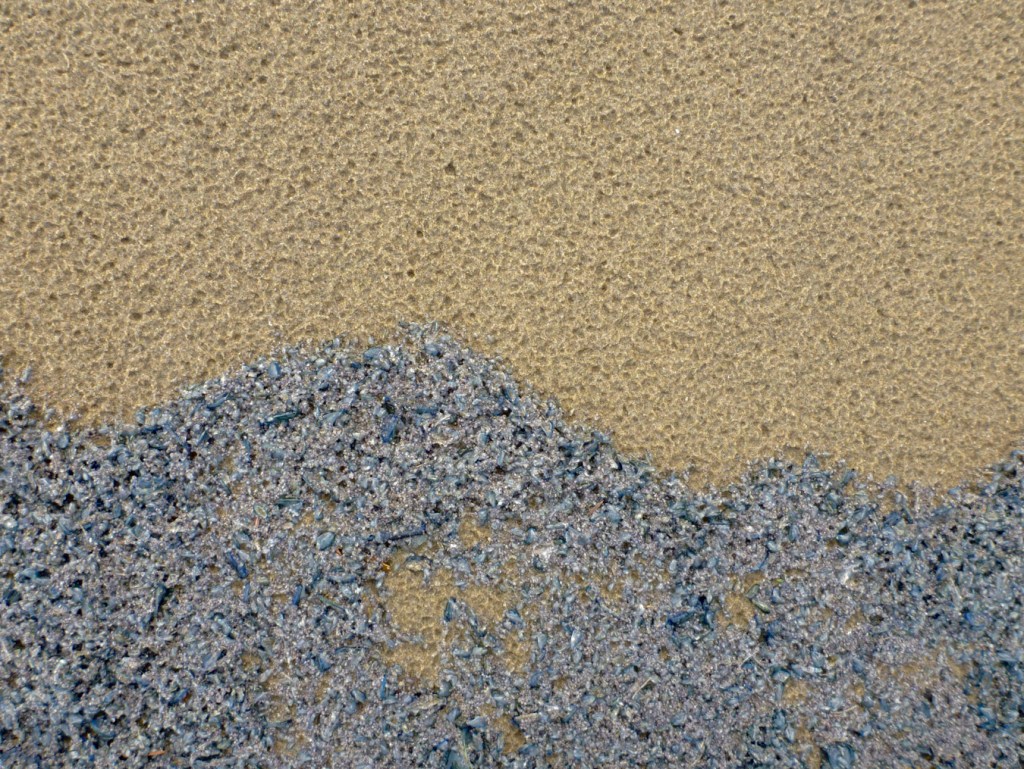
The wavy interface between raindrop dimpled sand and stranded Velella velella at the tip top of the tide
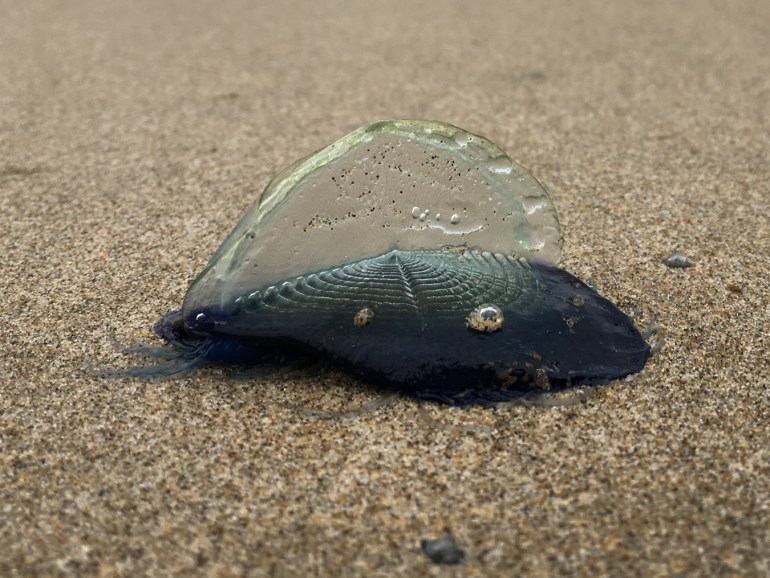
Even in a scene of death, freshly beached Velella are a lovely and enchanting wrack line discovery.
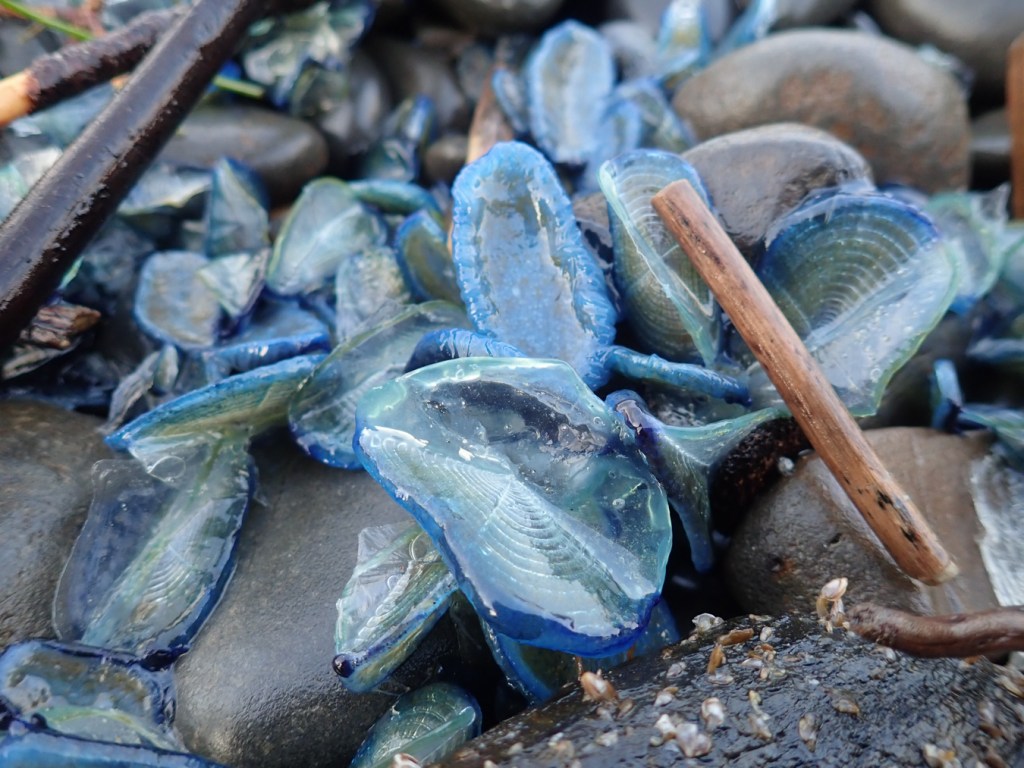
When the beauty fades, cellophane-like skeletons remain (top two panels). In a sustained beachcast event there’ll be a mix of fresh and bleached sailors in the drift (bottom panel).


When incalculable numbers of beached sailors arrive on the shore, it can get a little messy. When it does, expect the pungent odor of decay.


References
Gotshall, D. W. 2005. Guide to Marine Invertebrates, Alaska to Baja California 2nd Edition (Revised). Shoreline Press.
Harbo, R. M. 2011. Whelks to Whales: Coastal Marine Life of the Pacific Northwest. 2nd ed. Harbour Publishing Co.
Kozloff, E. N. 1993. Seashore Life of the Northern Pacific Coast. 3rd ed. University of Washington Press.
Lamb, A. and B. P. Hanby. 2005. Marine Life of the Pacific Northwest. Harbour Publishing.
Sept. J. D. 2019. The New Beachcomber’s Guide to the Pacific Northwest. Harbour Publishing.
Online Resources
Friends of Netarts Bay WEBS’ Hydroids, Jellies, Sea Anemones and Comb Jellies. Accessed January 27, 2025.
It’s worth scrolling down to Cnidaria in Common Sea Life of Southeastern Alaska: A field guide by Aaron Baldwin & Paul Norwood. Accessed January 27, 2025.
Species Accounts
Cowles, D. (2004). Velella velella (Linnaeus, 1758). Invertebrates of the Salish Sea. Rosario Beach Marine Laboratory. Accessed January 28, 2025.
Cowles, D. (2006 as edited). Aurelia labiata (Linnaeus, 1758). Invertebrates of the Salish Sea. Rosario Beach Marine Laboratory. Accessed January 28, 2025.
Cowles, D. (2006). Aequorea victoria (Murbach and Shearer, 1902). Invertebrates of the Salish Sea. Rosario Beach Marine Laboratory. Accessed January 28, 2025.
Cowles, D. (2006). Polyorchis penicillatus (Eschscholtz, 1829). Invertebrates of the Salish Sea. Rosario Beach Marine Laboratory. Accessed January 28, 2025.
Cowles, D. (2007). Cyanea capillata (Linnaeus, 1758). Invertebrates of the Salish Sea. Rosario Beach Marine Laboratory. Accessed January 27, 2025.
Cowles, D. (2010). Chrysaora fuscensens Brandt, 1835. Invertebrates of the Salish Sea. Rosario Beach Marine Laboratory. Accessed January 28, 2025.
Piazzola, C.D. 2015. Aequorea victoria. In: Oregon Estuarine Invertebrates: Rudys’ Illustrated Guide to Common Species, 3rd ed. T.C. Hiebert, B.A. Butler and A.L. Shanks (eds.). University of Oregon Libraries and Oregon Institute of Marine Biology, Charleston, OR. Accessed January 28, 2025.
Piazzola, C.D. and L. Hiebert. 2015. Polyorchis penicillatus. In: Oregon Estuarine Invertebrates: Rudys’ Illustrated Guide to Common Species, 3rd ed. T.C. Hiebert, B.A. Butler and A.L. Shanks (eds.). University of Oregon Libraries and Oregon Institute of Marine Biology, Charleston, OR. Accessed January 28, 2025.
Smith, C. R. 2002. Phacellophora camtschatica (Brant, 1835). Invertebrates of the Salish Sea. Rosario Beach Marine Laboratory. Accessed January 28, 2025.
I updated this page on February 7, 2025.
 theoutershores