
Below are examples of easy-to-find isopods from Oregon’s exposed rocky shores, beaches, and backshores. The photos are from northern Oregon unless noted. My organization loosely follows Lamb and Hanby (2005). Common names, if I use them, are my choice. The books, field guides, and identification resources listed at the bottom of the page cover these isopods and many more.
Let the isopods be upon you!
Ligia pallasii
My view of Ligia pallasii is shaped by my experiences with them at the base of cliffs that rarely get dunked, even by big surf and surge. That’s the only habitat where I’ve encountered them, so with that frame of reference, I think of them as high crevice dwellers. They blend in pretty well on the cliff face where they are shy, fast-moving escape artists.
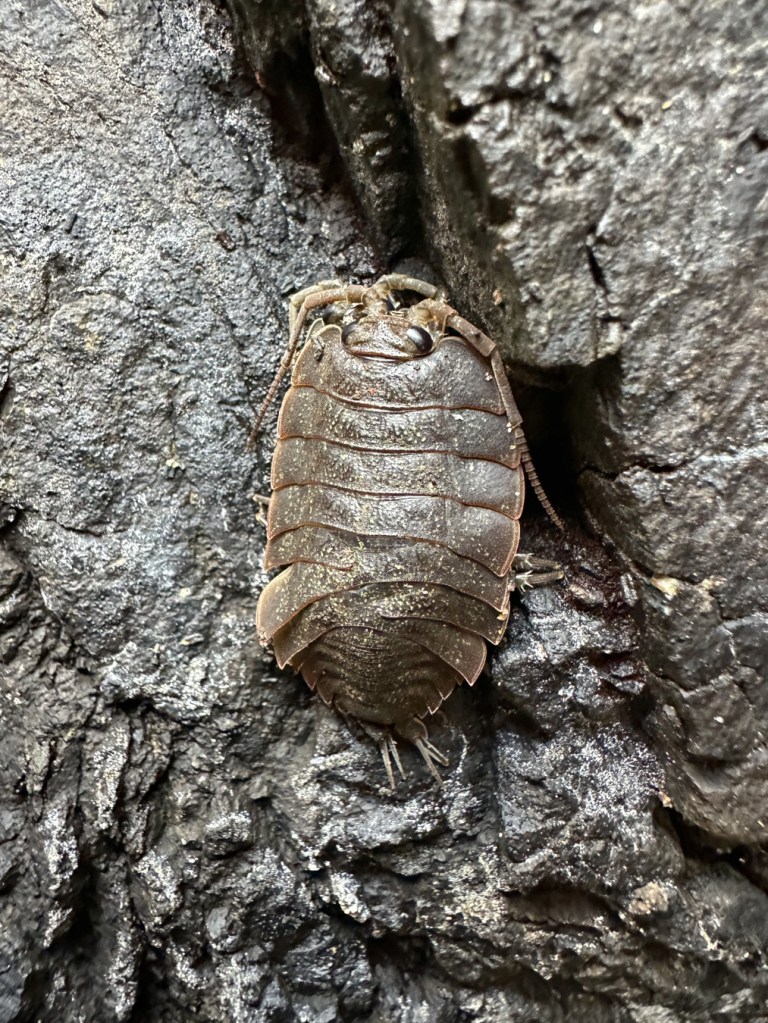
In spite of their color-matching you can sometimes detect and, to a degree, and sneak up on Ligia. On cliffs, look for them in places with some moisture, plenty of crevices, and overhangs. (The same individual is shown in both panels below. Even in the first shot (left-hand panel) it was already on the move.)


Kids look pretty much like adults (but there is some variation in adult size and shape).

Speaking of shape variation, the bottom panel below illustrates that some adults achieve wide-body status (I think these wider individuals might be adult males, but I’ve read varying accounts).


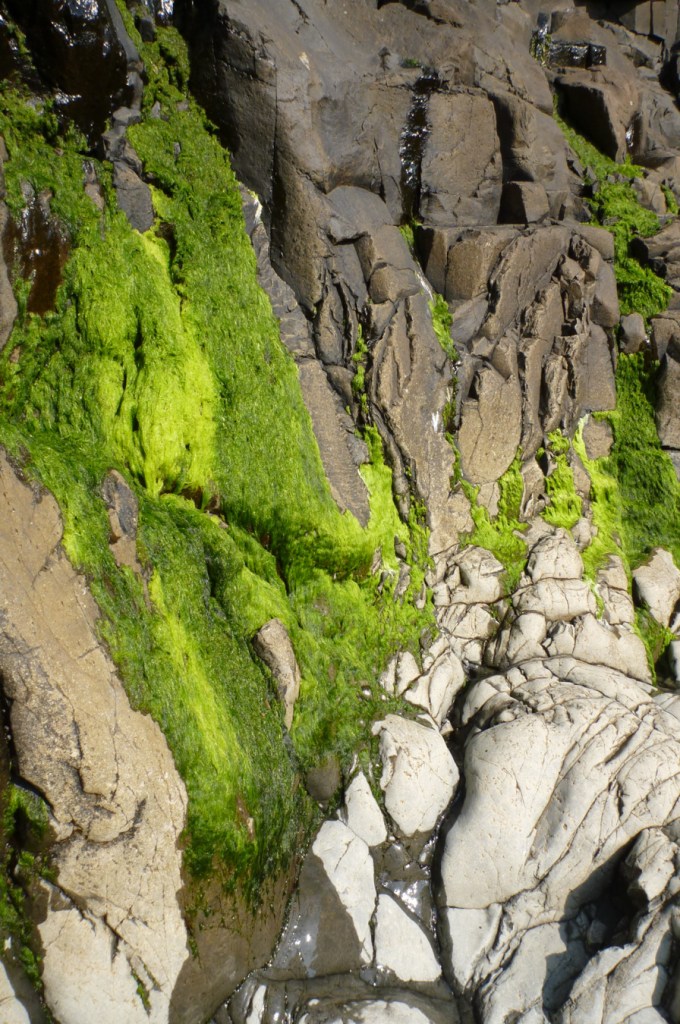
Examples of cliff habitats of Ligia pallasii.

When the habitat has a vertical dimension, the escape route is often up. I love the mad scramble in the right-hand panel, below.


To view a short and kind of intimate video of Ligia pallasii in a variety of shapes and sizes in their home crevice, click here.
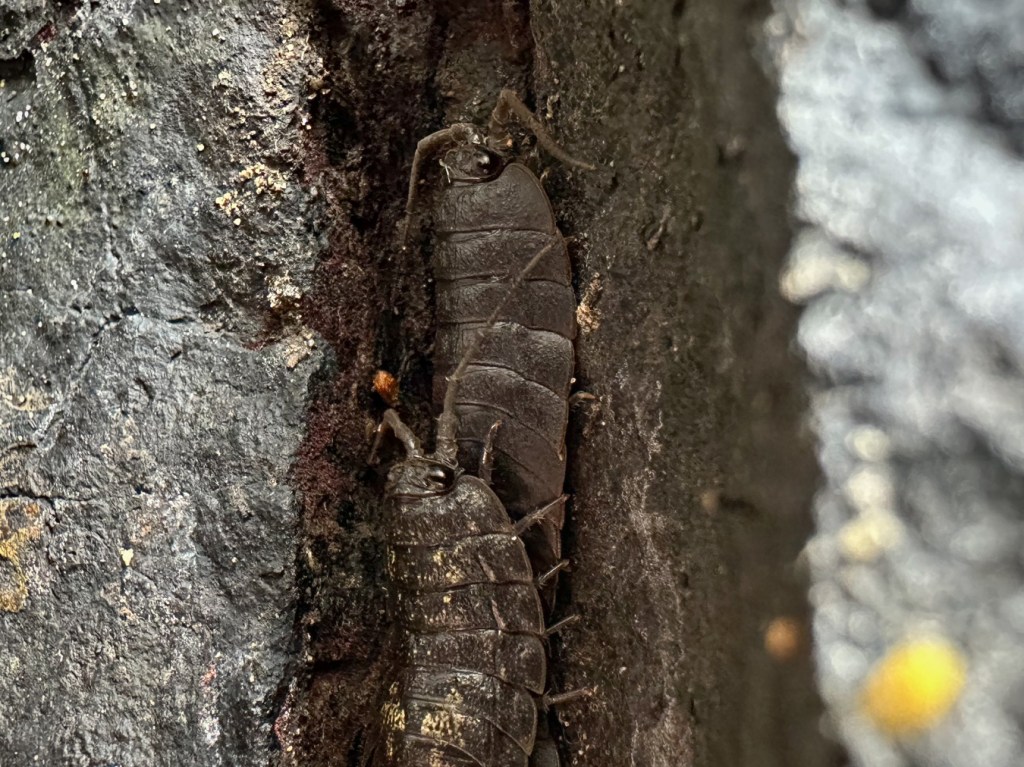
There’s a surprise waiting in the image at the left. How many Ligia do you see? That’s right, two, a larger one, probably a male, mostly covering a smaller female. (You can make out two sets of antennae.) I think this might illustrate precopulatory mate guarding, pretty common in isopods and some other crustaceans like crabs.
***
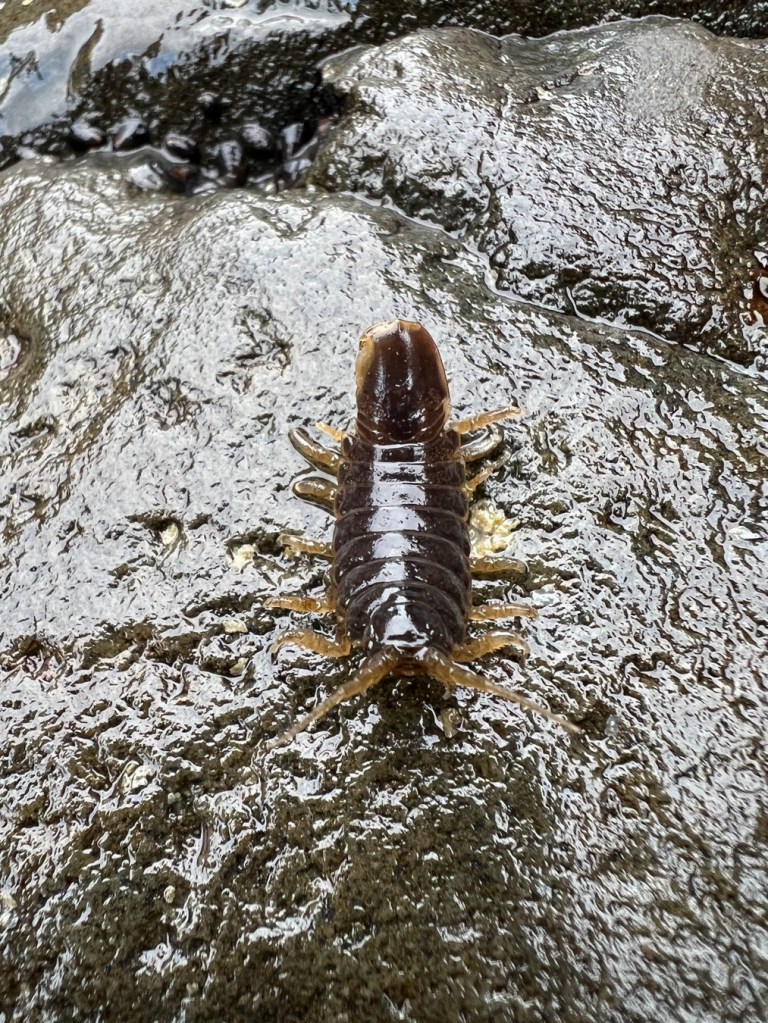
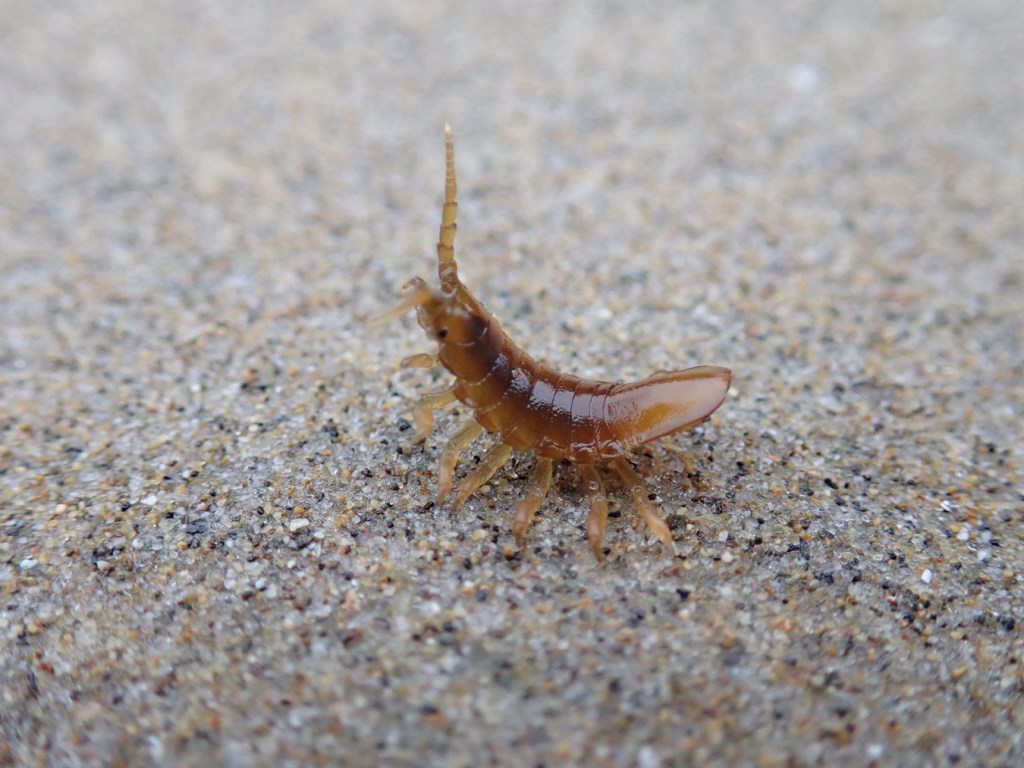
The little isopod below, with the distinctive telson did not want to pose for me, but I gave it a try anyway and for a few minutes, as it explored the edges of a tiny sand-filled mid intertidal pool, I lost myself in that world. I think this is probably Exosphaeroma, maybe something like E. russellhansoni or a look-alike, like E. amplicauda.

Pentidotea
Delightful color variation exists in some of the species in this group. Those I’ve met up with on the exposed outer coast have strong sharp claws which help them maintain their perches on surfgrass, corallines and seaweeds, on the rocks, and in the mussel beds. I think the examples in the set below show one or more Pentidotea wosnesenskii characteristics, and I think that’s what they are, but there are look-alikes.
When I discovered the specimen below, deep in the surfgrass, I was so excited I grabbed it and laid it out for a better look. The image illustrates enough Pentidotea wosnesenskii characteristics to make identification fairly certain. Variations of purple-brown coloration with white markings are common in P. wosnesenskii, but expect other colors, as shown below.

Below, a sample of Pentidotea showing off their colors in various settings. I think these examples are all P. wosnesenskii, but where look-alikes exist so does uncertainty.




I came across the individual shown below on the sand beneath mussel and seaweed encrusted rock. I’ll never know how it got there, but it had already taken this seemingly defensive pose by the time I came along. Note the similar stance on the specimen in the upper right-hand panel in the gallery above.
Another behavior I’ve noticed is stacking. Below, four P. wosnesenskii have stacked themselves on a seaweed blade, maybe Prionitis. (It’s kind of hard to make out the fourth individual here.) The largest individual in the stack is the largest Pentidotea I have encountered.

I’ve mentioned how identifying isopods resembling Pentidotea wosnesenskii can be tricky, so I’m leaving this entry with two beautiful red specimens from roughly the same exposed location, and questions. Are they both P. wosnesenskii? Neither?


Idotea
I’ve only come across this slender, straight-bodied isopod once. I noticed it at the bottom of a sand-filled tidepool below an isolated mussel-covered boulder. The photographs below are of the same individual, first in a white finger bowl, then on clear glass. It looks a lot like the photograph of the pencil isopod Idotea fewkesi featured in Sept (2019).


Synidotea
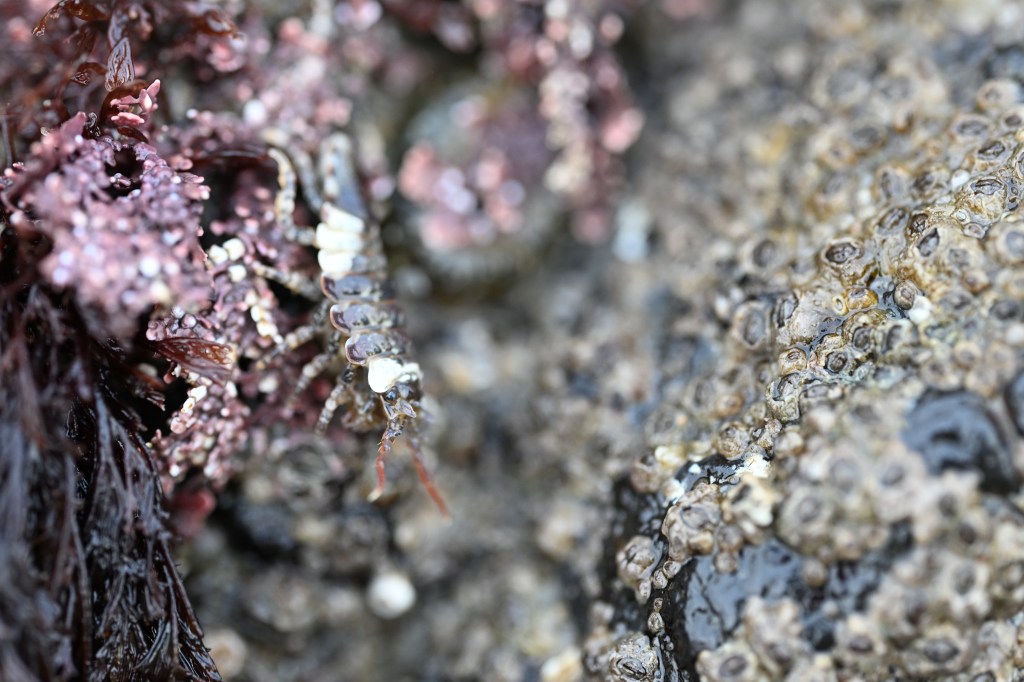
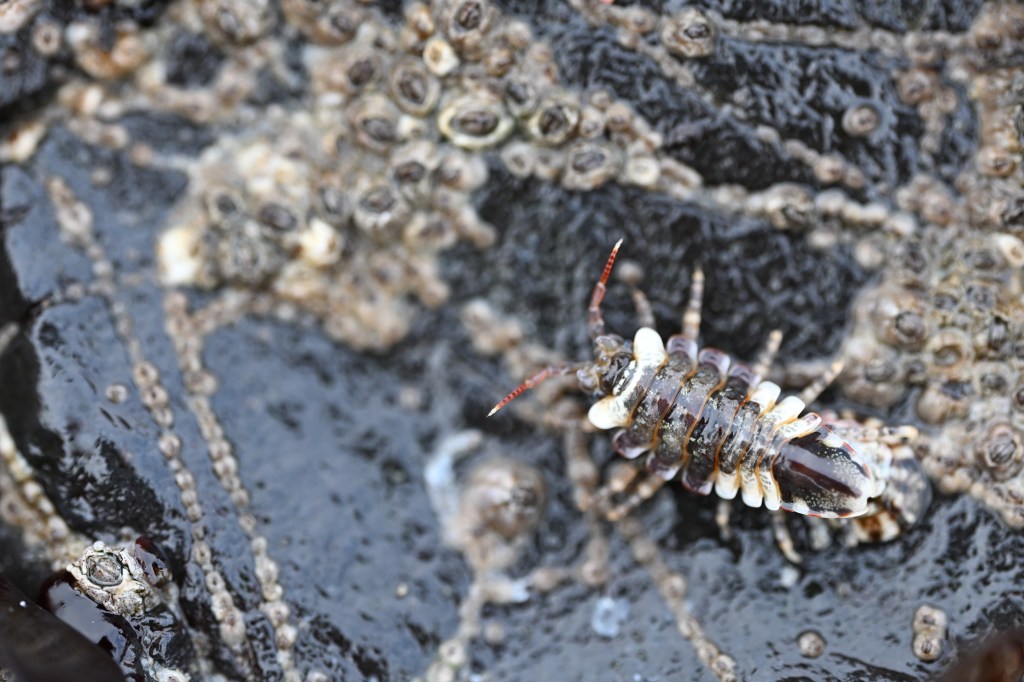
I’m pretty confident this beauty is Synidotea ritteri. Both images featured below are of the same individual, who, after I discovered it on a low patch of inscrutable red blades, was making things pretty difficult on me, but I don’t blame it; I was making life difficult on it too. We achieved a truce in just under six minutes.
References
Gotshall, D. W. 2005. Guide to Marine Invertebrates, Alaska to Baja California 2nd Edition (Revised). Shoreline Press.
Harbo, R. M. 2011. Whelks to Whales: Coastal Marine Life of the Pacific Northwest. 2nd ed. Harbour Publishing Co.
Kozloff, E. N. 1993. Seashore Life of the Northern Pacific Coast. 3rd ed. University of Washington Press.
Lamb, A. and B. P. Hanby. 2005. Marine Life of the Pacific Northwest. Harbour Publishing.
Sept. J. D. 2019. The New Beachcomber’s Guide to the Pacific Northwest. Harbour Publishing.
Wall, A.R., N. L. Bruce, R. Wetzer. 2015. Status of Exosphaeroma amplicauda (Stimpson, 1857), E. aphrodita (Boone, 1923) and description of three new species (Crustacea, Isopoda, Sphaeromatidae) from the north-eastern Pacific. ZooKeys 504: 11-58. Accessed November 9, 2024.
Online Resources
Friends of Netarts Bay’s Crustaceans page. Accessed November 9, 2024.
Pacific Northwest Shell Club’s Crustaceans page. Accessed November 9, 2024.
It’s worth scrolling down to barnacles in Common Sea Life of Southeastern Alaska: A field guide by Aaron Baldwin & Paul Norwood. Accessed November 9, 2024.
Key to Suborder Valvifera by H. Leno (2002 as edited). Invertebrates of the Salish Sea. Rosario Beach Marine Laboratory. Accessed November 9, 2024.
Species Accounts
Cowles, D. 2006. Pentidotea wosnesenskii (Brandt, 1851). Invertebrates of the Salish Sea. Rosario Beach Marine Laboratory. Accessed November 7, 2022. Accessed November 9, 2024.
Hiebert, T.C. 2015. Ligia pallasii. In: Oregon Estuarine Invertebrates: Rudys’ Illustrated Guide to Common Species, 3rd ed. T.C. Hiebert, B.A. Butler and A.L. Shanks (eds.). University of Oregon Libraries and Oregon Institute of Marine Biology, Charleston, OR. Accessed November 9, 2024.
Leno, H. (2002 as edited). Idotea (Idotea) fewkesi. Invertebrates of the Salish Sea. Rosario Beach Marine Laboratory. Accessed November 9, 2024.
Leno, H. (2002 as edited). Ligia (Ligia) pallasii Brandt, 1833. Invertebrates of the Salish Sea. Rosario Beach Marine Laboratory. Accessed November 9, 2024.
I updated this page on November 9, 2024.
 theoutershores