Below are a few examples of crabs living on Oregon’s exposed rocky shores or beaches. The photos are from northern Oregon unless noted. These are the most easy-to-spot crabs on the Oregon shores I’ve visited—they’re the ones you can find with a light touch without turning rocks or creating disturbances. Organization-wise, I loosely follow Lamb and Hanby (2005). If I use common names, they’re my choice. Experts cover these crabs and many more in the books, field guides, and identification resources listed at the bottom of the page.
Let’s explore the shrimps and crabs!
Hemigrapsus nudus Purple shore crab

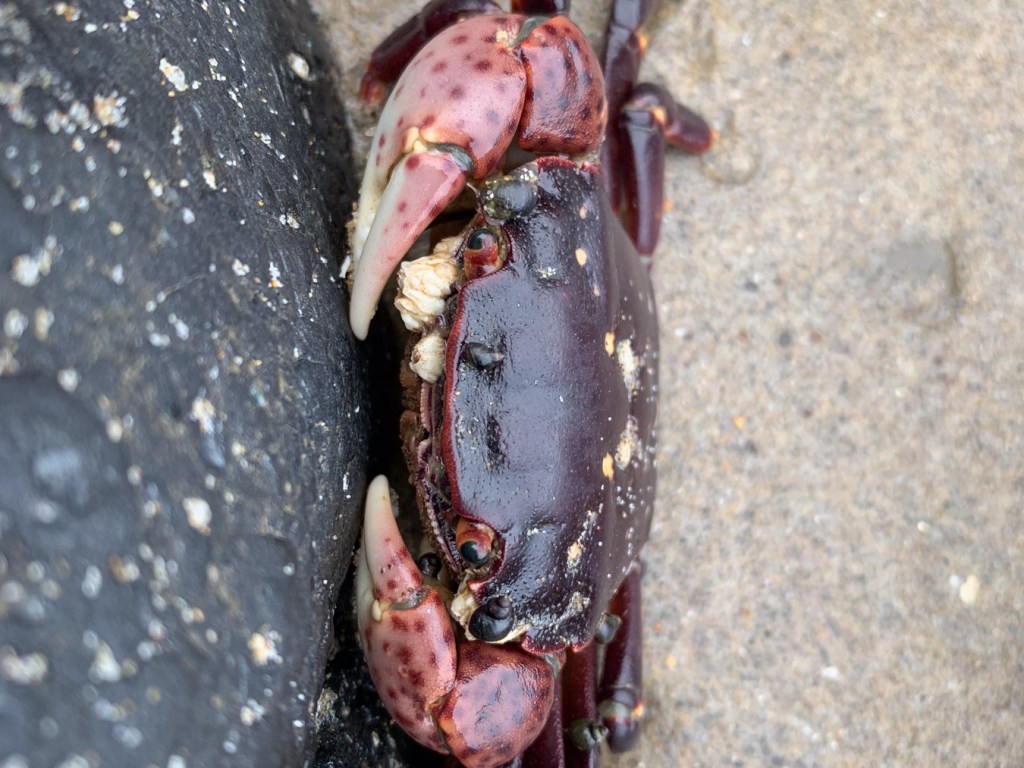


Purple shore crabs live on the rocks and in rocky crevices, but during the lowest tides I’ve found plenty of them out on the sand in the early morning hours. I’ll probably never know if they’ve been on nocturnal excursions, or if keen-eyed birds hunting the low tides have dislodged them from their rocky perches.
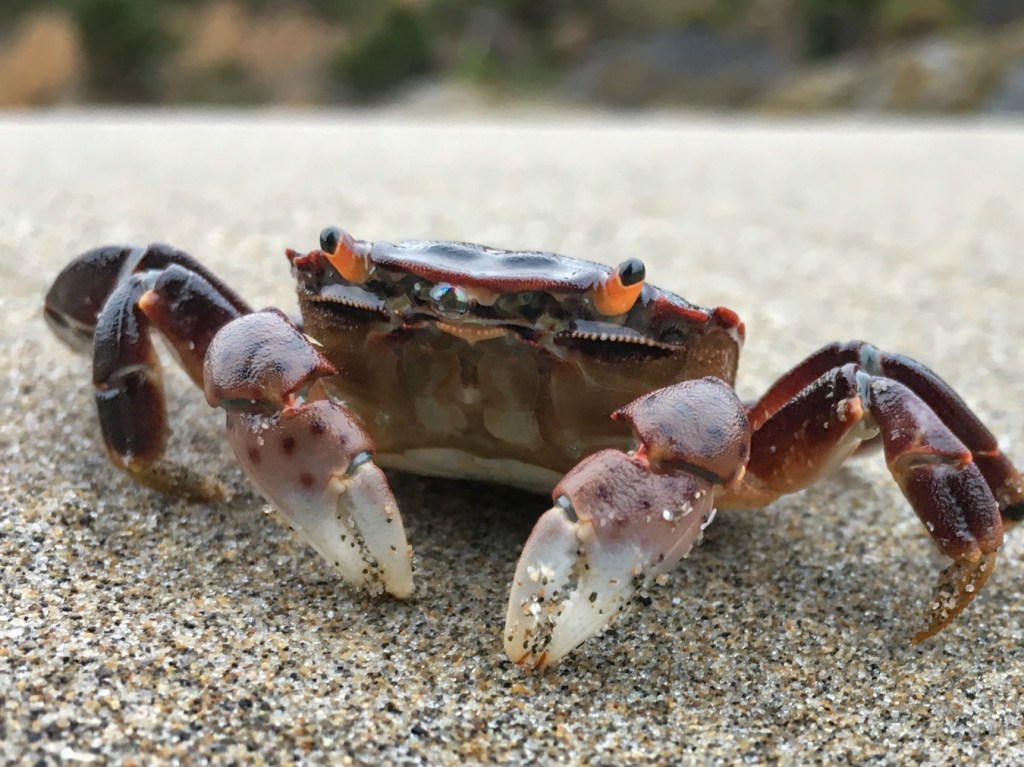
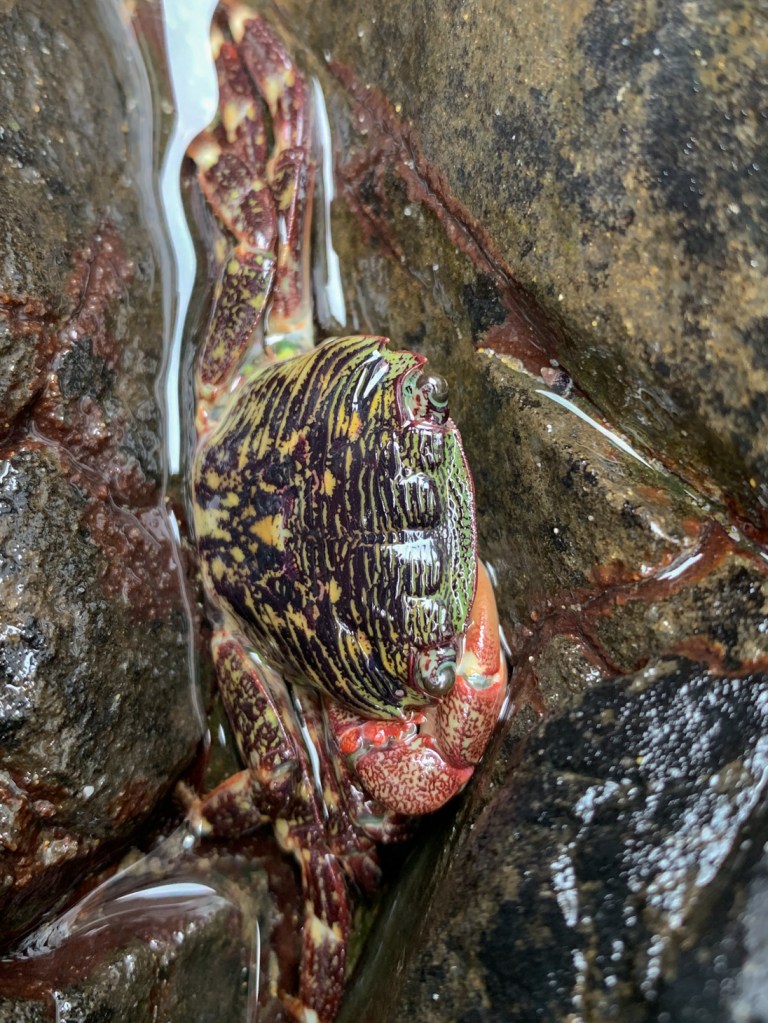
Pachygrapsus crassipes Striped shore crab
You may hear them scuttling over the rocks and away before you see them. Occasionally, mid-retreat, or, more likely, if cornered, striped shore crabs will pull up and briefly adopt a combative stance.

Just seconds after the initial standoff, the same crab let me move in pretty close for a look at its beautifully-colored carapace.
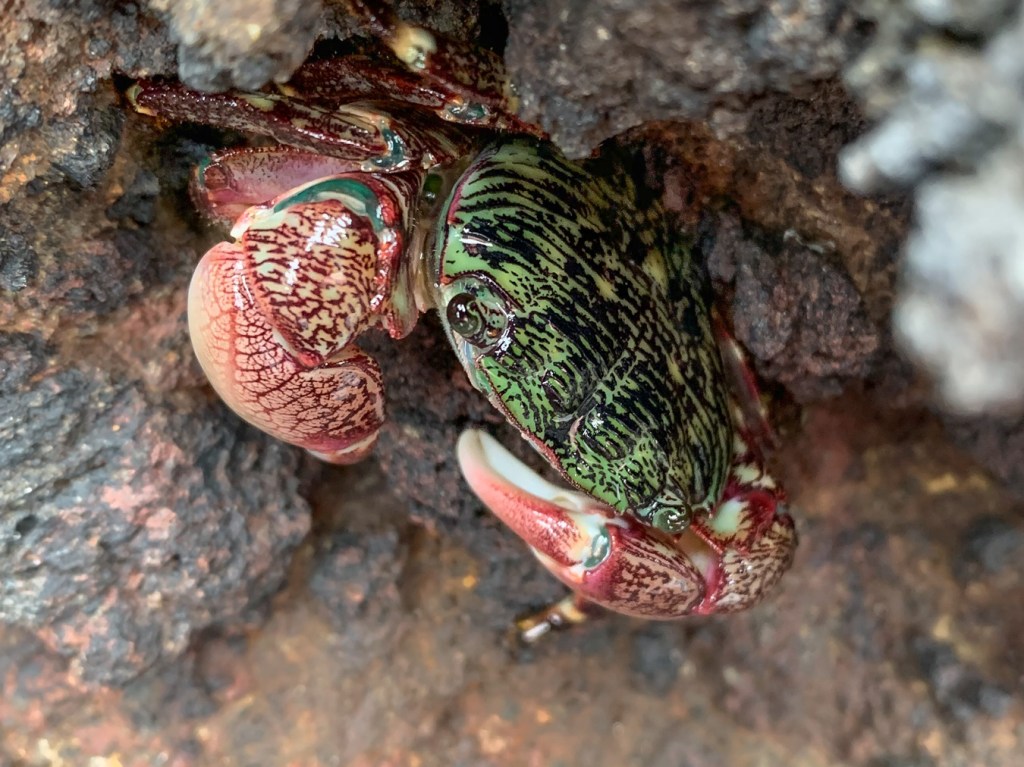
Finding that perfect niche

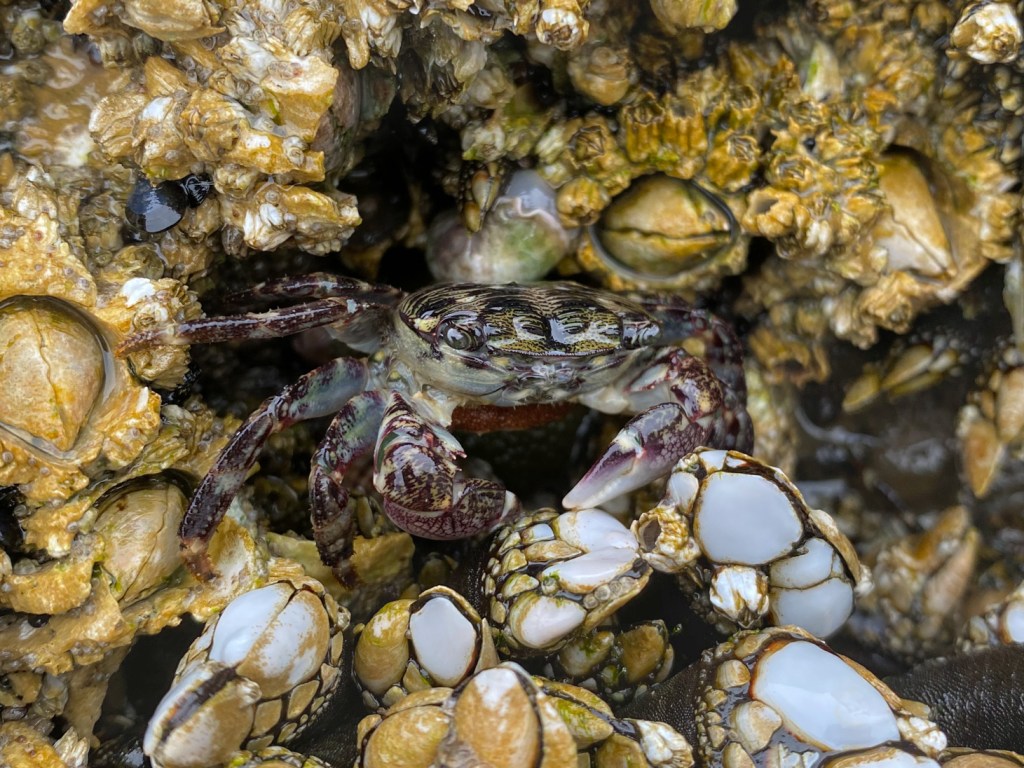
Fitting in
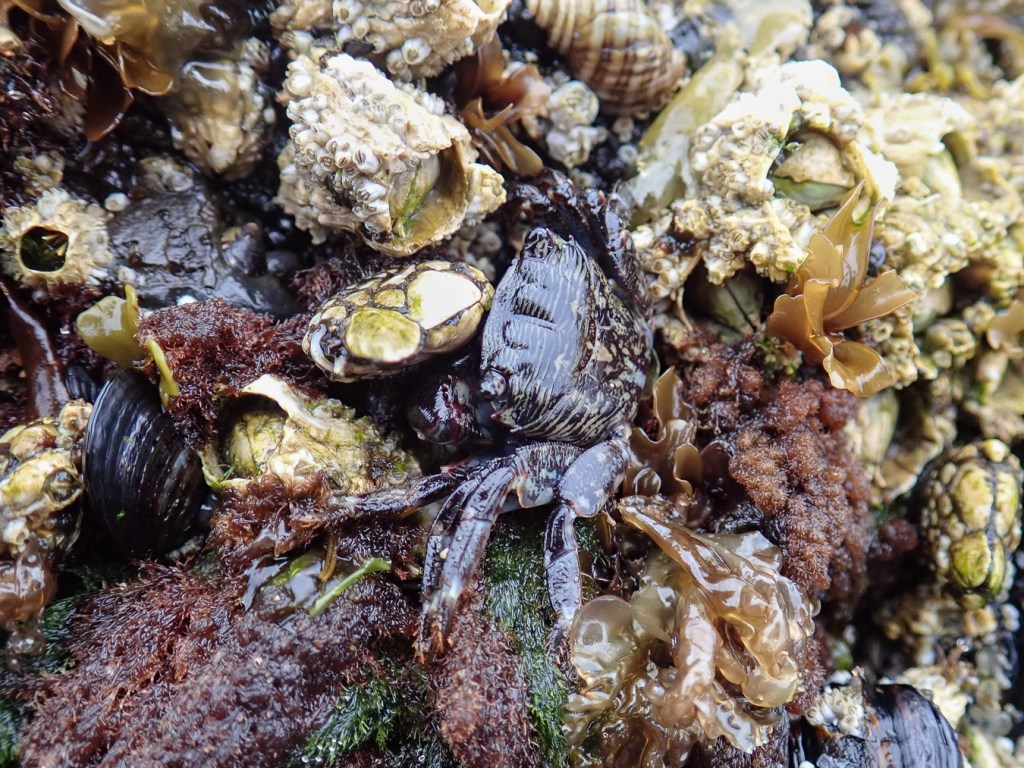
Planes
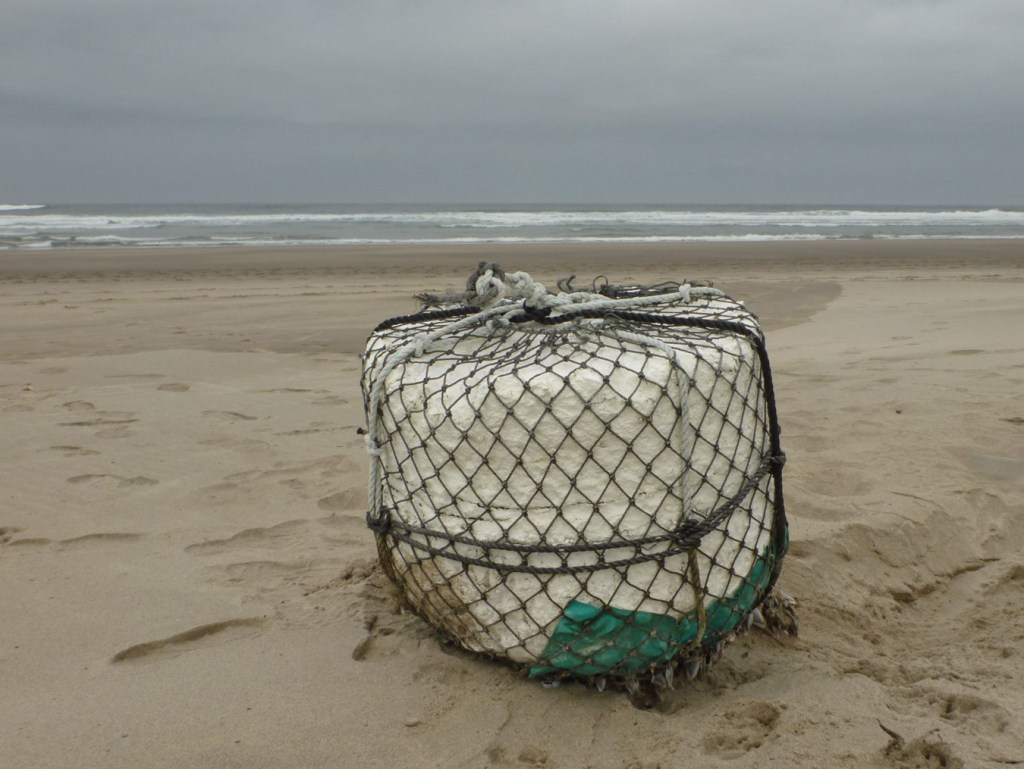
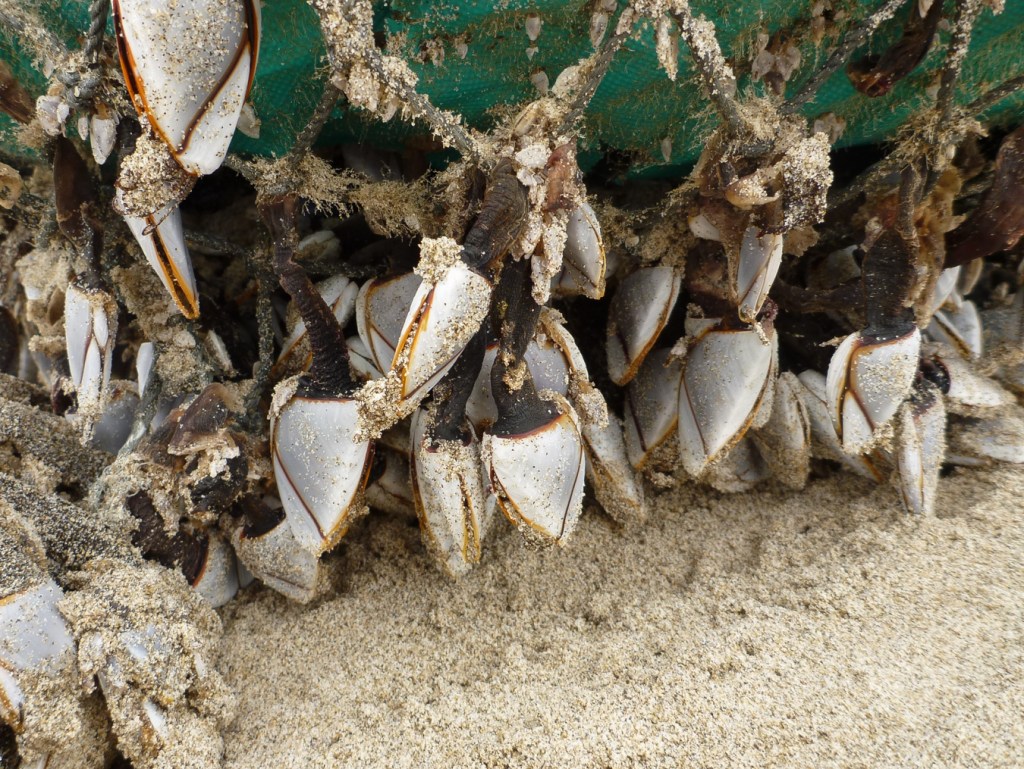
Planes is an oceanic crab that you’re not likely to see on the shore unless they’ve washed in on a floating object. The crabs shown here—probably Planes minutus—were hiding in and under a well-developed community of pelagic barnacles inhabiting a beached buoy.
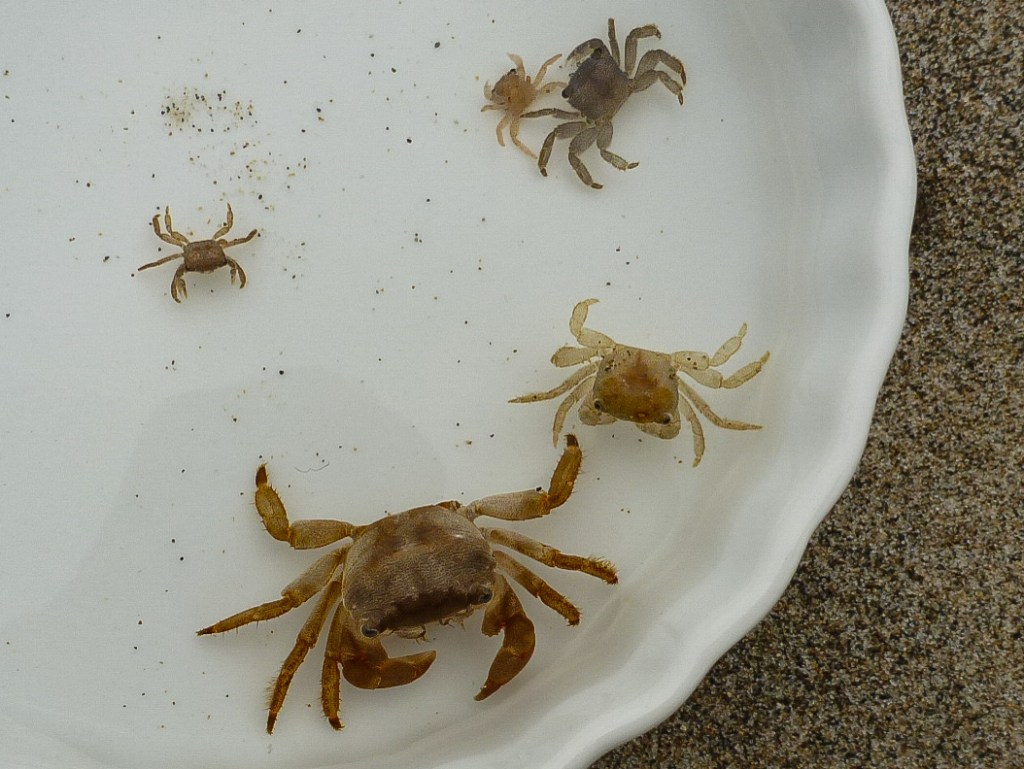
The panels below show the dorsal and ventral view of an adult female (note the broad abdomen in the right-hand panel), at least I believe it’s an adult, she’s up in that size range.


Quite a few crabs arrived, along with a community of pelagic barnacles, on the do-it-it-yourself buoy seen in the top left-hand panel. The presence of various sizes was hard to miss. (The largest crab among those in the bottom panel is the female shown above.)
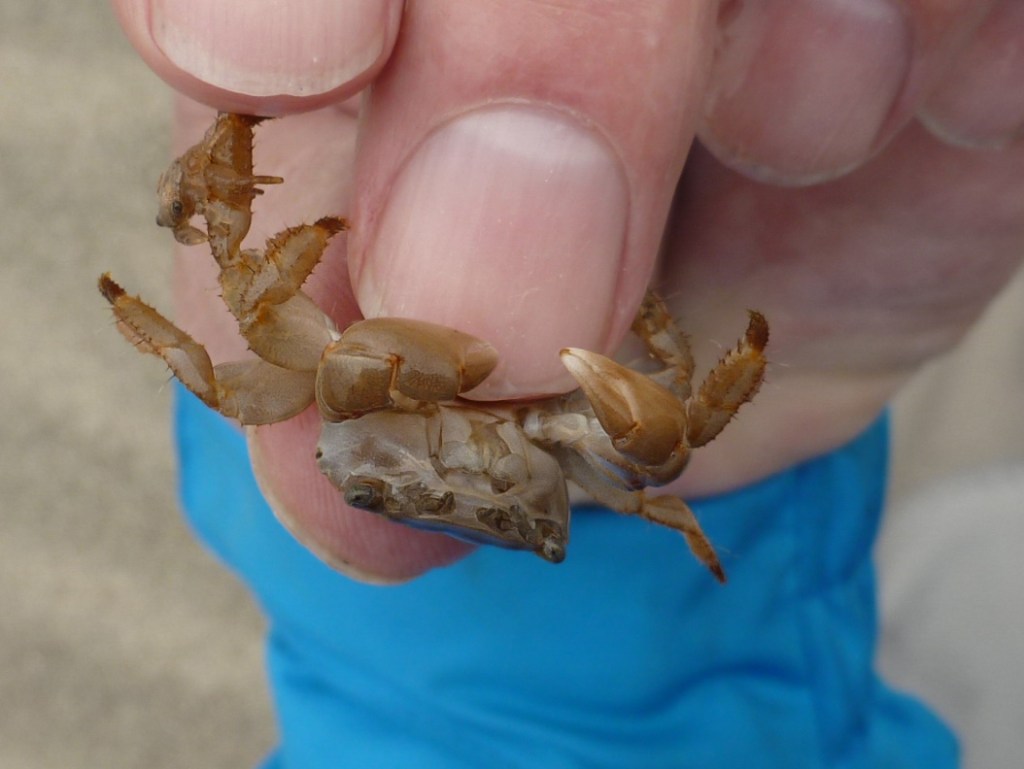
Planes minutus, as its name suggests, is a small crab and I feel like this image, which I think is an adult female, puts that in perspective better than words can. (That carapace is only about the width of the nail on my middle finger.) After taking the photograph, I learned first-hand that these little crabs are clingers. It didn’t want to let go, so I let it crawl up my index finger, where it seemed quite at home, which is unlike other shore crabs I have known, which don’t seem at all at home on fingers. Pulling it off was a task. These drifters are meant to stay on.
Glebocarcinus oregonensis Pygmy rock crab
I found this crab upside down on the sand below a mussel-laden rock during a pretty low tide. The crows had been working the area pretty hard, so it’s possible they dislodged it before I arrived. Whatever the circumstances, it didn’t seem to be injured, and I didn’t resist the urge to flip it over for a right-side-up look.

Glebocarcinus oregonensis highlights
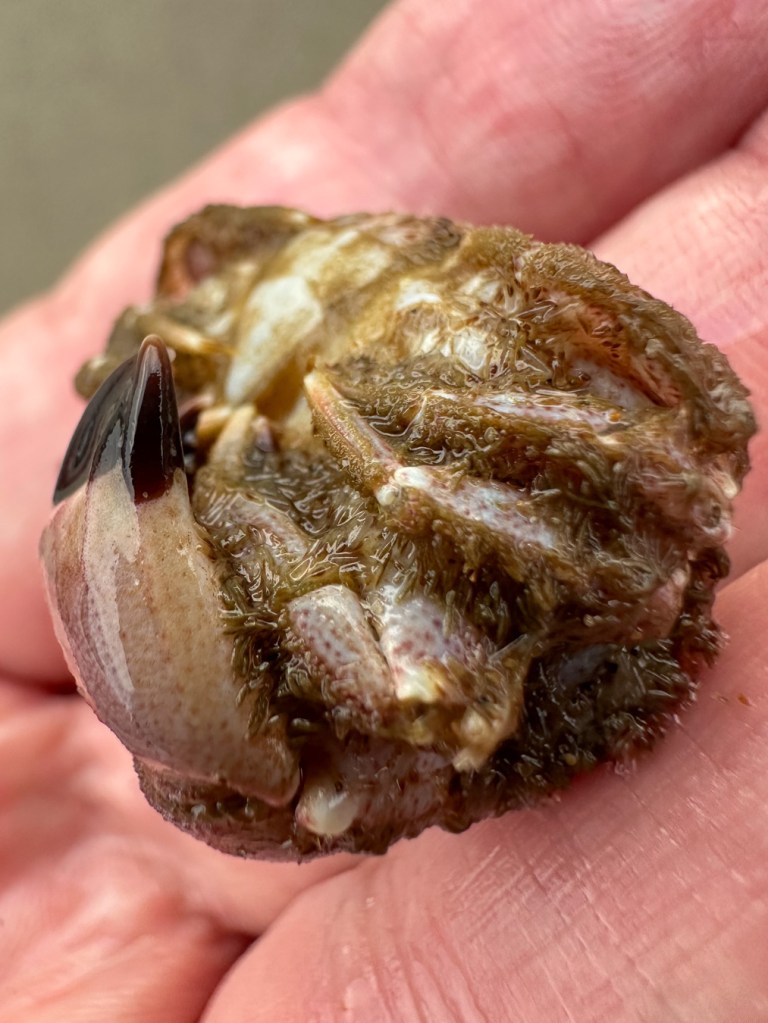

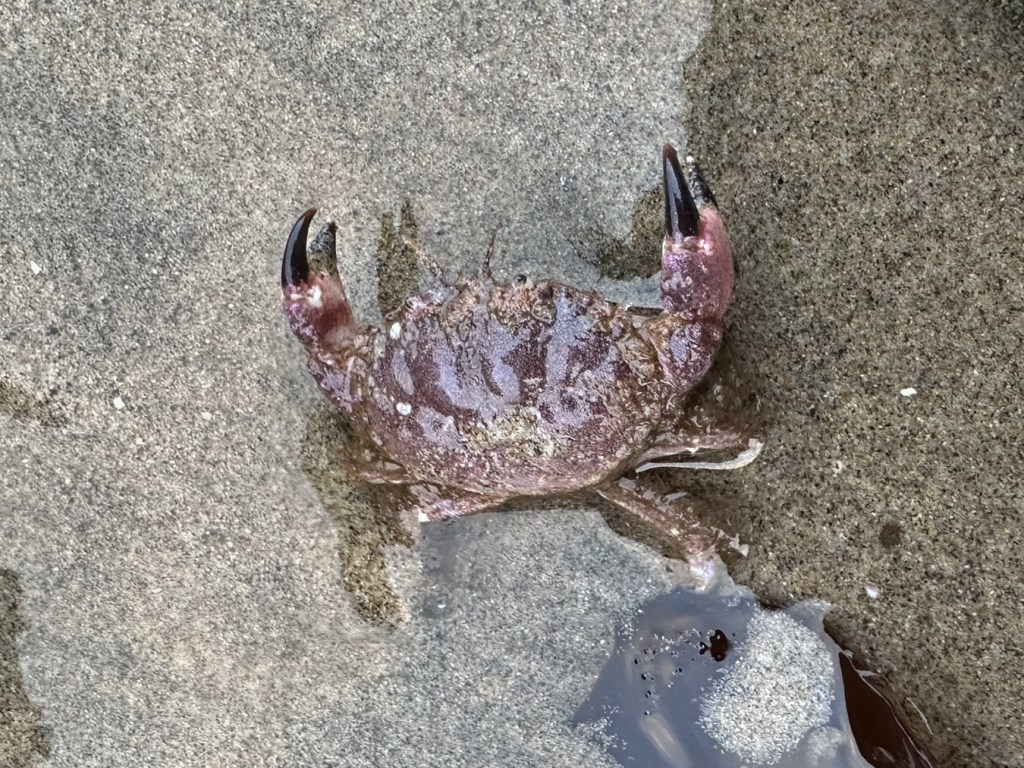
This crab was out on the sand in an area where several rocks jut from the sand. I have a feeling the birds disturbed it, but, as in the previous example, I can’t be sure. Nevertheless, when small crabs like Glebocarcinus are exposed on open sand during daylight hours they are pretty vulnerable.

Posed on what I hope is its home rock and washed free of sand, you can see its hairy legs and impressive claws.

Cancer productus Red rock crab
On the sandy beaches of the open coast, I don’t cross paths with a ton of red rock crabs, but when I do–usually in places where there are at least a few rocks—there’s a good chance they’ve already been discovered by sport harvesters more interested in Dungeness crabs.

When I found the crab below, it was already disturbed, so I went ahead and flipped it over for a look at its underside. I believe the narrow shape of its abdomen confirms this example is a male. (The abdomen of a female would probably be comparatively a bit broader and more rounded than what you see in the right-hand panel.) Another thing to notice on the right-hand panel is the underside can have some color, but it isn’t really spotted. (For comparison see Romaleon antennarium below.)
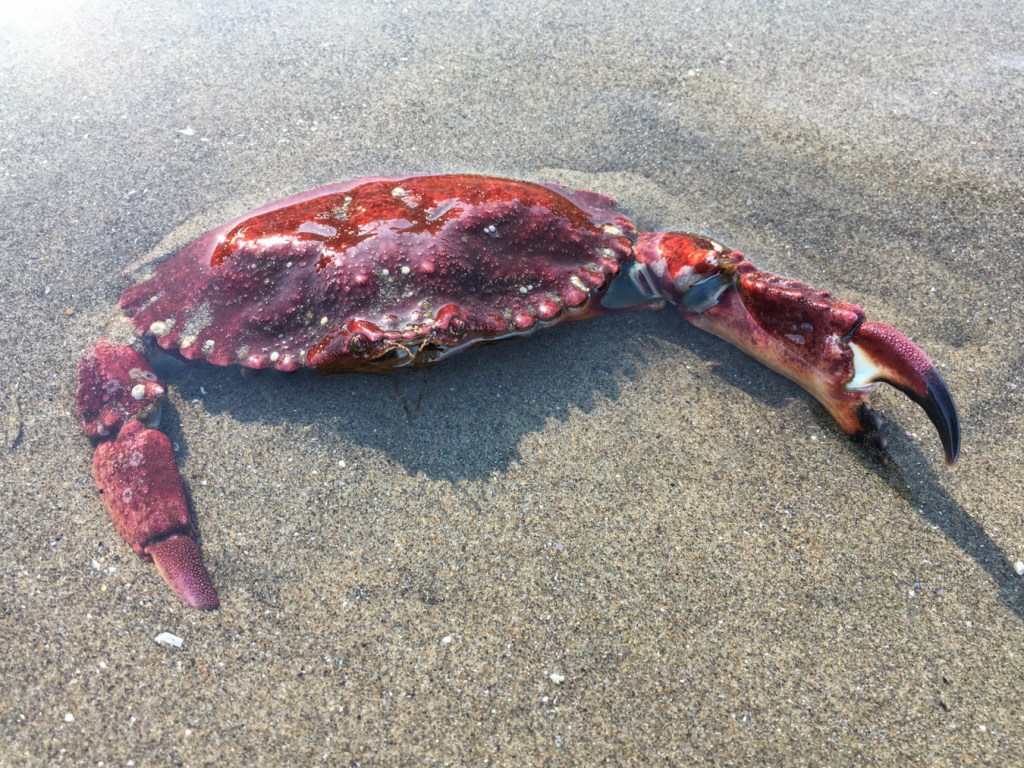

The fabled pinching claw

The color and pattern differences between juveniles and adults can be kind of surprising if you’re not ready for them. Juveniles are variable but their color is usually lighter than adults; it and the pattern change over the course of development.

A drifted carapace

Romaleon antennarium Spot-bellied or Pacific rock crab
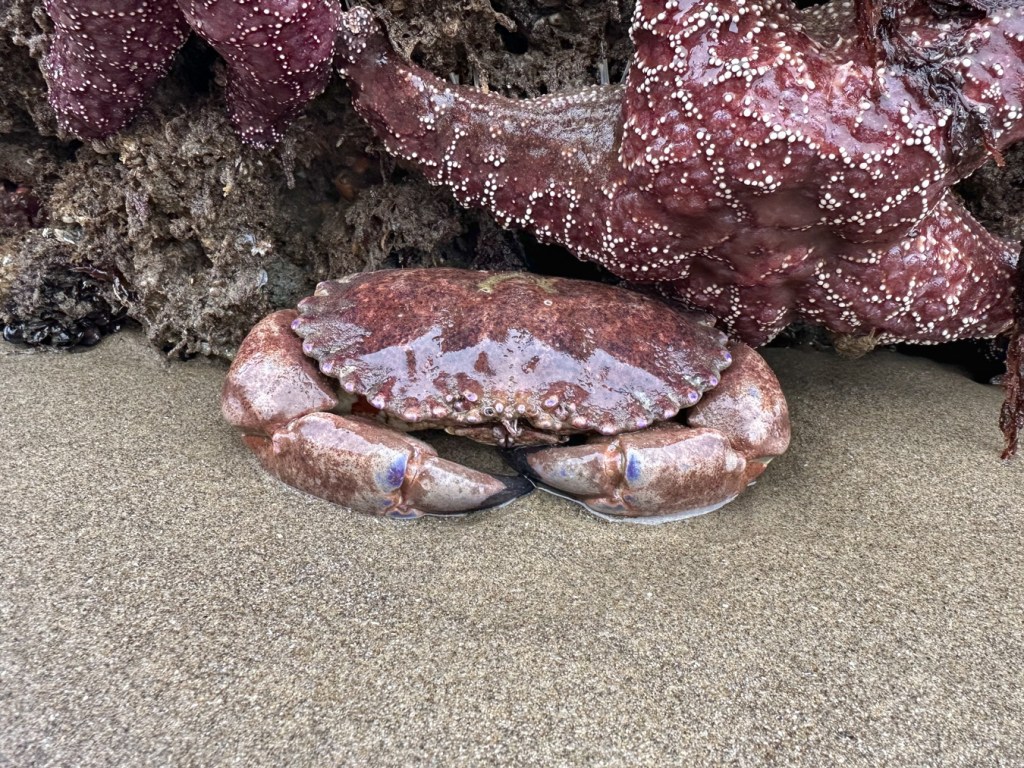

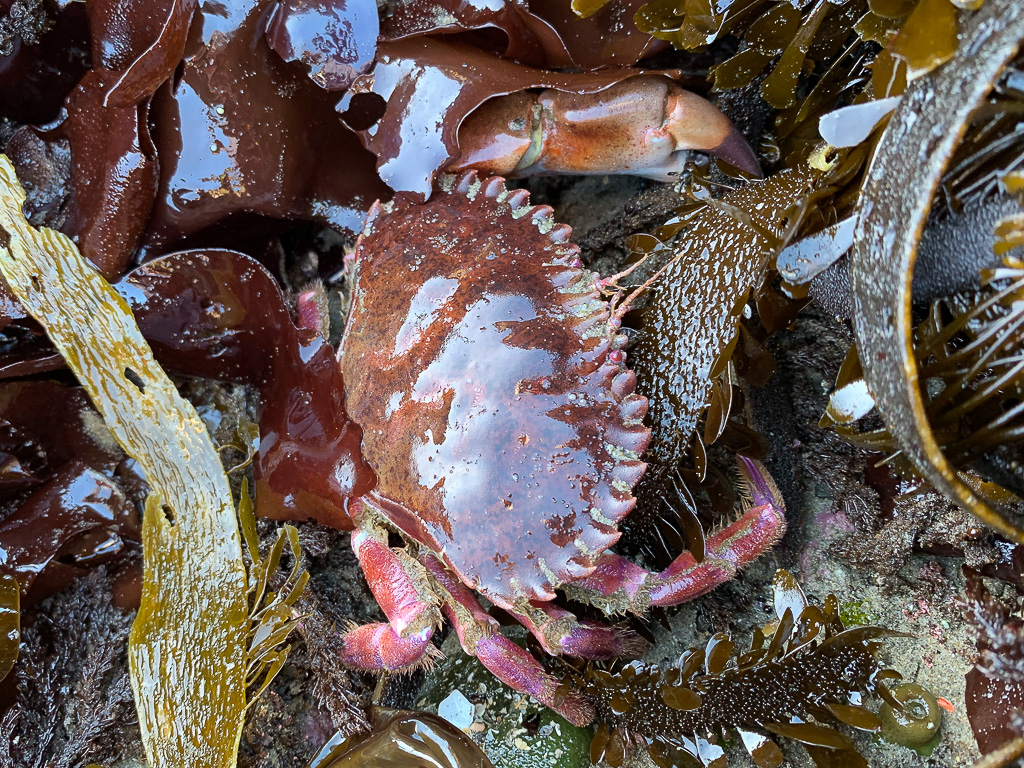


I flipped over these individuals to reveal the namesake belly. The upper right-hand panel shows the narrow abdomen of the male and the bottom panel shows the broader abdomen of the female.
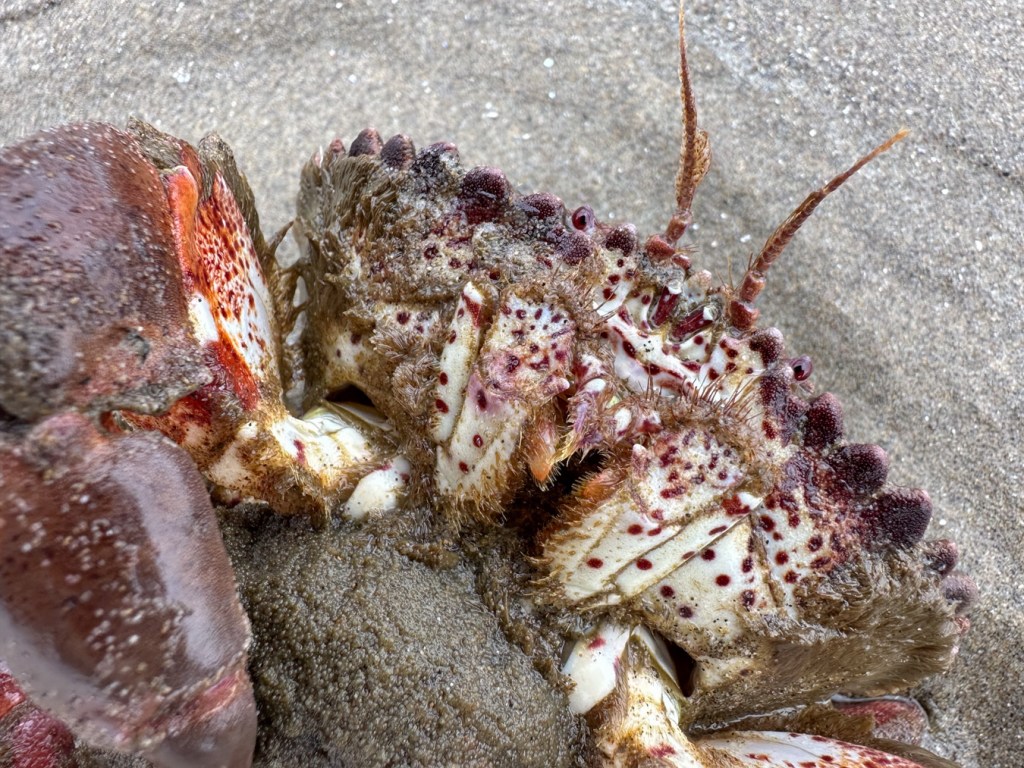
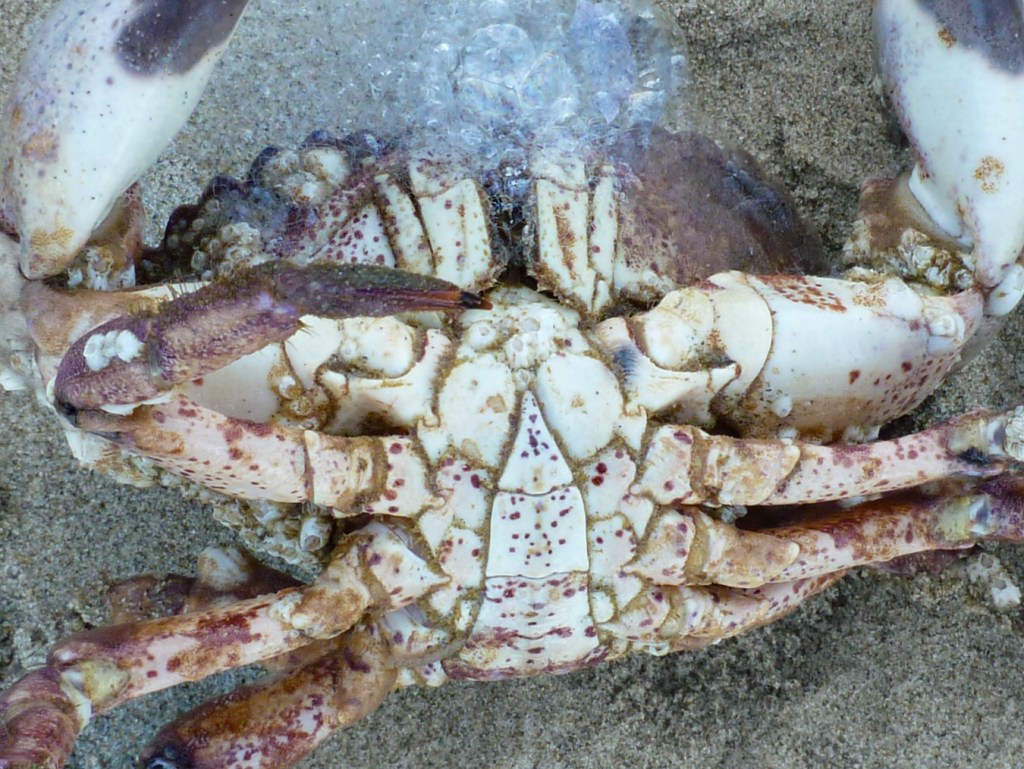

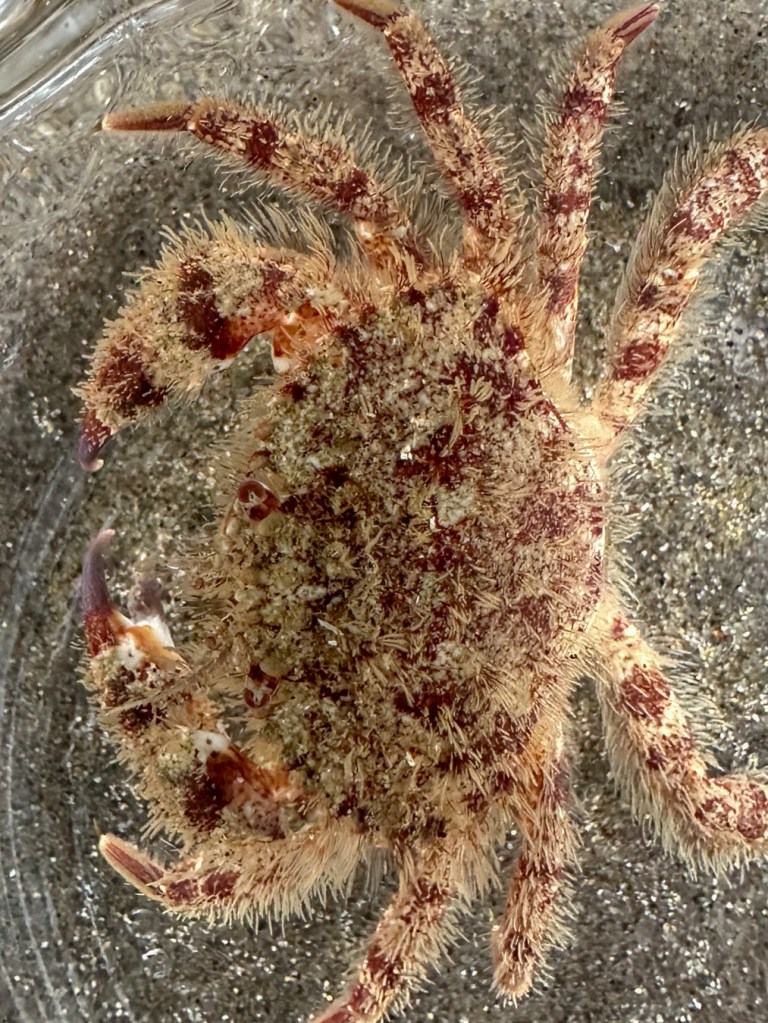
Juvenile spot-bellies have plenty of similarities to adults but one obvious difference is the juveniles are hairier; they have a hairy carapace and their legs seem hairier too.

Spot-belly molts and drifted remains are occasional beach combing finds on the beaches I visit most, but not nearly to the degree seen in the Dungeness crab (see next entry).


Metacarcinus magister Dungeness crab


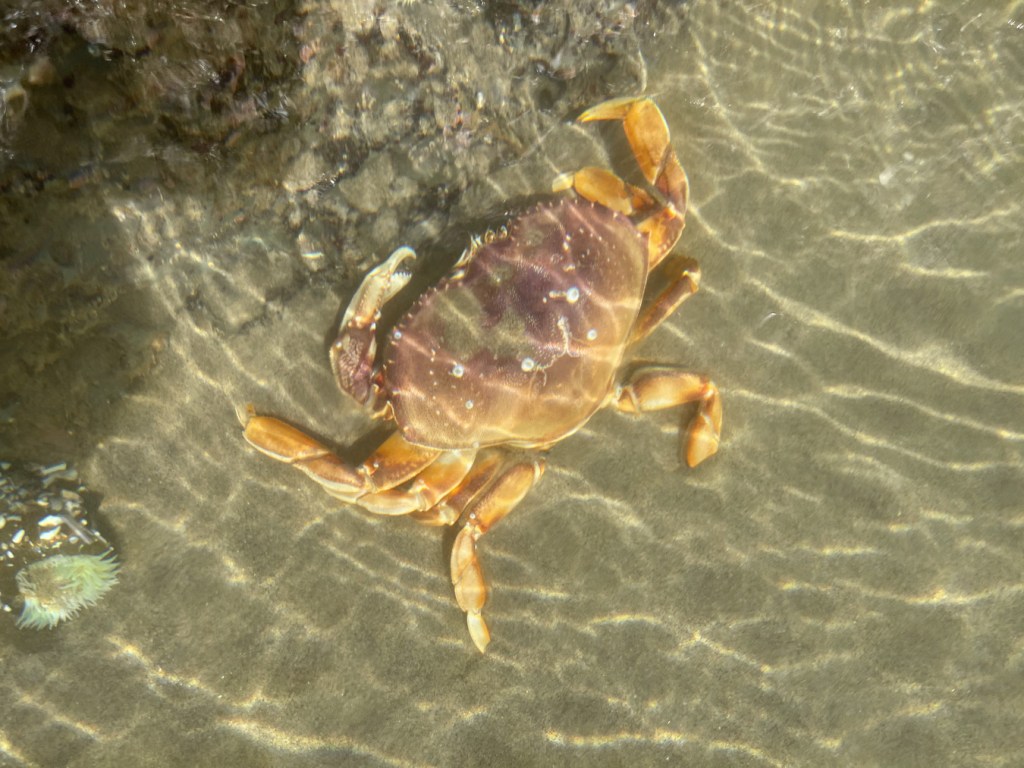
Compare the broad abdomen of the female (left-hand panel) with the narrower abdomen of the male (right-hand panel).
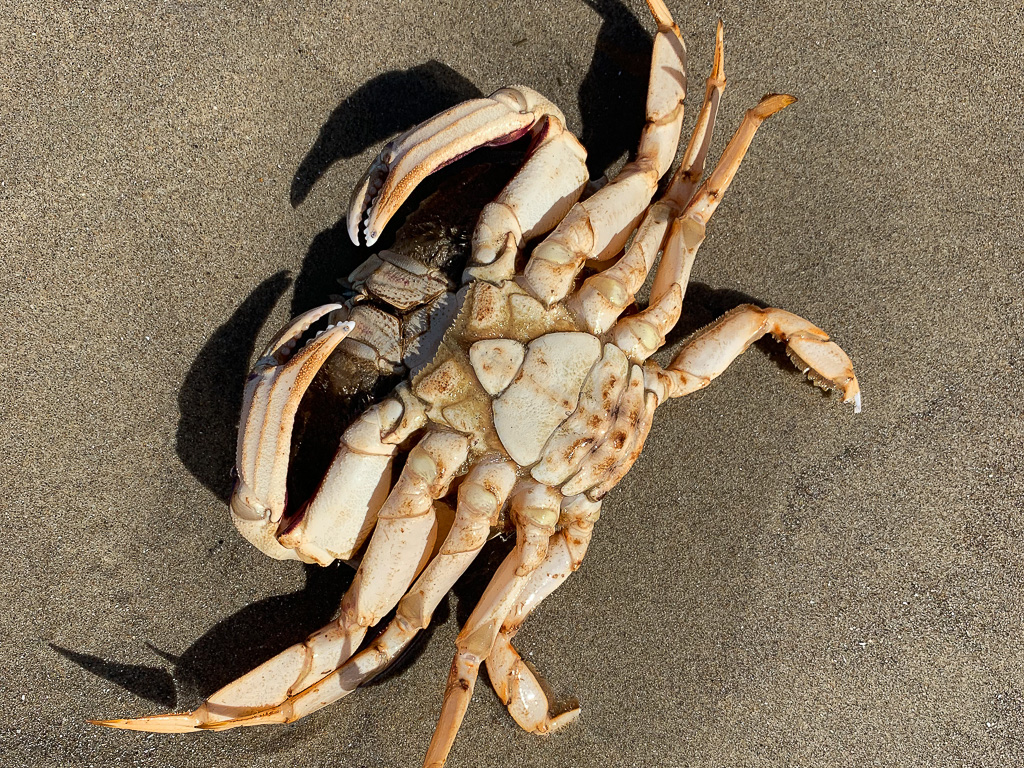
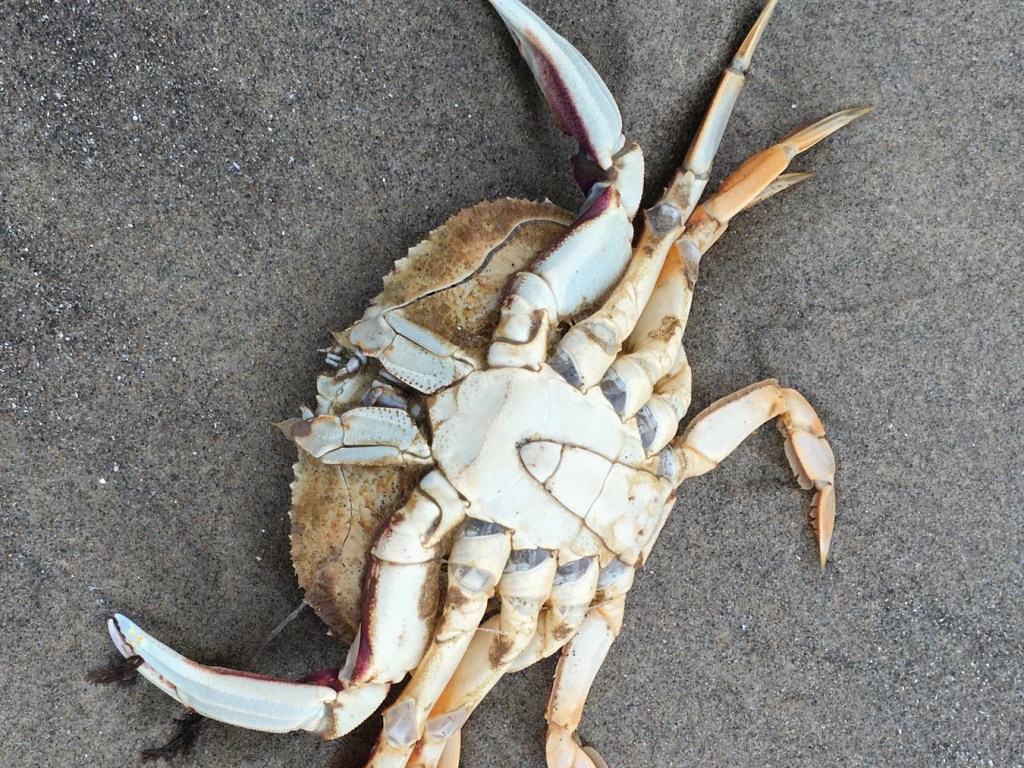
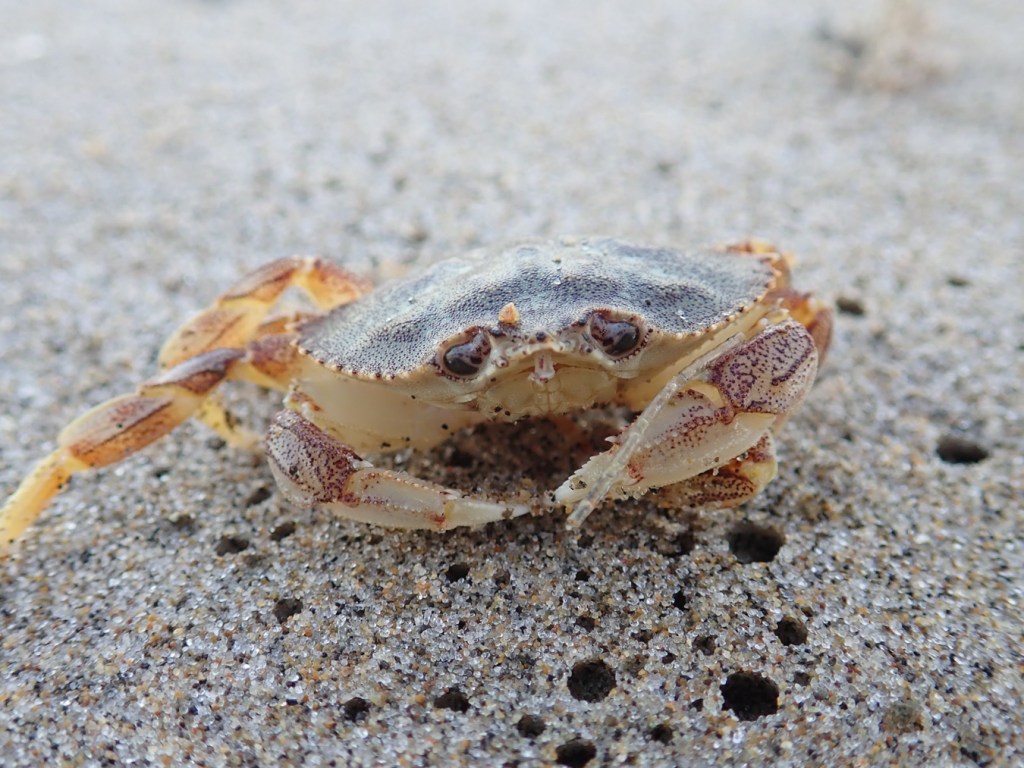
A beachcast babe, only about 3 cm across.

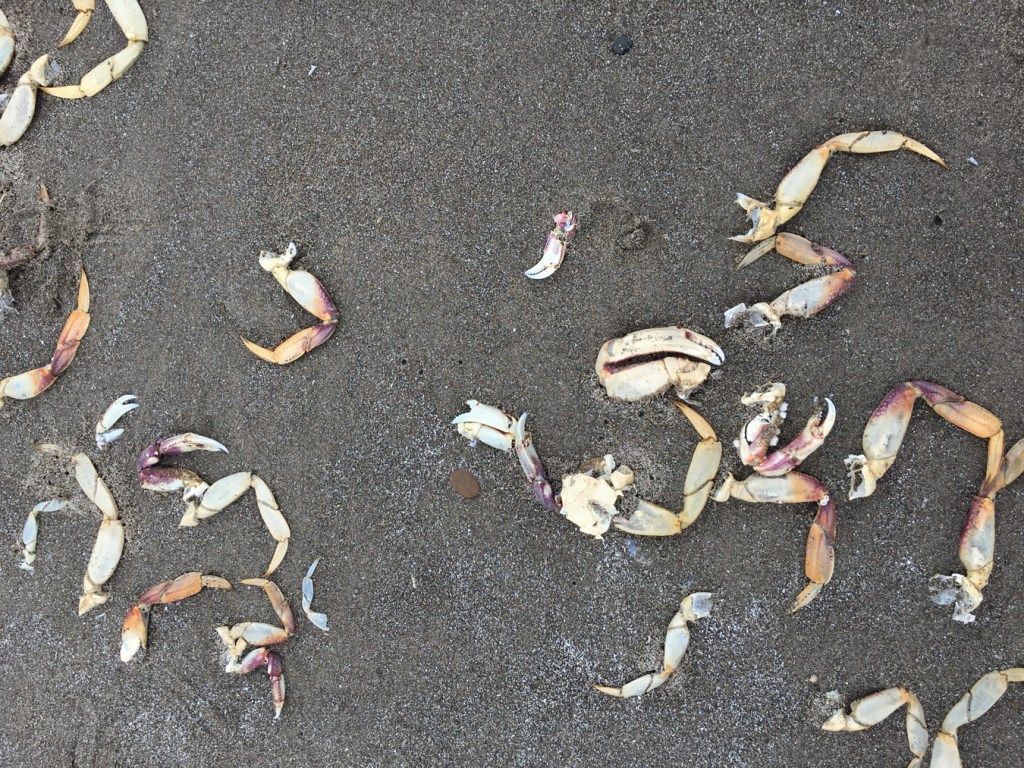
Molts are seasonal, but stray carapaces and pinching claws are abundant year-round on just about any beach.
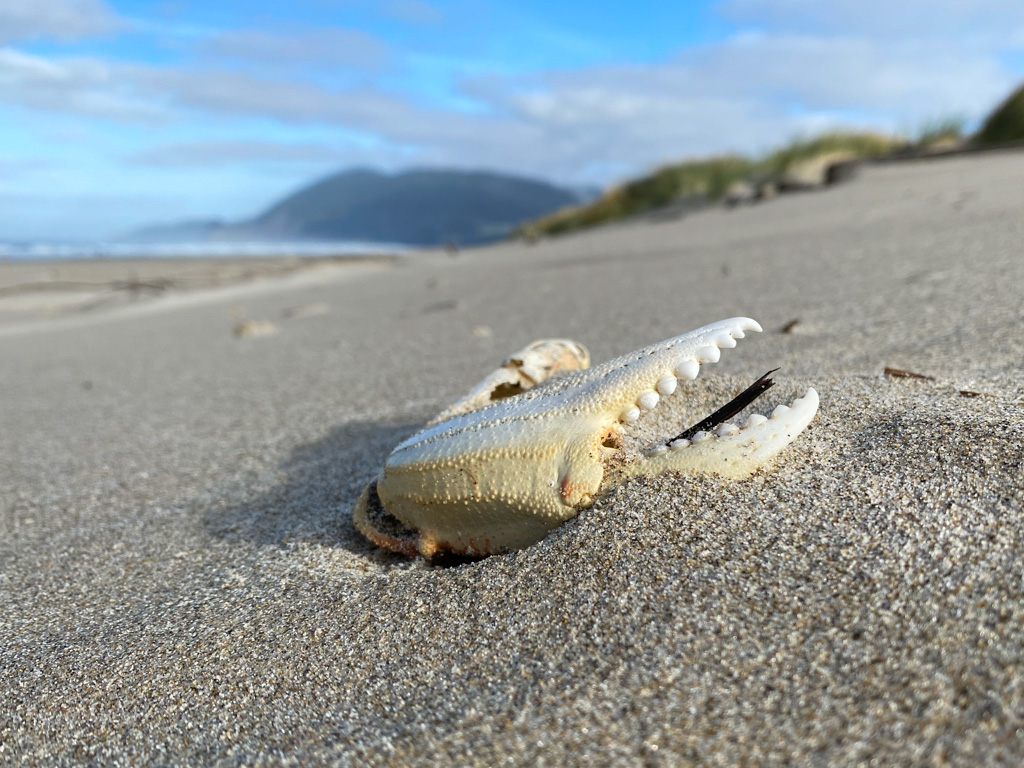


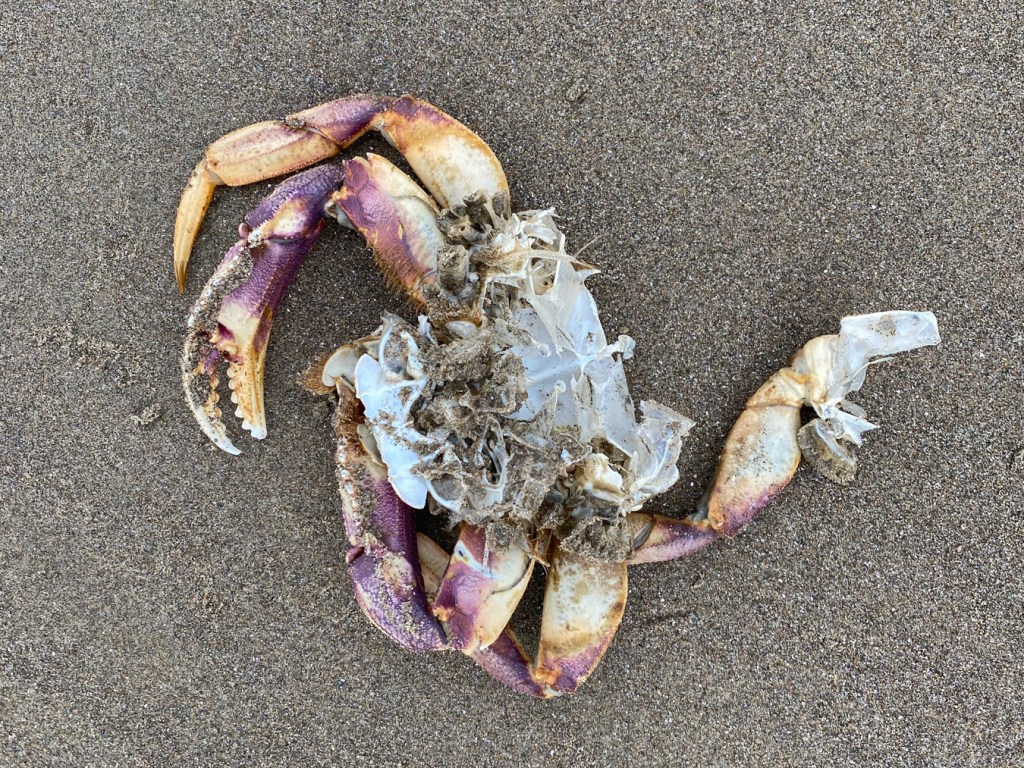
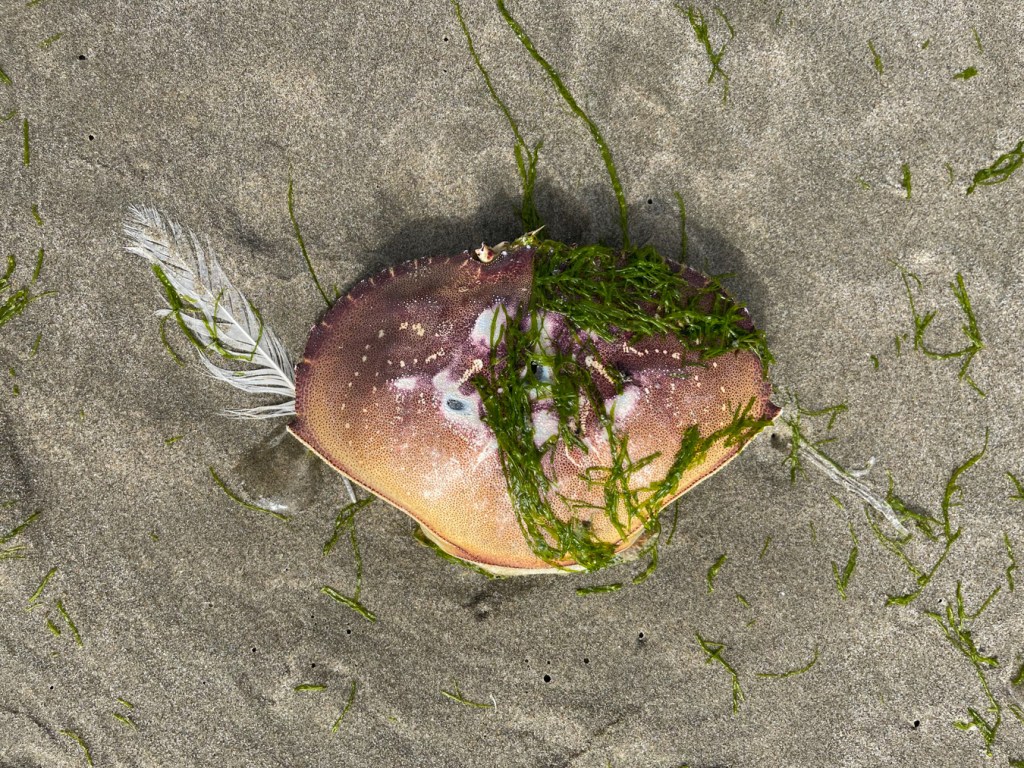


Some beaches become so littered with shells during full-swing molts it can look like a die-off.

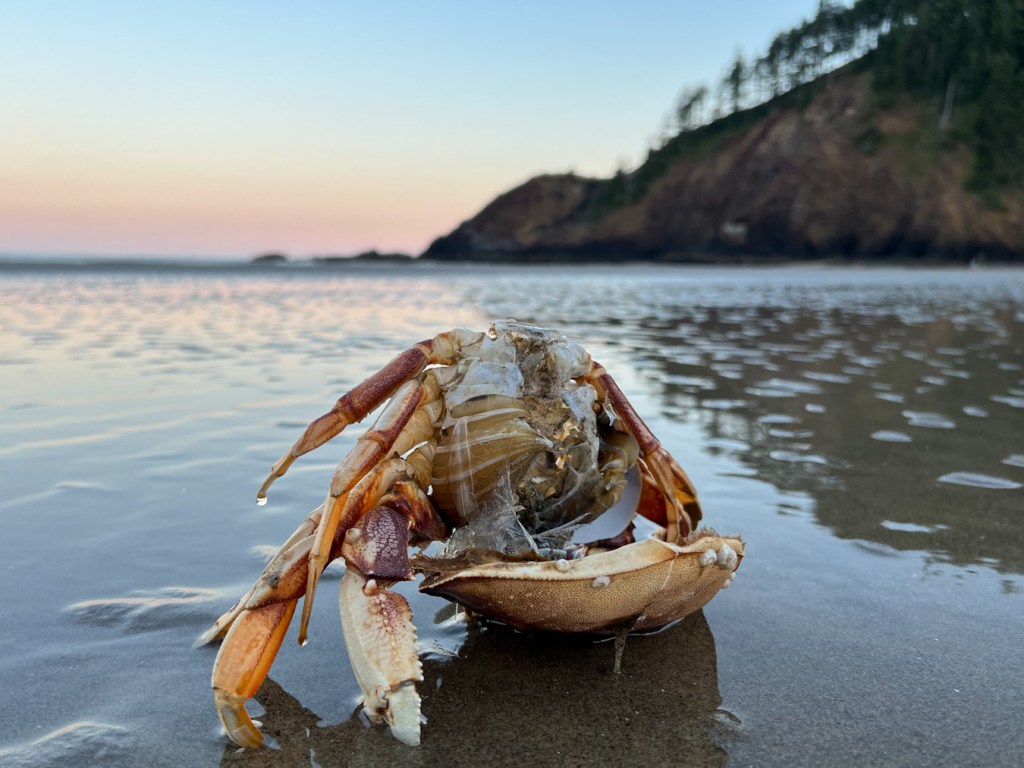
There are occasional intact molts that help you imagine the crab stepping out and leaving the old shell behind.

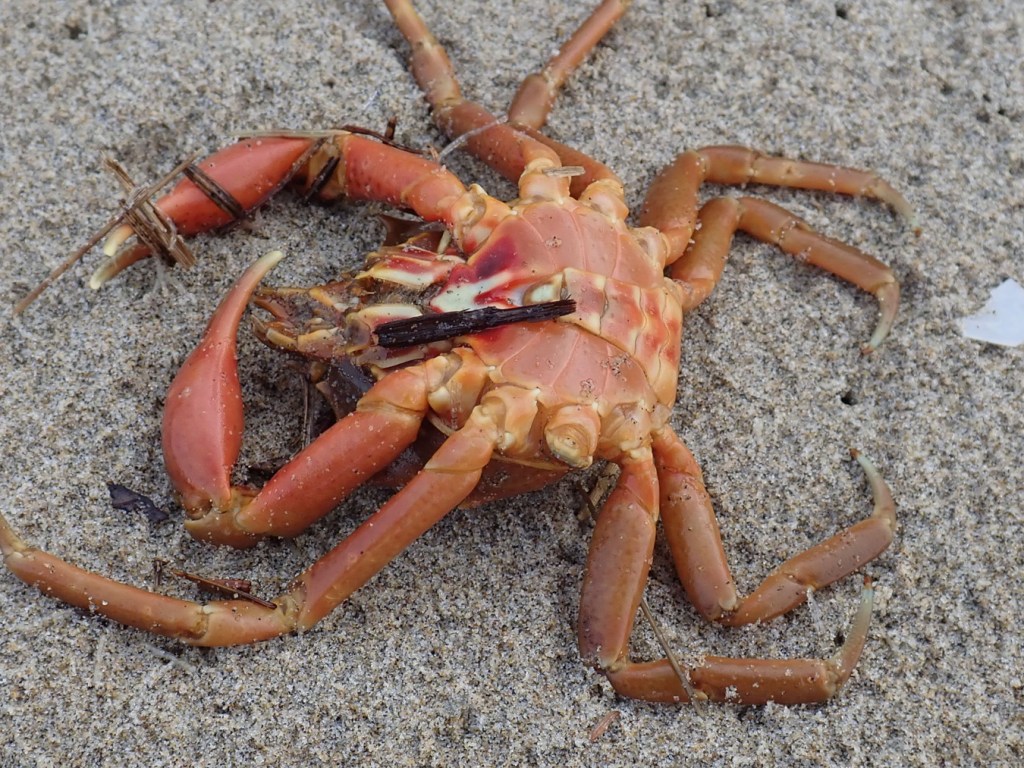
Pugettia producta northern kelp crab


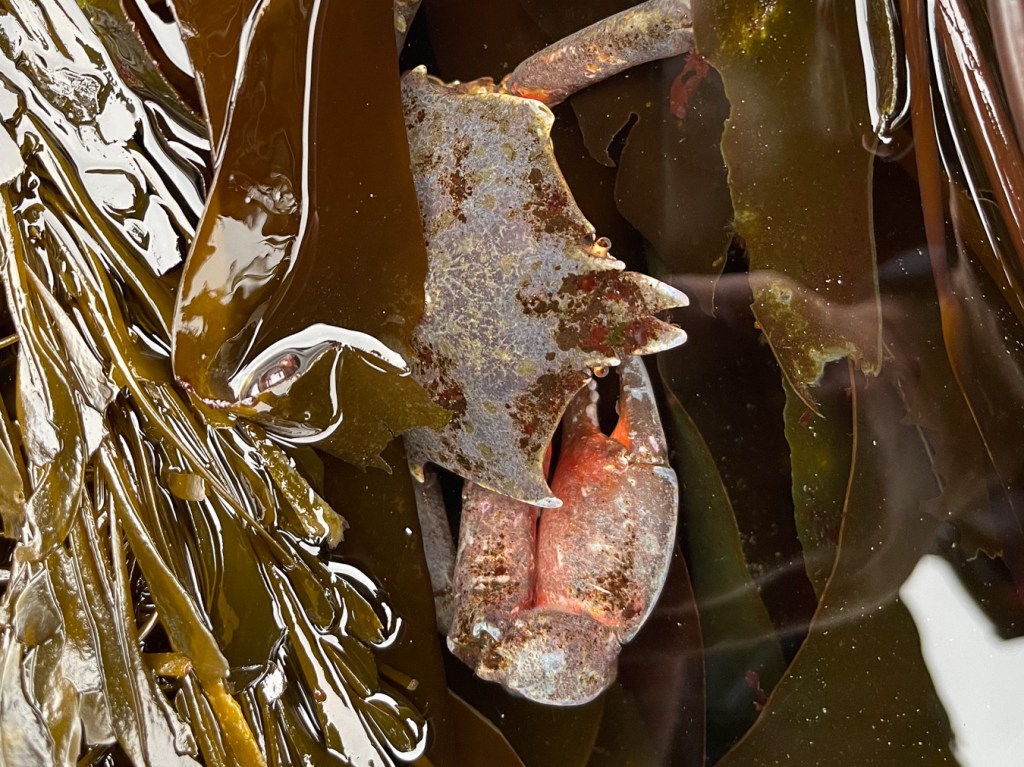
Compare the broad abdomen of the female (left-hand panel) with the narrower abdomen of the male (right-hand panel).

Avian scavengers won’t turn down a kelp crab.
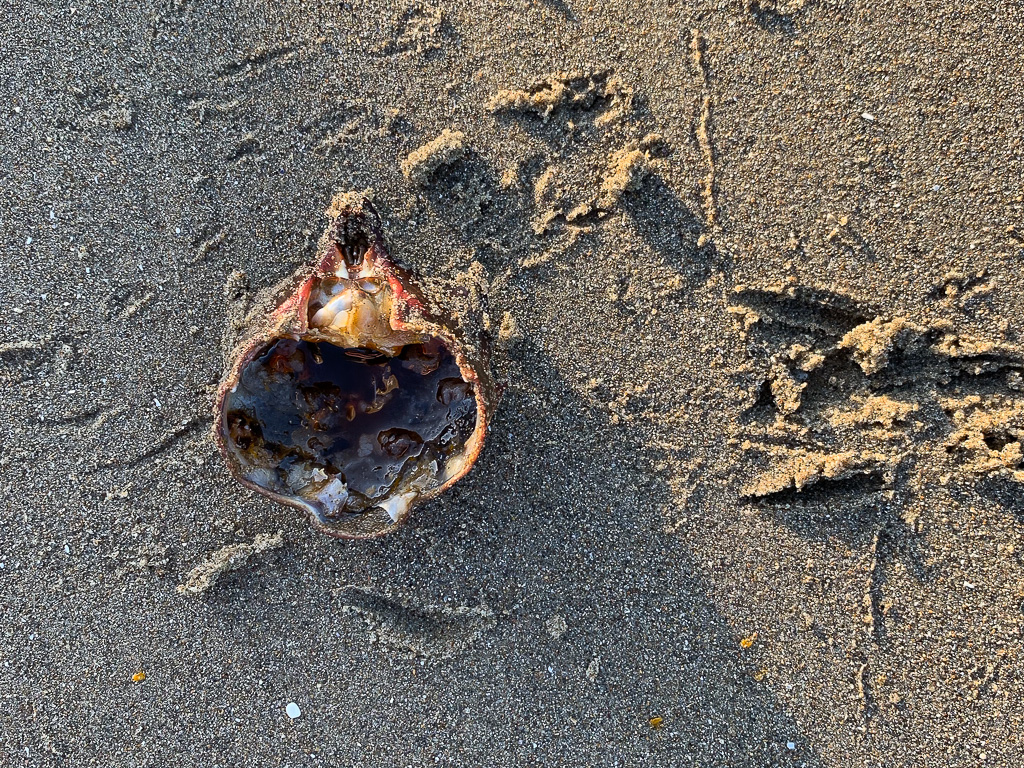
Pugettia gracilis graceful kelp crab
The signature claw
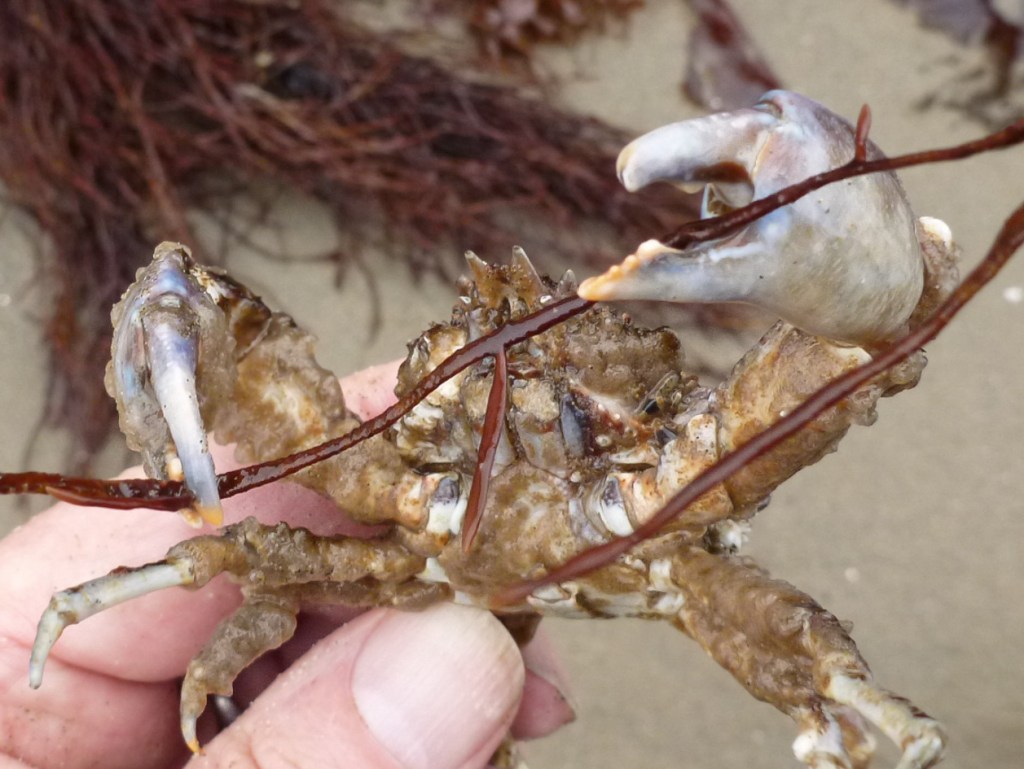
Graceful kelp crabs look out of place on open sand, and indeed they are. When I see it, I feel like they’ve been chivvied by birds taking advantage of a low tide to hunt rarely exposed seaweed-covered rocks. The crab featured below is sparsely decorated, as graceful kelp crabs tend to be, but it sports good seaweed diversity.

Porcelain crabs
If I’ve correctly identified them, the set below compares Petrolisthes eriomerus (top left-hand panel), Petrolisthes cinctipes (top right-hand panel), and Pachycheles rudis (bottom panel). I confess I found the P. eriomerus example under a rock (violating my usual practice of not turning rocks) and moved it onto a patch of adjacent Ulva for a photograph. The other two were photographed as I found them—P. cinctipes out on the sand beneath a mussel-bearing rock, and Pachycheles rudis nestled on the top of a rock where it blended in wonderfully.


Oedignathus inermis Granular claw crab
In the regular view, that is, the view of undisturbed individuals, all you usually get to see is the larger of the two pinching claws, which makes it easy to understand this crab’s common name.
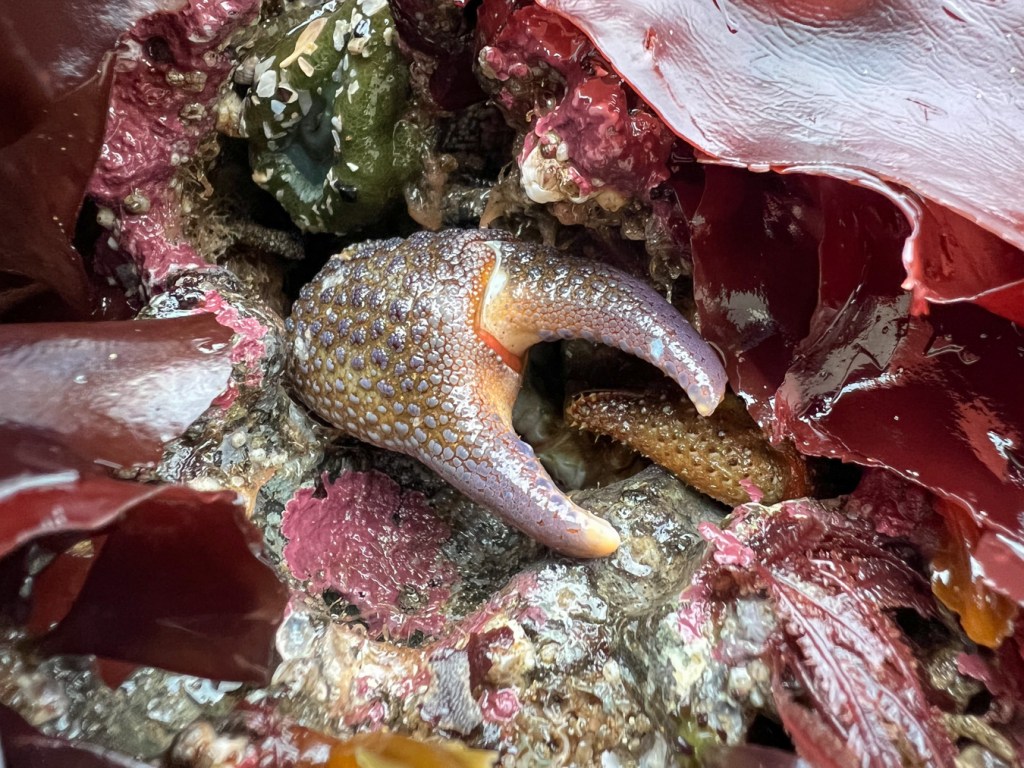
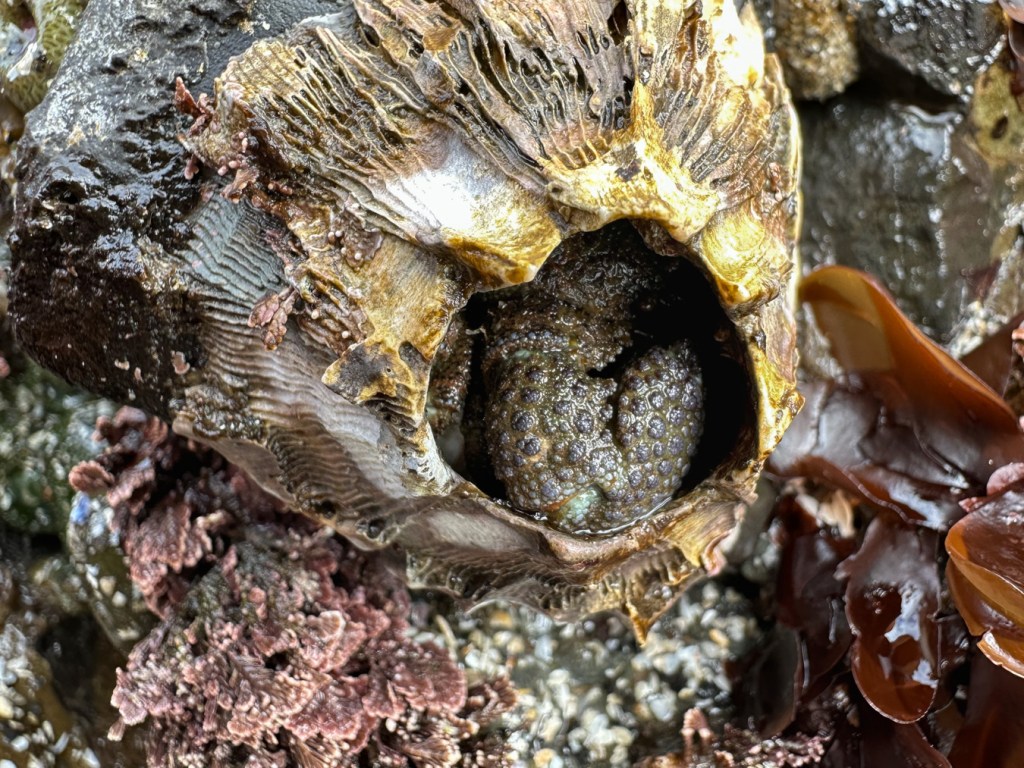
Despite their secretive nature, granular claw crabs seem awfully vulnerable when tides permit avian predators to hunt the low rocks.
You might find discarded remains that look like a whole body, or a claw or other body parts; what you won’t find is the abdomen. That’s the part the birds favor and they won’t willingly leave it behind.


References
Gotshall, D. W. 2005. Guide to Marine Invertebrates, Alaska to Baja California 2nd Edition (Revised). Shoreline Press.
Harbo, R. M. 2011. Whelks to Whales: Coastal Marine Life of the Pacific Northwest. 2nd ed. Harbour Publishing Co.
Jensen, G. C. 1995. Pacific Coast Crabs and Shrimps. Sea Challengers, Monterey.
Kozloff, E. N. 1993. Seashore Life of the Northern Pacific Coast. 3rd ed. University of Washington Press.
Lamb, A. and B. P. Hanby. 2005. Marine Life of the Pacific Northwest. Harbour Publishing.
Sept. J. D. 2019. The New Beachcomber’s Guide to the Pacific Northwest. Harbour Publishing.
Online Resources
Friends of Netarts Bay WEBS Crustaceans page. Accessed August 5, 2023.
It’s worth scrolling down to crabs in Common Sea Life of Southeastern Alaska: A field guide by Aaron Baldwin & Paul Norwood. Accessed August 5, 2023.
Species Accounts
Cowles, D. (2007). Romaleon antennarium (Stimpson), Schweitzer and Feldmann, 2000. Invertebrates of the Salish Sea. Rosario Beach Marine Laboratory. Accessed August 5, 2025.
Cowles, D. (2007). Oedignathus inermis (Stimpson, 1860). Invertebrates of the Salish Sea. Rosario Beach Marine Laboratory. Accessed August 5, 2025.
Cowles, D. (2005). Cancer productus Randall, 1839. Invertebrates of the Salish Sea. Rosario Beach Marine Laboratory. Accessed August 5, 2025.
Cowles, D. (2005). Glebocarcinus oregonensis (Dana), Schweitzer and Feldmann, 2000). Invertebrates of the Salish Sea. Rosario Beach Marine Laboratory. Accessed August 5, 2025.
Cowles, D. (2005). Hemigrapsus nudus (Dana, 1851). Invertebrates of the Salish Sea. Rosario Beach Marine Laboratory. Accessed August 5, 2025.
Cowles, D. (2005). Pachygrapsus crassipes Randall, 1839. Invertebrates of the Salish Sea. Rosario Beach Marine Laboratory. Accessed August 5, 2025.
Cowles, D. (2005 as edited). Pugettia gracilis Dana, 1851. Invertebrates of the Salish Sea. Rosario Beach Marine Laboratory. Accessed August 5, 2025.
Cowles, D. (2005). Pugettia producta (Randall, 1839). Invertebrates of the Salish Sea. Rosario Beach Marine Laboratory. Accessed August 5, 2025.
Cowles, D. (2005). Petrolisthes eriomerus Stimpson, 1871. Invertebrates of the Salish Sea. Rosario Beach Marine Laboratory. Accessed August 5, 2025.
Cowles, D. (2005). Pachycheles rudis Stimpson, 1860. Invertebrates of the Salish Sea. Rosario Beach Marine Laboratory. Accessed August 5, 2025.
Cowles, D. (2006). Petrolisthes cinctipes (Randall, 1839). Invertebrates of the Salish Sea. Rosario Beach Marine Laboratory. Accessed August 5, 2025.
Hiebert, T.C. 2015. Cancer antennarius. In: Oregon Estuarine Invertebrates: Rudys’ Illustrated Guide to Common Species, 3rd ed. T.C. Hiebert, B.A. Butler and A.L. Shanks (eds.). University of Oregon Libraries and Oregon Institute of Marine Biology, Charleston, OR. Accessed August 5, 2025.
Hiebert, T.C. and A. Burgess. 2015. Pugettia producta. In: Oregon Estuarine Invertebrates: Rudys’ Illustrated Guide to Common Species, 3rd ed. T.C. Hiebert, B.A. Butler and A.L. Shanks (eds.). University of Oregon Libraries and Oregon Institute of Marine Biology, Charleston, OR. Accessed August 5, 2025.
Maxwell, J. (2002 as edited). Metacarcinus magister (Dana, 1852) Schweitzer and Feldmann, 2000. Invertebrates of the Salish Sea. Rosario Beach Marine Laboratory. Accessed August 5, 2025.
I updated this page on August 5, 2025.
 theoutershores