
Below are some red seaweeds I’ve been lucky enough to find and photograph on Oregon’s exposed rocky shores or washed up on the beaches. I’ve organized them loosely after Lamb and Hanby (2005) in the order they might be encountered from highest to lowest in the intertidal. The photos are from northern Oregon unless noted. If I use common names, they’re my choice. Experts cover the seaweeds shown below and many more in the books, field guides, and identification resources listed at the bottom of the page.
Let’s explore some reds!
Pyropia
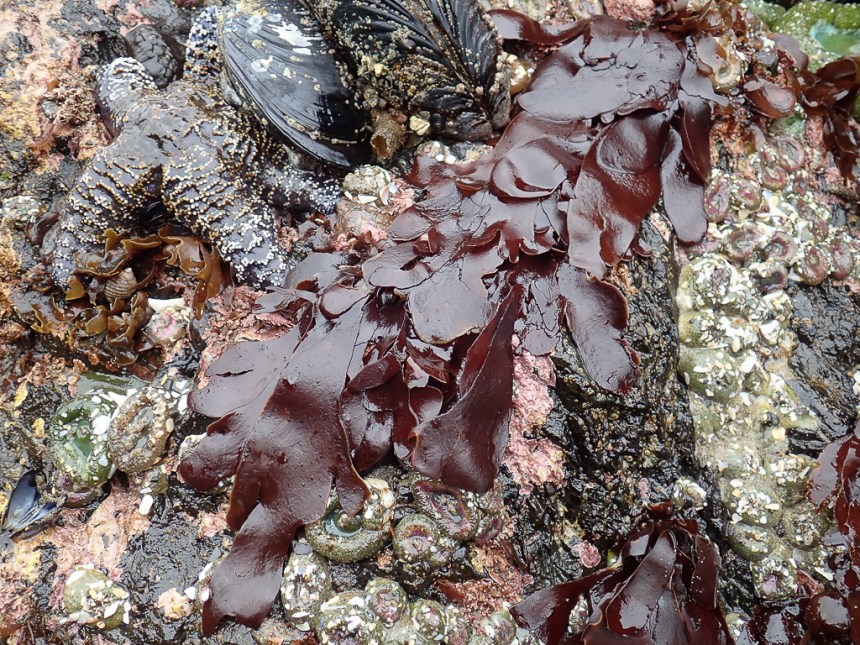
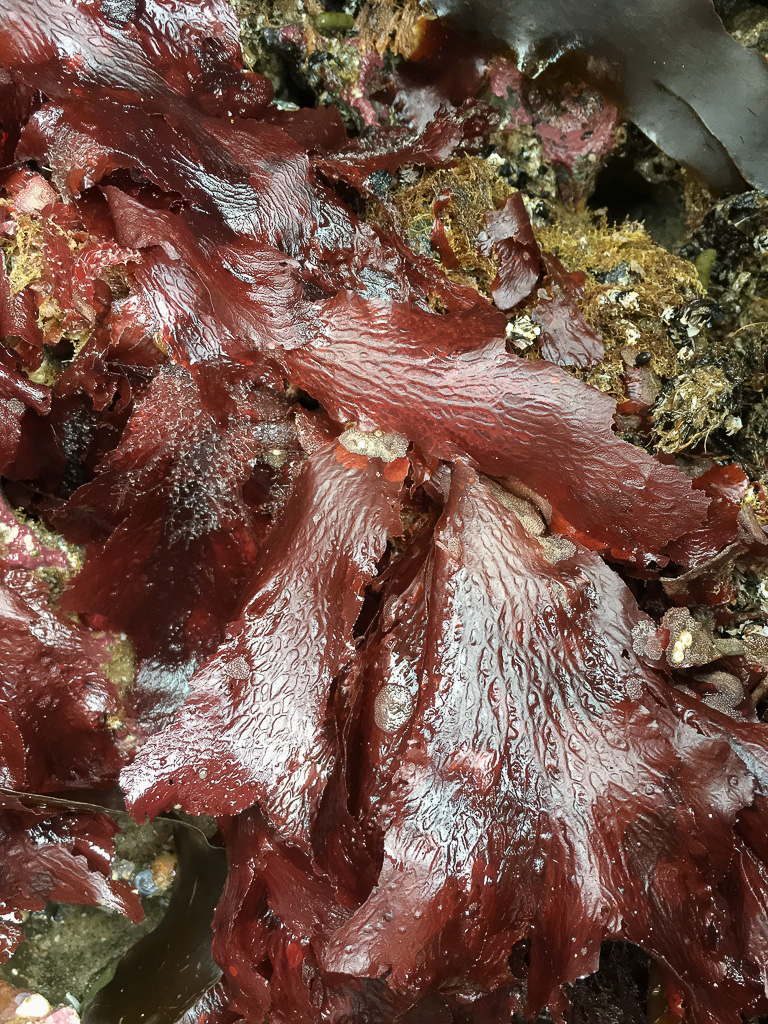
There are plenty of species and I haven’t had much luck sorting them out, so in the set below, I show a range of examples from the mid and high intertidal. Pyropia leans toward iridescence, but its degree is variable. Kozloff says they appear oiled. You’ll see that in some of the images. The examples I show have either a ruffled or wrinkled character to varying degrees.


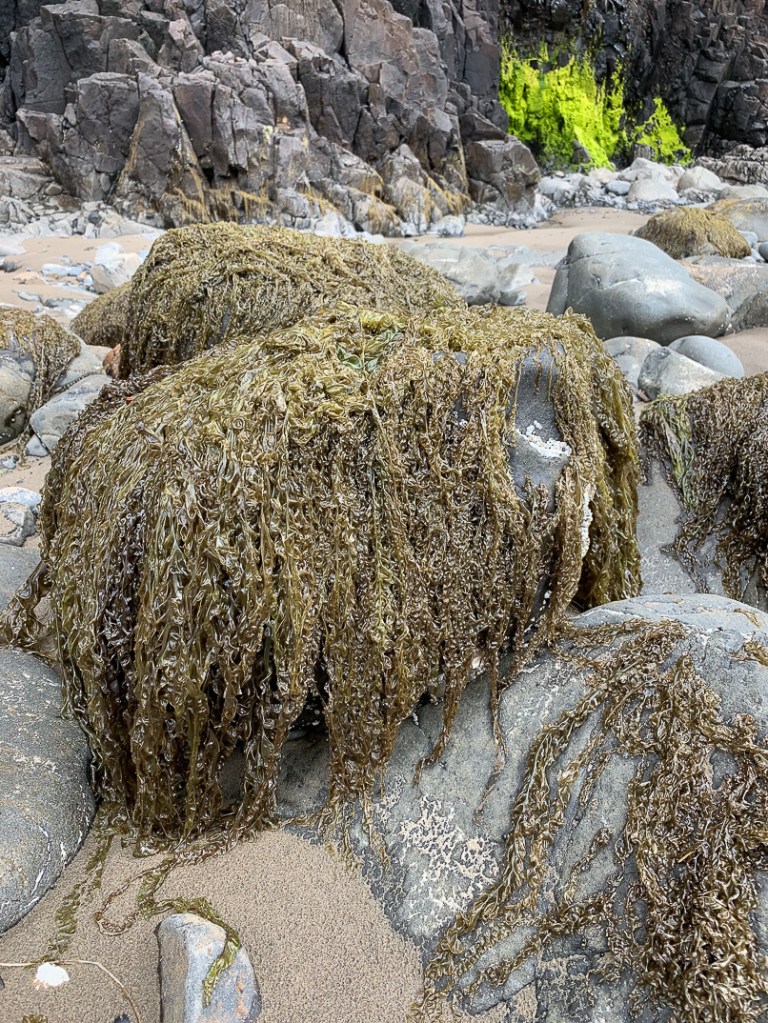

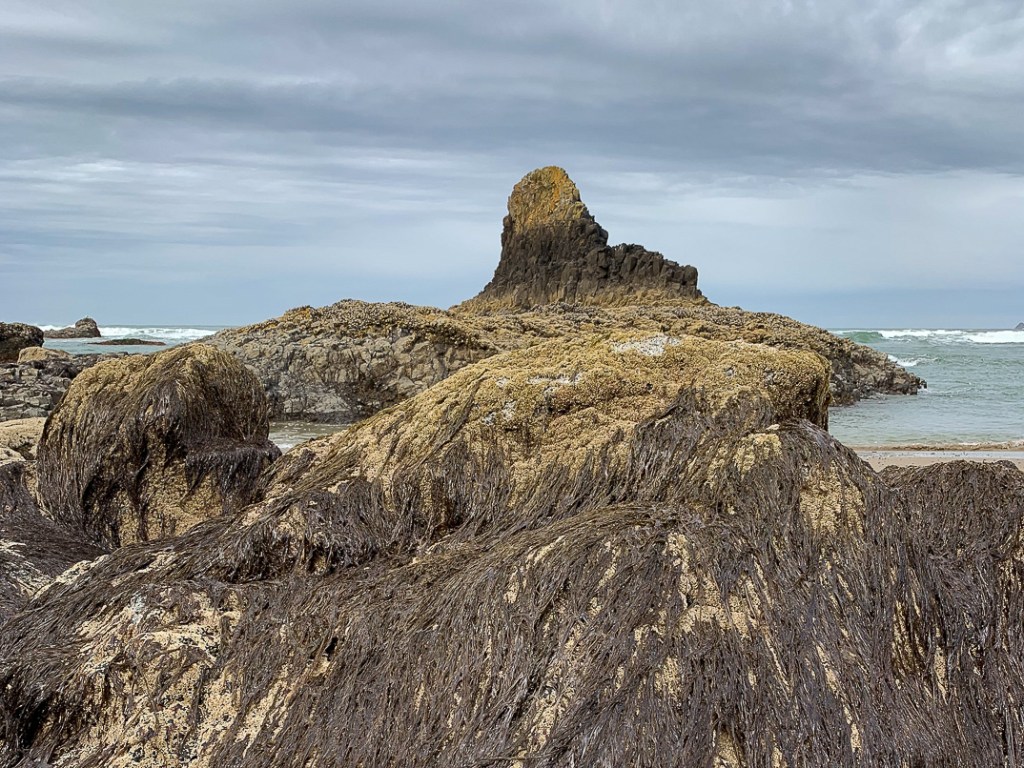
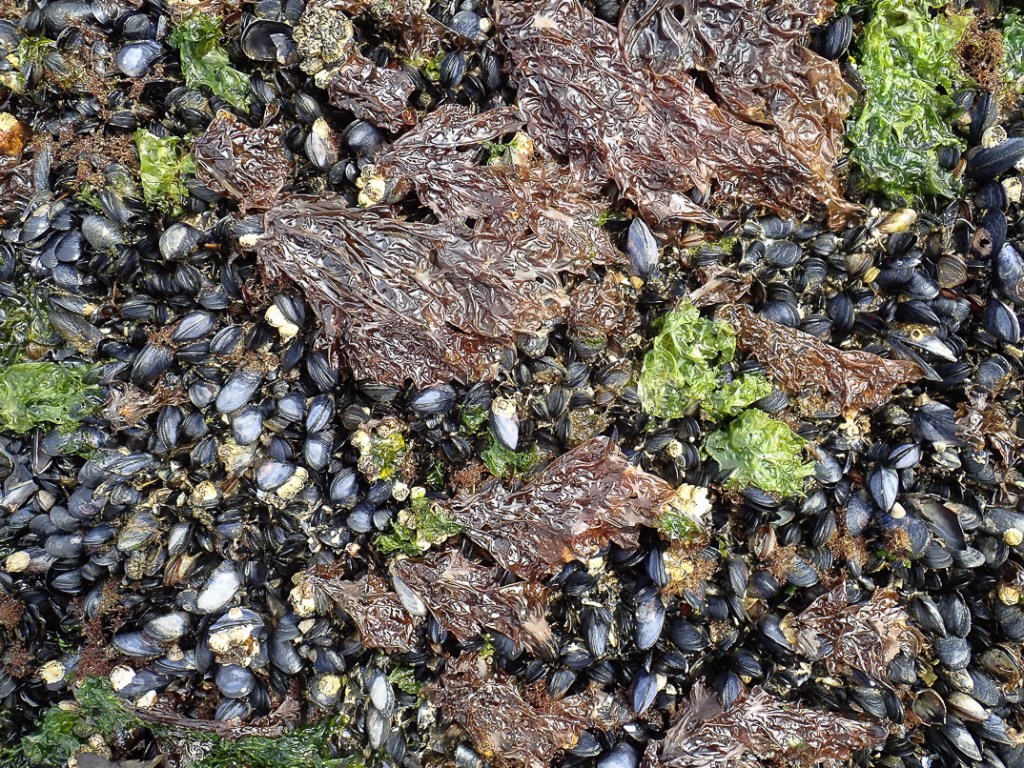

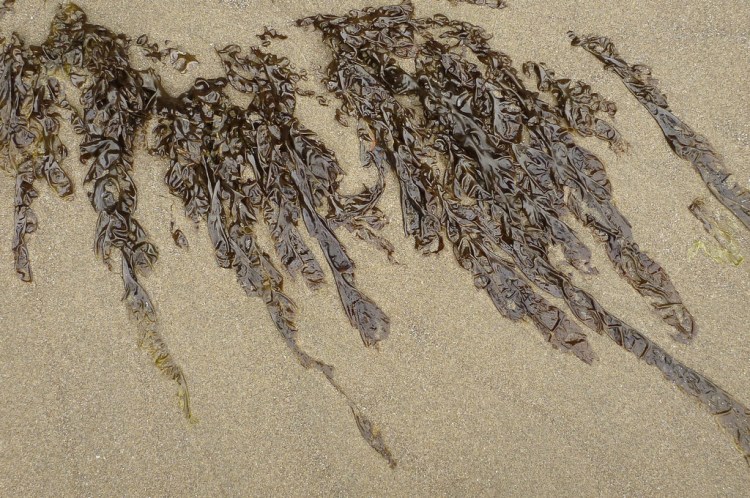
It’s pretty common to find drifted fragments washed up on the beach.


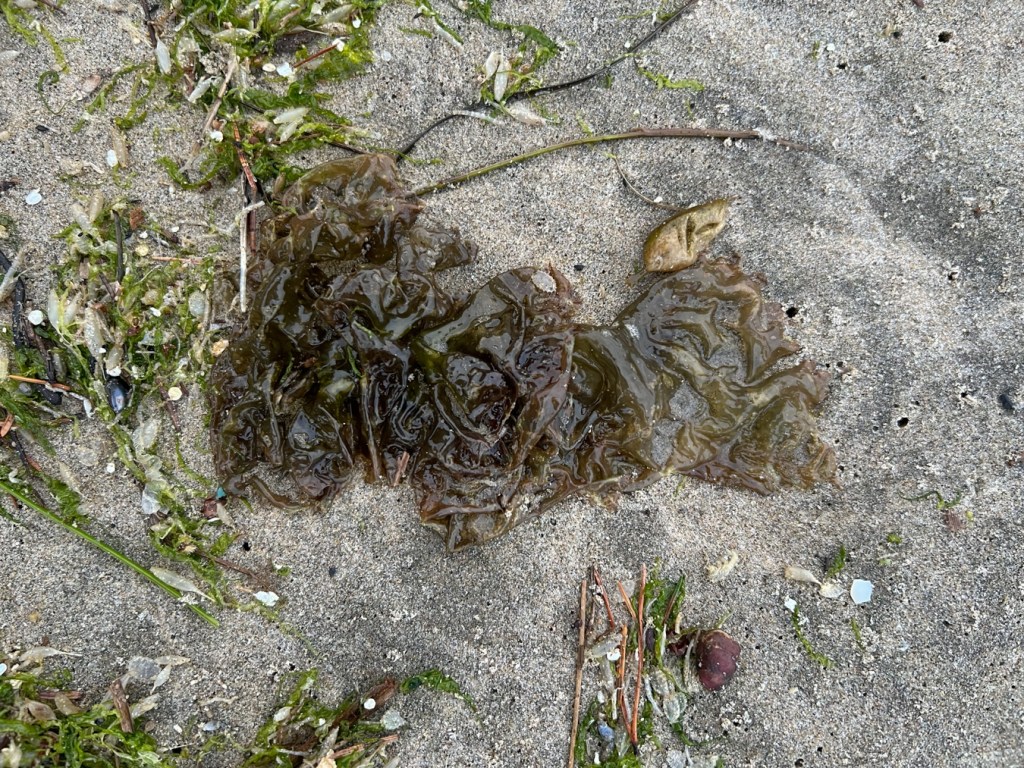

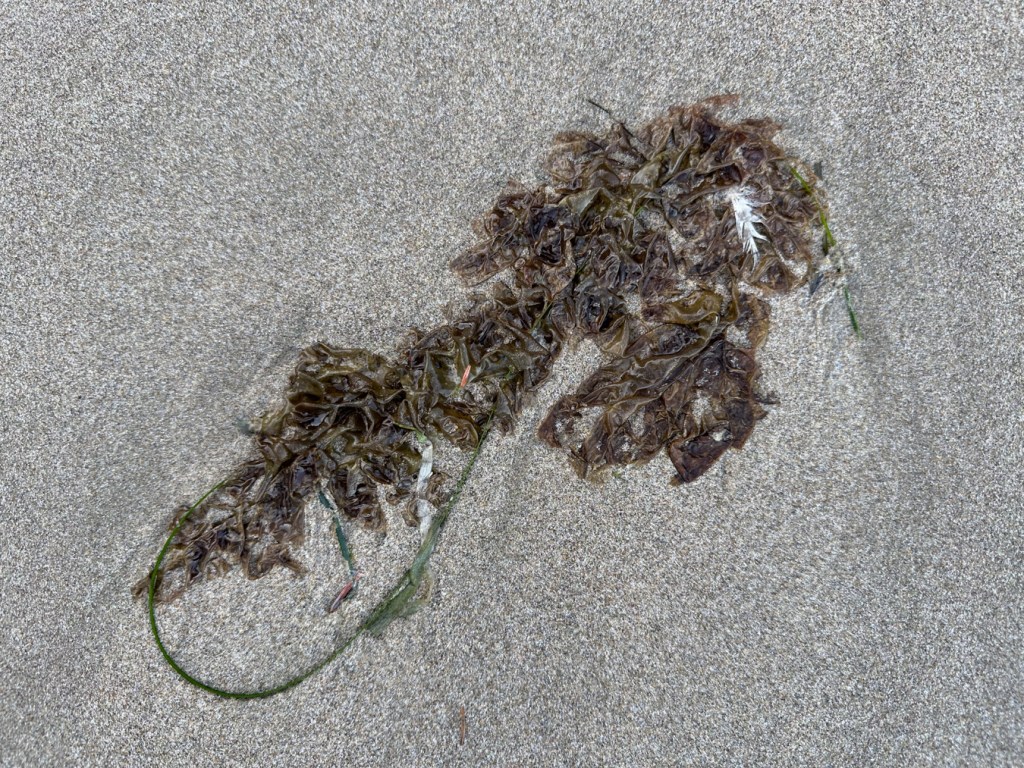
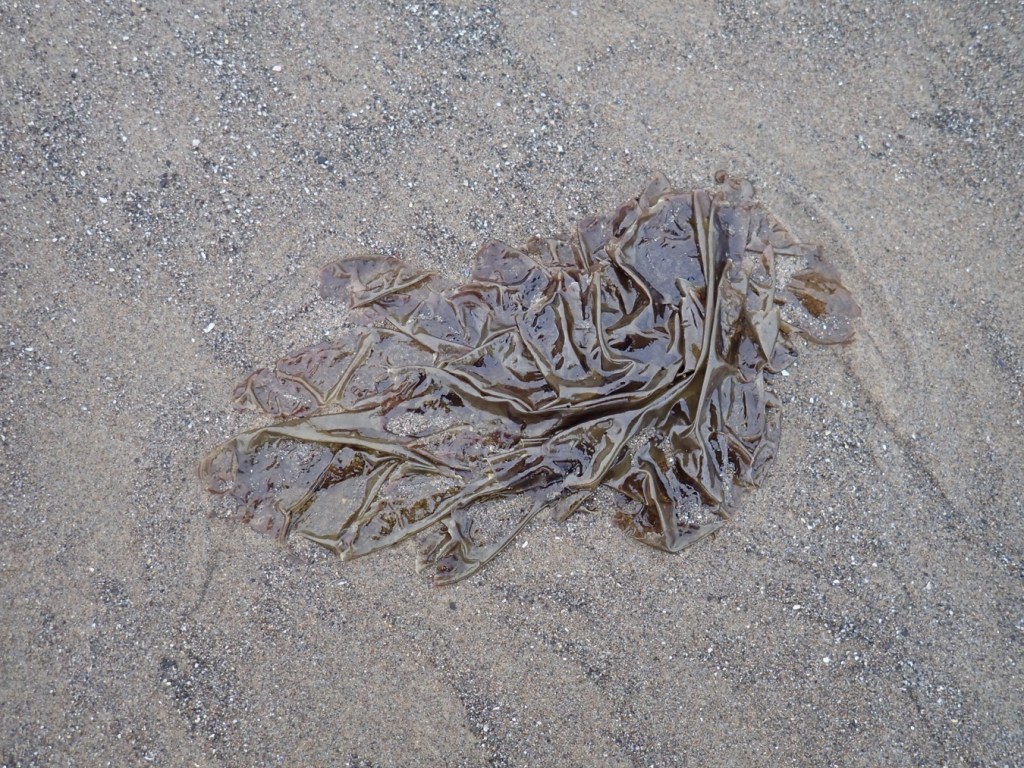


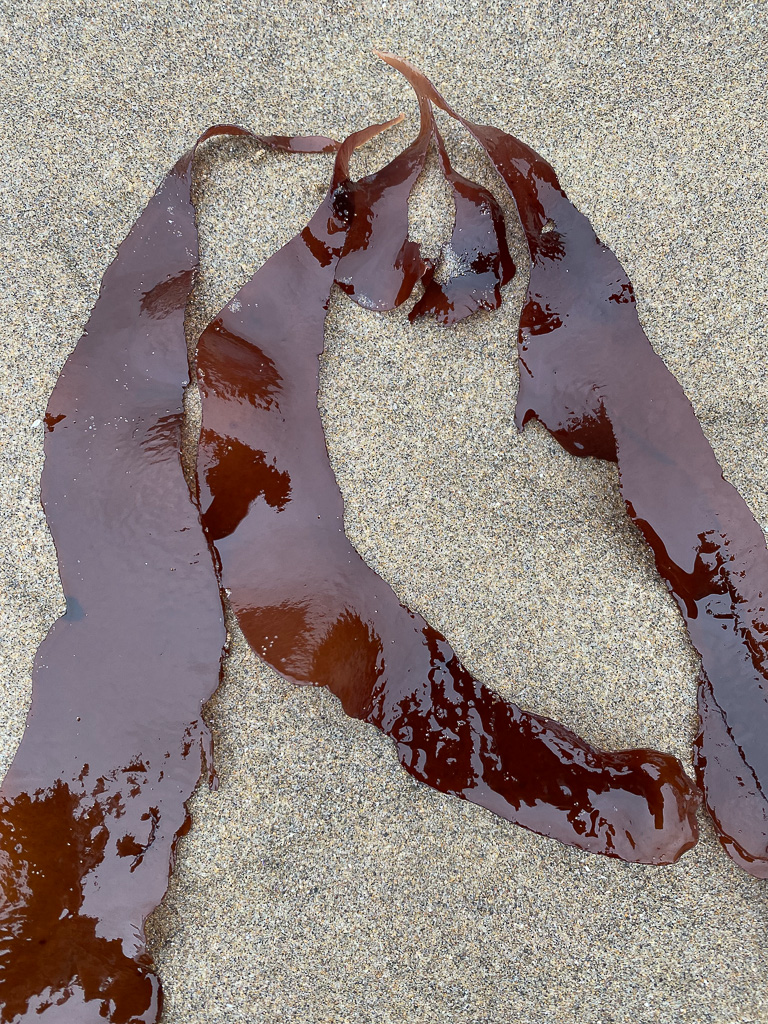
Here’s a long red blade to add to the mix. Is it Pyropia, Wildemaina, or something else? These were found a bit lower than most of the examples shown above. The longest blades are a meter, maybe a little more, in length.
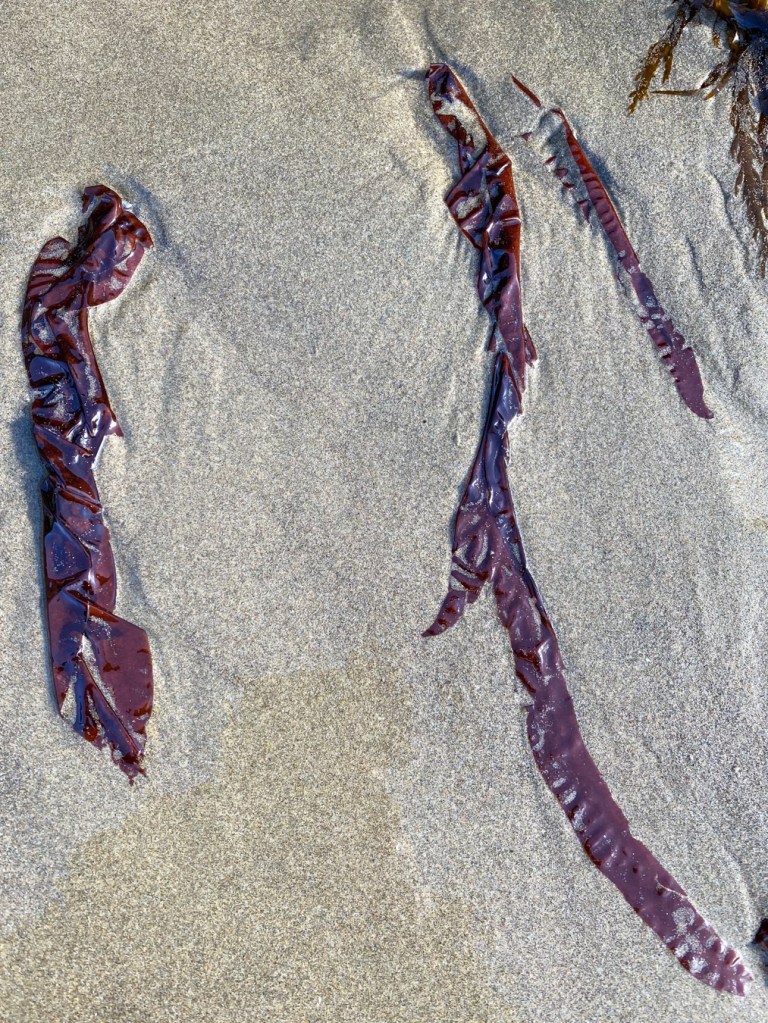

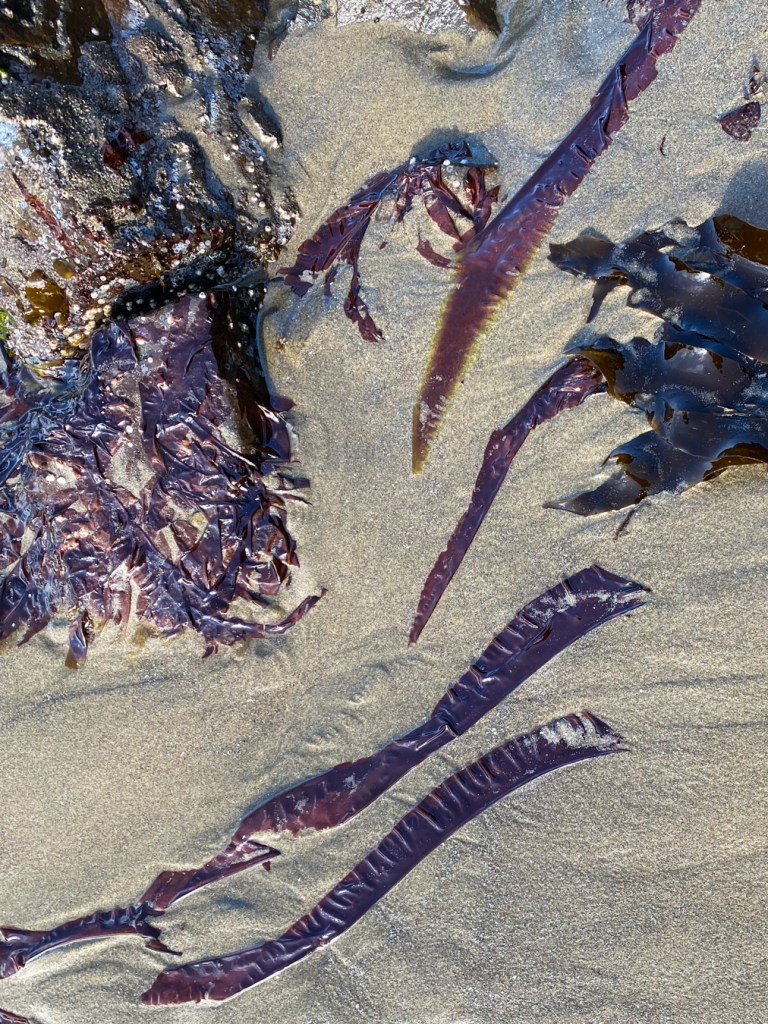

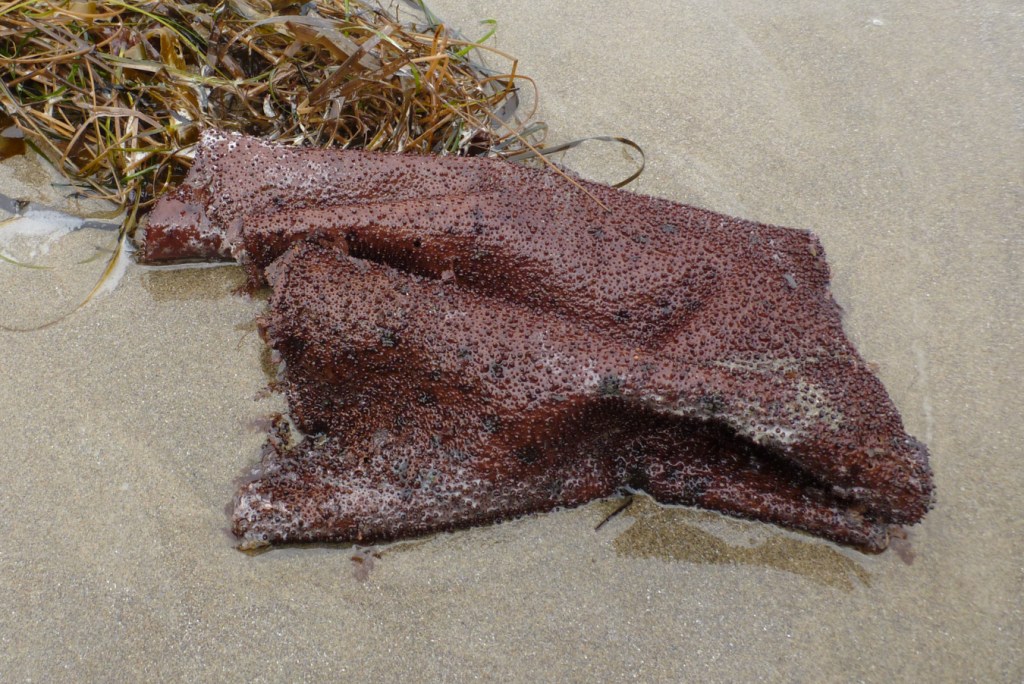
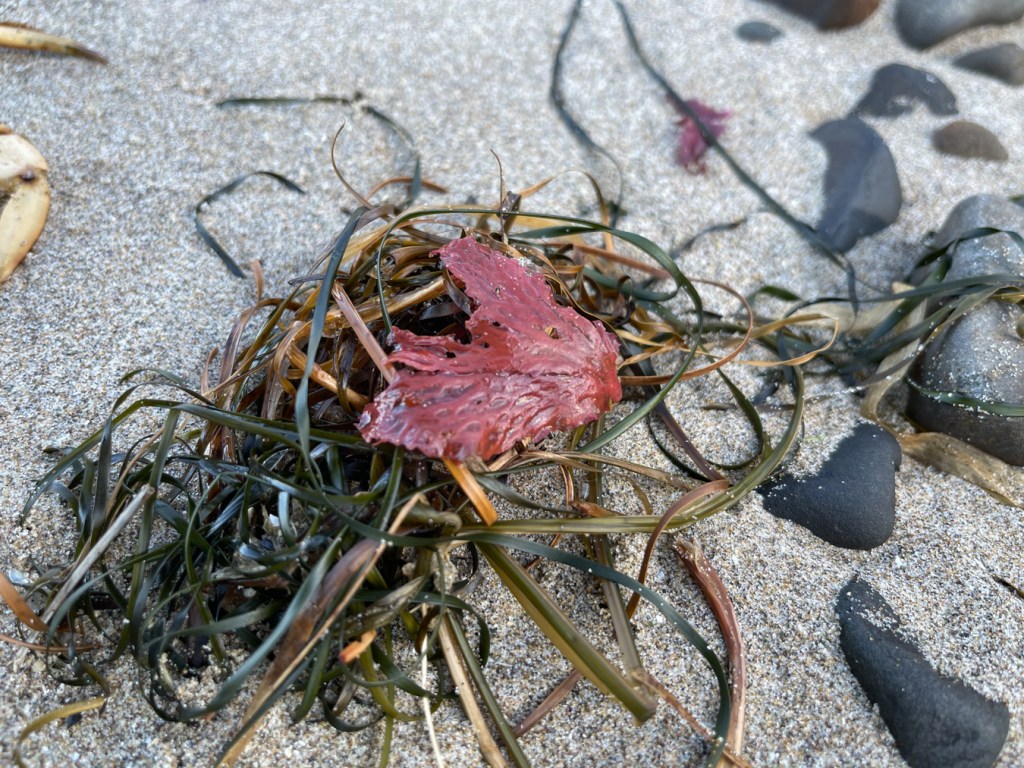
Sticking with the red theme, below, a broad drifted blade I found washed up on the beach.

Bangia
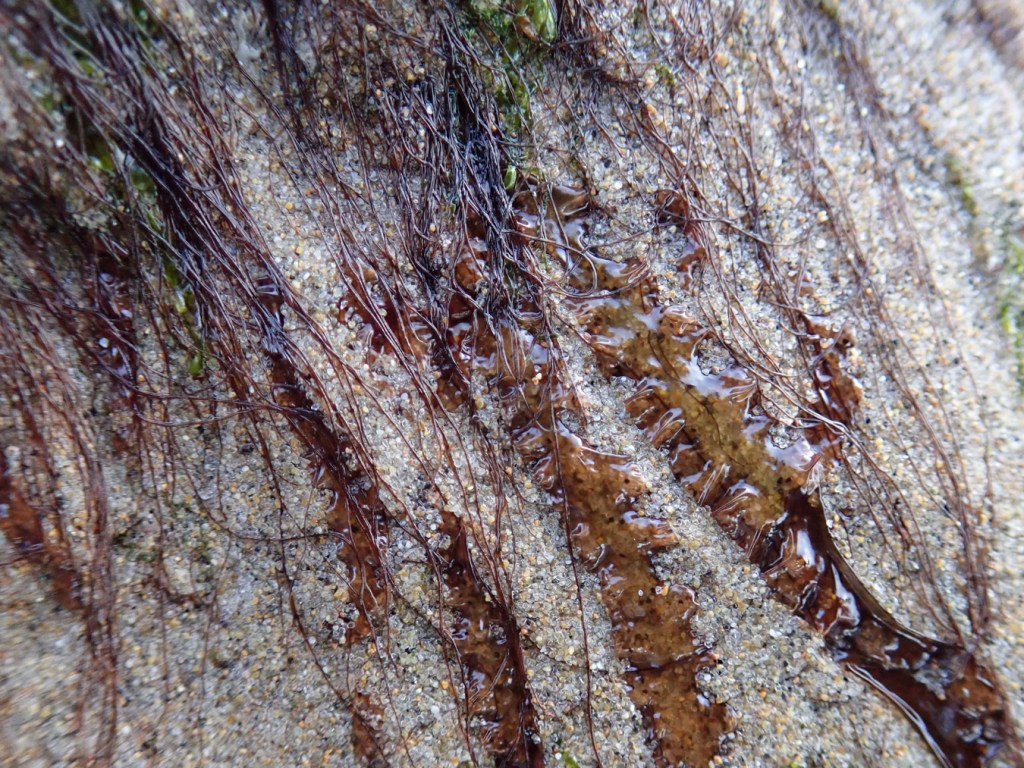
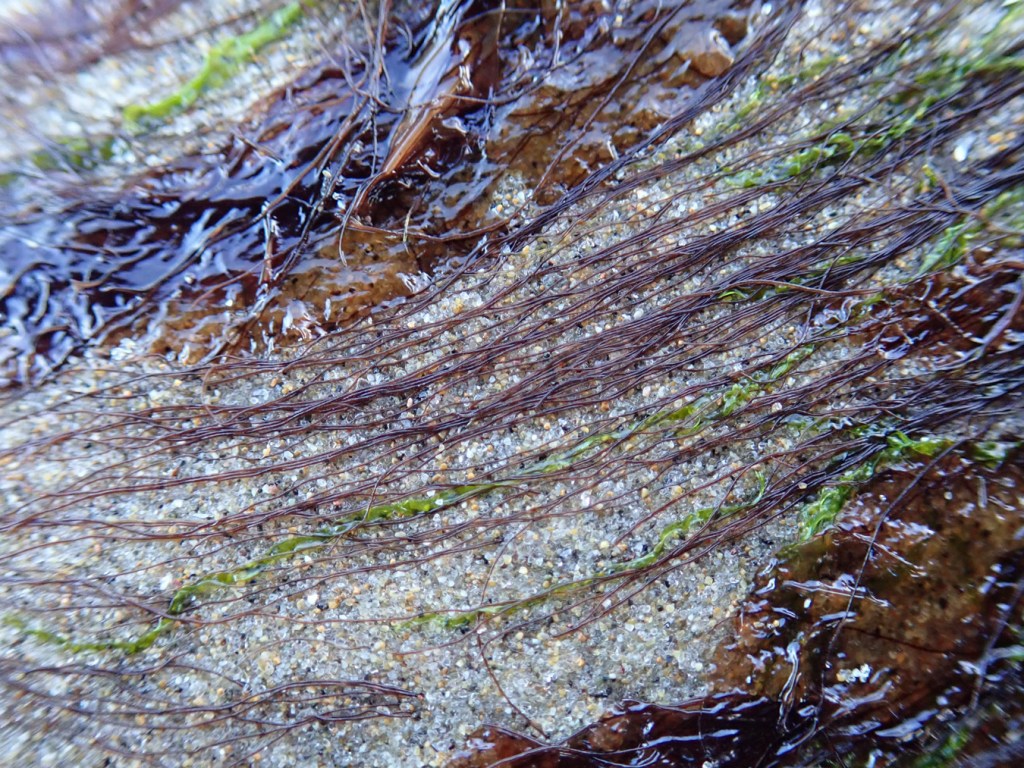
You’ll find Bangia or Bangia-like filaments on rounded high intertidal rocks, where it looks and behaves like thinning human hair. To illustrate this, I featured Bangia in A Brief Account (with Video!) of the Bangia-Human Hair Resemblance. (Note: Druehl and Clarkston (2016) explain that Bangia is in a complex of filamentous reds.)
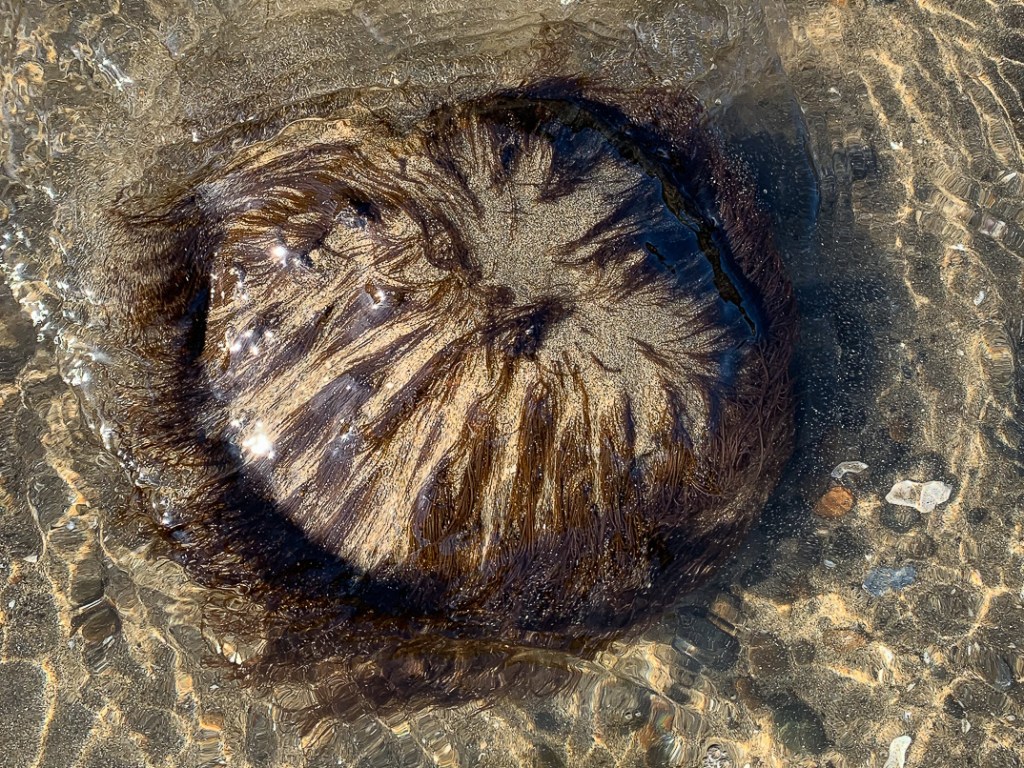
The reddish filaments don’t mind a little sand.
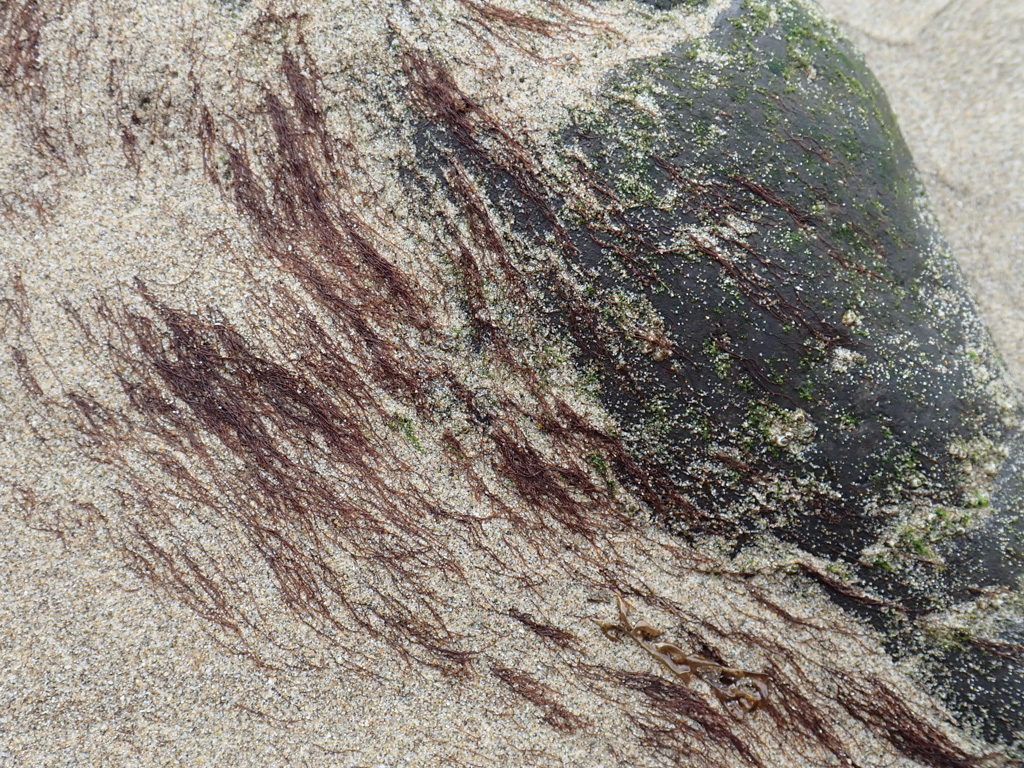

And another sequence, just for the love of Bangia-like filaments.

Endocladia
Endocladia muricata is a common mid- to high intertidal tuft.
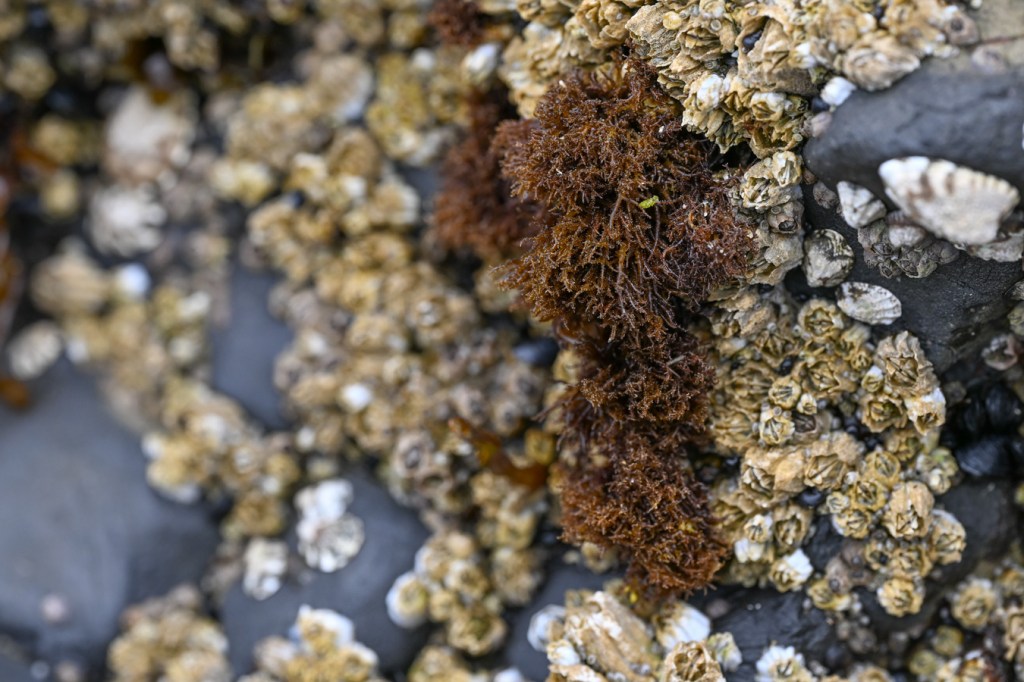


Tiny spines and a wiry hand feel, even when wet, help identify Endocladia.

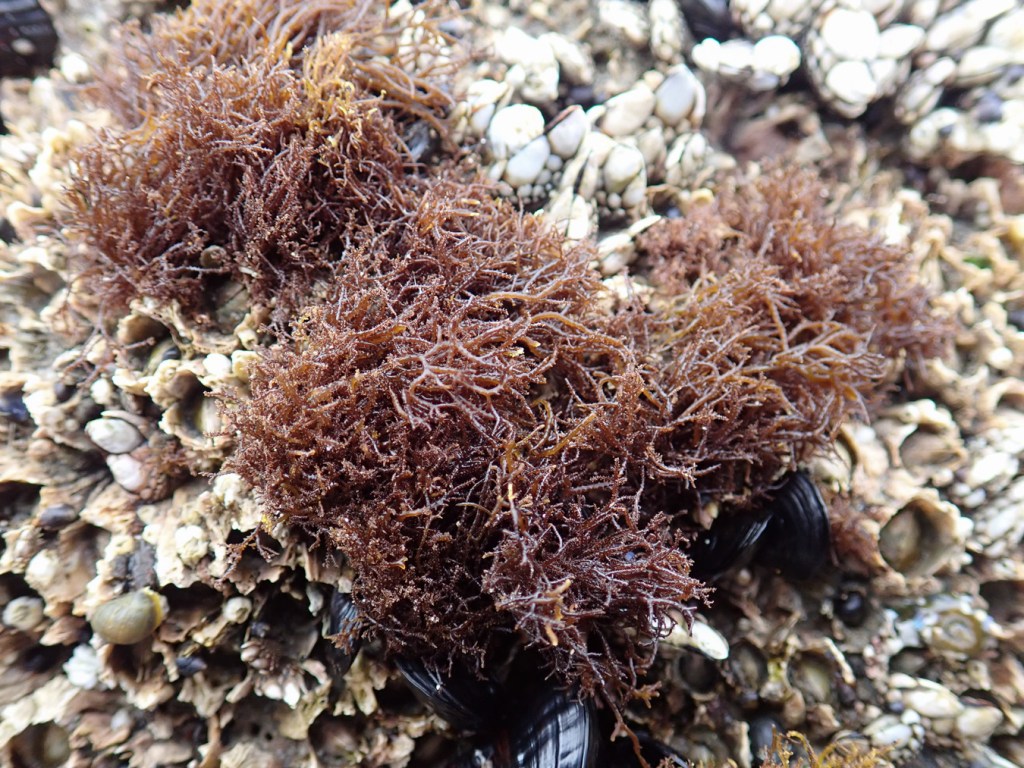
Endocladia on exhibit
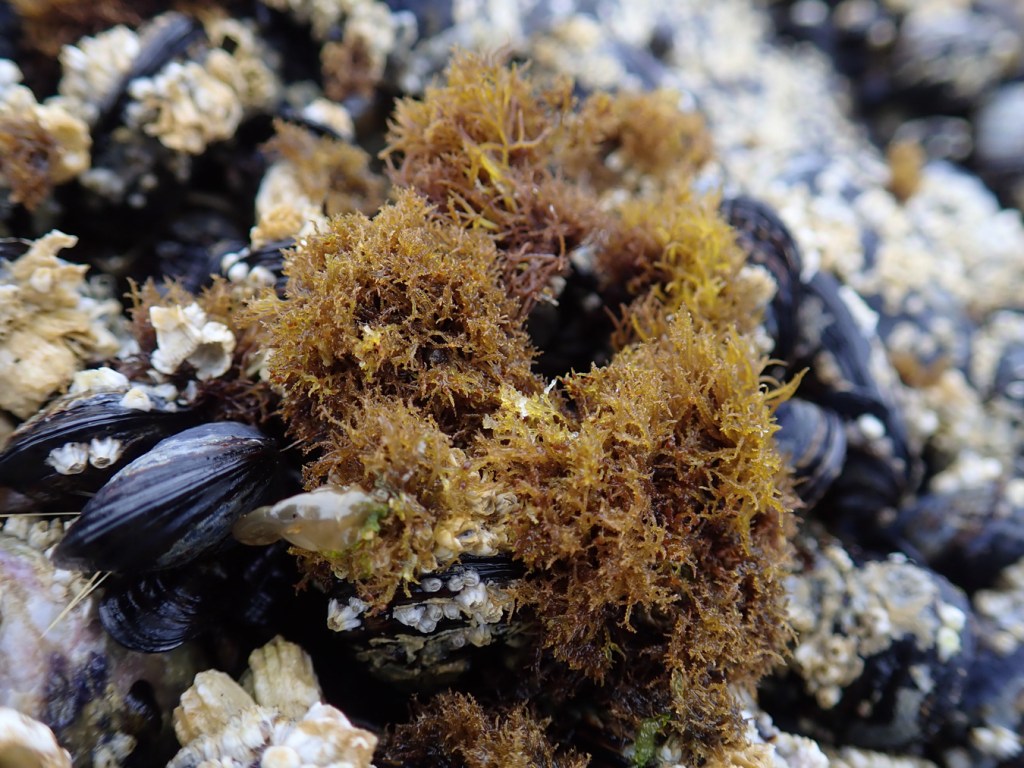


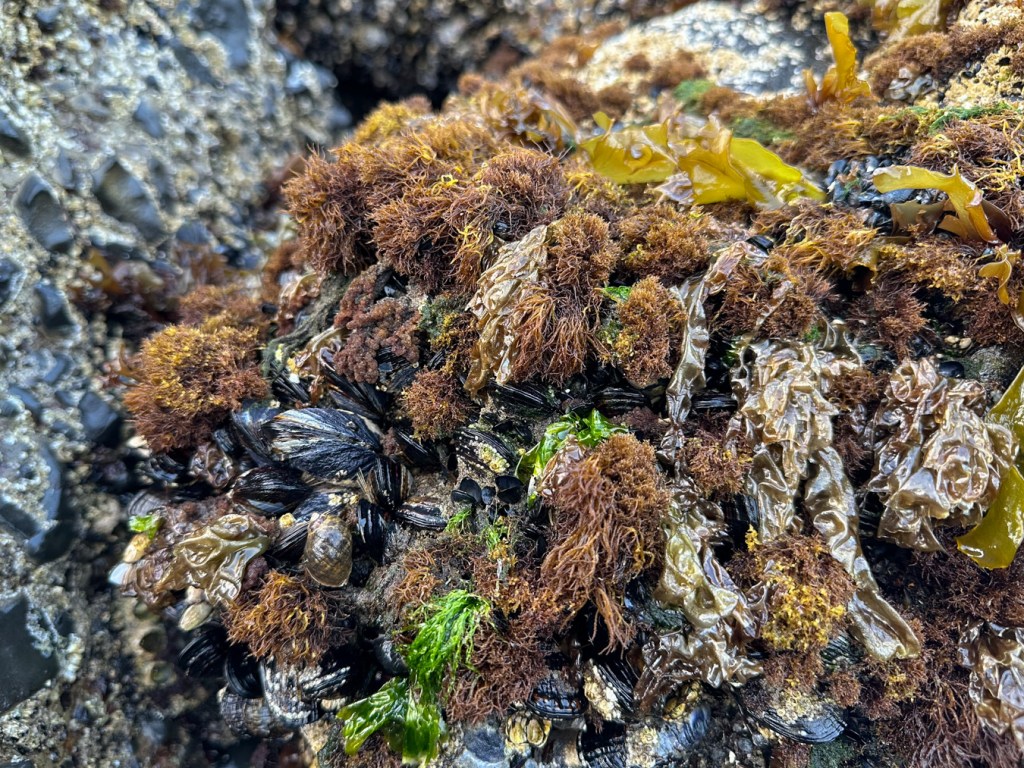
Below, yellow-gold spheres around branch tops are mature reproductive structures.

Gloiopeltis furcata
I didn’t notice this unassuming red ’til I took a closer look at the periwinkles that seemed to like it.

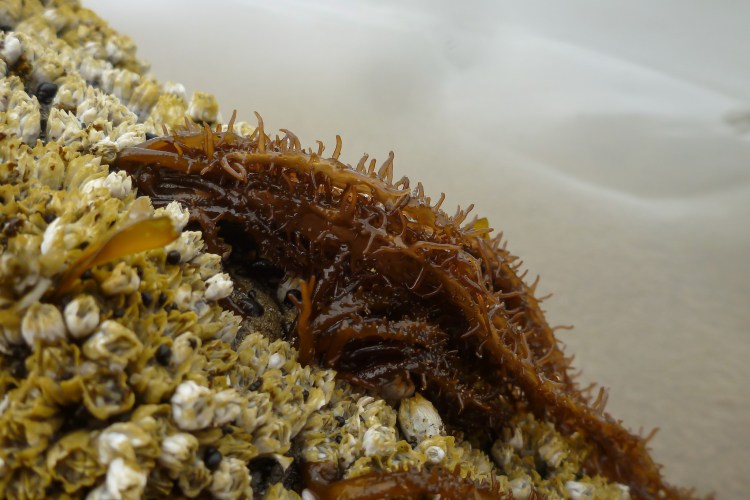
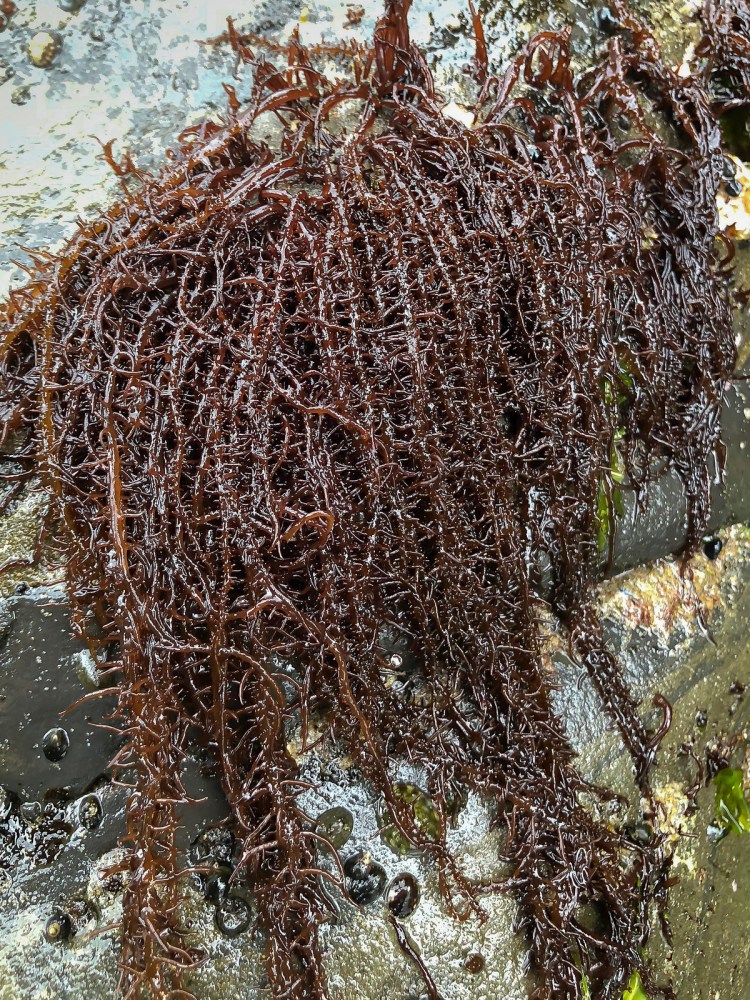
Cumagloia andersonii Hairy Seaweed



Red Crusts
When it comes to red crusts, the guides listed on this page suggest Hildenbrandia, the crust phase of Mastocarpus, and the basal crusts of a few other reds. That’s enough to make identifying them an enjoyable challenge. Here I feature two seemingly distinct forms: a thin red crust and a thicker darker one. Both are from the low intertidal.
The three images immediately below are from April 2018. The crust is thin and hard to the touch and seems to be associated with red blades.


The three images immediately below are from May 2021. The crust seems a thicker and darker than the crust shown above. The look here is more like dark caramel or dripped hard candy. Its surface is hard, and a common theme is the presence of branched corallines.


Mazzaella parksii Horn-Of-Plenty
A fun one to know; it’s another one of those reds that aren’t very red. Look for it on surf-exposed high intertidal rocks. On my home beaches, March through May is a good time to find nice-looking patches.


Mastocarpus
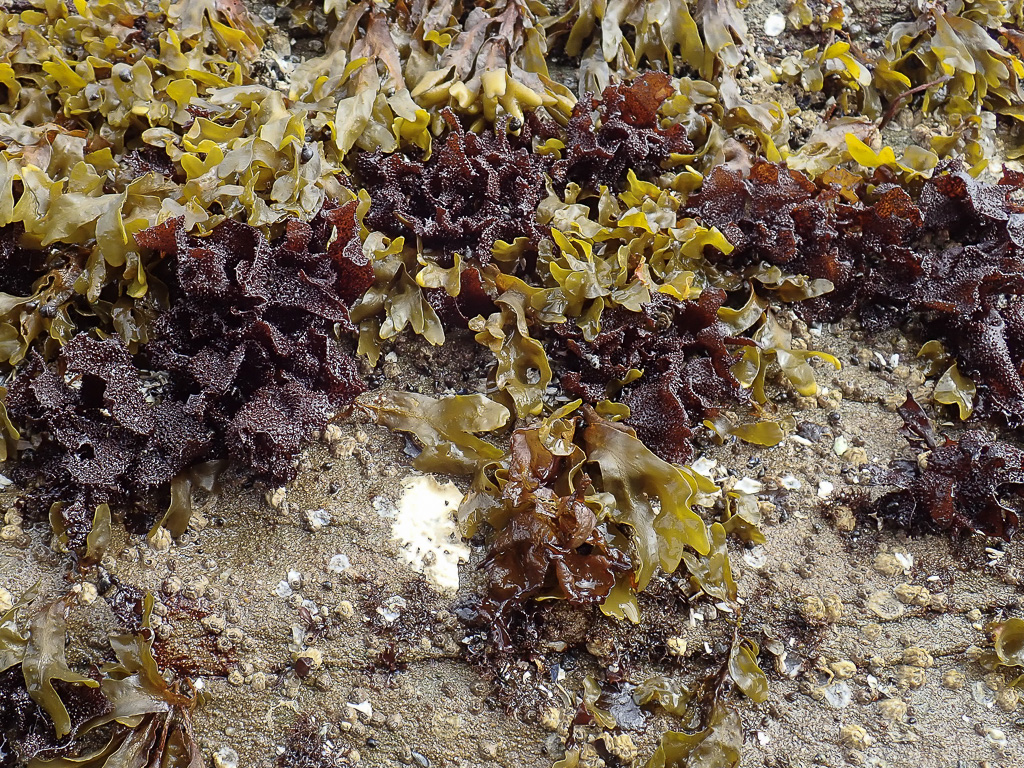
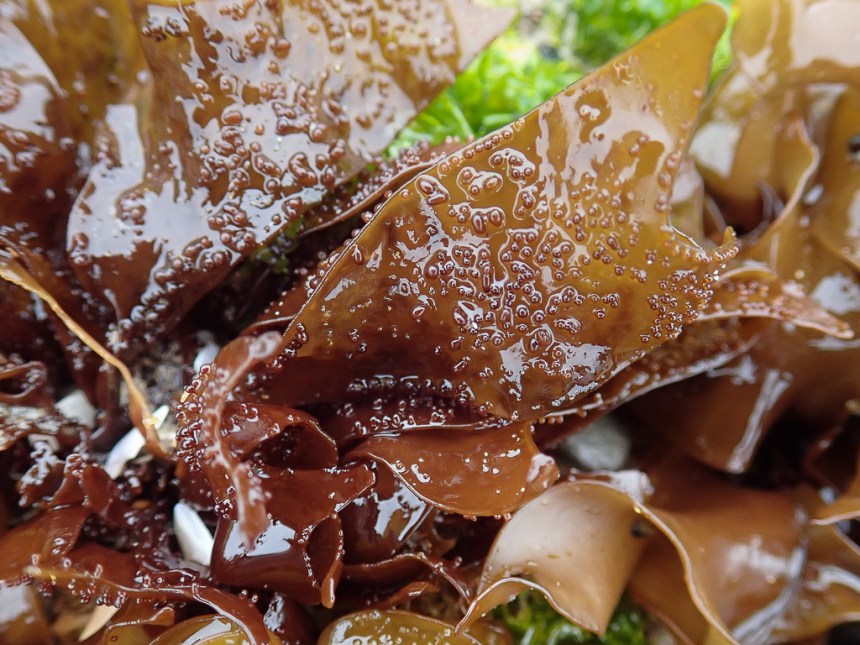
One of the common bladed reds in the mid to upper intertidal. I used to confidently call the bladed form shown below Mastocarpus papillatus. But Druehl and Clarkston (2016) explain the genus is a complex of variable species. To make things more interesting, Mastocarpus also has a black crust life history phase.



Neorhodomela
This is Neorhodomela larix, black pine


Cryptosiphonia woodii Bleached Brunette
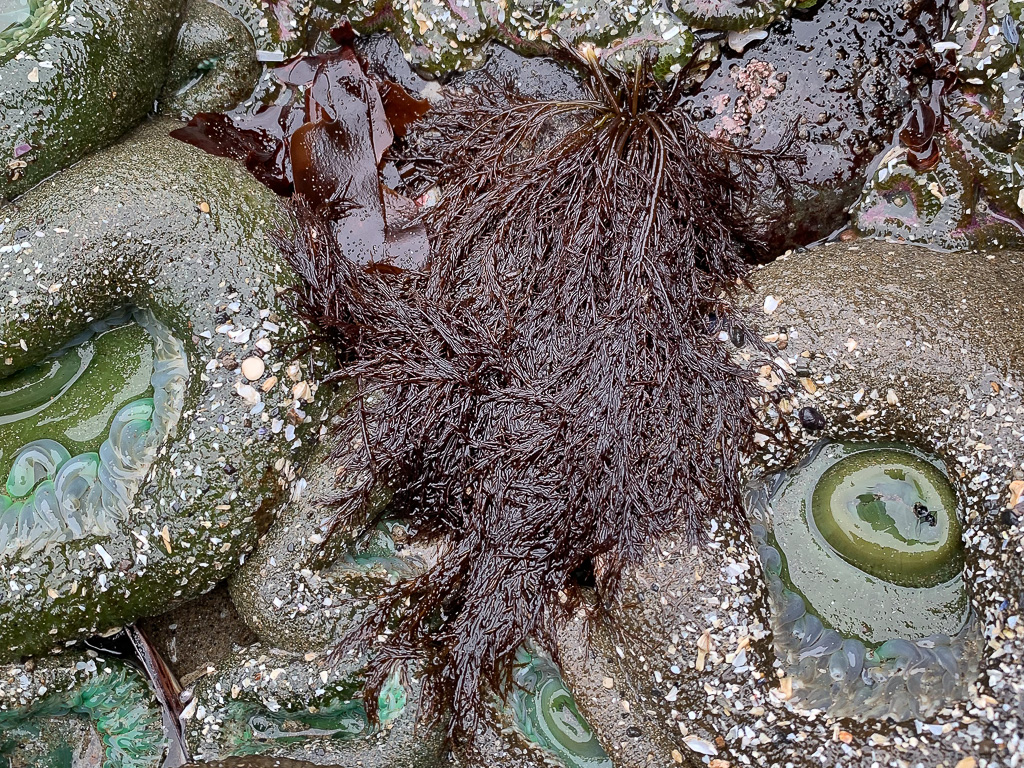
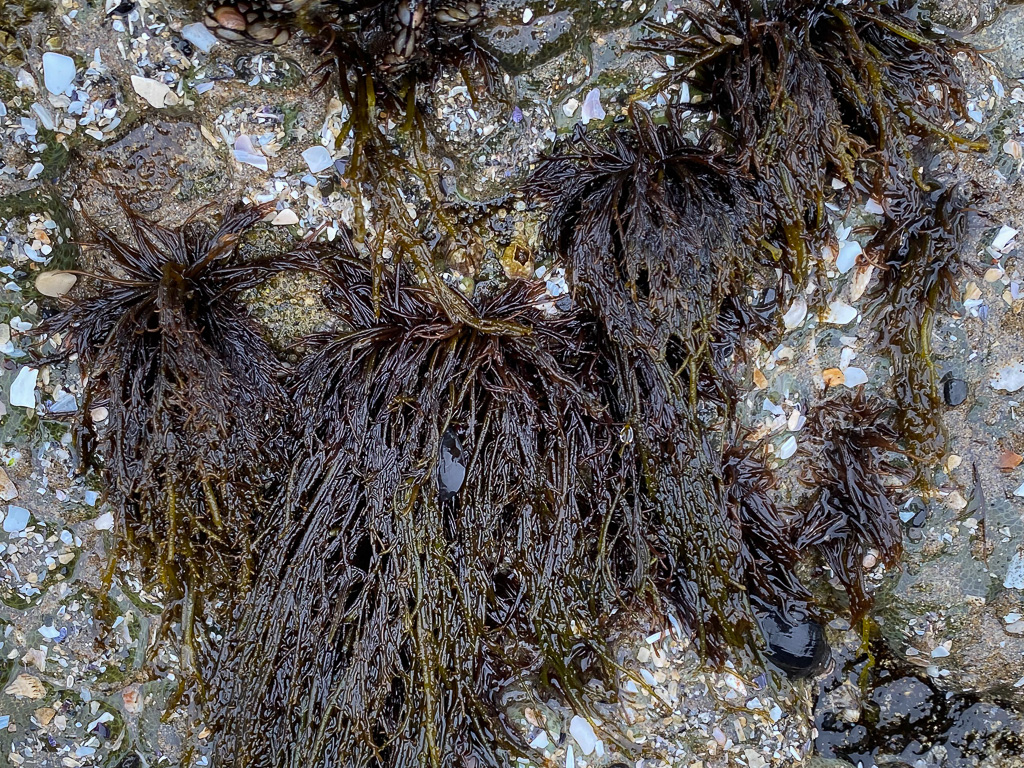
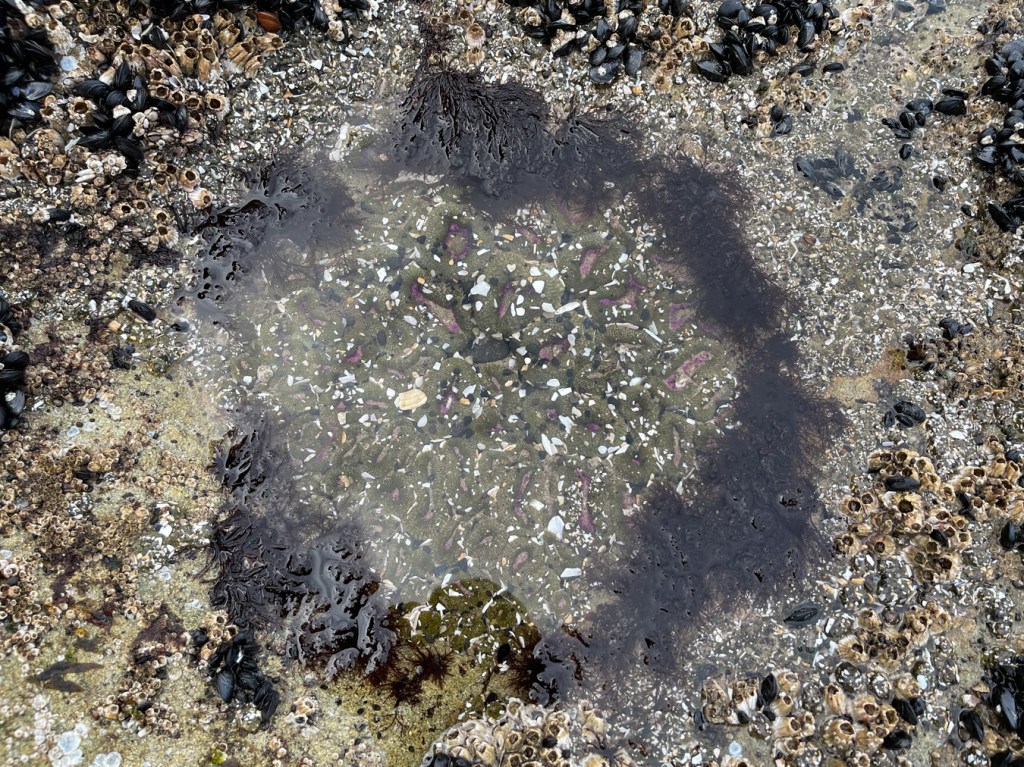
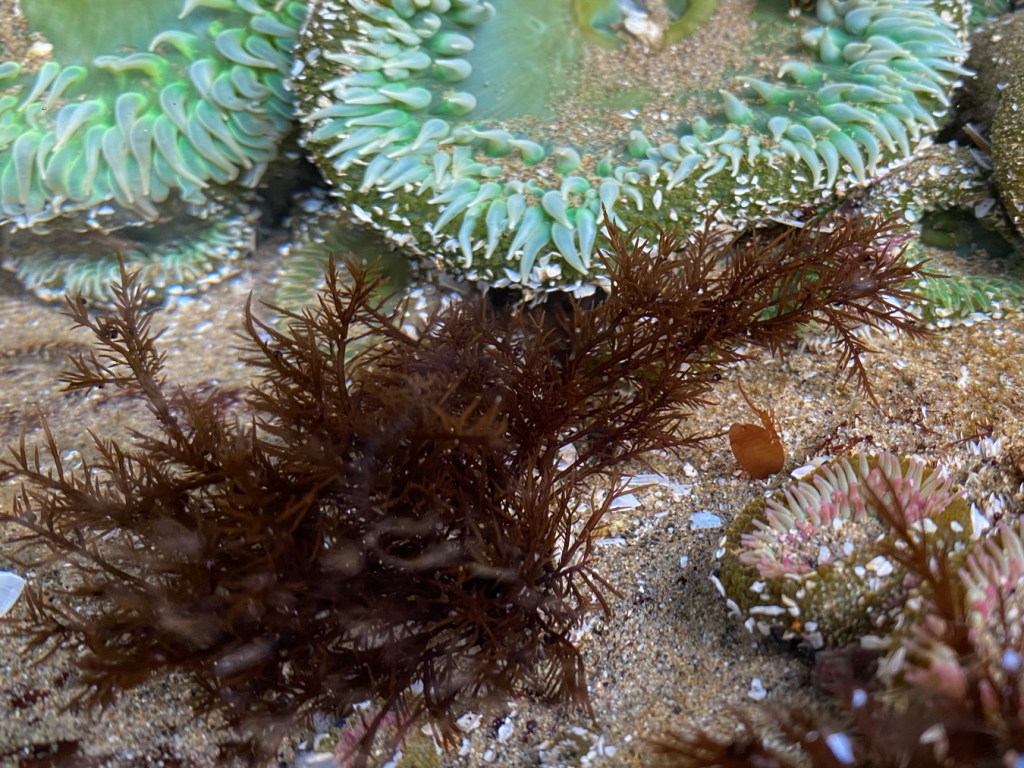
Cryptosiphonia woodii can be dense and turfy, can ring a tide pool, or show up as isolated tufts. It is limp when exposed and can become matted and appear dark, almost black. By July, in northern Oregon, you might see bleaching on the branch tips.


Herpochondria borealis
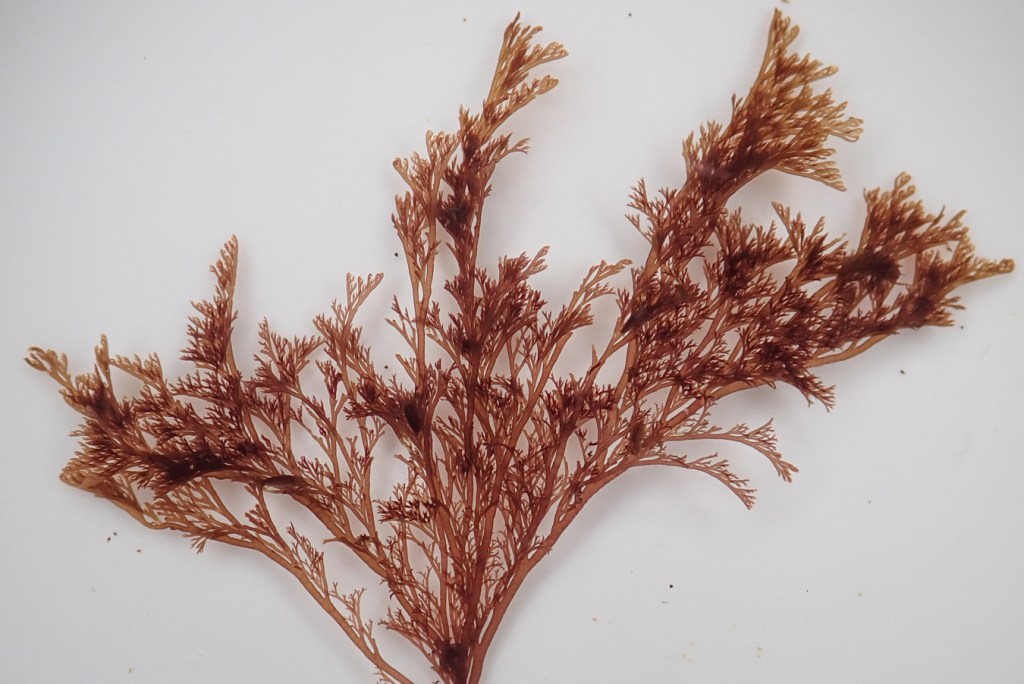
A common red tuft, often limp when exposed and not really a standout from a distance, Herpochondria borealis is easy to overlook or confuse with other red tufts. Up close, its details are unique and lovely. Previously known as Microcladia borealis.


It wouldn’t be hard to overlook a tuft of Herpochondria (center frame) snuggled up to a patch of Neorhodomela.

When things are just right, Herpochondria borealis will take up at least its share of space on the tops of mid intertidal rocks.

Halosaccion Sea Sacs
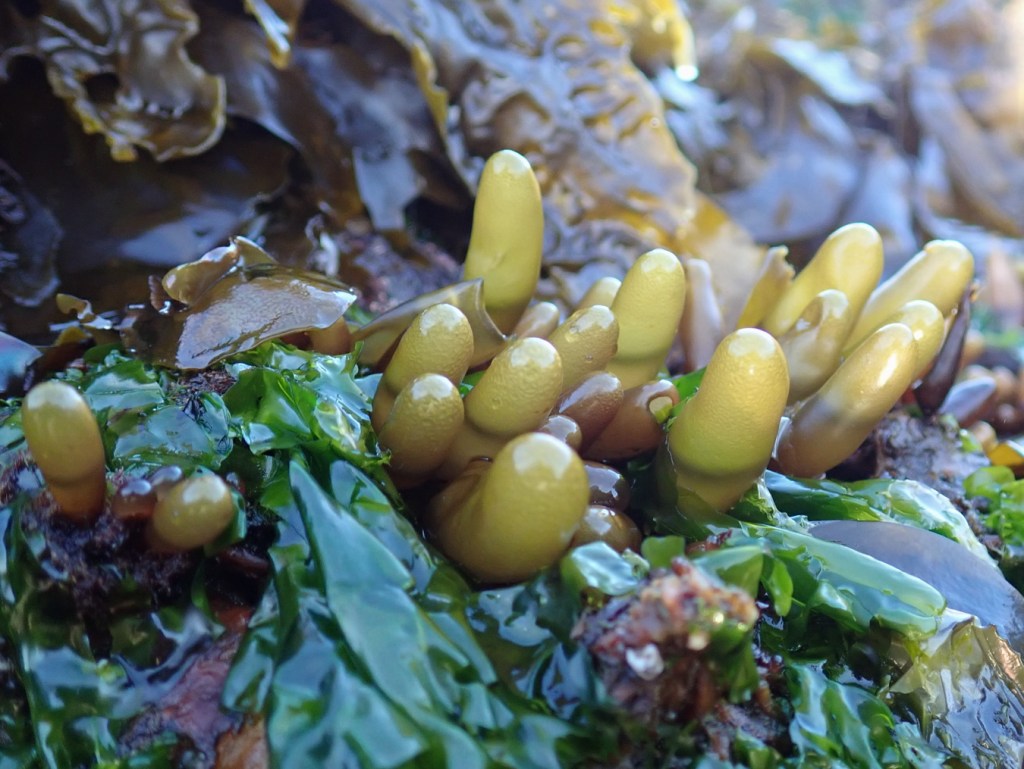
Below, Several sacs partially filled with seawater.
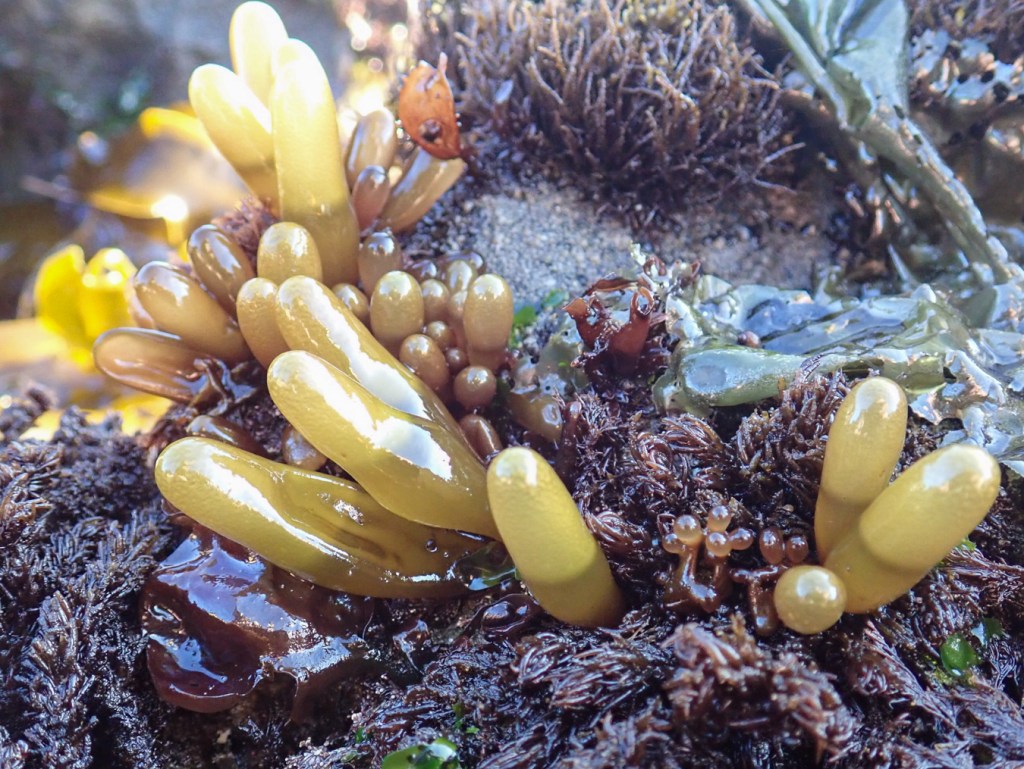
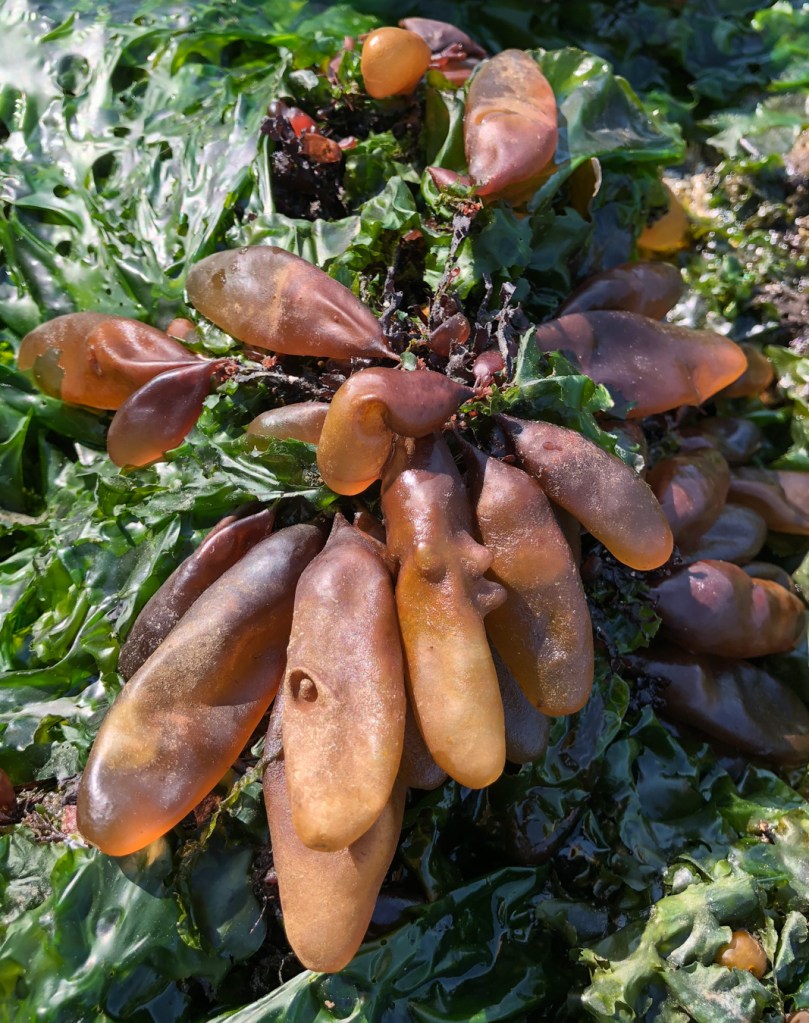
In some circles, Halosaccion goes by dead man’s finger, and I can see it (particularly the left hand panel, below). The other thing notable about the two images below, both from Orcas Island, is the red coming through.

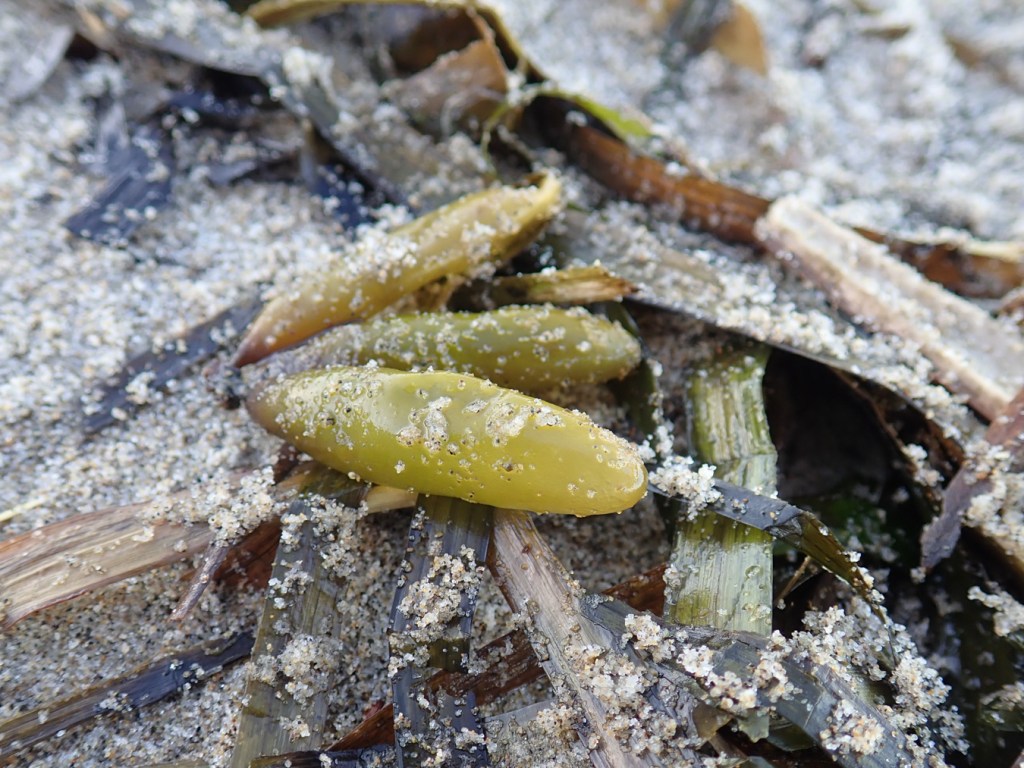
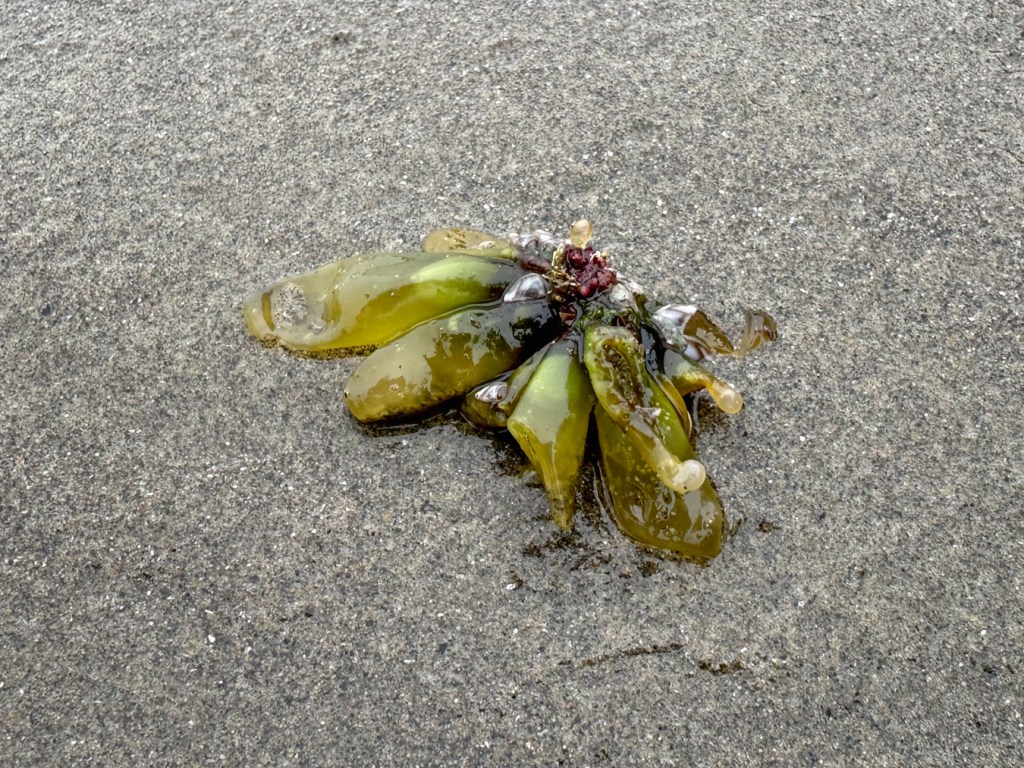
On the beaches I visit most often, I only come across Halosaccion in the drift.


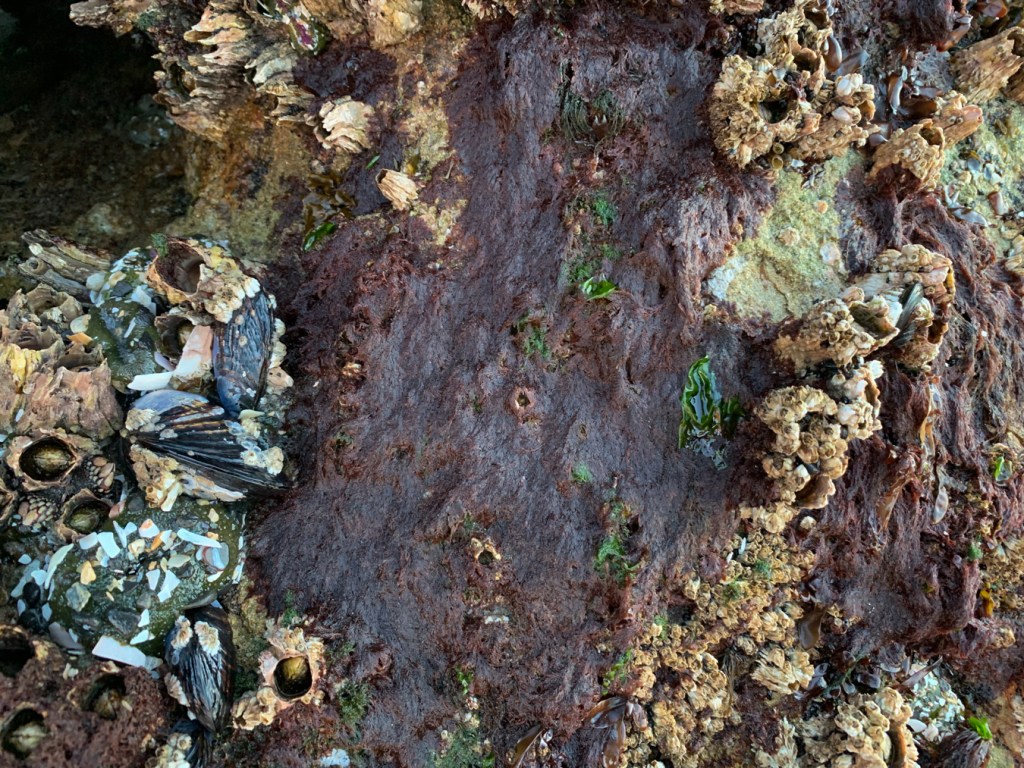
This dripping red carpet is a delicious mystery. Could it be Erythrotrichia? That’s just a guess.


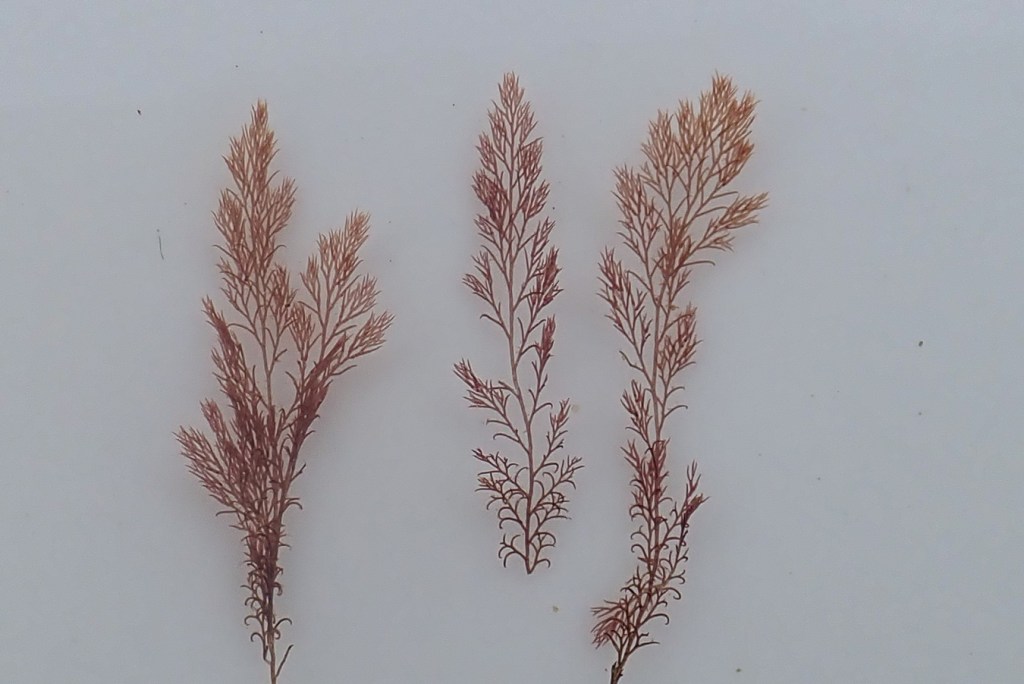
This is one of the filamentous reds, along with Polysiphonia (next entry, below). You’ve probably seen it as Pterosiphonia bipinnata, but things are ever-evolving so you might see it now as Savoiea robusta. In any case, its common name, black tassel, works pretty well. It can be found in more or less isolated tufts or cover quite a bit of space on mid-intertidal (and lower) vertical walls.



Polysiphonia
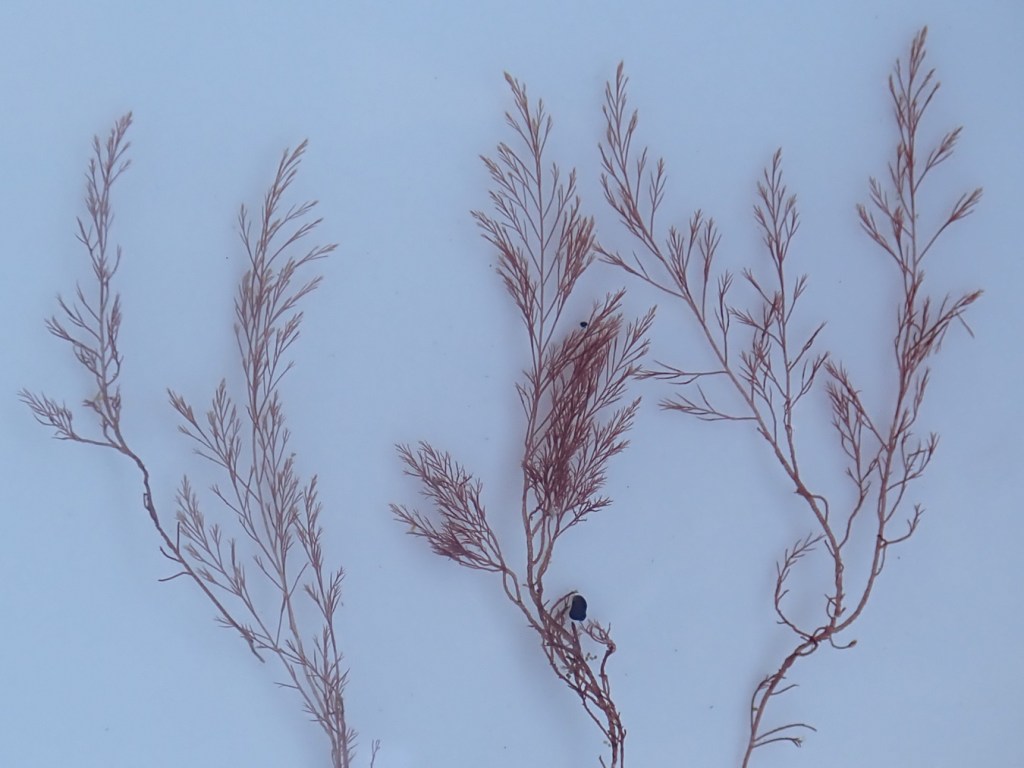
Polysiphonia can show up as a perfect filamentous puffball.

I feel like sand is often part of the Polysiphonia picture.


A closer look at the filaments (compare with Pterosiphonia in the previous entry)

Callithamnion Beauty Bush
The images below probably show Callithamnion pikeanum. Some references mention the branches are often covered with diatoms. I don’t know if the distinctive fuzzy look in the images below is due to a covering of diatoms or an inherent fuzziness.


Prionitis
With several species of Prionitis in our area and lots of variability, I’m hesitant about specific identifications in this entry. (I’ll be happy if the examples in the featured images are indeed Prionitis.)
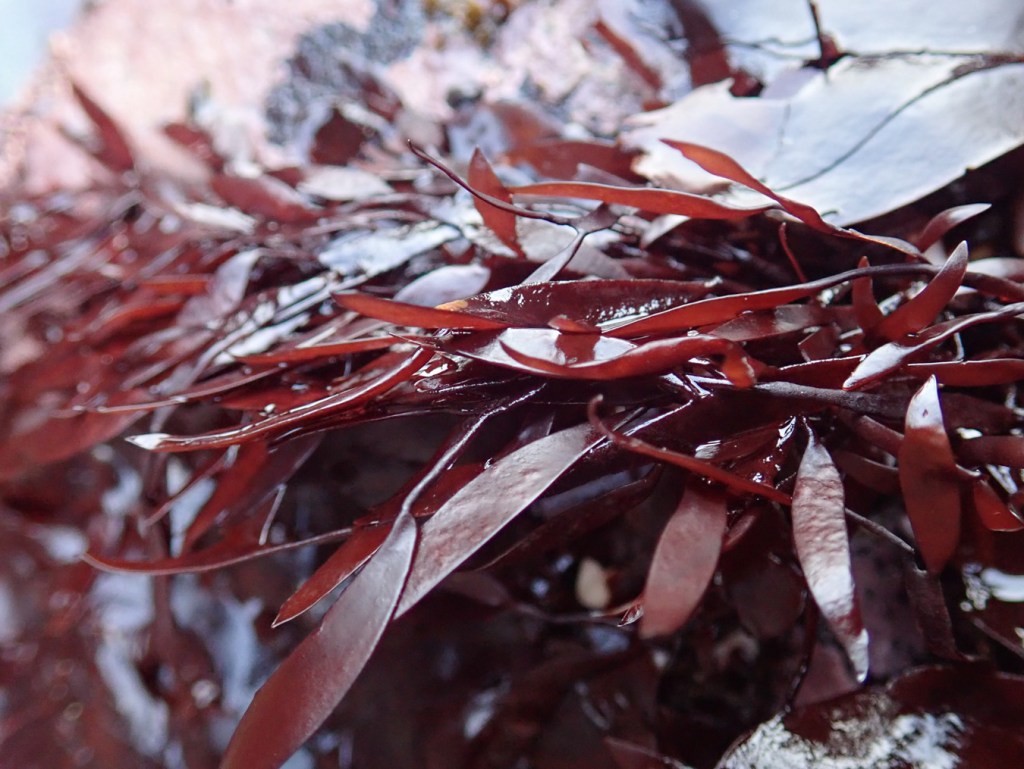
It was down on the low rocks, where I first came across the robust brick-red beauty shown in the four images immediately below.


Sticking with the low rocks, the pair of images below illustrates two beautiful and very different forms.

These examples below show additional diversity from the low shore.

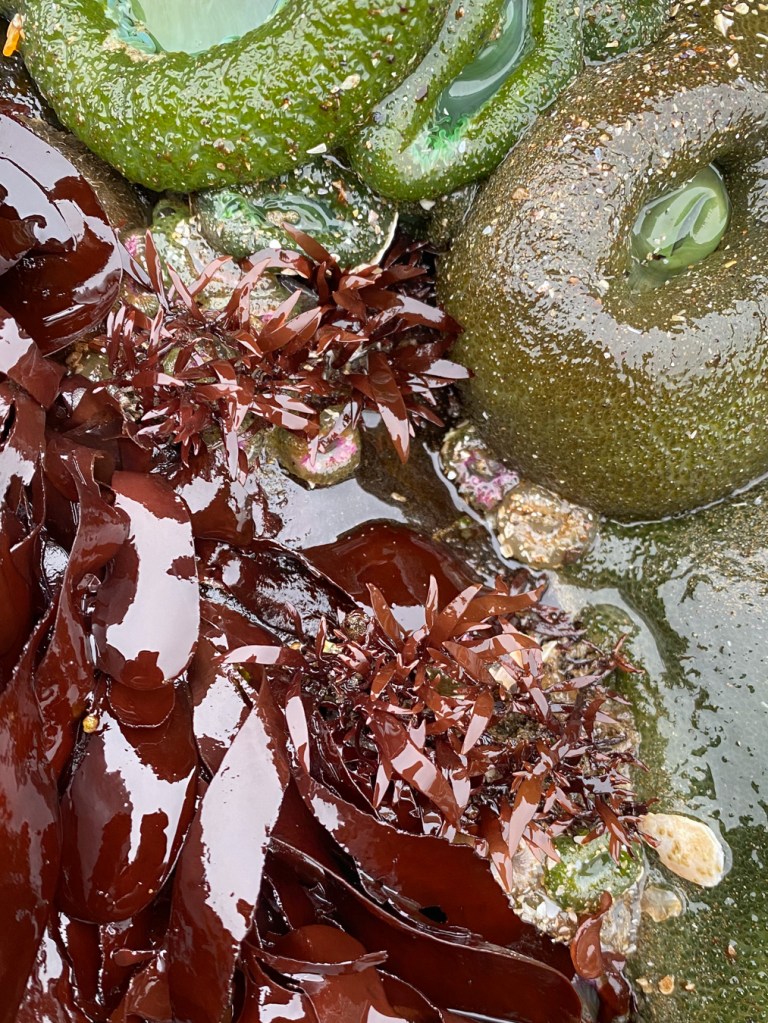

Finally, a selection of examples from the low rocks, crevices, and small pools laid out for comparison.

The lovely examples below are from a skosh higher, in the mid-intertidal.
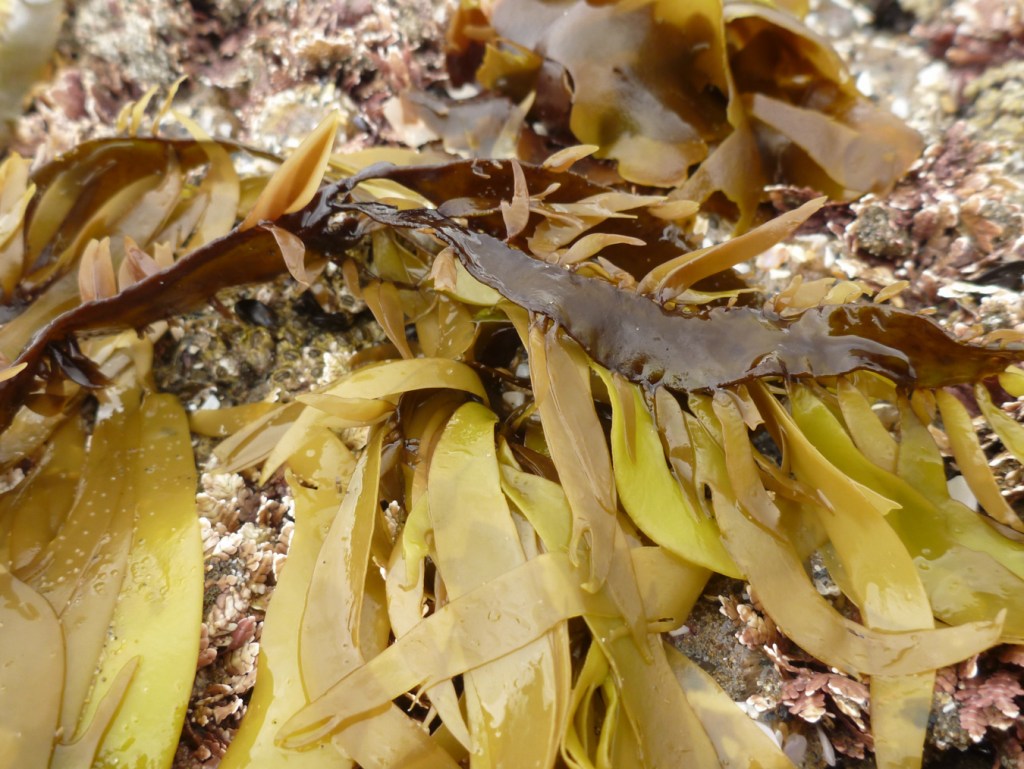

More scenes from mid and fairly high pools.


Examples lifted from mid and fairly high pools for—I hope—a better look.

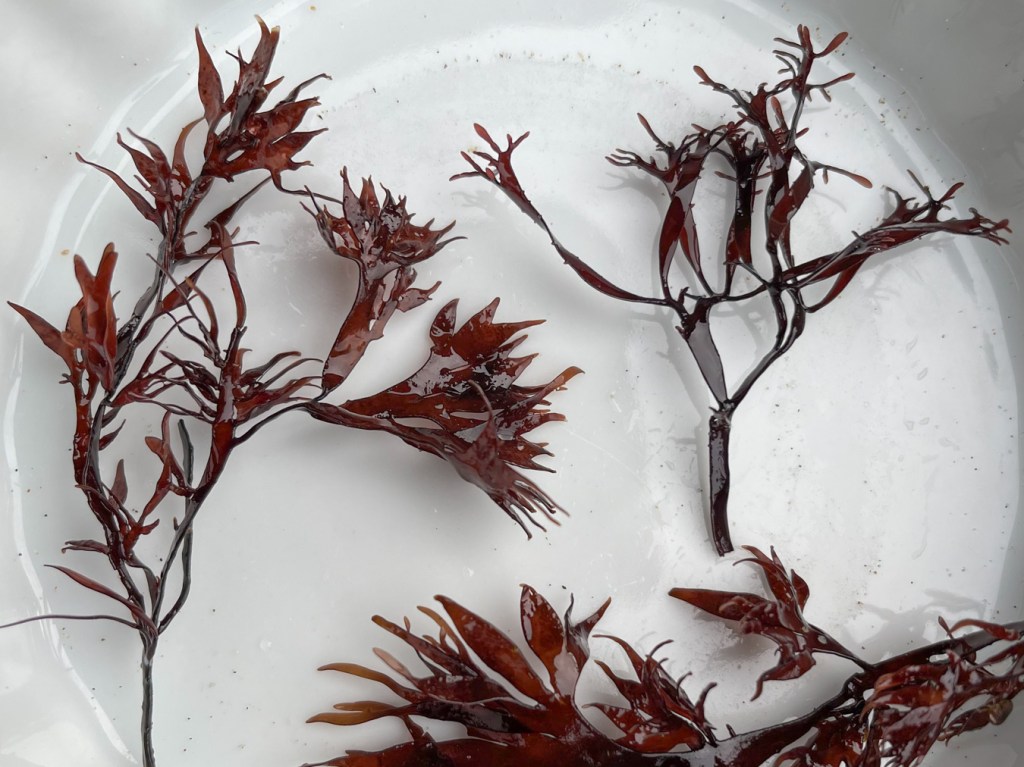
Plocamium
On beaches I visit most, I come across two forms of Plocamium. I’m pretty sure the examples immediately below are P. violaceum. It’s quite common.


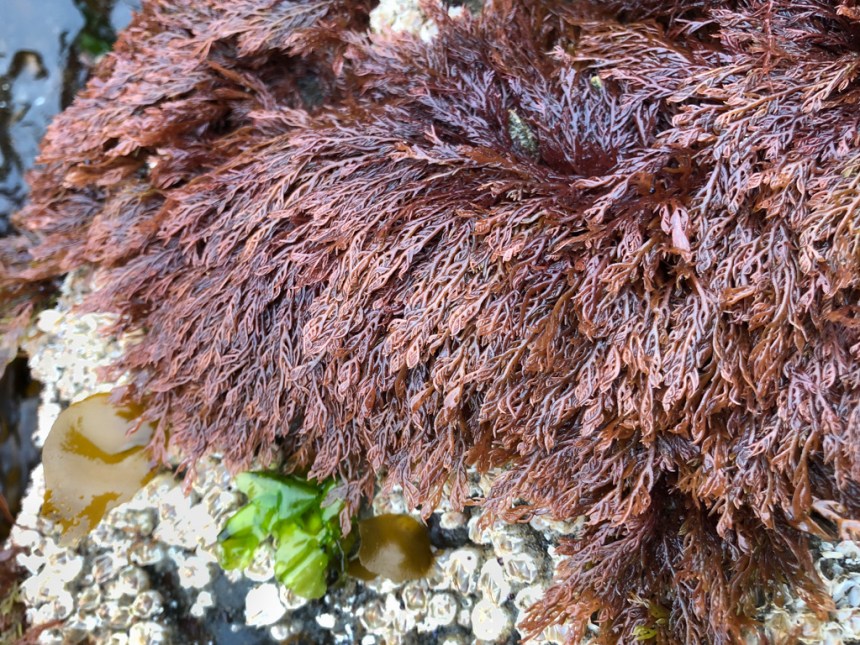


The other Plocamium I sometimes encounter, and it brings me a smile whenever I do, is P. pacificum.


Melobesia Seagrass Crust
Easy to find whenever the tide is low enough to expose surfgrass beds. Melobesia can also be found in drifted surfgrass among sea wrack.


Corallina
According to Druehl and Clarkston, Corallina diversity in our area is higher than the two broadly recognized wide-ranging forms I highlight below.
Corallina chilensis (Corallina officinalis var. chilensis in many of the references and resources at the bottom of this page) is at home in and around tide pools. Note the feather-like appearance of the pink fronds, but beware of variation. The examples featured below are from the central Oregon shore.


Corallina vancouveriensis often has a bit more of a purplish cast than Corallina chilensis and the calcified reds it frequently shares space with, but the difference is subtle, subject to variation, and not conspicuous from a distance.

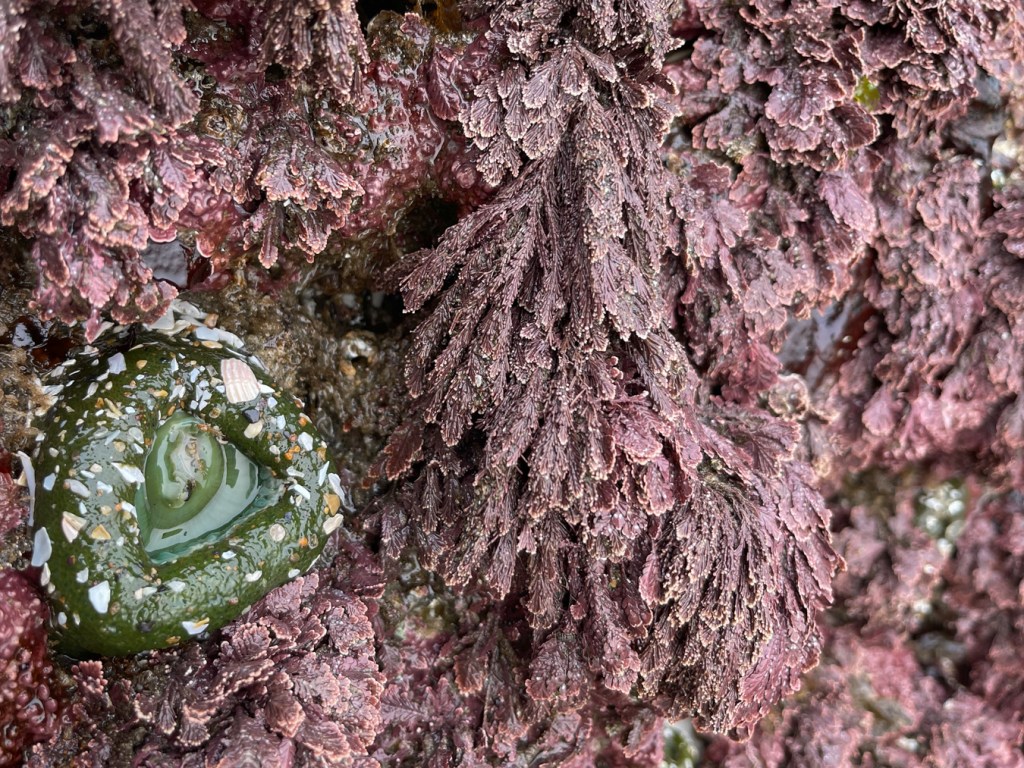
Up close, Corallina vancouveriensis (center and along the right-hand edge) is usually pretty distinctive. Its look has been described as limp purplish tufts hanging down, and that is often the case.
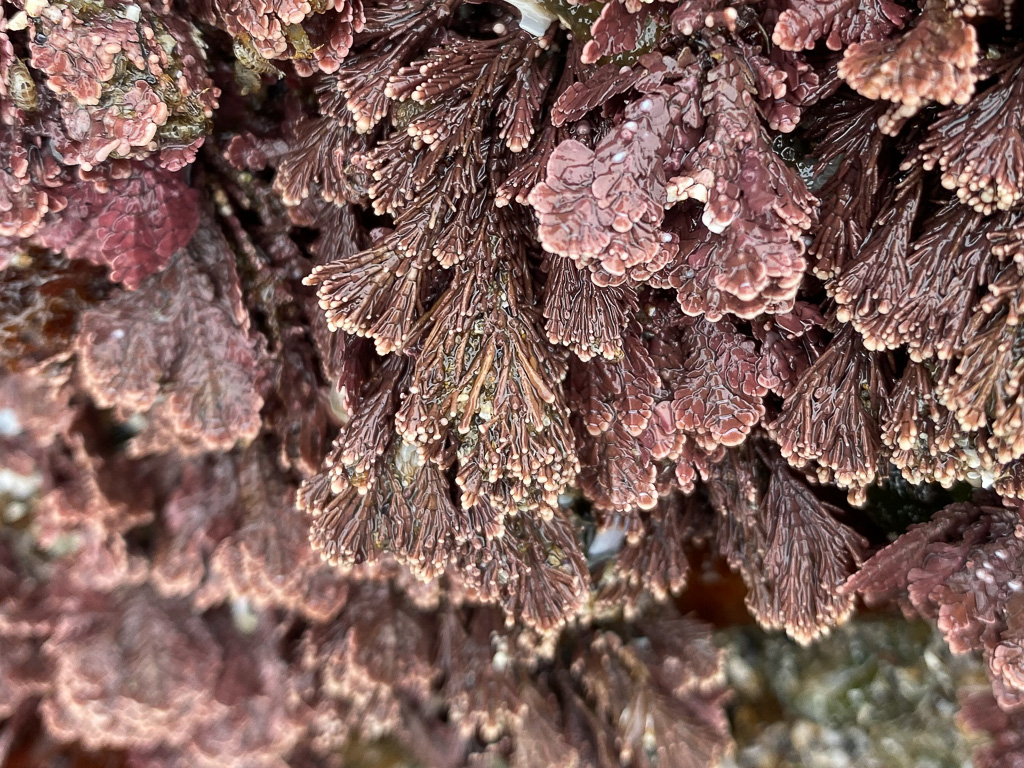
Lovely delicate and densely-branched fronds, a little on the purplish side.



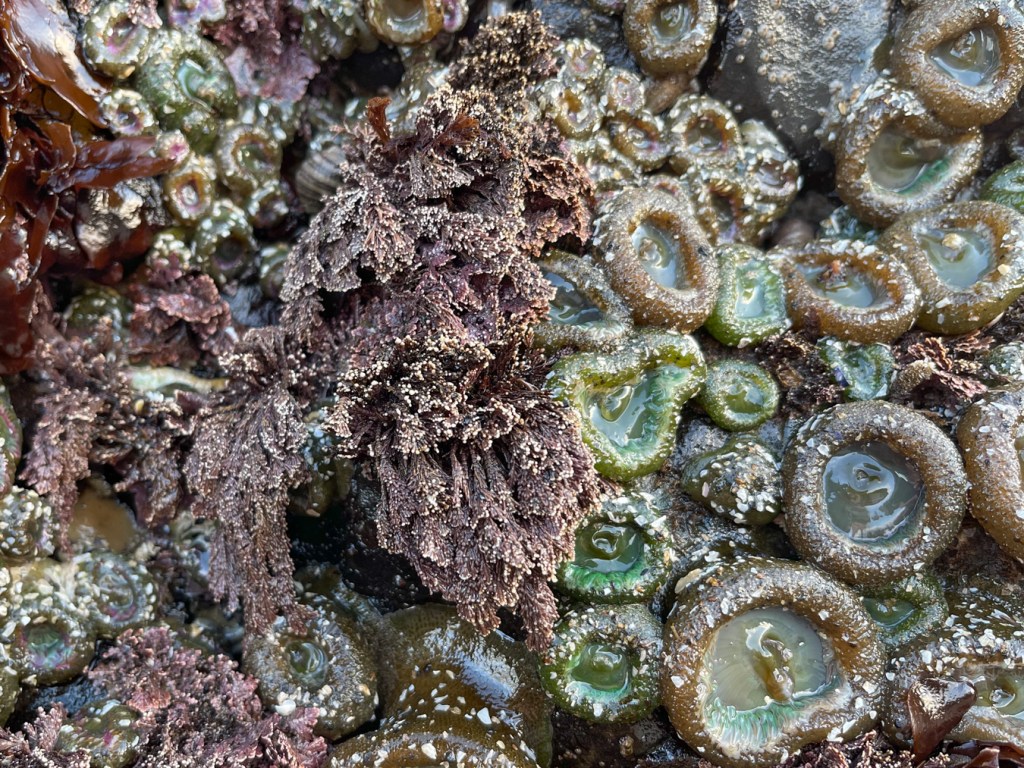

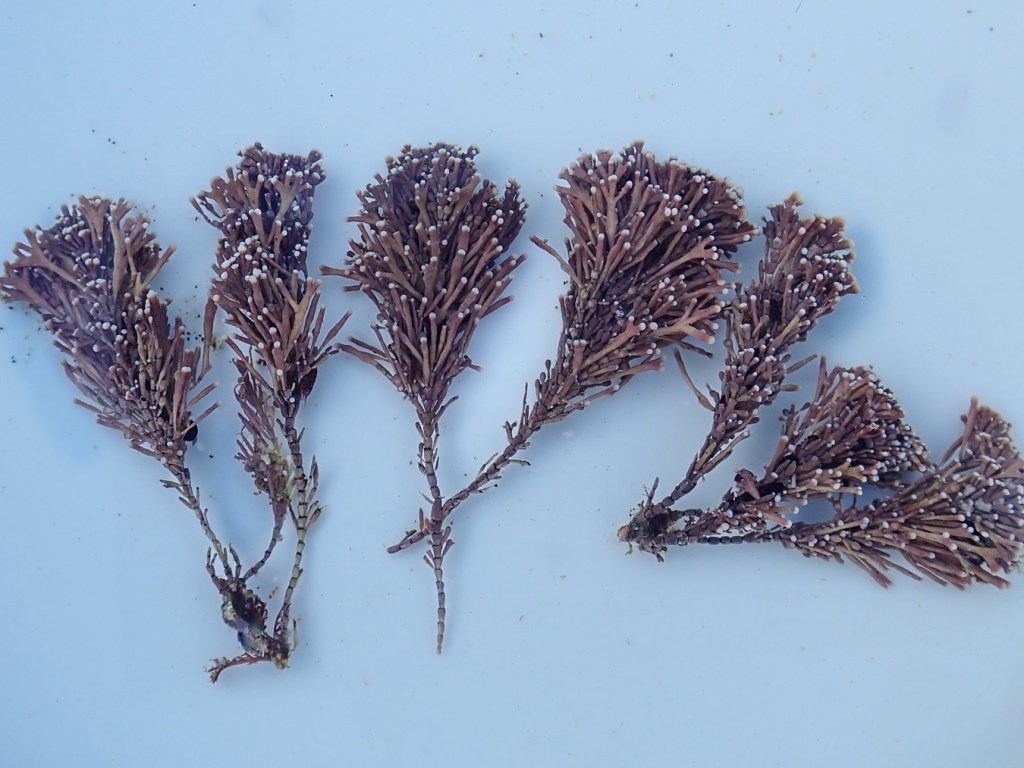
I floated a few fronds in a shallow bowl for a better look at the branching pattern out near the tips.
Bossiella
As with Corallina, Bossiella diversity in our area is higher than has been traditionally recognized. I feature examples based mainly on their overall look in the wild, which is dependent, somewhat, on the branching patterns of the exposed terminal portions of the fronds. Having said that, I’m not very good at distinguishing between the branching patterns (e.g., pinnate, dichotomous, irregular). Fortunately, segment size on the branch axes also aids in identification. Thus, I separate my examples into two groups based on branching out near the frond ends, and segment size. I don’t make any claims or guesses about species-level identification here; I’m content to have made my way to the correct genus, if indeed I have.
I compare terminal branching and segment size in the set of four images below. The upper pair were taken just seconds (and inches) apart. On top left, dense terminal (pinnate?) branching and comparatively small segments; and on the top right, loose terminal branching and comparatively large segments. For further comparison, the densely branched form also makes an appearance along the right-hand edge of the upper right-hand image. The two lower images compare the two forms nestled together.
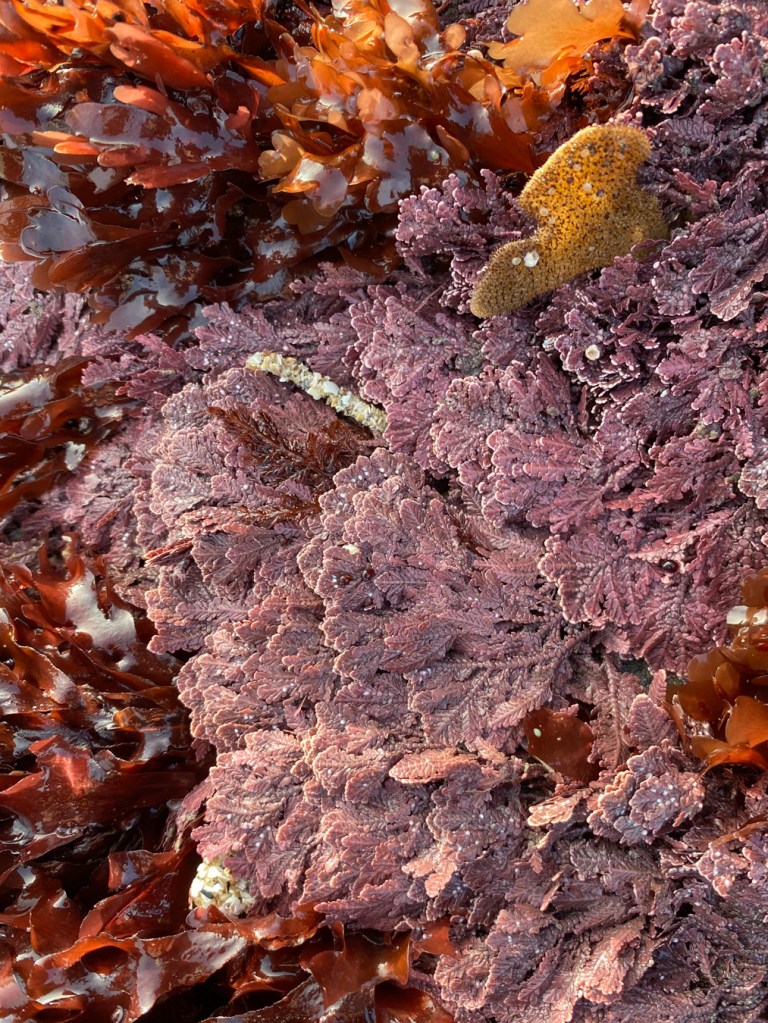


The examples in the set below are from mid to low intertidal rocks where they tolerate at least some to quite a lot of sand scouring. Their segments are relatively small and their terminal branching pattern is dense and pinnate, or so it seems to me. (Speaking of pinnate forms, Johansenia shares that character, adding some uncertainty to this entry because I don’t know much about its distribution in Oregon (there aren’t many records), and I don’t know if I could distinguish it.


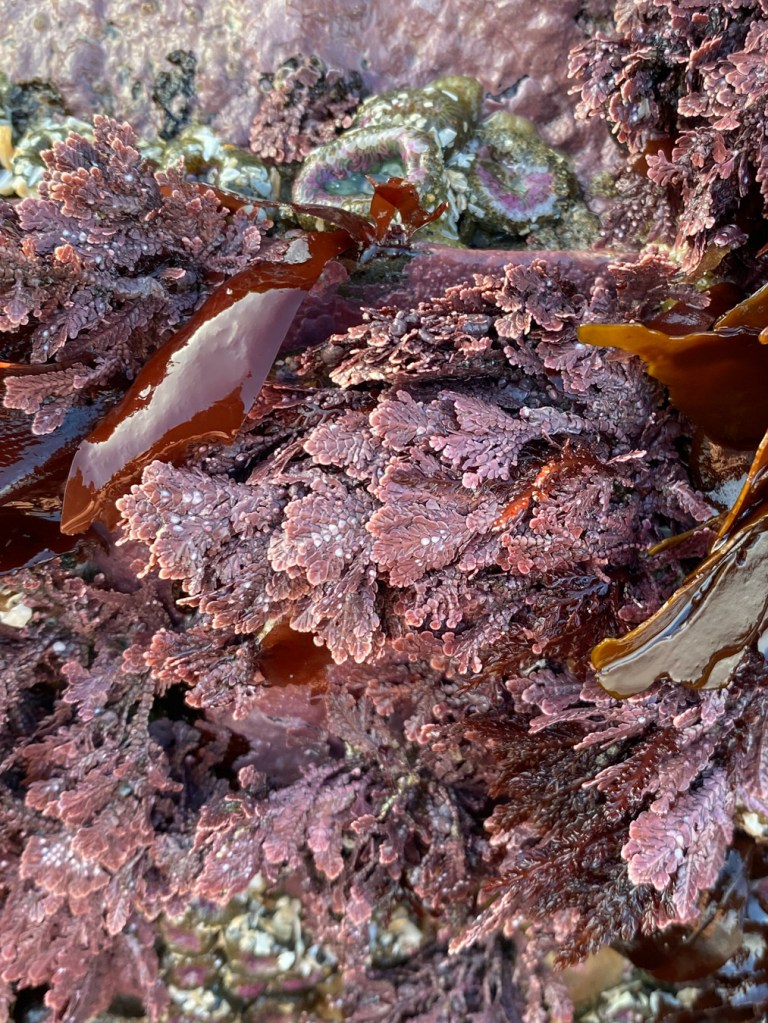


For a better look at the terminal branching illustrated above—that was my intention, anyway—I floated some isolated frond ends in a shallow bowl. The specimens in the left-hand panel are from the central Oregon shore.


With a slightly different look, the examples below seem to have more of a rounded or club-shaped look out on the frond ends compared to those shown above (but remember, variation).
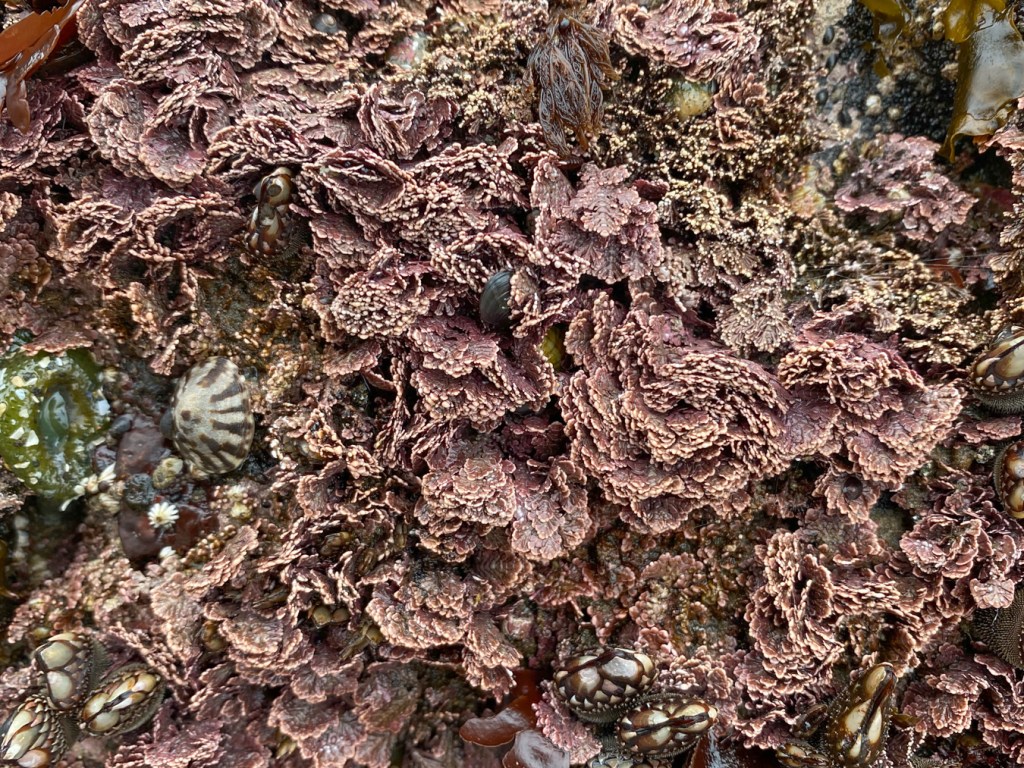


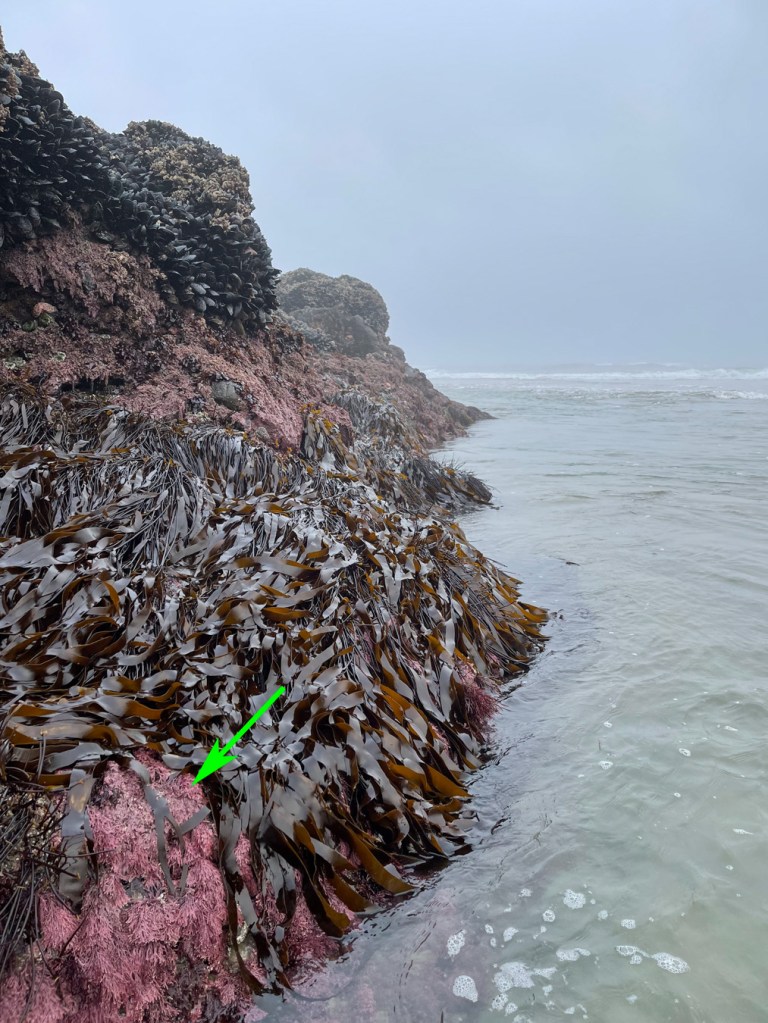
Out on the surf-swept rocks one or more loosely branched forms are frequent companions of the densely branched pinnate form featured above. In the left-hand panel below, the arrow indicates a patch of loosely branched Bossiella peeking through the Laminaria. The right hand panel is a closeup from the same patch. (Both images are from the Central Oregon shore.)

For a closer look, in the left-hand panel, a Bossiella-like patch from a sand-scoured northern Oregon setting. On the right, a few plucked fronds isolated on nearby Laminaria.


Scouring and even modest seasonal sand accumulation seem to be tolerated.


Here, two views from a single patch. The left-hand panel shows a closeup of a tuft (or maybe a few fronds is a better way to say it) from just below center screen on the right-hand panel.
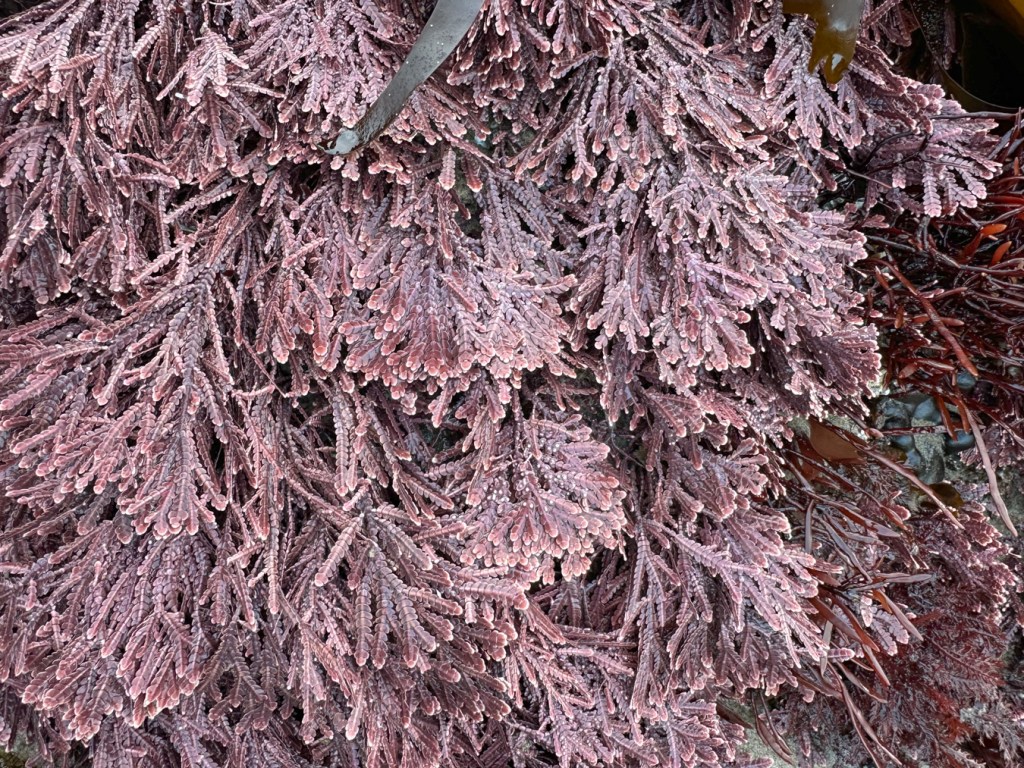

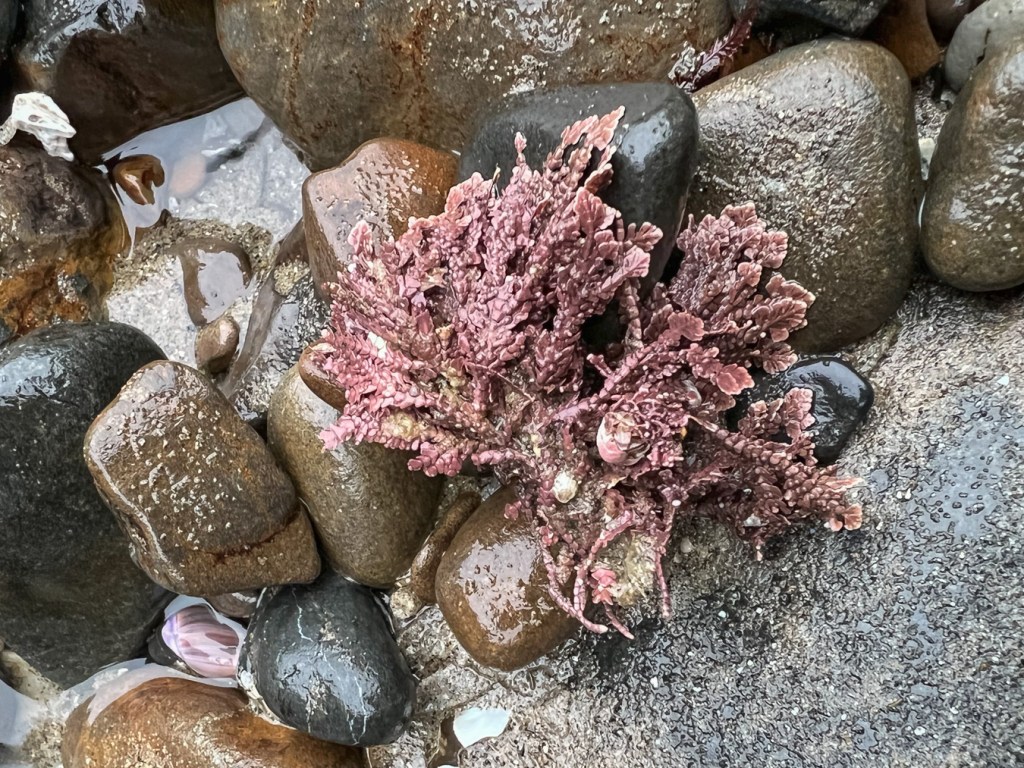
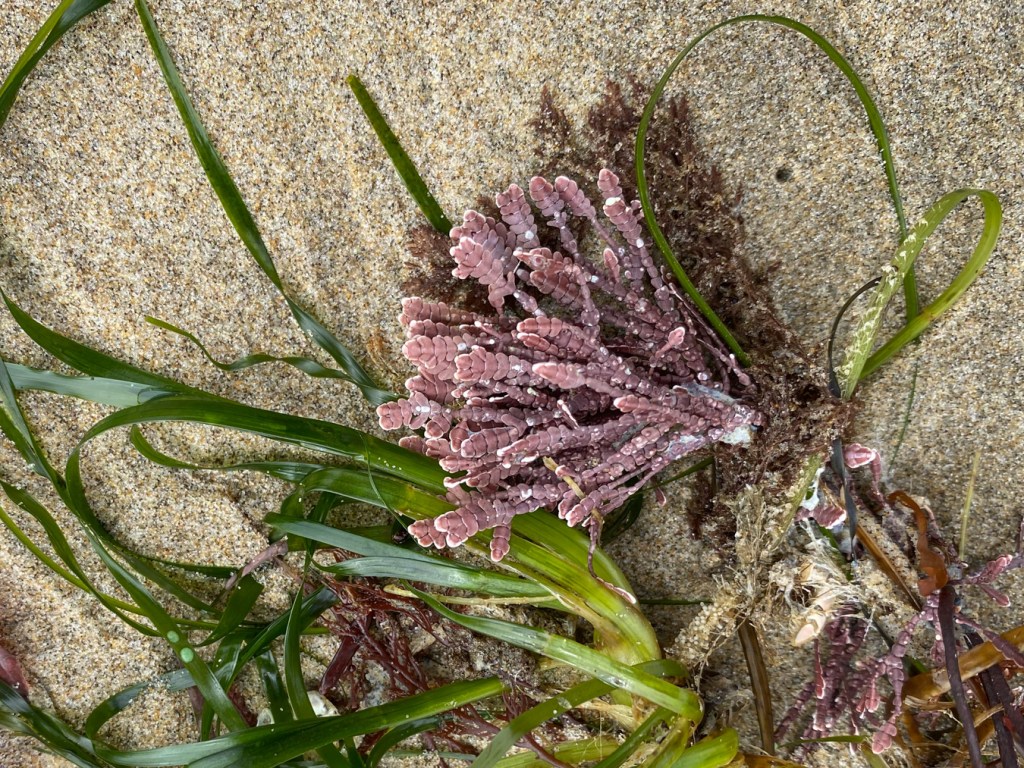
It’s not too uncommon to find drifted tufts and fragments up in the cobbles and on beach.
Calliarthron
I’m pretty sure the images below, from the central Oregon shore, show Calliarthron. If they do, it’s probably C. tuberculosum.


Look for white reproductive conceptacles spaced irregularly on flat surfaces and segment margins


Dilsea californica


Farlowia mollis


Ahnfeltiopsis
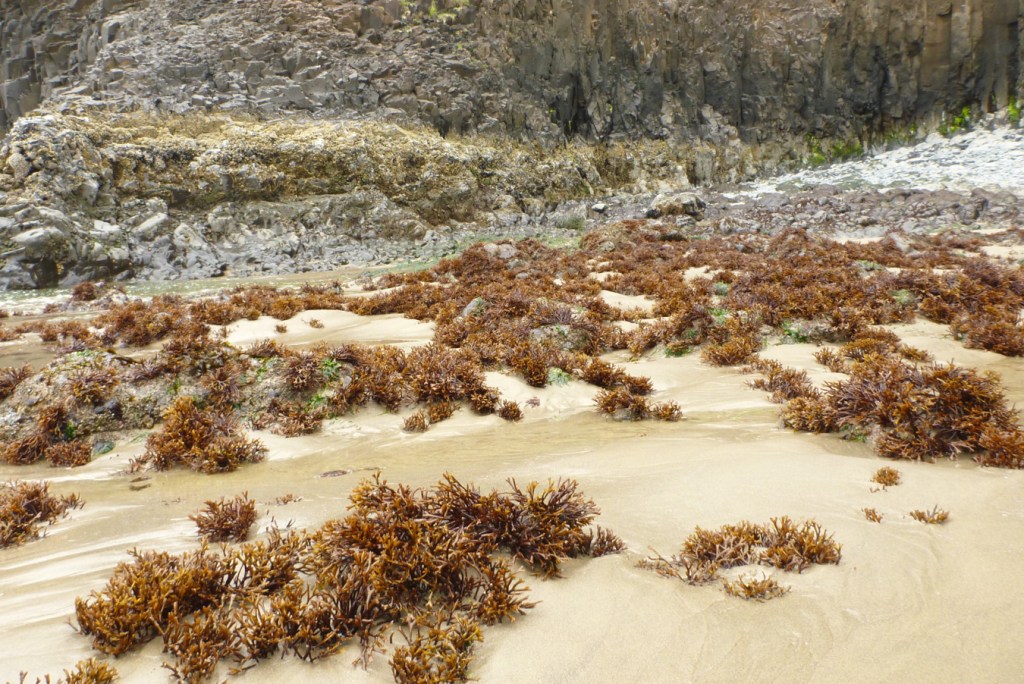
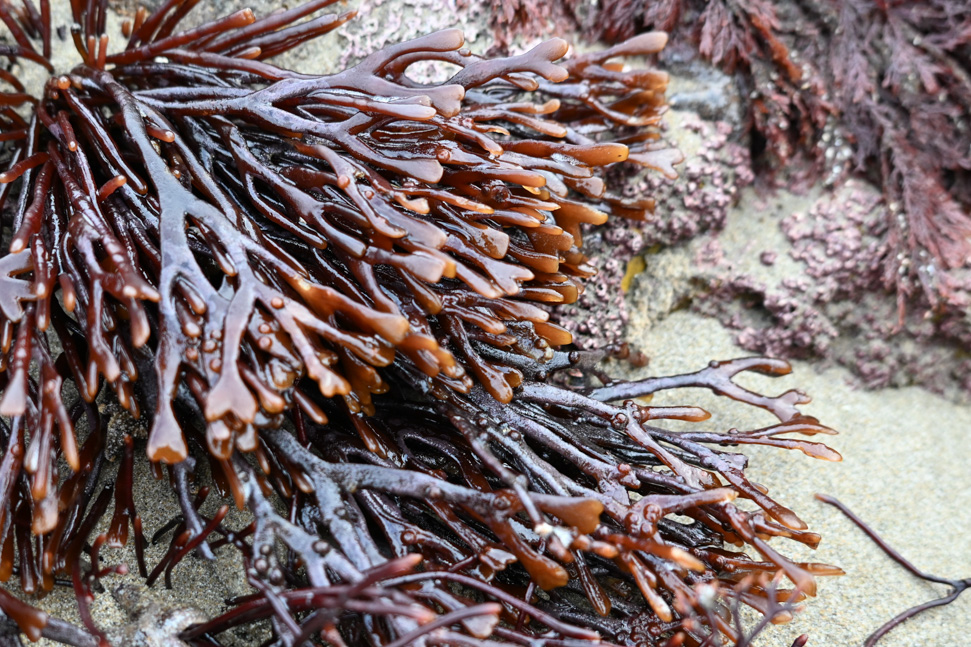
I’m pretty sure the examples in this entry are Ahnfeltiopsis linearis. Attractive and photogenic, it is at home with routine sand scouring and periodic burial.
The scene immediately below is notable for me when I think about sand accumulation and seaweed; the photograph was taken in the month of May when sand accumulation is usually ramping up on our shores. For much of the summer, however, almost every year, this site is a sandy beach without a sign of seaweed.
More views of always-lovely Ahnfeltiopsis


Gloiosiphonia
I think the examples shown in this entry are Gloiosiphonia verticillaris.
You’ll have to go some to beat the sand-scoured scene of seaweed diversity shown in the image immediately below. (Gloiosiphonia is at the center of it all and at the upper left-hand corner and along the right-hand edge of the frame.)

Sand scouring doesn’t seem to be a deal breaker. Summer sand is frequently part of the Gloiosiphonia picture.


Draped down a rock wall among big red blades works too.


I isolated and immersed a few branches in a shallow bowl to show off some Gloiosiphonia characteristics.

Chondracanthus Turkish Towel
I think the examples shown in this entry are Chondracanthus exasperatus.

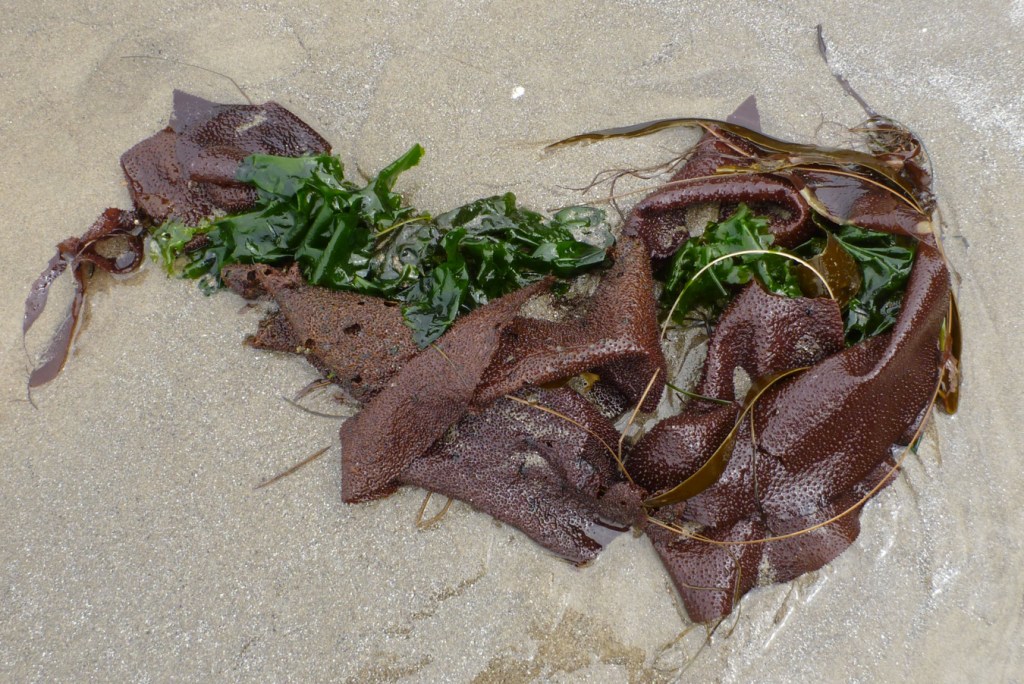
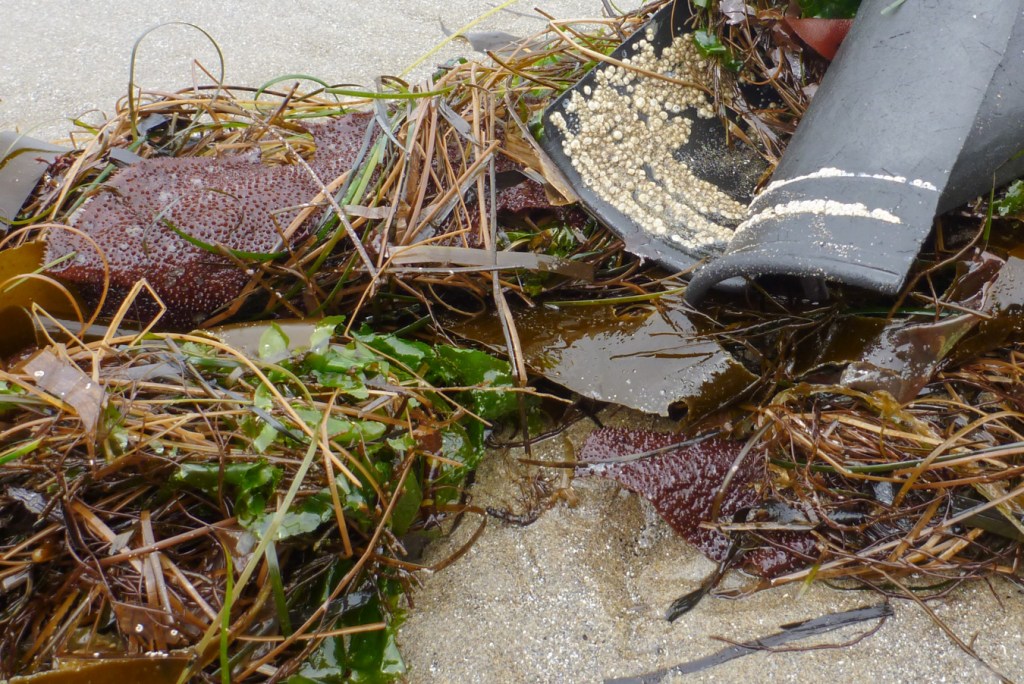
I don’t run across Chondracanthus on the northern Oregon shores I visit, at least not that I’ve noticed, but I did see a lot of it one summer morning following a beach cast event that left a lot of it in the wrack line. The images in this set are a selection from that August event.




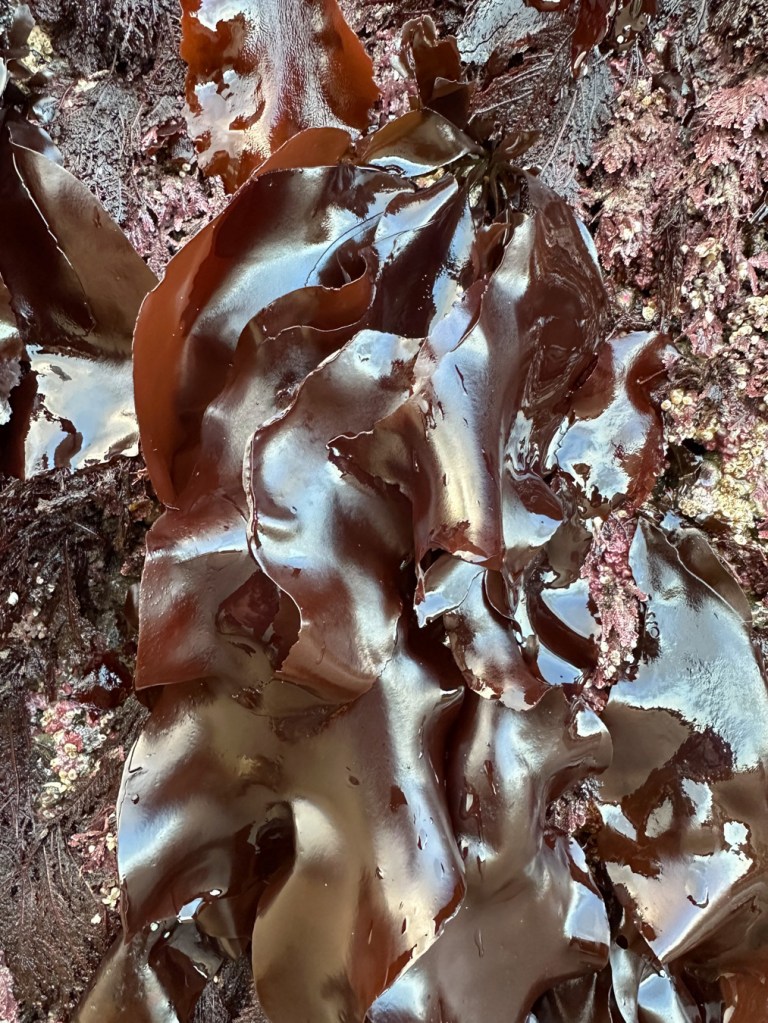
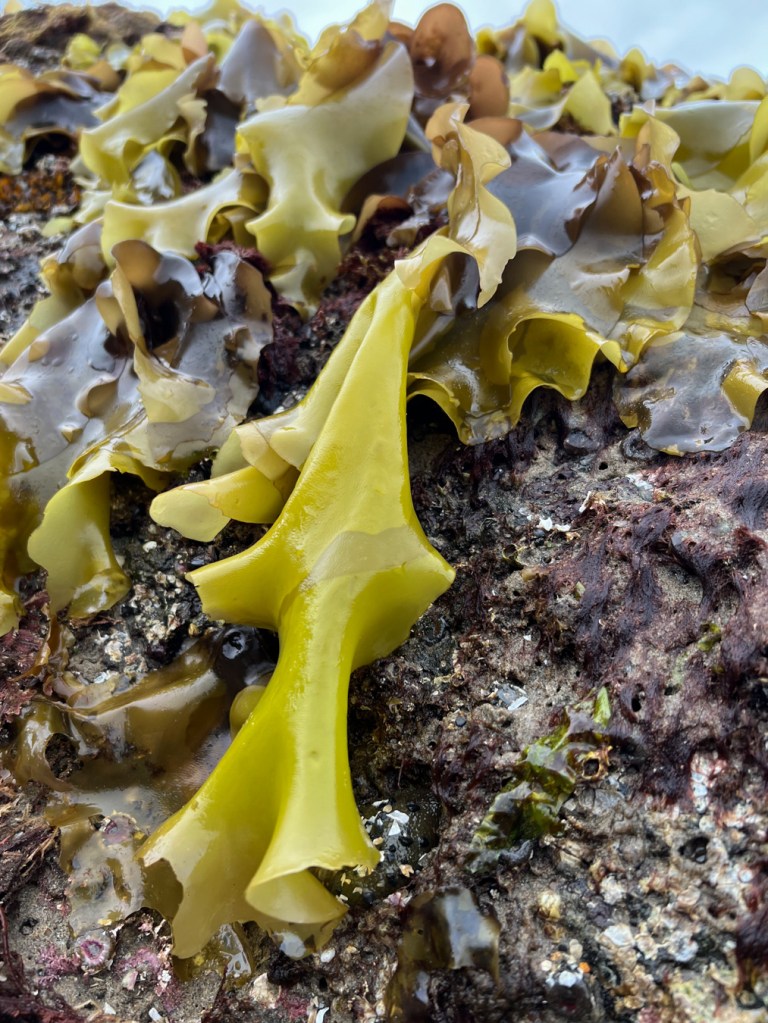
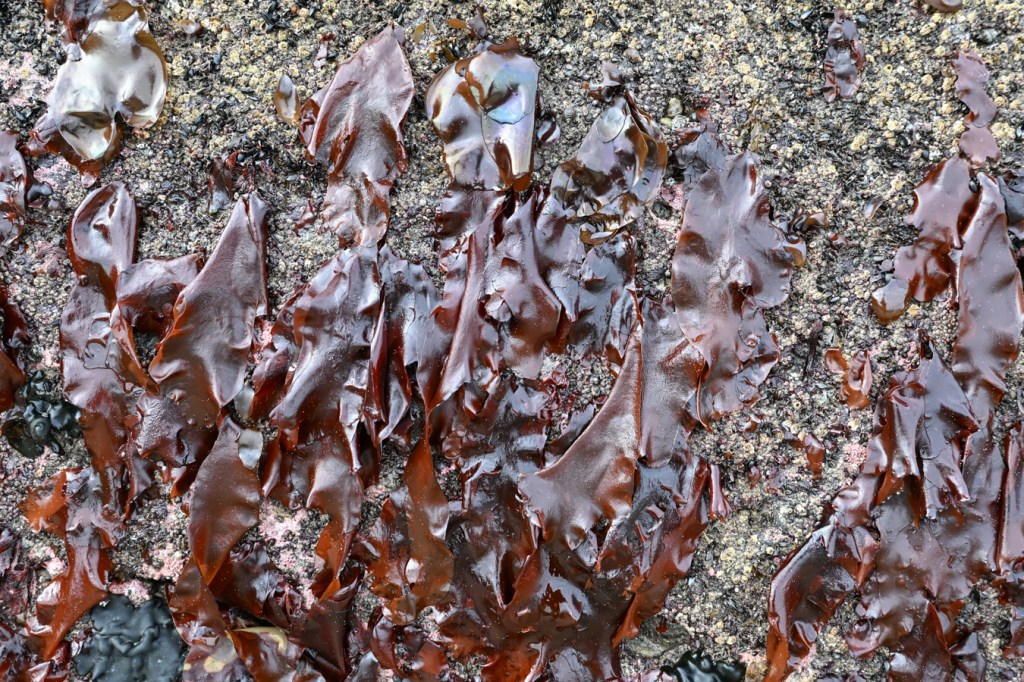
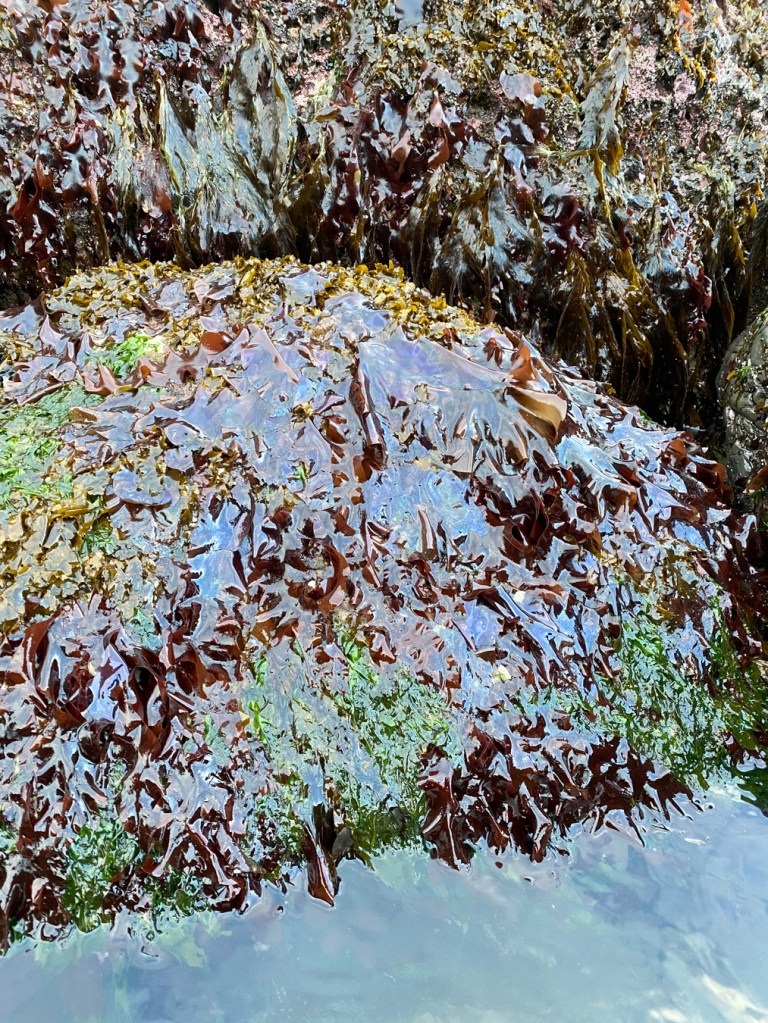
Mazzaella Rainbow Leaf, Iridescent Algae, and their variations
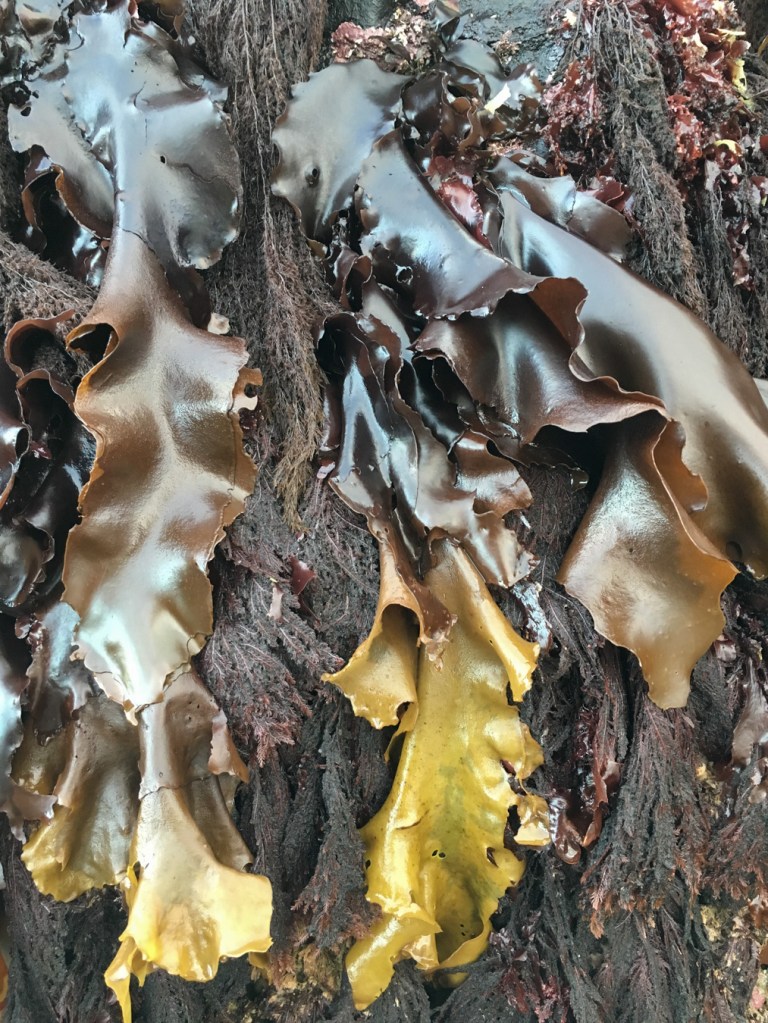
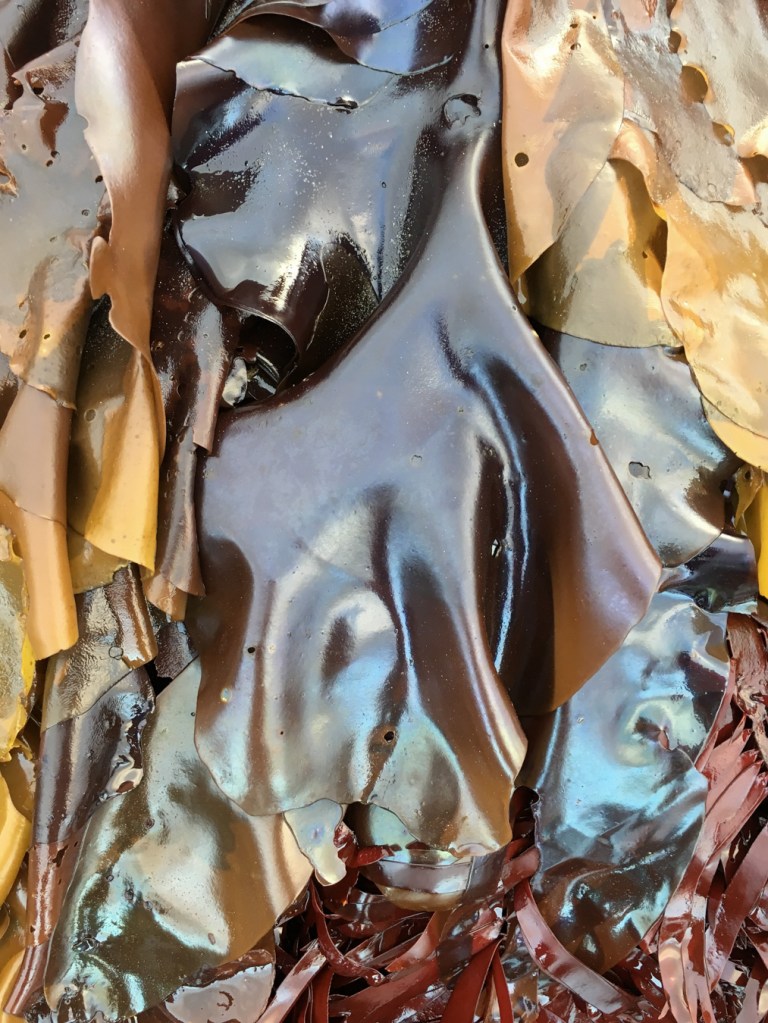
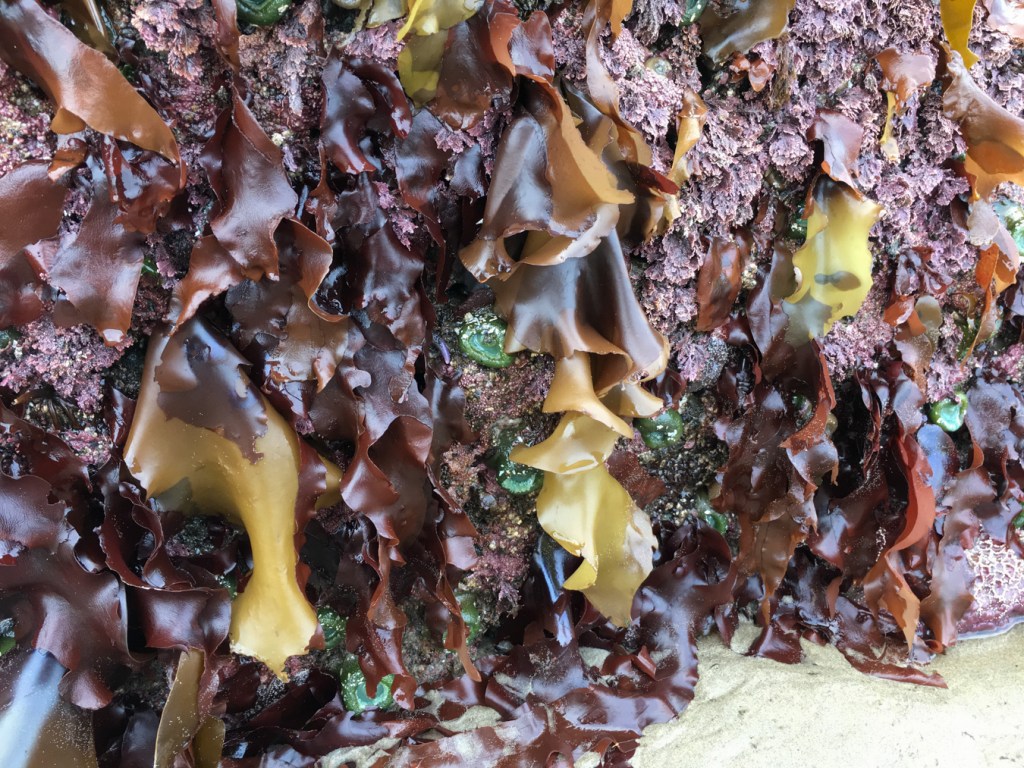
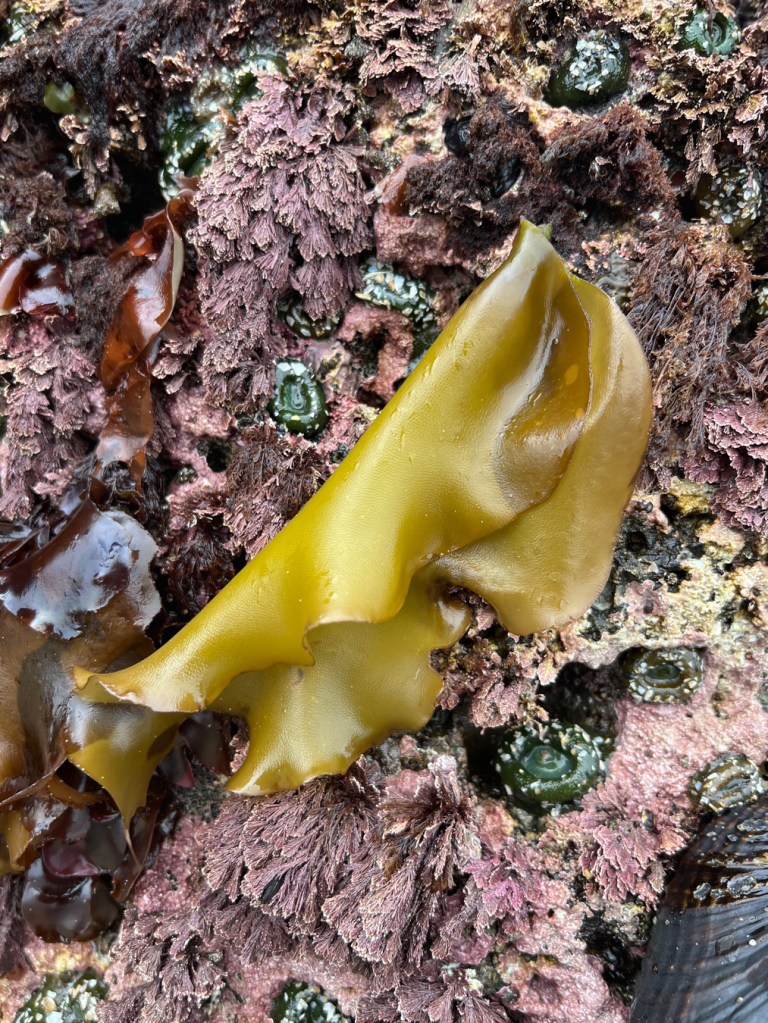
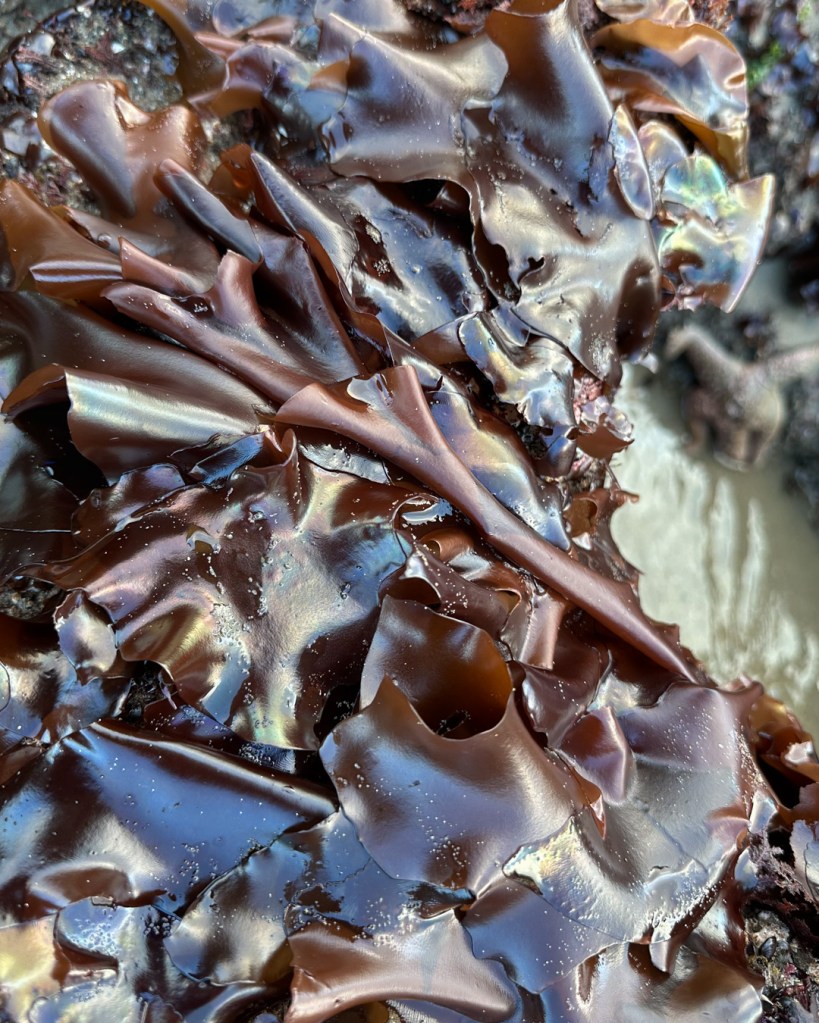
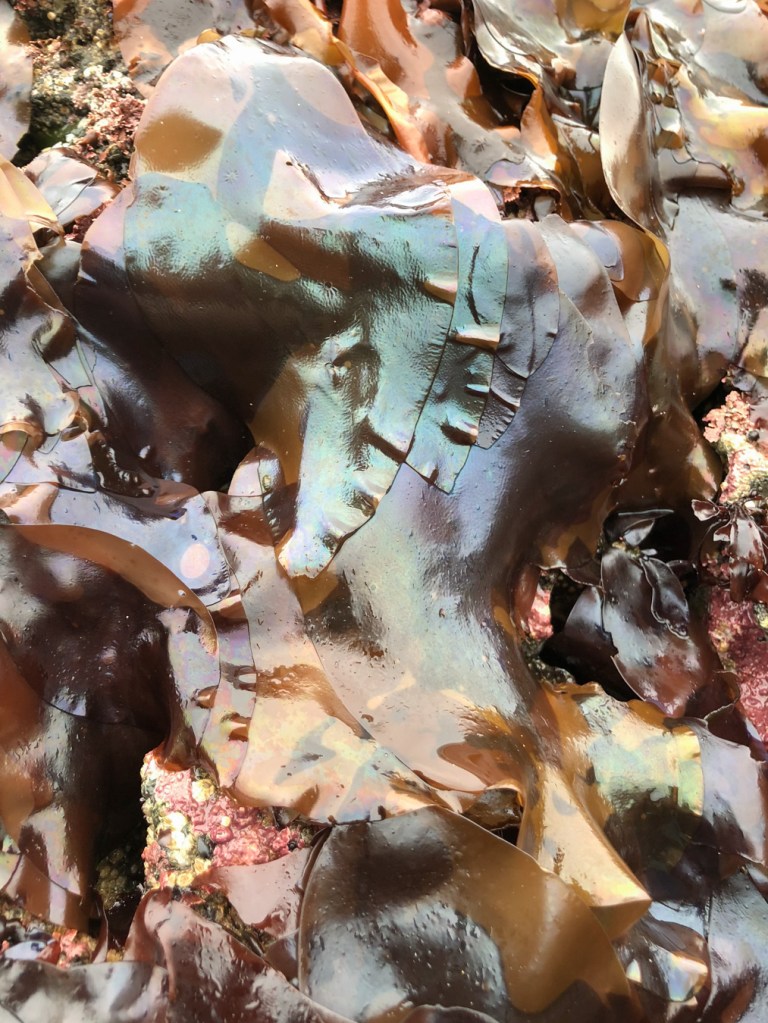
With a few similar-looking species, quite a bit of phenotypic variation, and subtle habitat differences with some overlap, Mazzaella brings head-scratching variety to an already diverse mid- to low intertidal seaweed montage. Recognizing Mazzaella’s multiformity and the presence of lookalikes, I feel like I’d probably overstep if I tried to make specific identifications from photographs like mine. Thus, I invite all the more or less big-bladed mid- to low intertidal Mazzaella (and maybe a few of its look-alikes) to a big, rainbow-themed party. (Note: I separately feature Mazzaella parksii, more typical on high surf-exposed rocks, above on this page.)
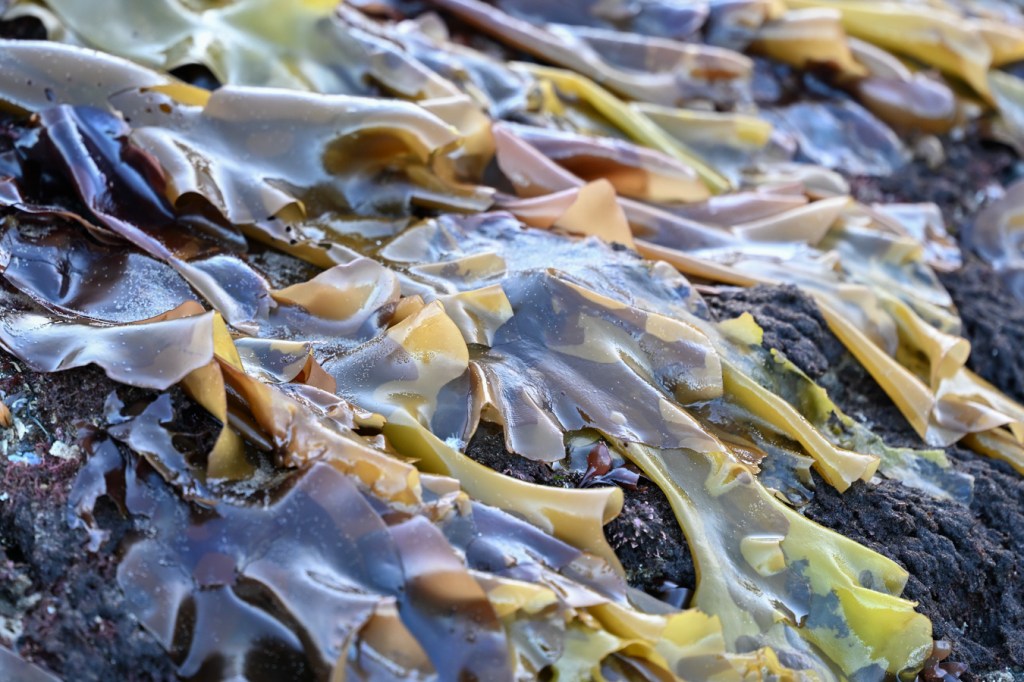
A celebration of big blades
The set of images below is a peek at just some of the variety the big Mazzaella blades can throw at you.
Perspectives
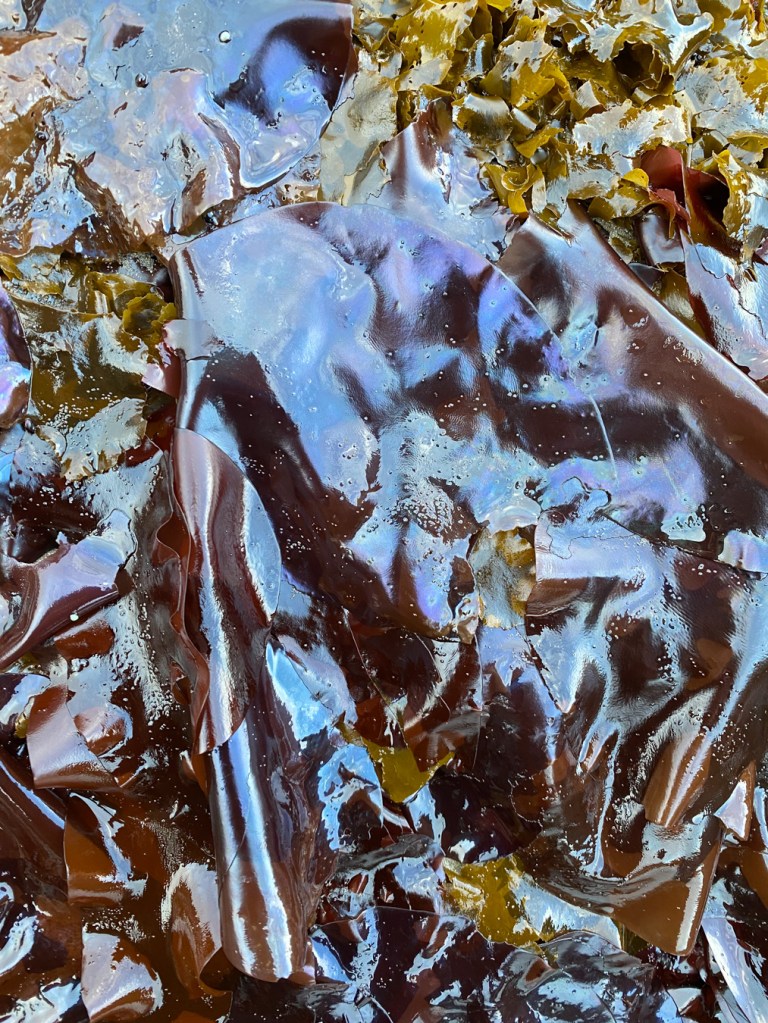
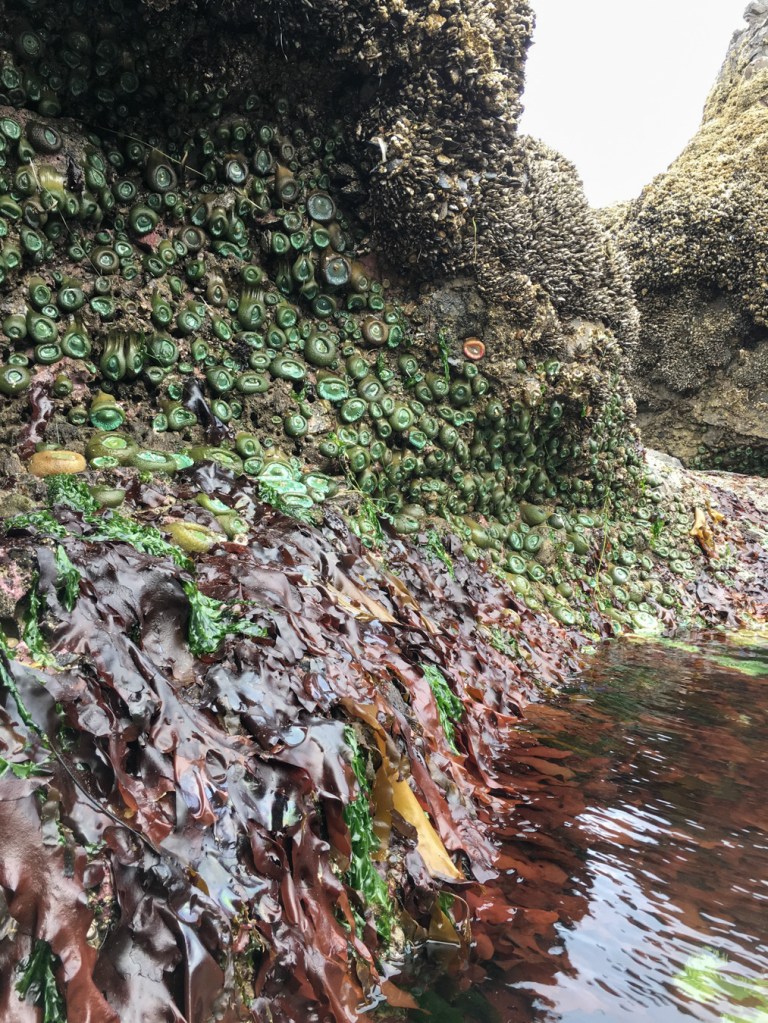
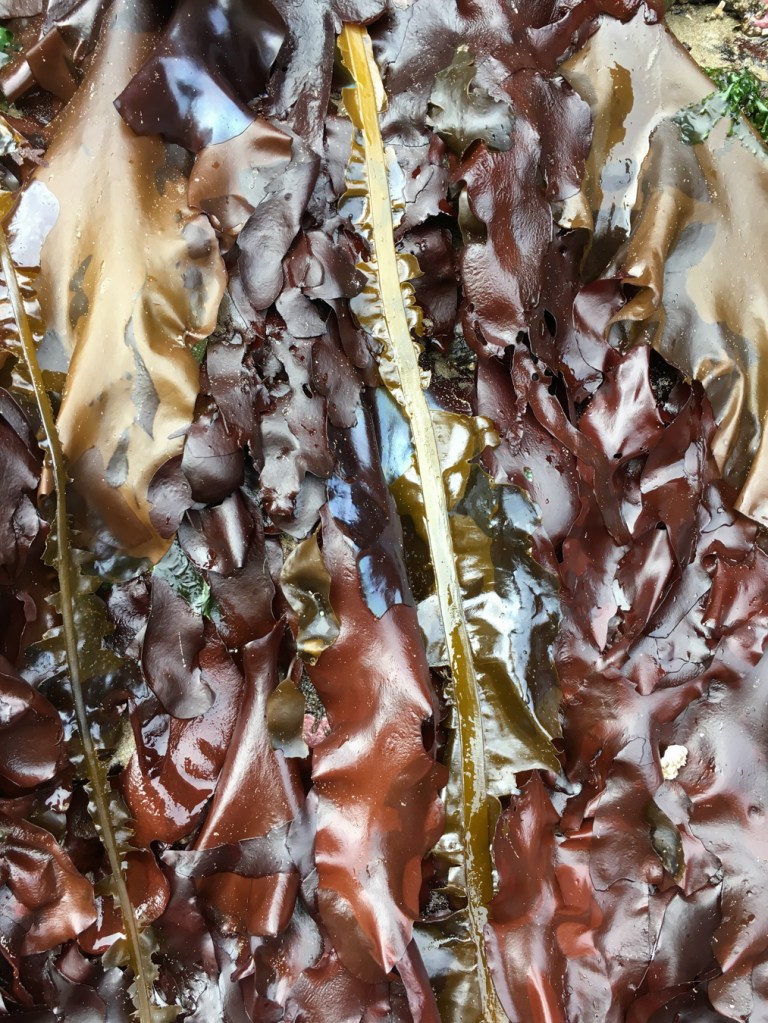
Intimacies
Making sense out of inscrutable Mazzaella-like blades is going to take some close-up work beyond understanding habitat and the appearance of undisturbed blades. Some helpful characteristics need to be felt to be appreciated, traits like rubberiness, slipperiness, and stretchiness. Taking hold of a blade can also help you understand blade shape, stipe length, and the overall layout of whatever it is you’re puzzling over. Getting to know Mazzaella and Mazzaella-like blades is probably going to involve a little touching and tugging.
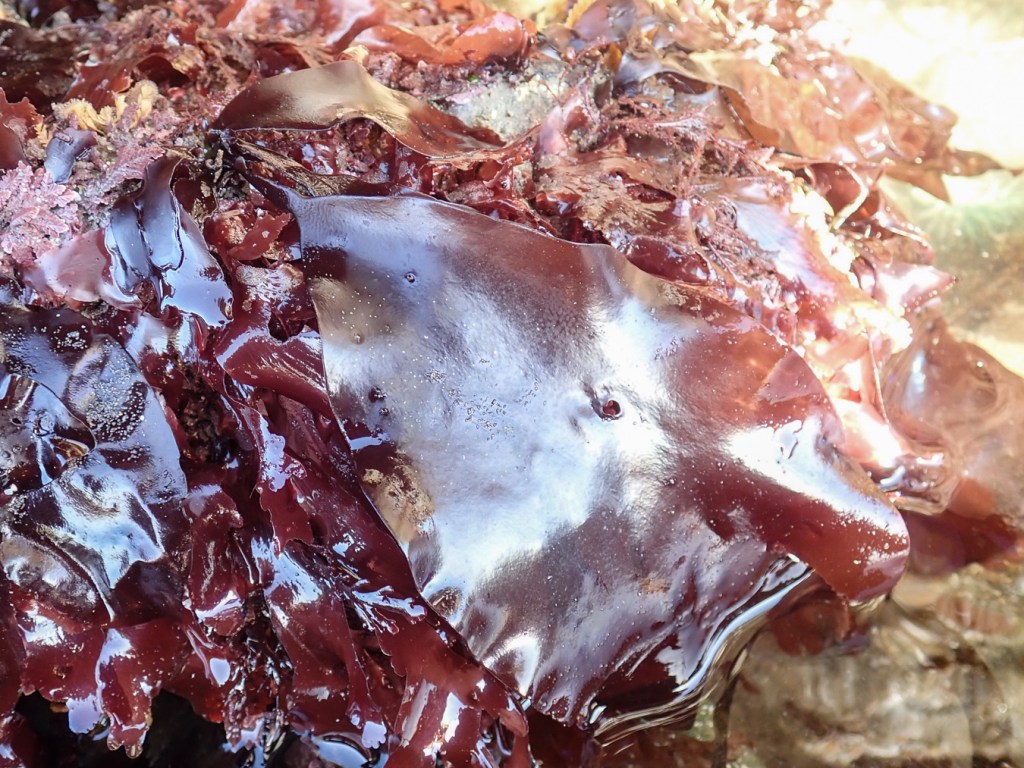
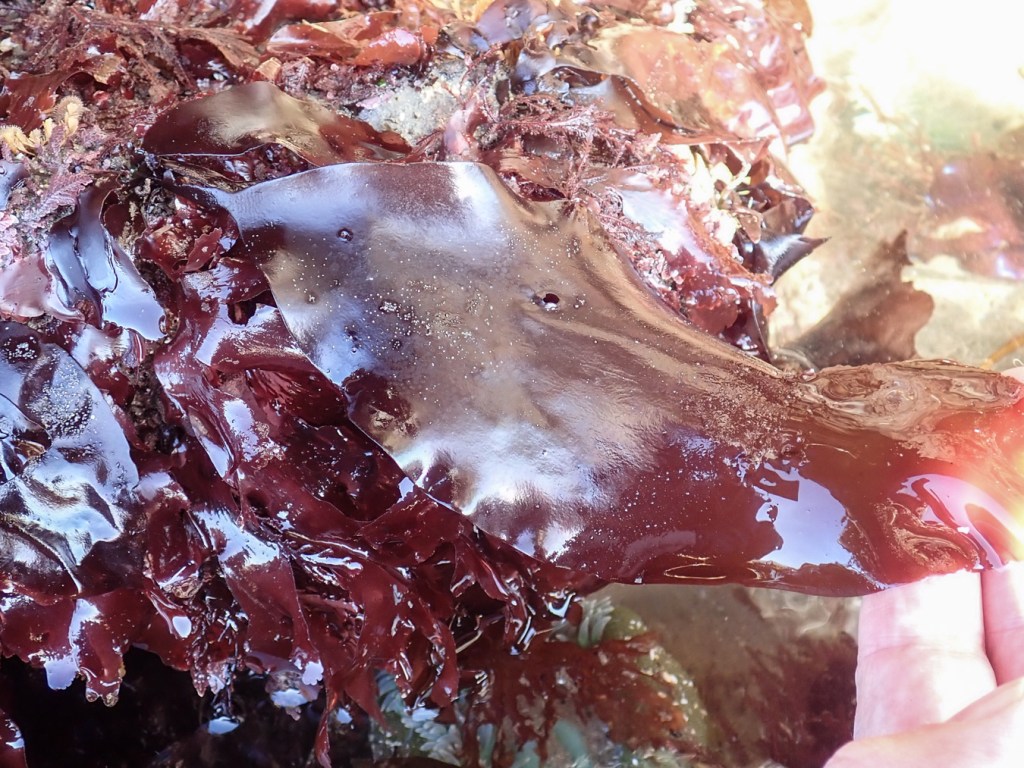
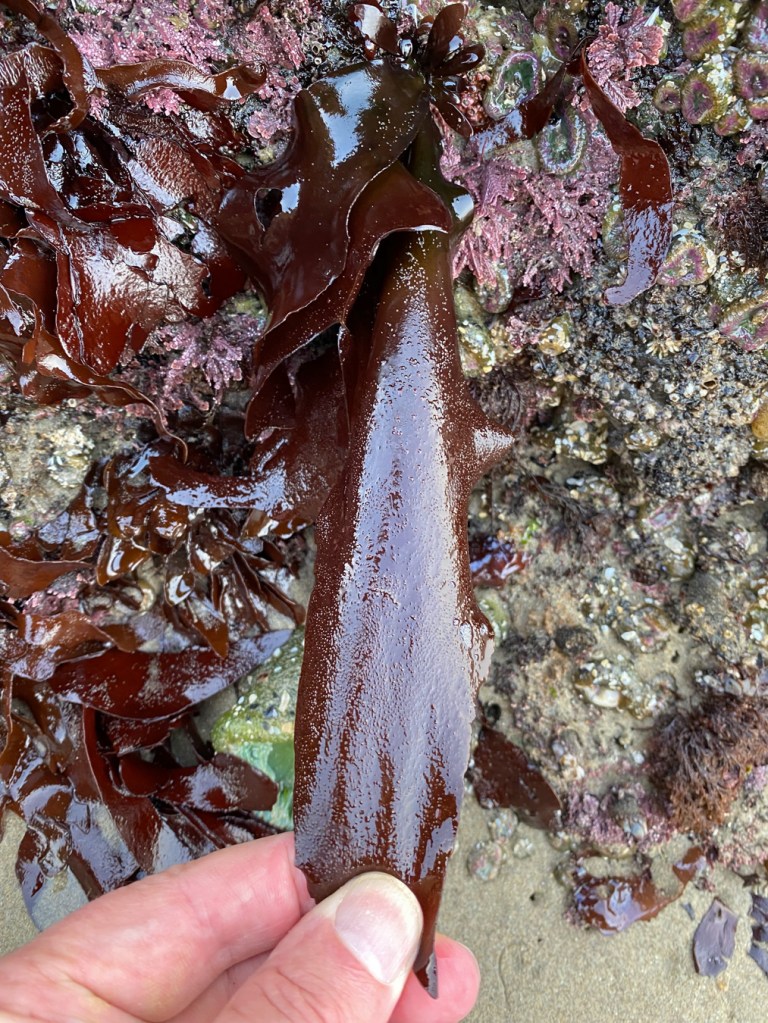
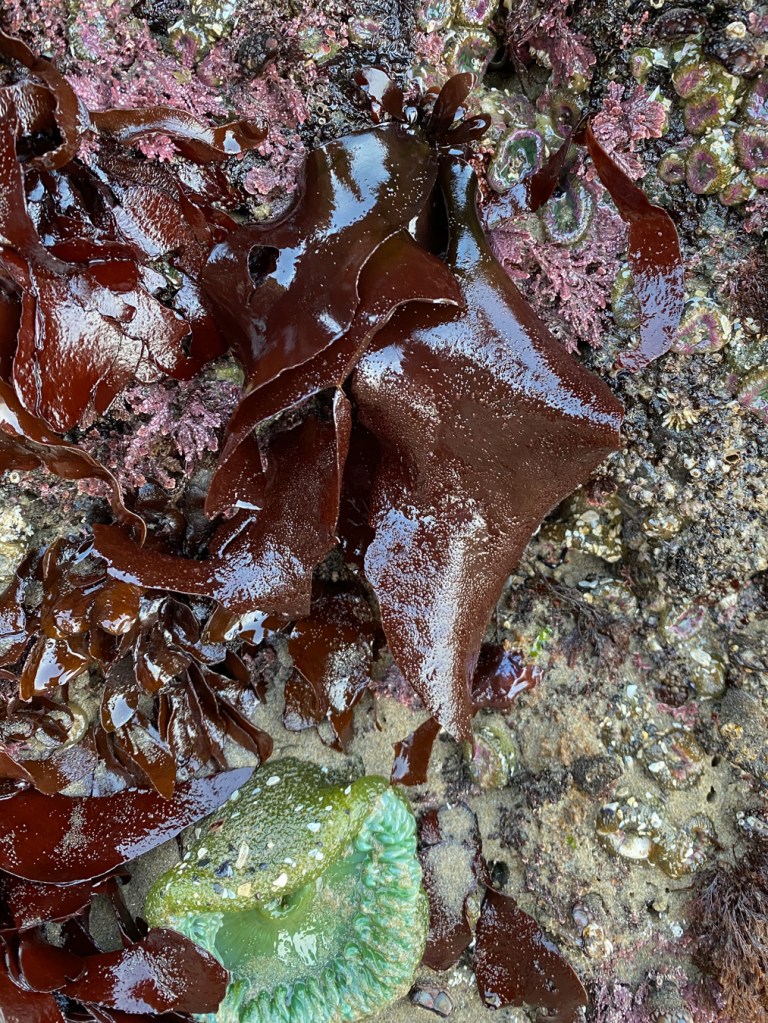
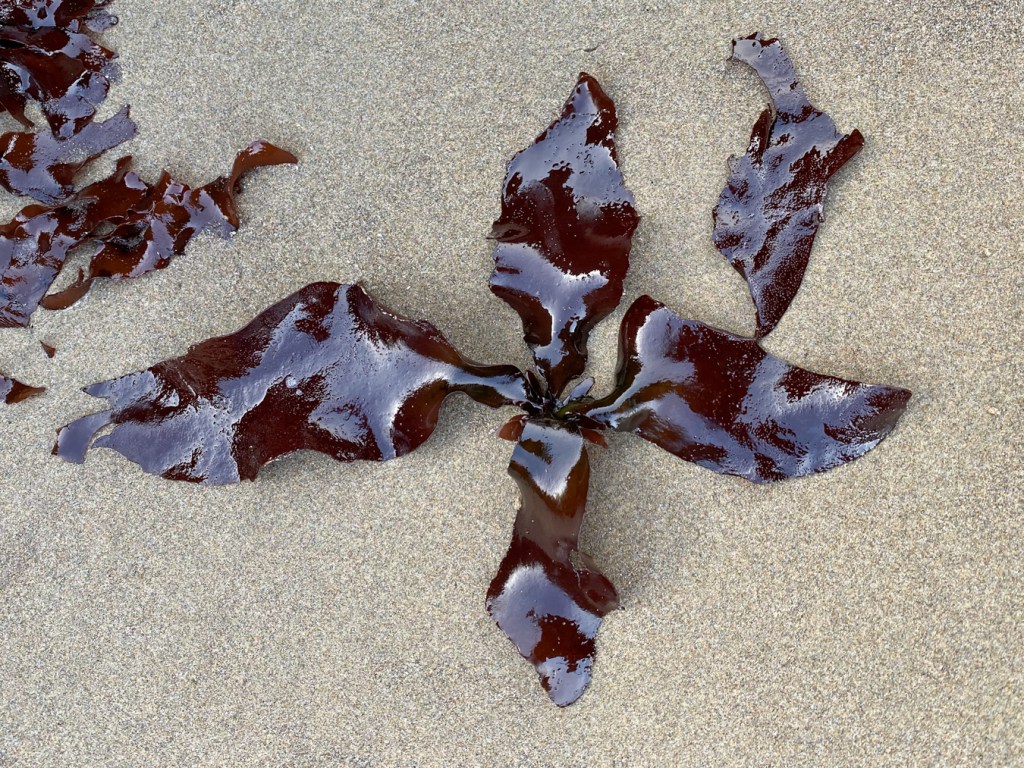
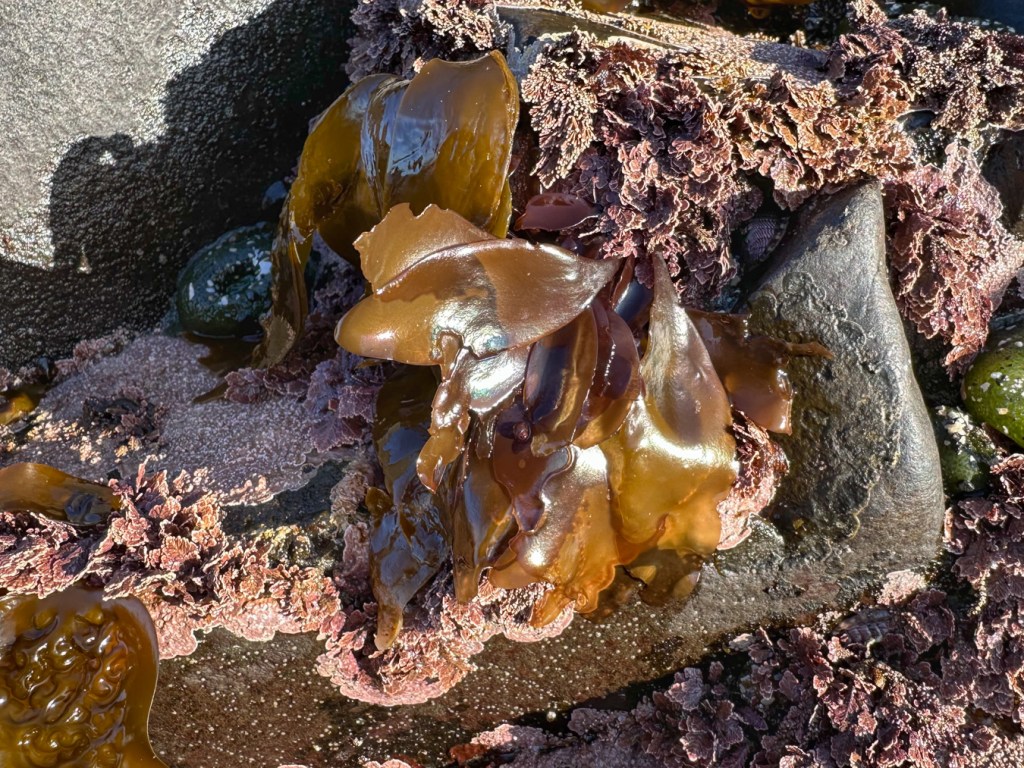
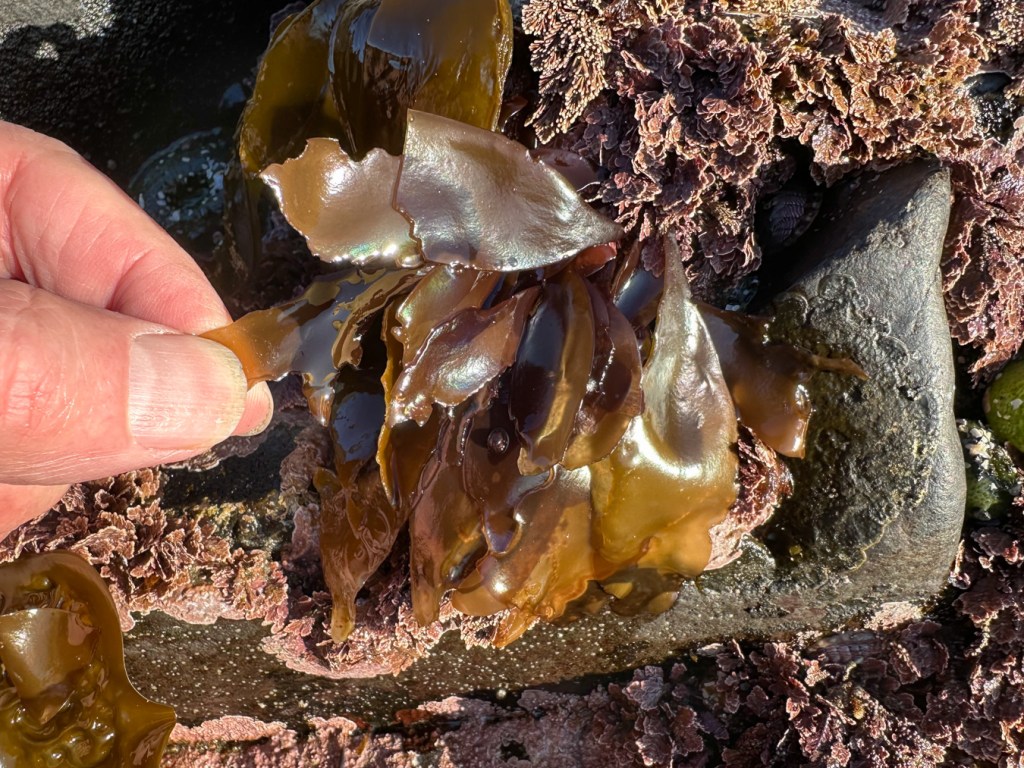
Iridescence is a familiar Mazzaella theme
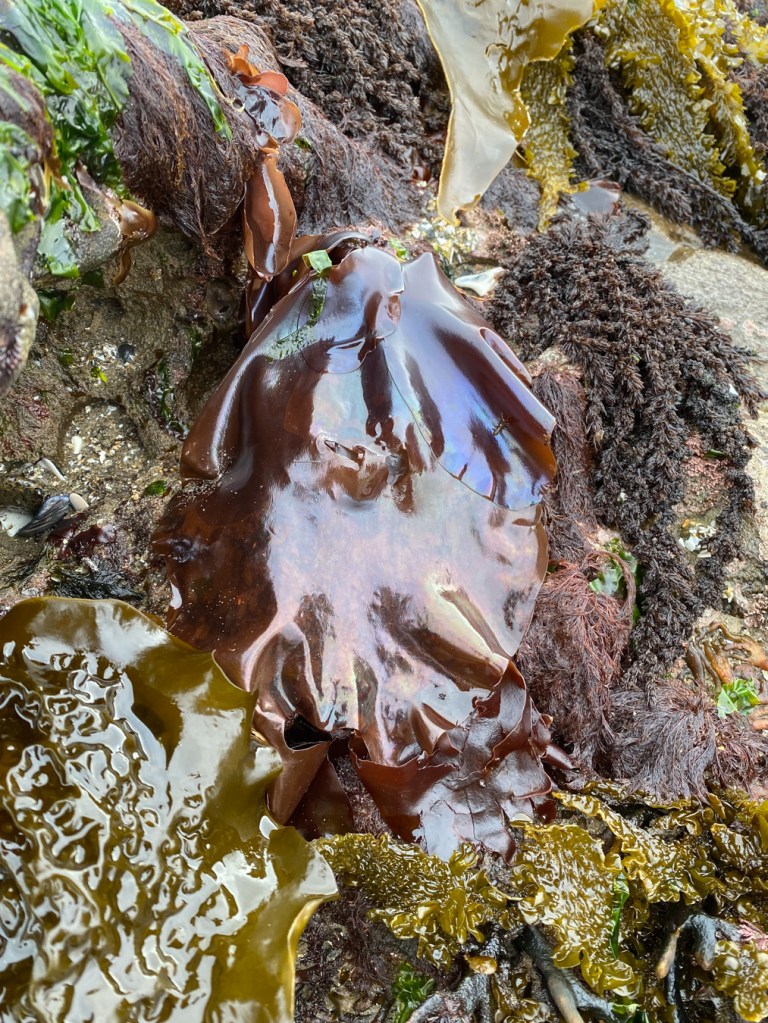
Set among diverse seaweed neighbors, the showoff featured in the image below, from a semi-protected site on the central Oregon shore, is too cute for words.
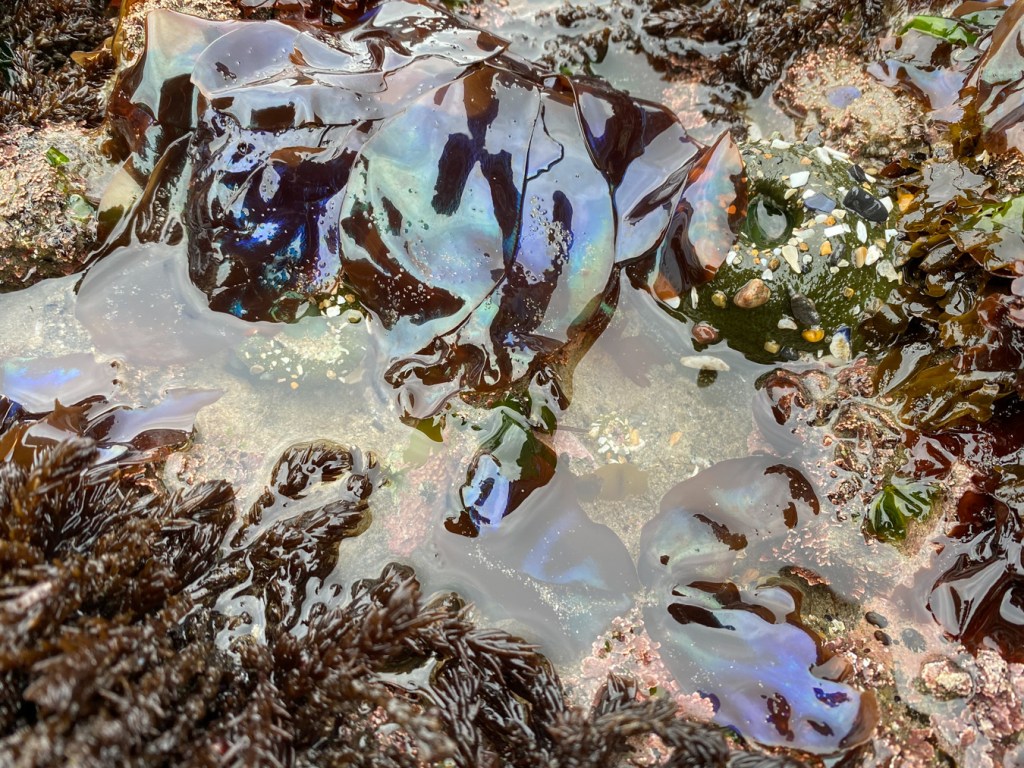
In the pair of images below, also from the central Oregon shore, I love how the iridescence (left-hand panel) shines through the rush of the swash (right-hand panel).
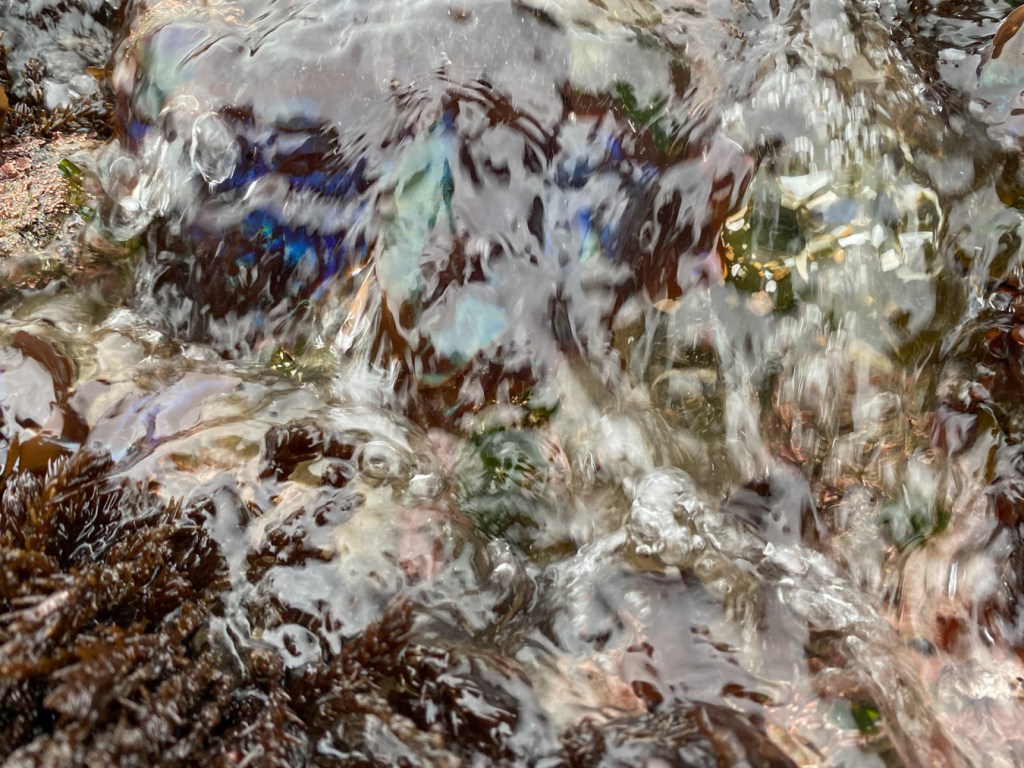
The set below is a collage of iridescent blades, common in some fairly exposed settings low on the northern Oregon shore.
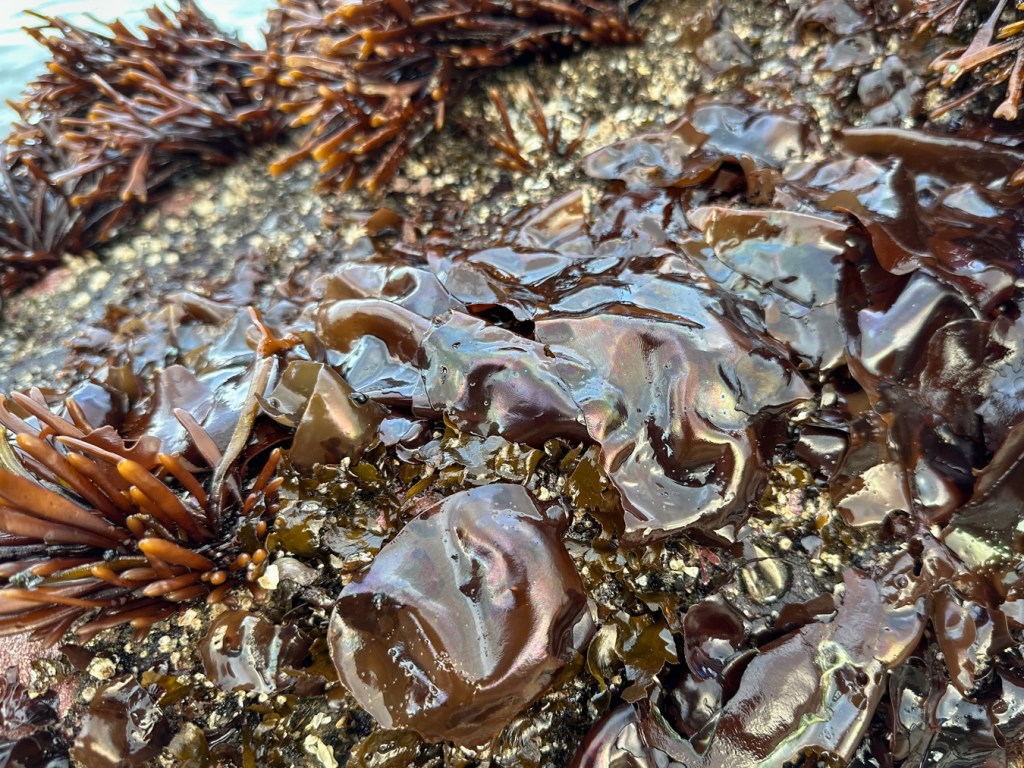
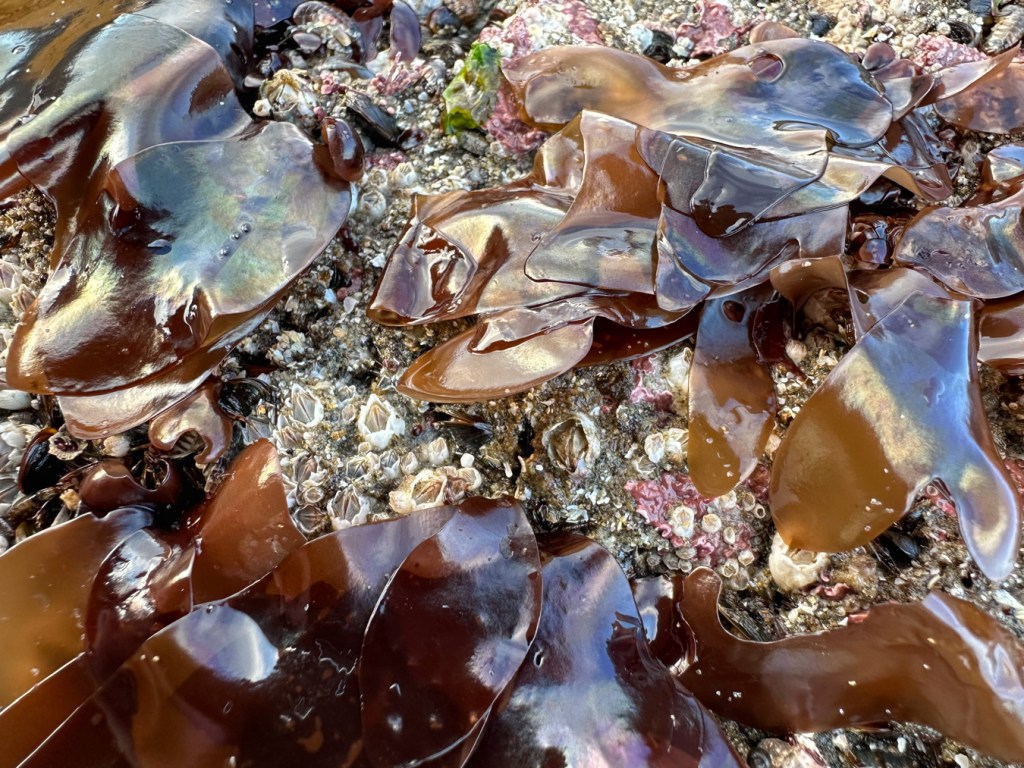
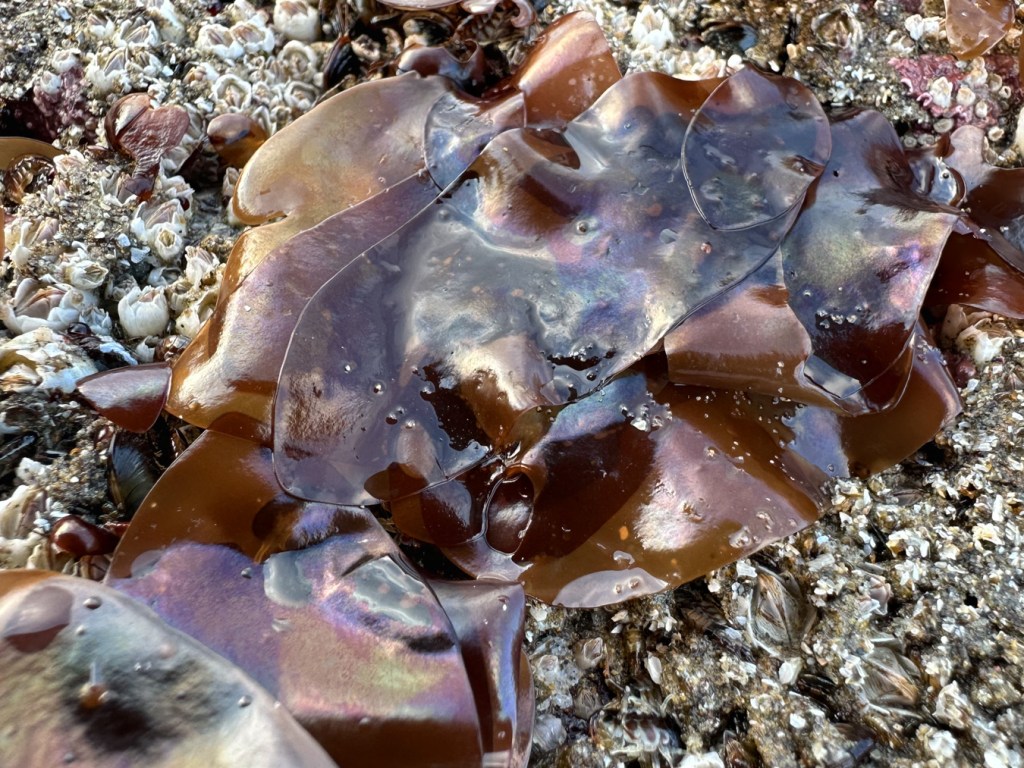
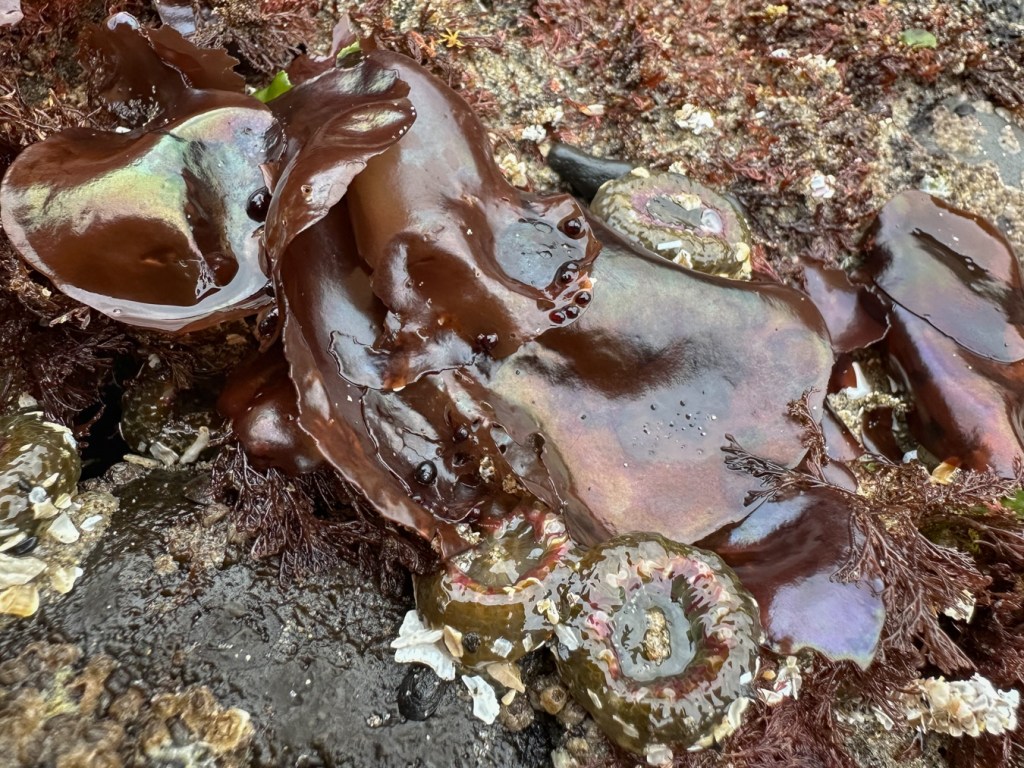
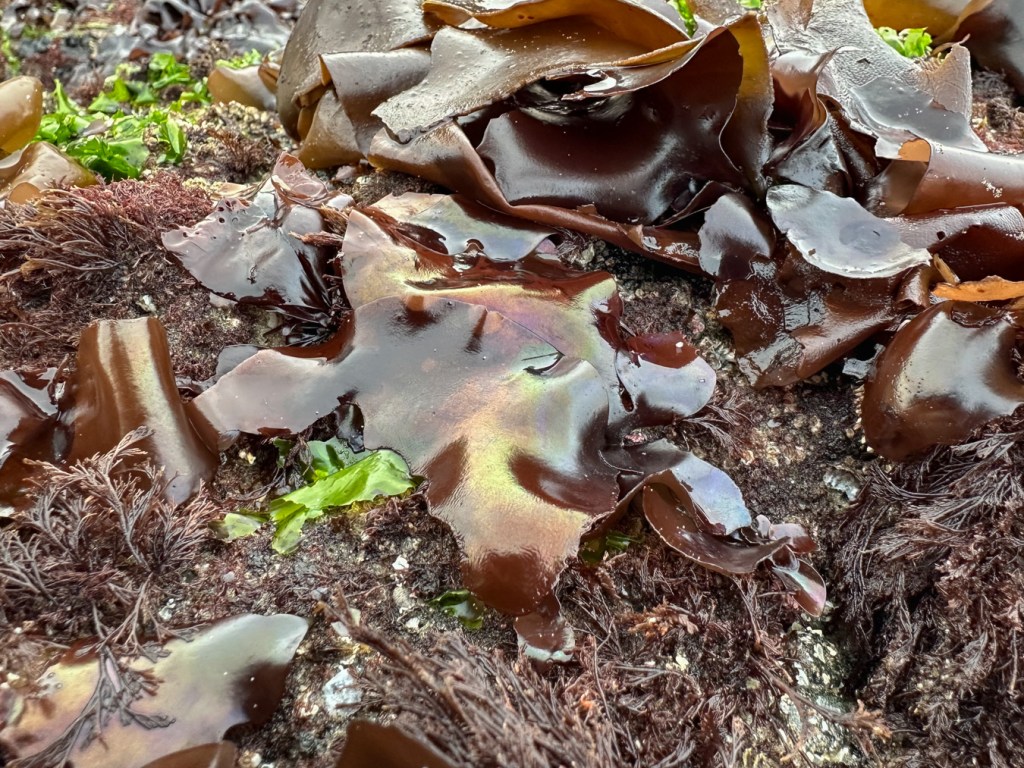
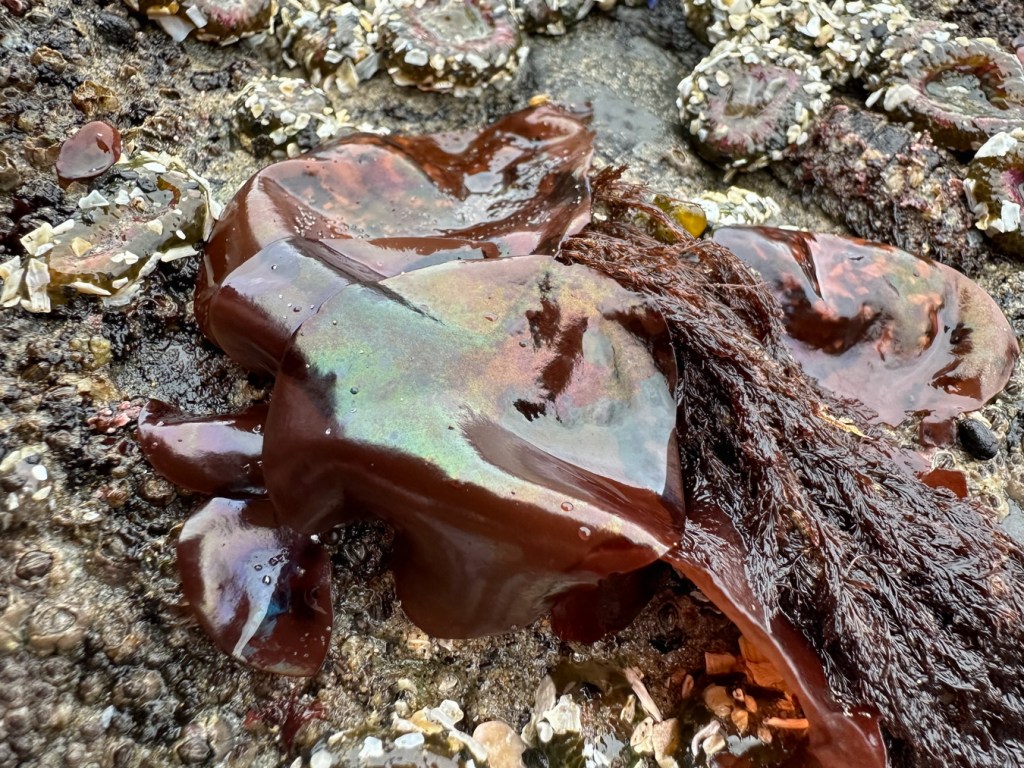
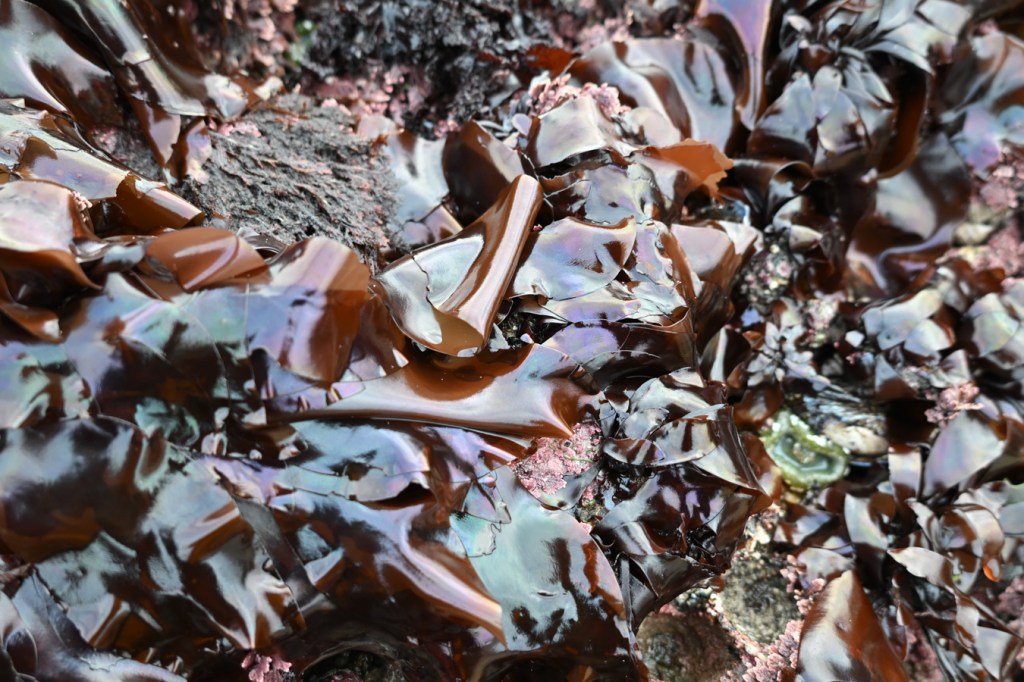
Also seen
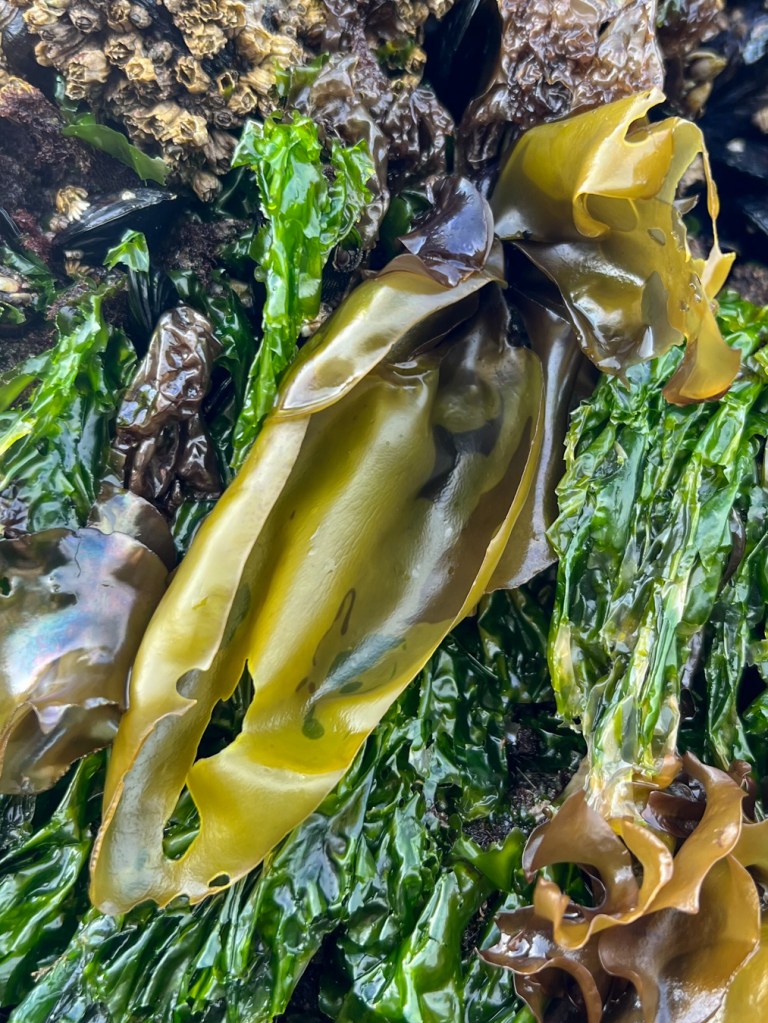
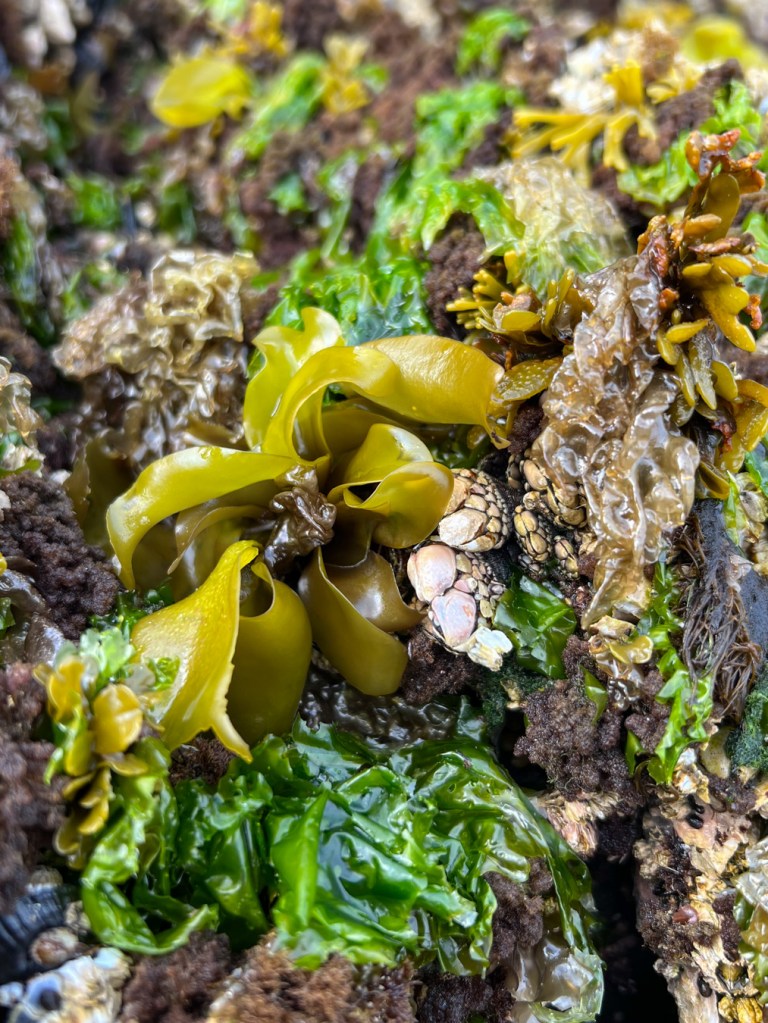
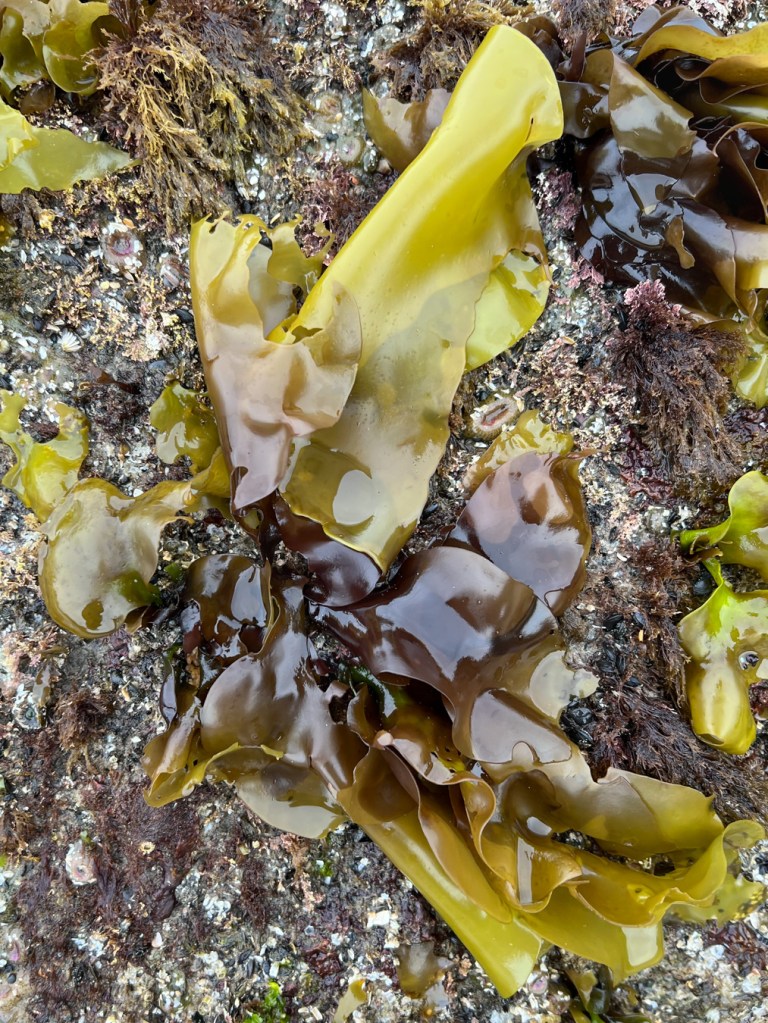
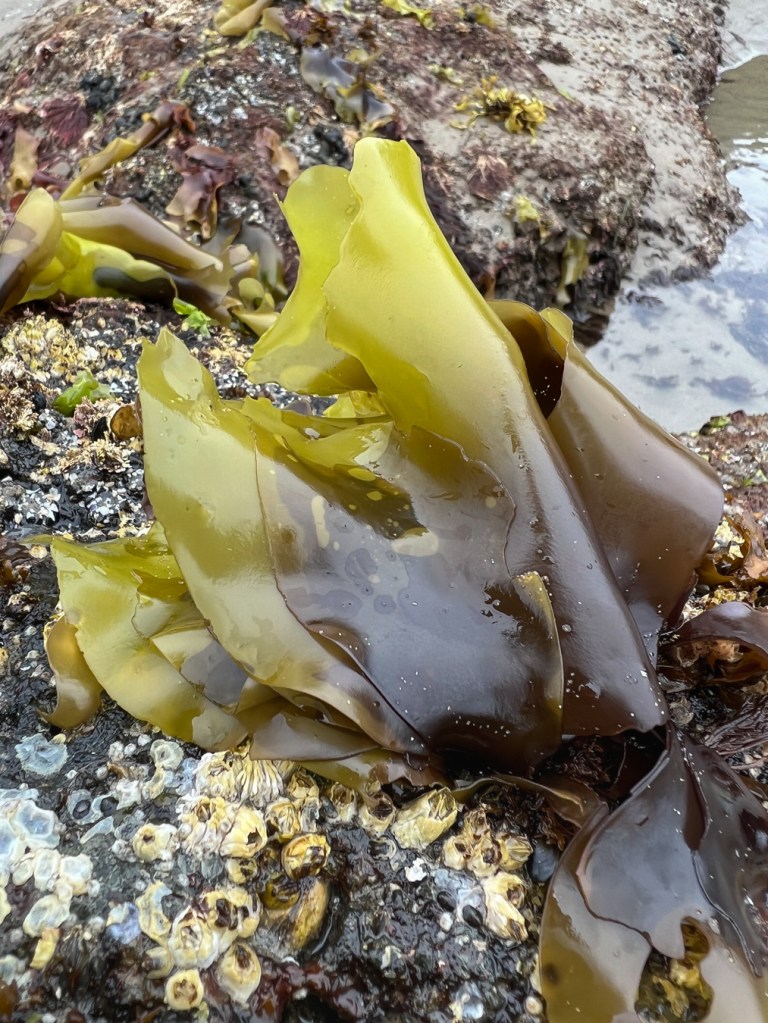
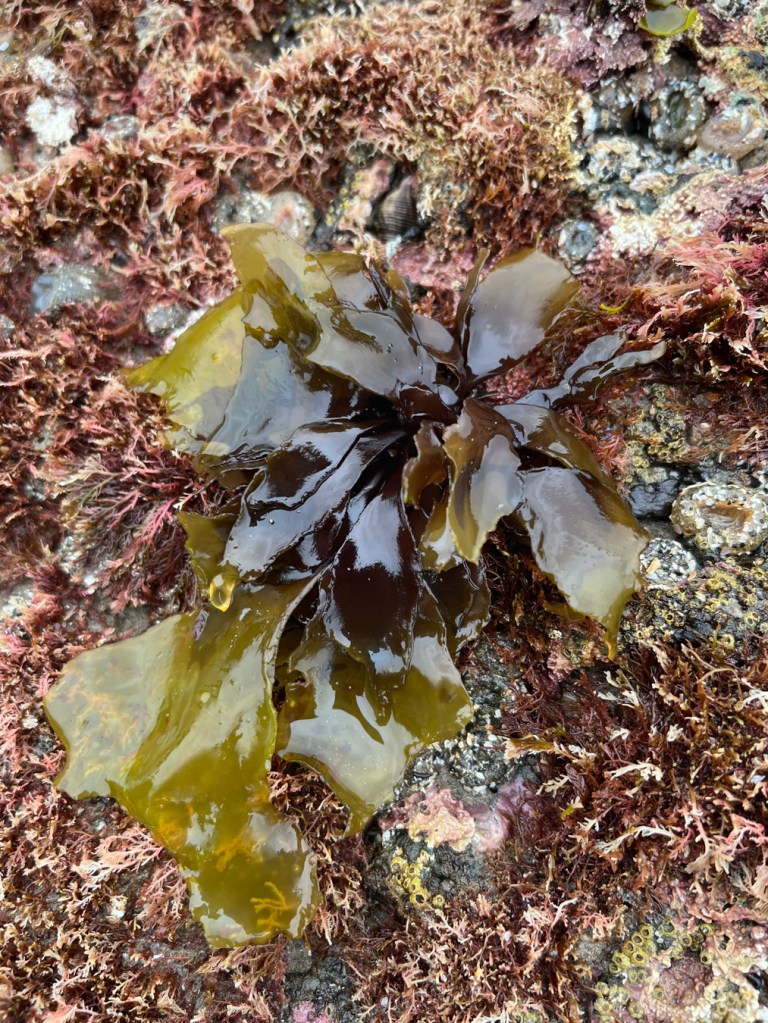
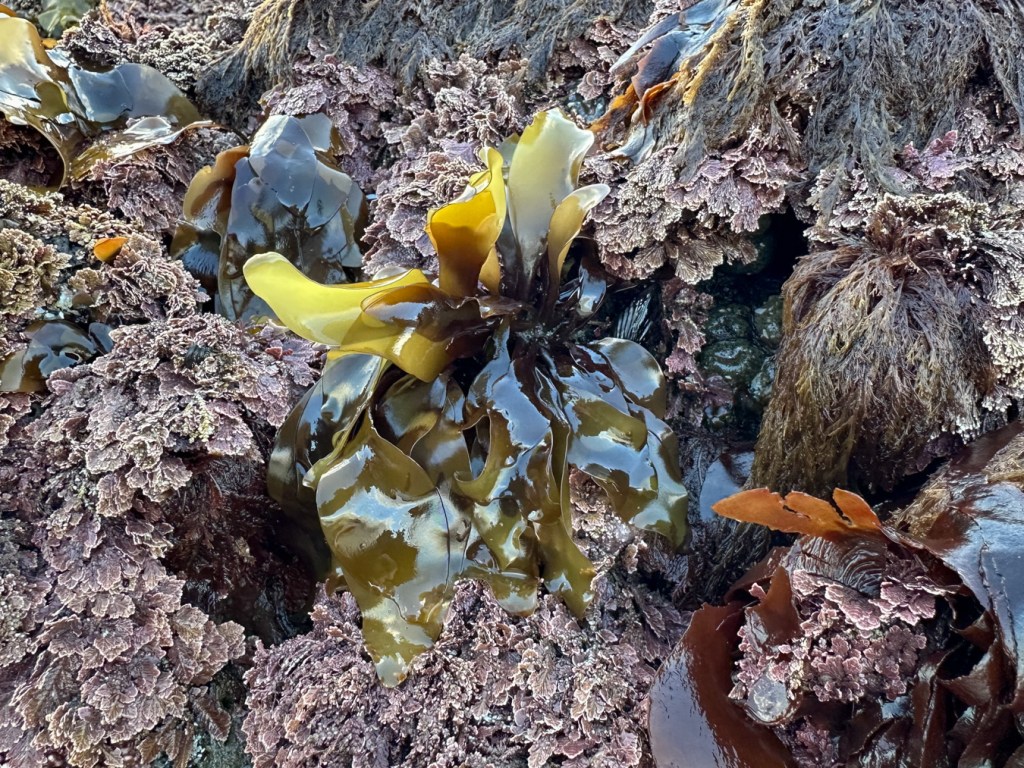
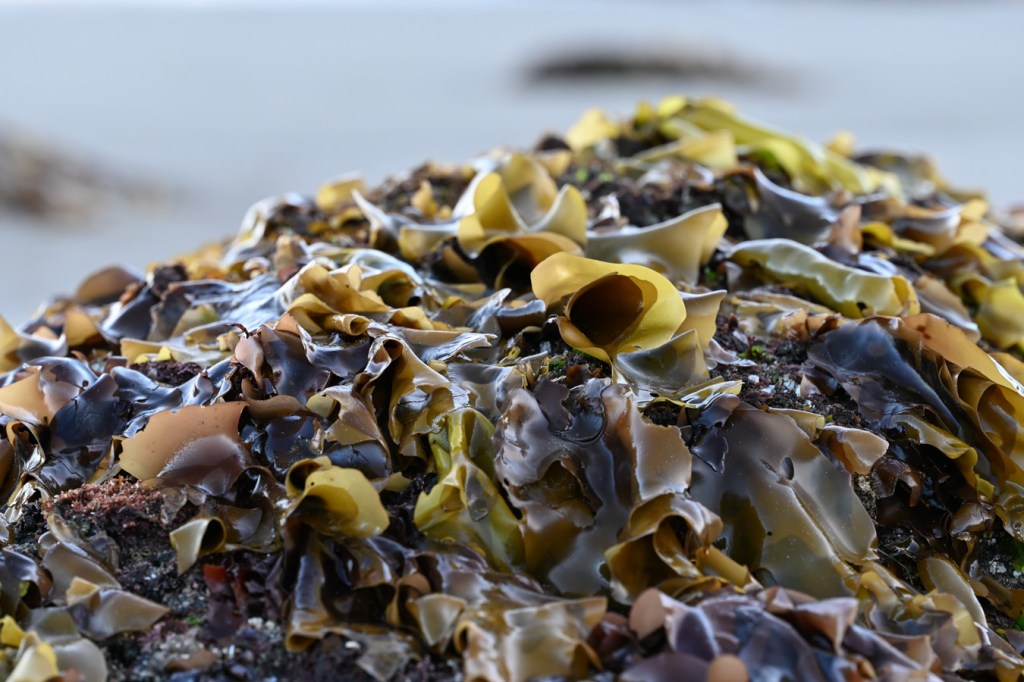
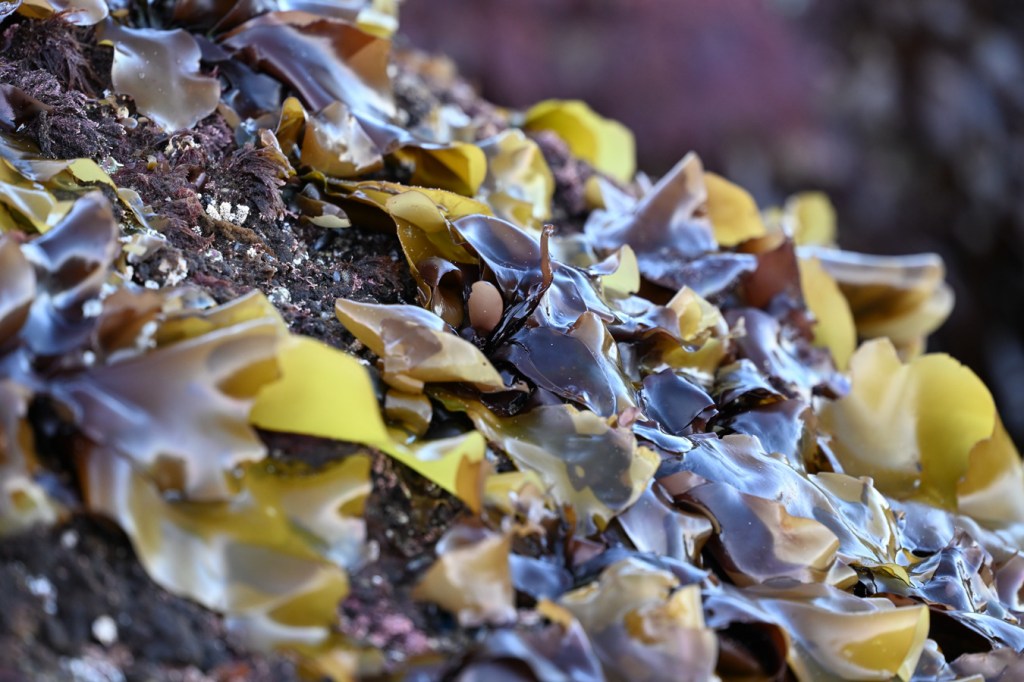
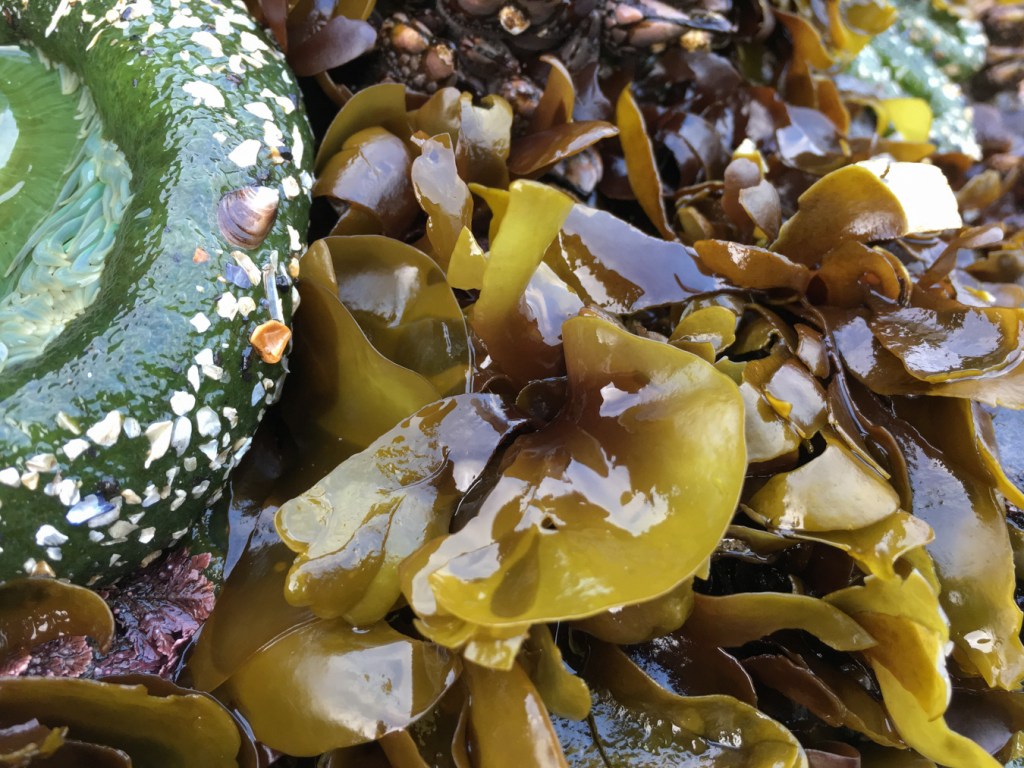
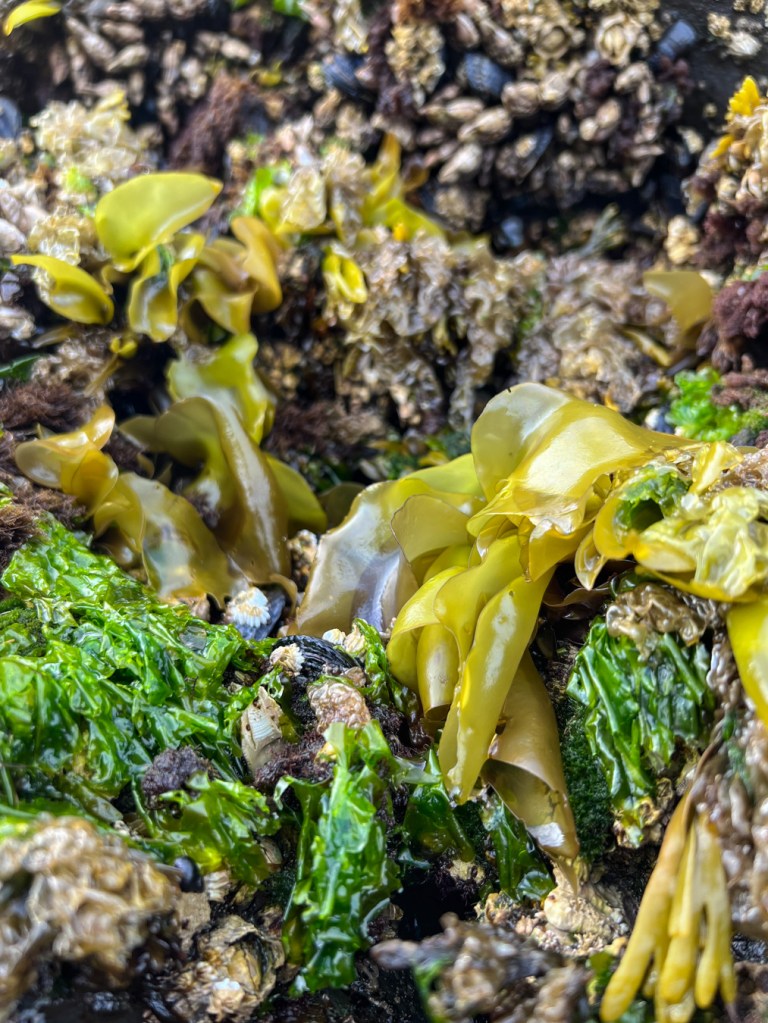
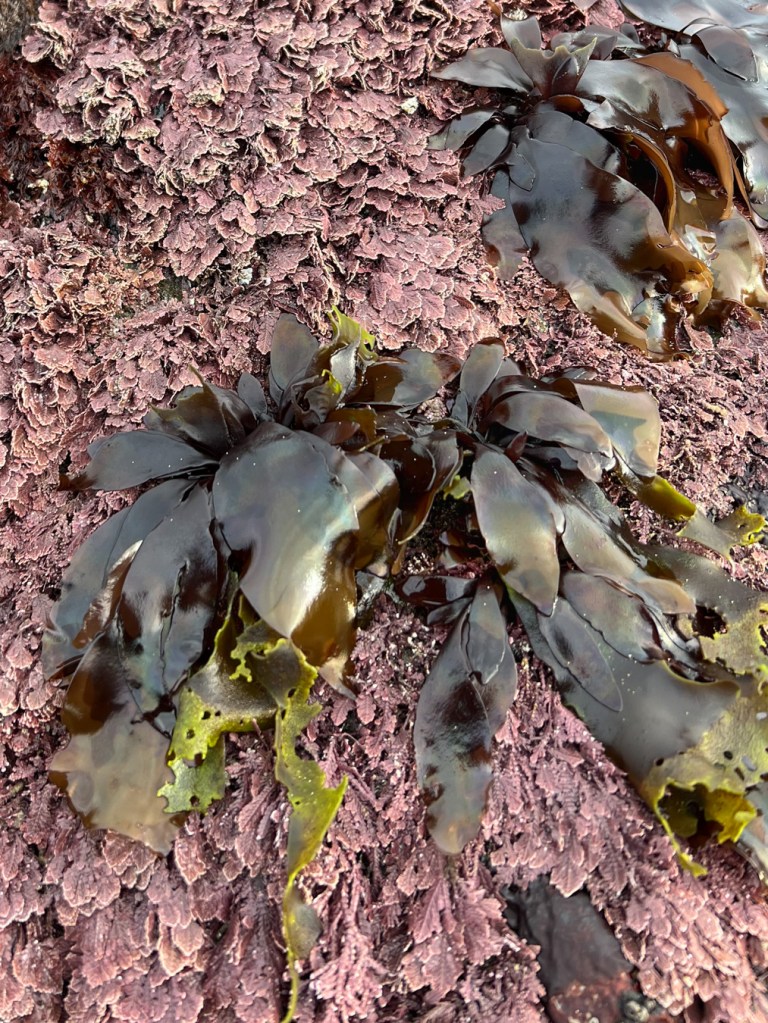
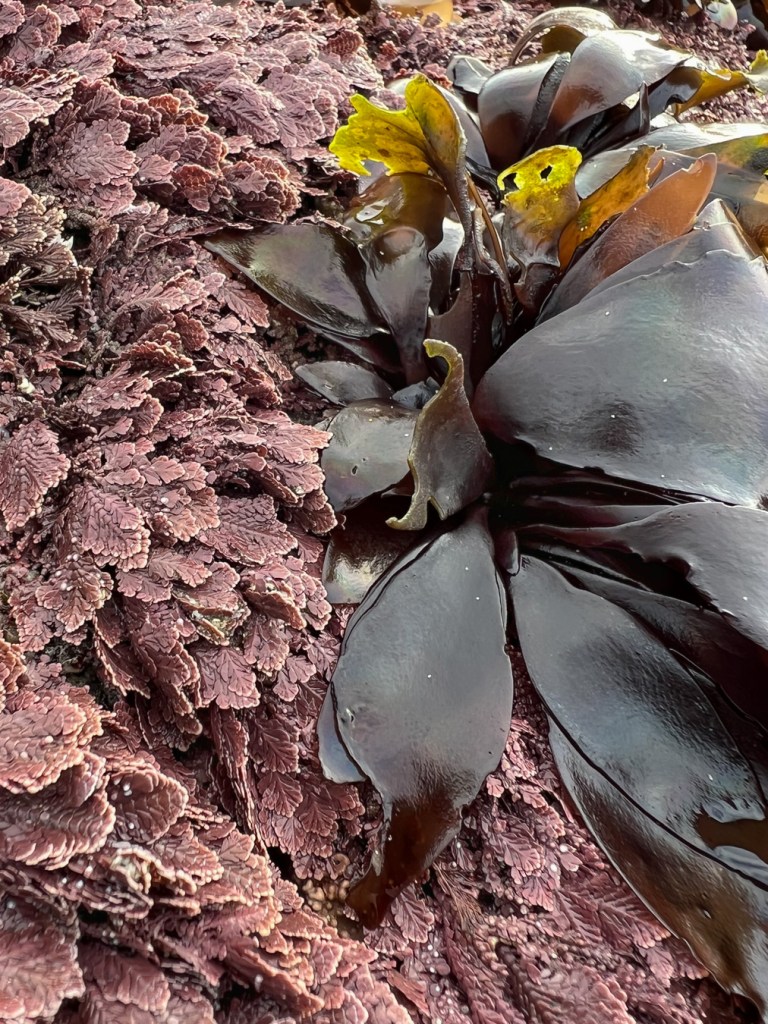
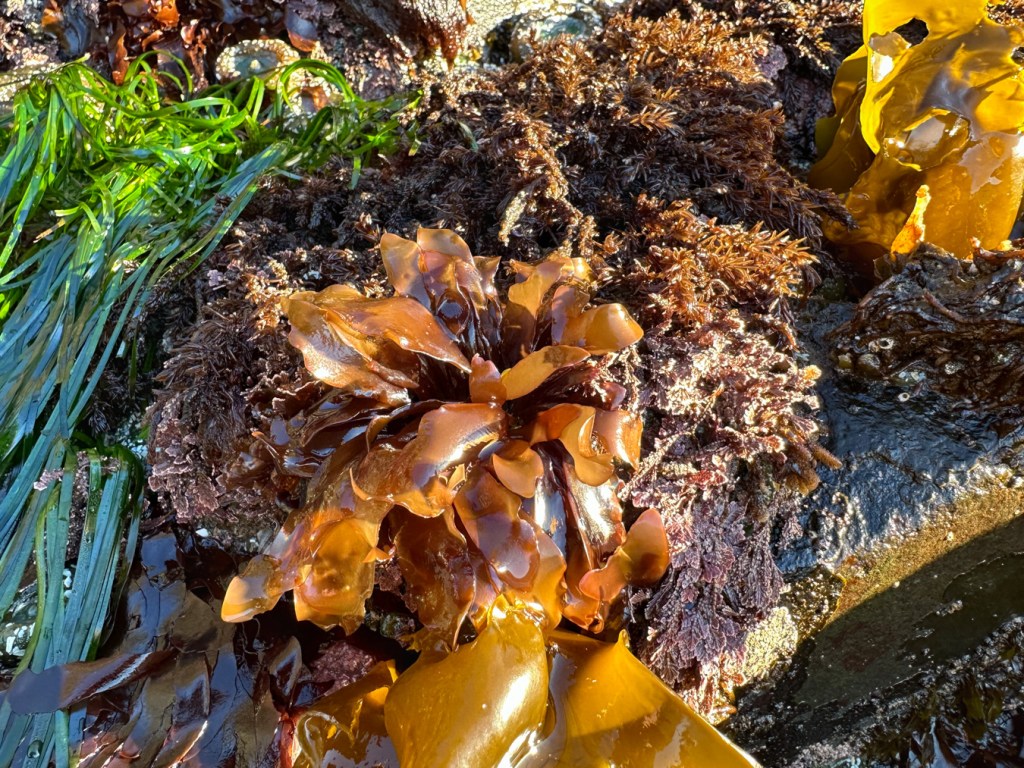
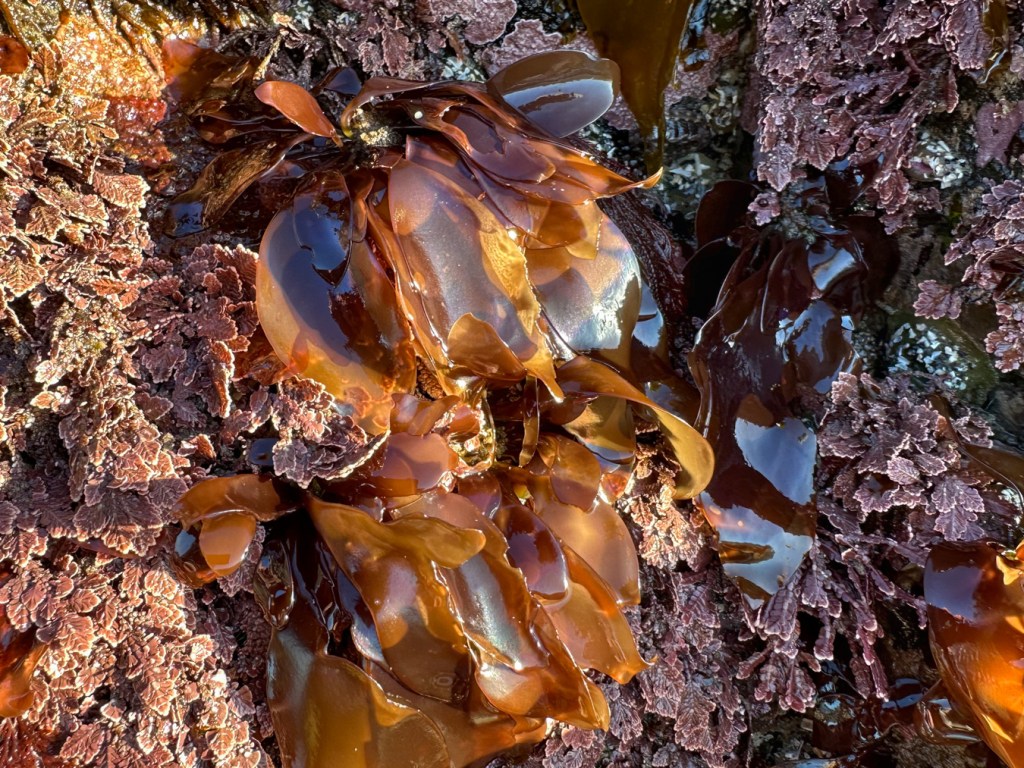
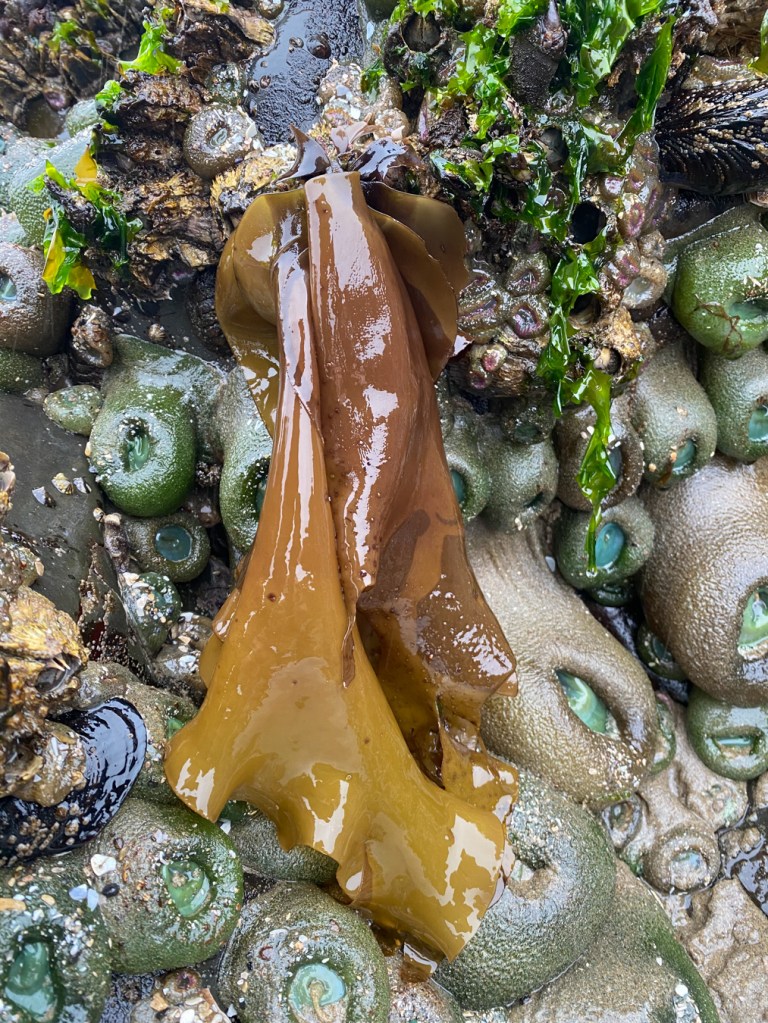
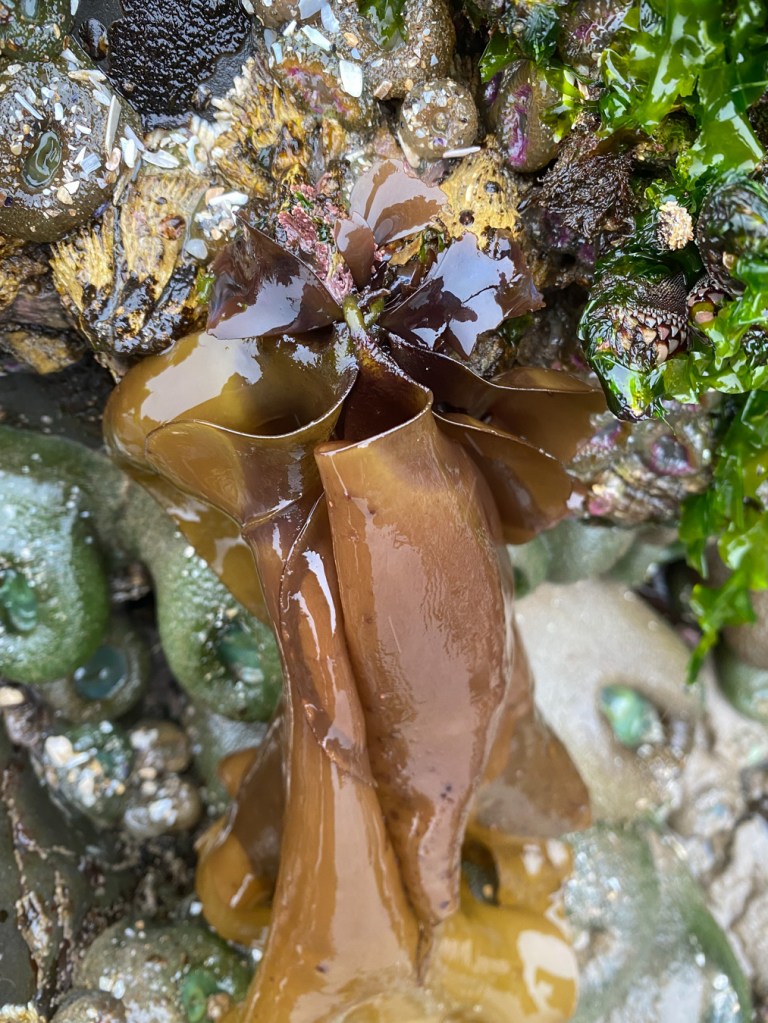
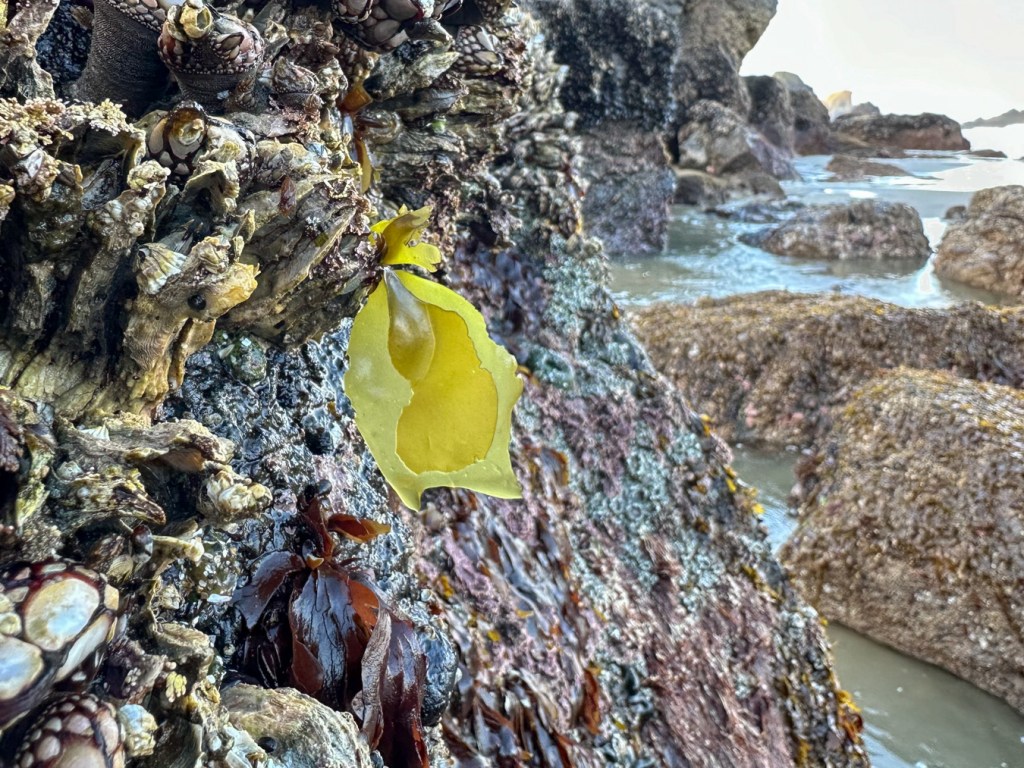
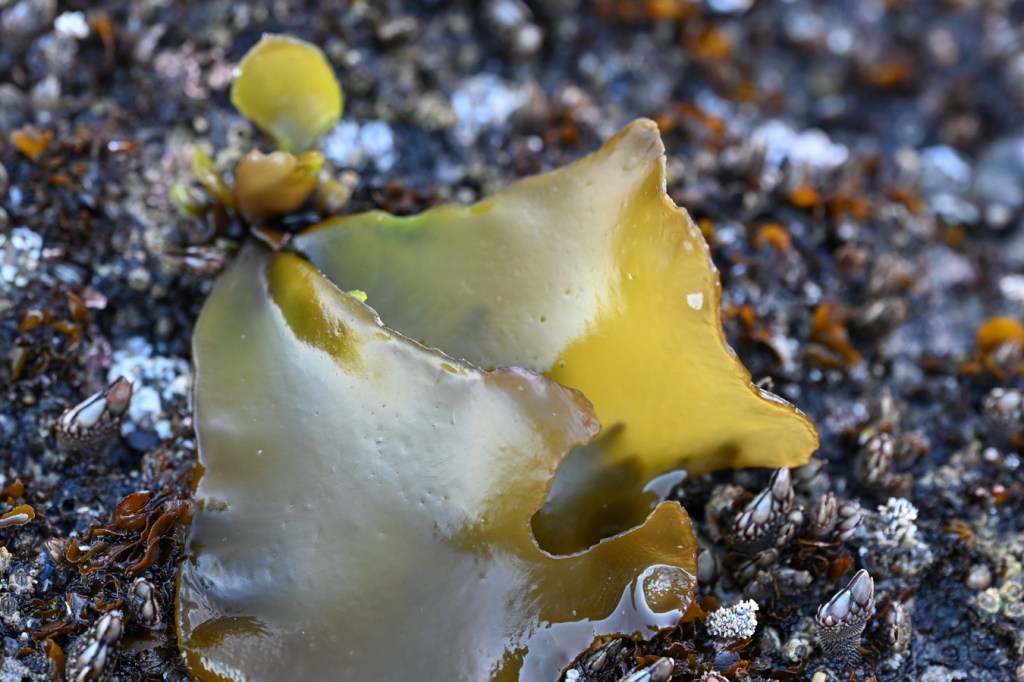
The set below highlights a seemingly less-irridescent color combination: yellow or yellowish-green blades with purplish-brown bases. I have seen forms like these in a mosaic of exposed surf-swept rocks hosting either iridescent or yellow and greenish blades. (Note: on high surf-exposed rocks Mazzaella parksii (see above, this page) has yellow blades with purplish bases.)
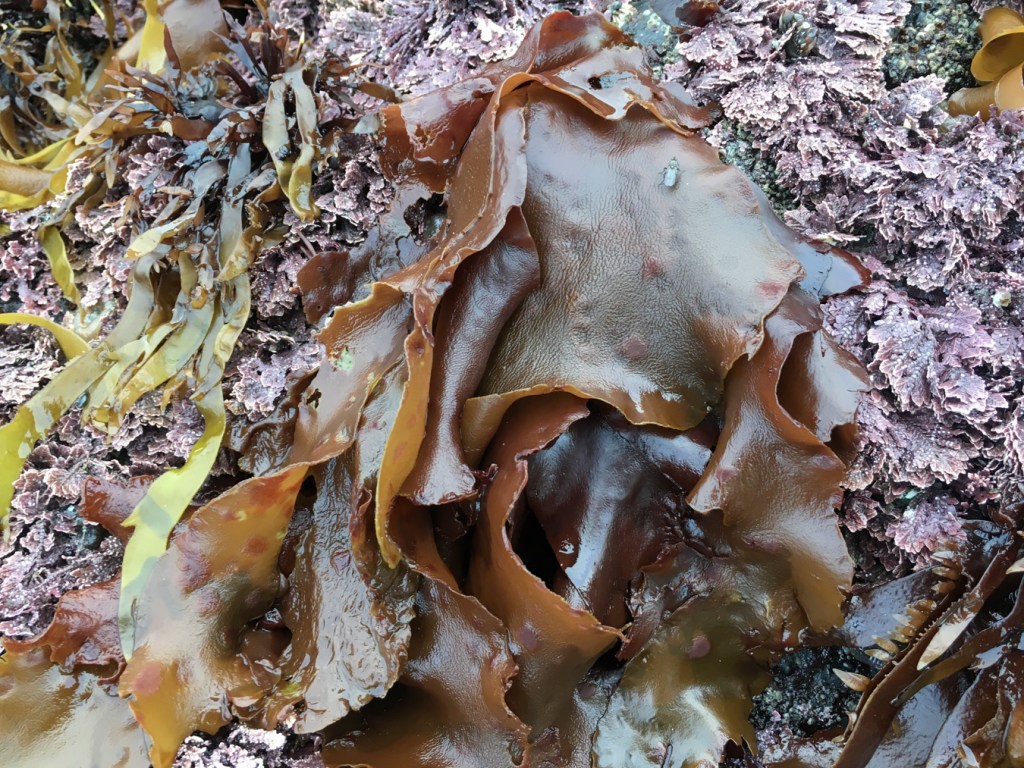
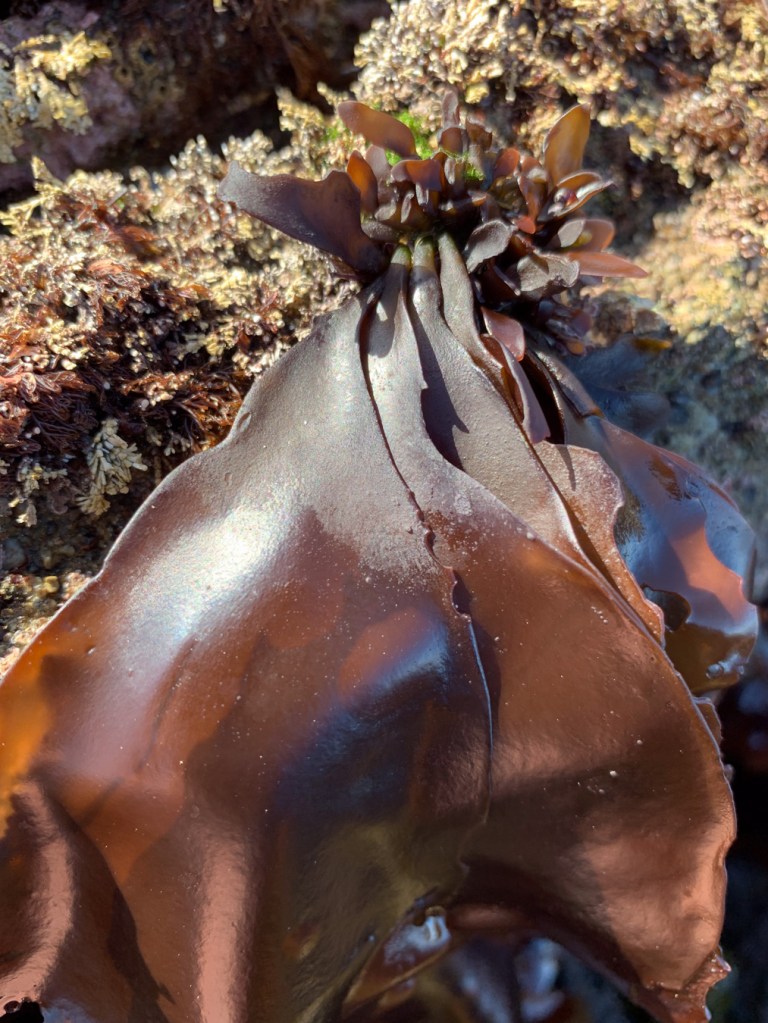
A few other blades of note
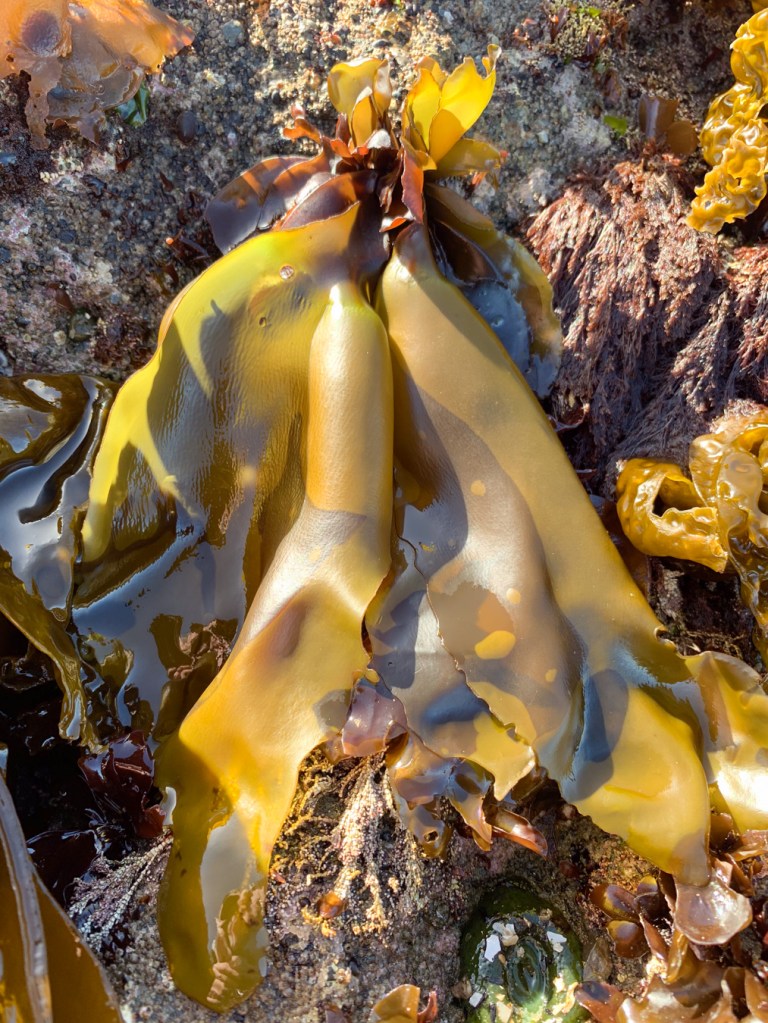
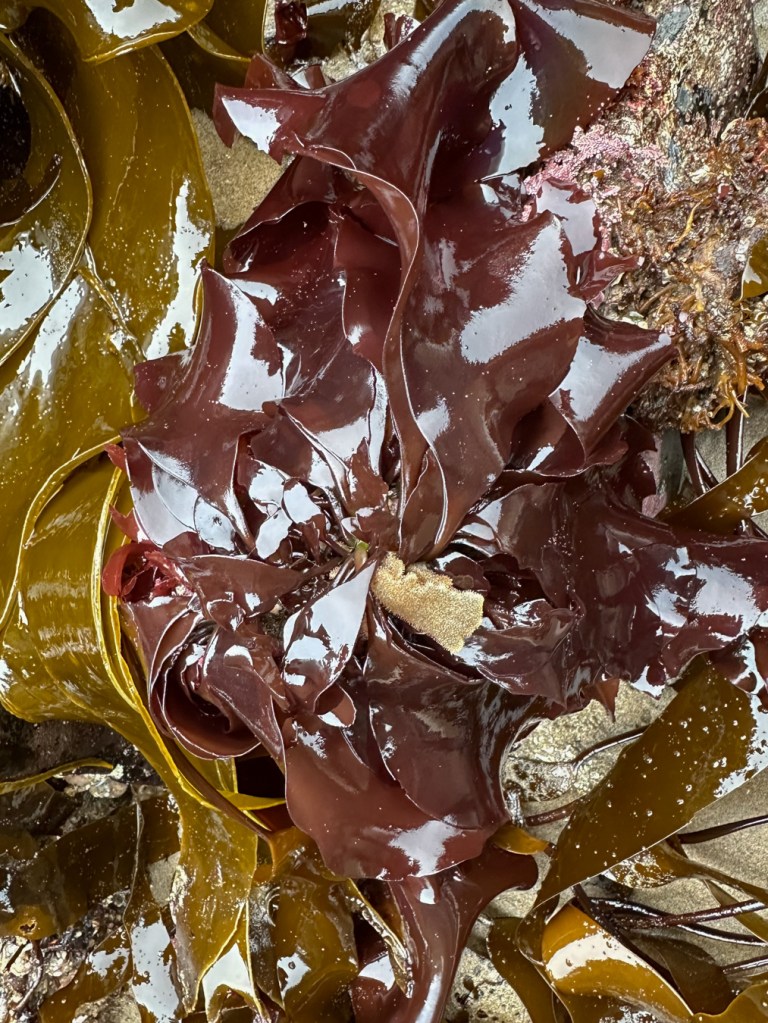
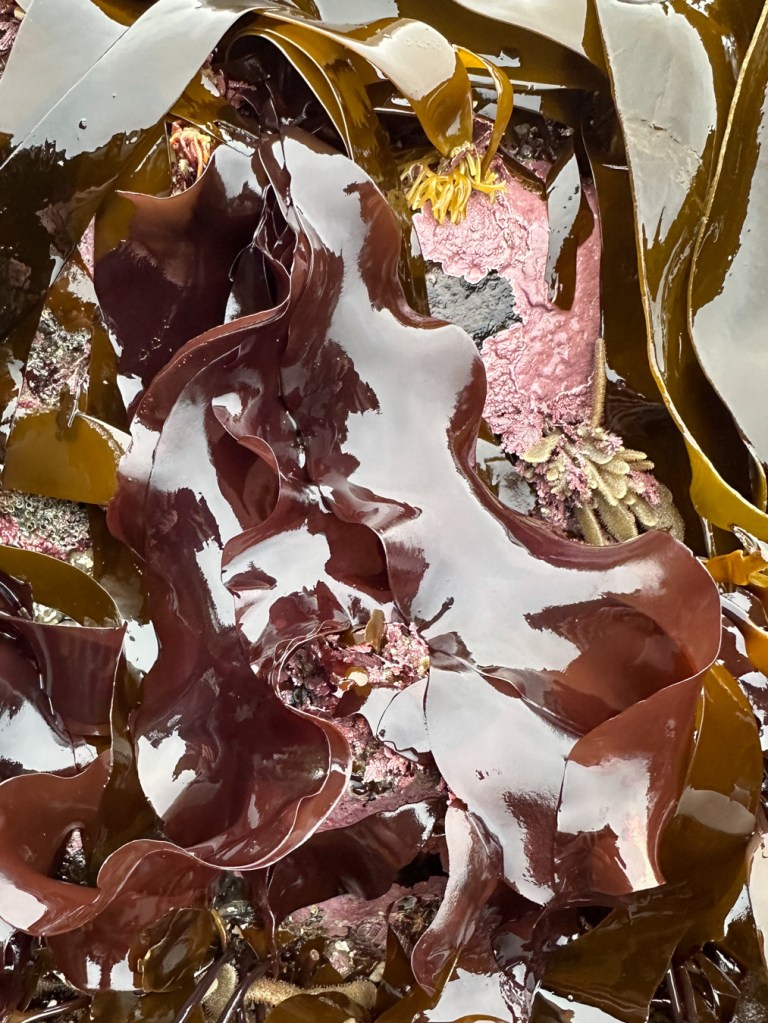

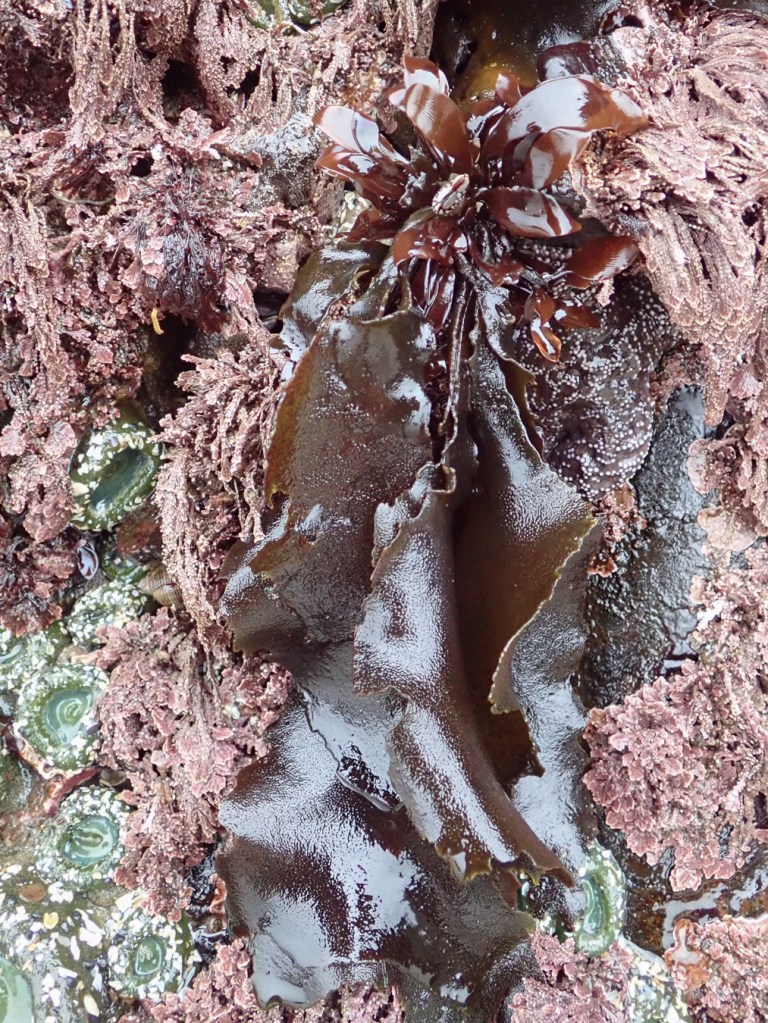
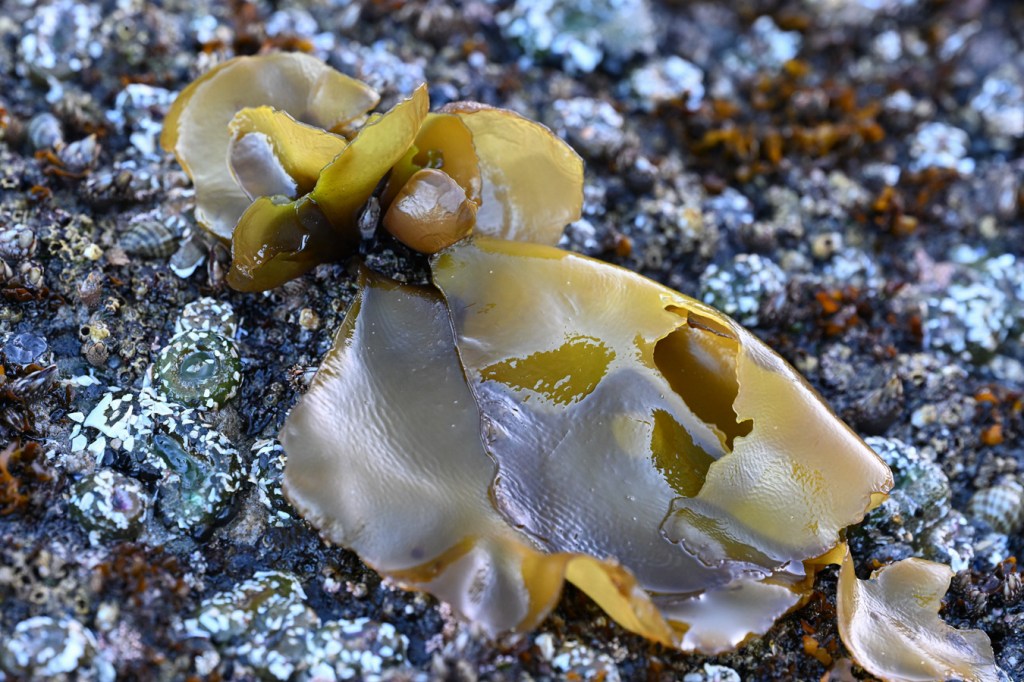
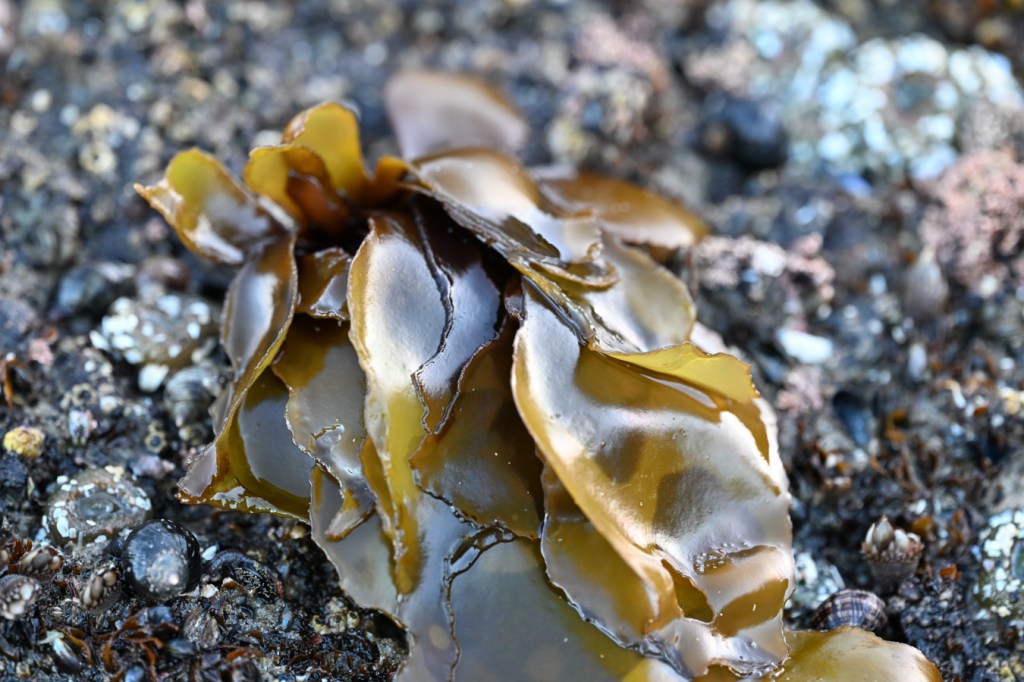
Cryptopleura or Hymenena
Or maybe both! These reds washed ashore in a diverse mass of drift macroalgae. The irridescence stands out pleasingly in the drift line. My identification is tentative and general; please drop me a line if you have identification ideas.


***
Erythrophyllum
When morning sunlight brightens its midribs, Erythrophyllum is a beauty. Finding it is a special treat for me because it’s not too common on the shores I frequent, where even a drifted blade is notable. When I have found Erythrophyllum, its habitat, on the sides of surge channels and other rough low places, usually makes intimate photographs kind of perilous. The examples featured below are probably Erythrophyllum delesserioides.

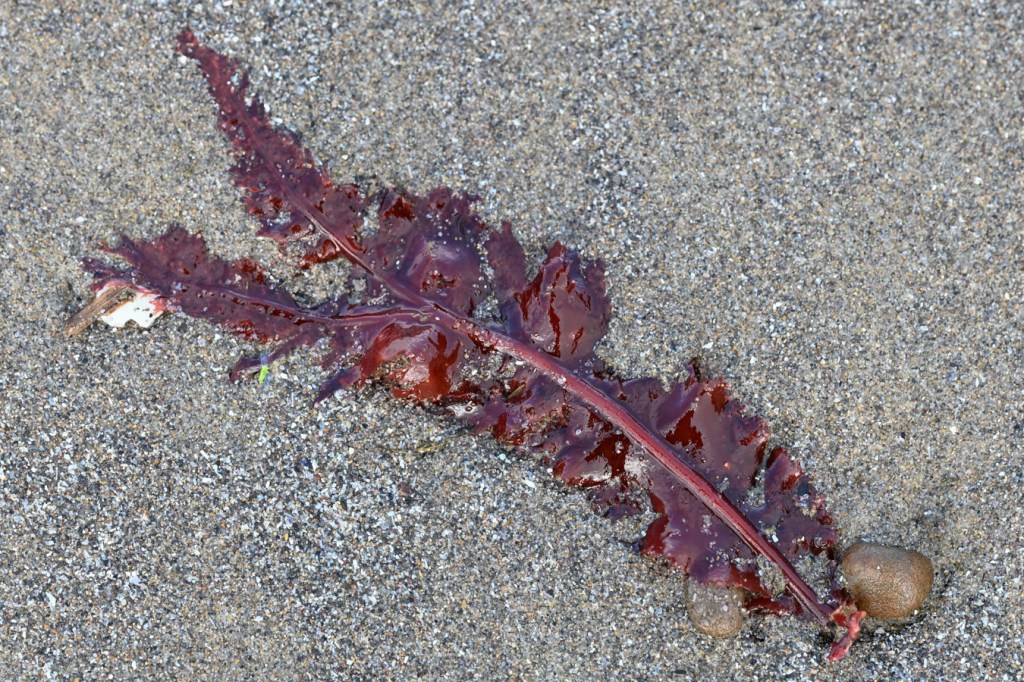
The examples below are in that Gracilaria/Gracilariopsis crowd. Seems like sand is always present or very nearby.

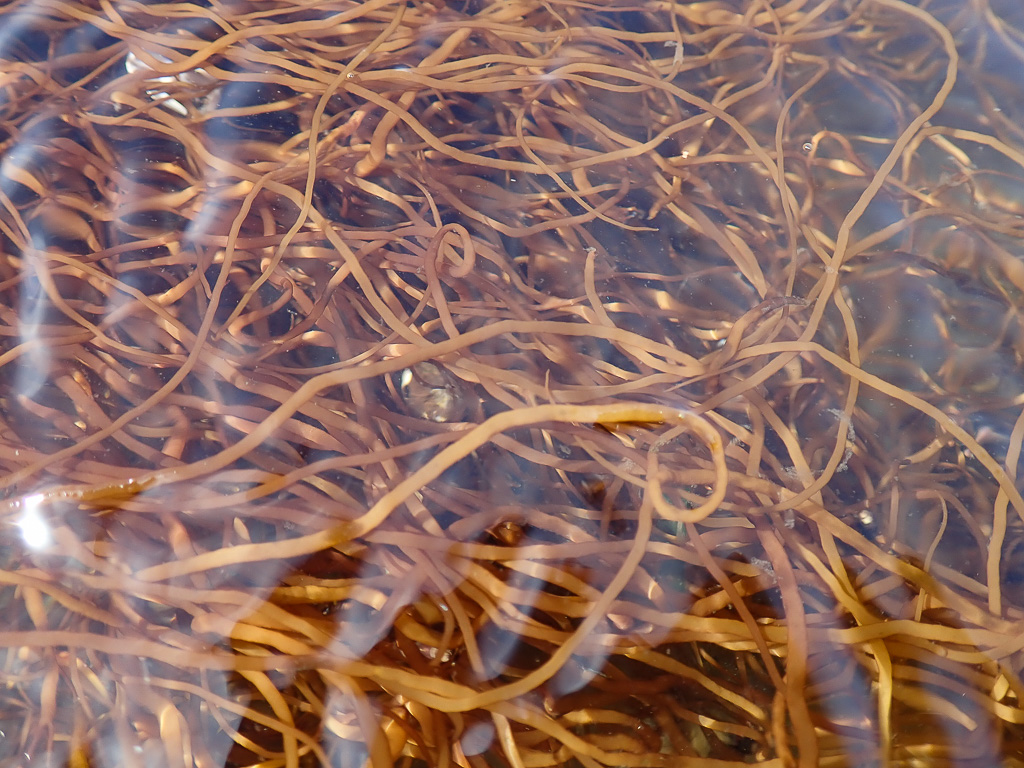

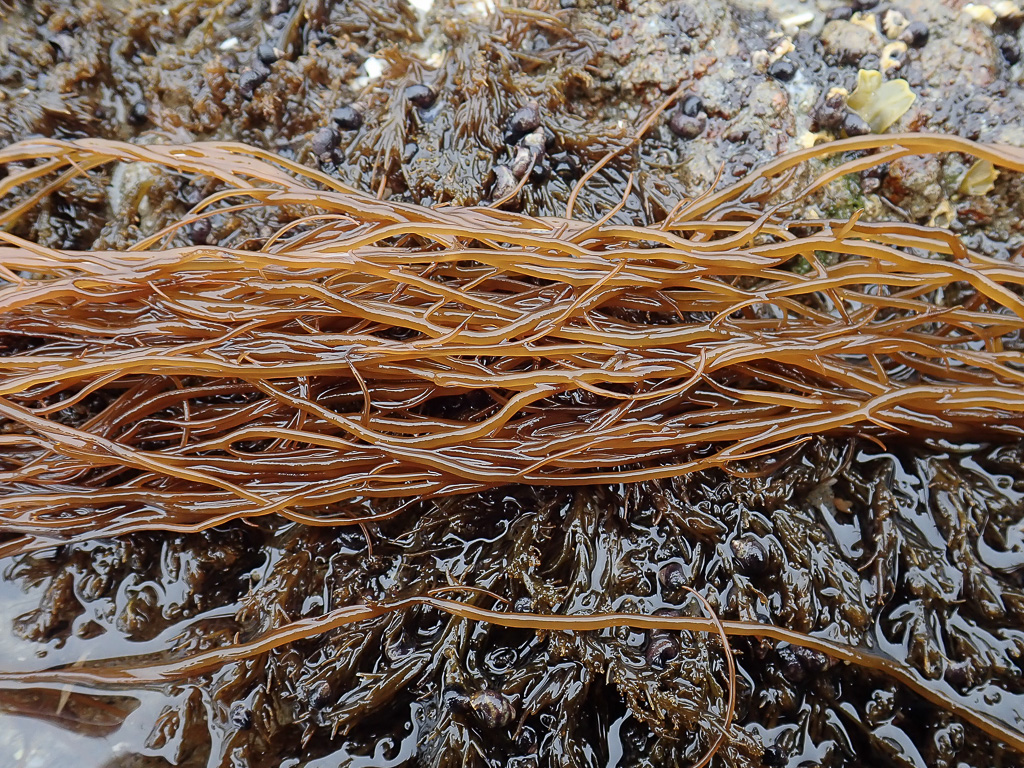
Odonthalia floccosa


Odonthalia floccosa f. comosa
Not super common on my home beaches, this shaggy red sure is a beauty.

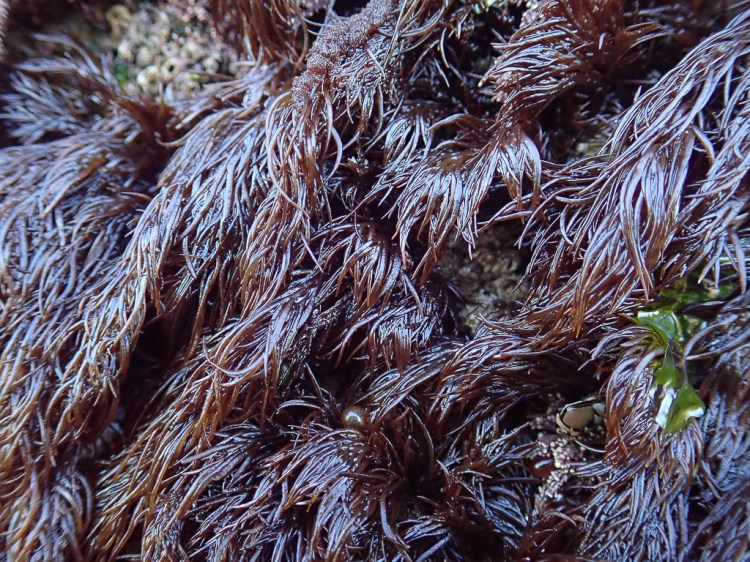

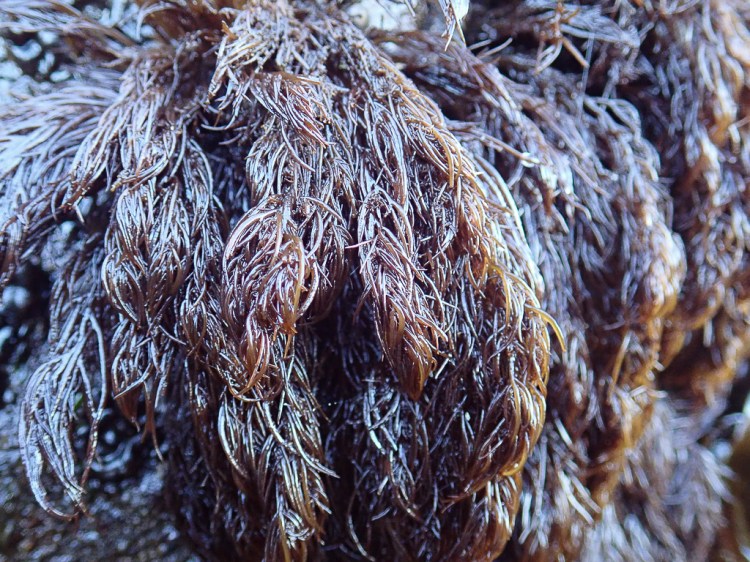
There are a few delicate fern-like Neoptilota and Ptilota on our low shores. The examples below are among them.
The three images in this set look a lot like Ptilota filicina, common in the low intertidal.


Also in the Neoptilota and Ptilota collection, here’s something a little different. The three images in the set below are of the same drifted mass. There’s a decent superficial resemblance to Ptilota hypnoides, but things are ever so much more complicated than that.

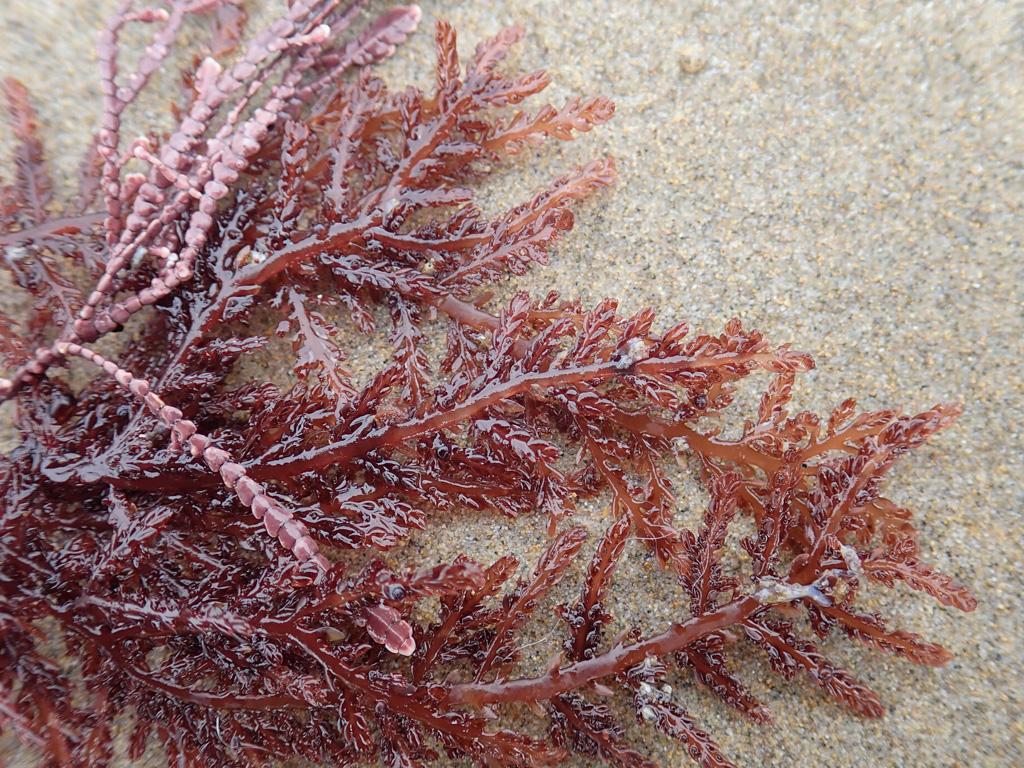

Neogastroclonium subarticulatum, sea belly

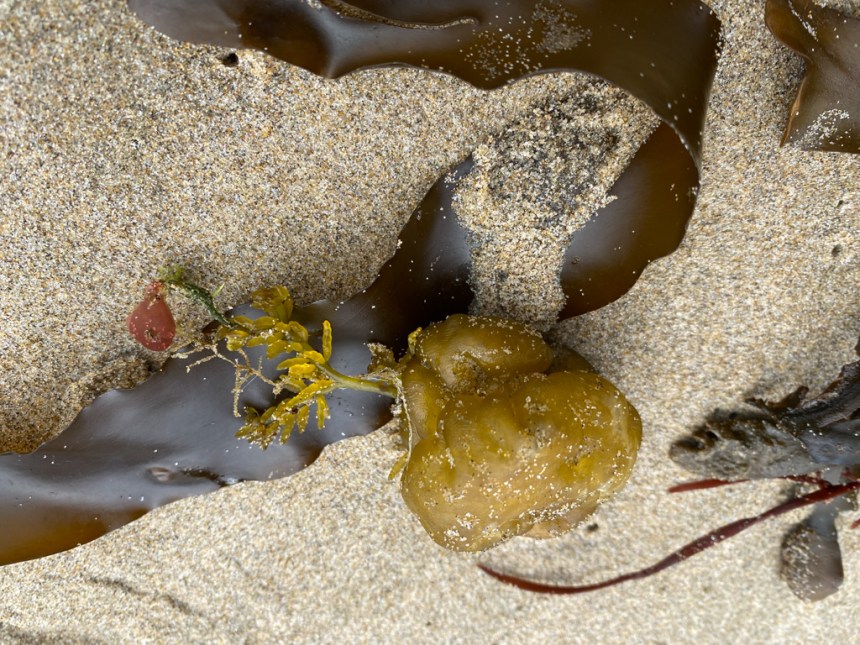
Osmundea spectabilis


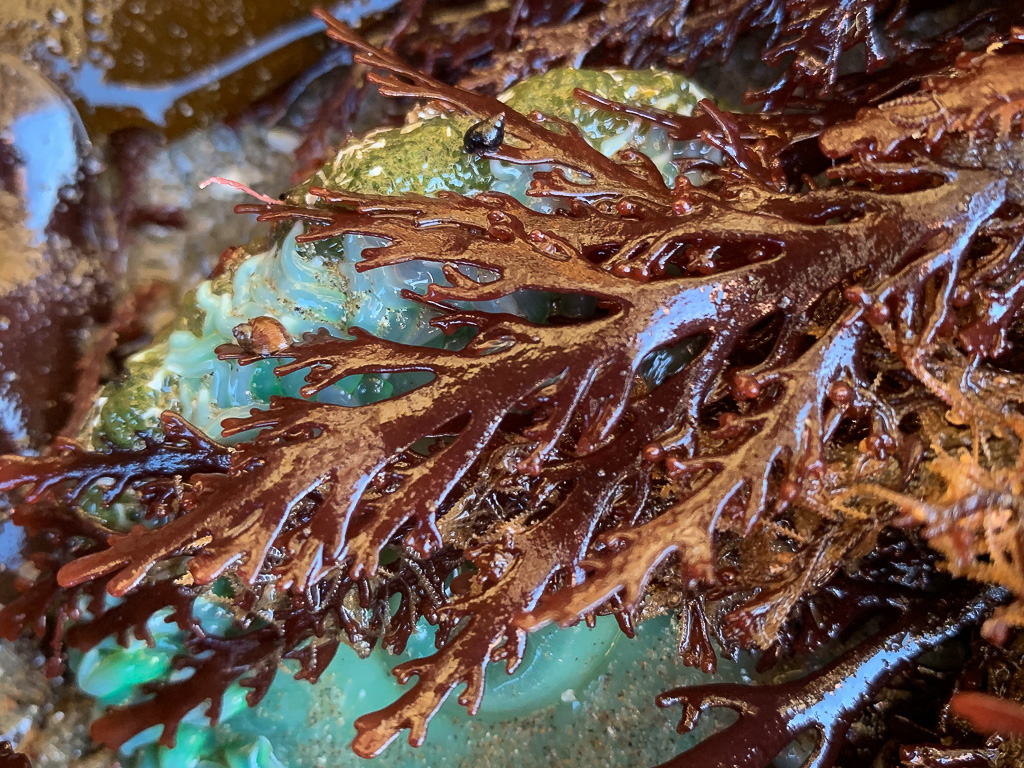
Sarcodiotheca gaudichaudii, succulent seaweed
I’ve seen S. gaudichaudii only at low tide on Salish Sea shores


***
Smithora naiadum Seagrass Laver, Red Fringe
If you’ve got the patience, one way to find Smithora on the outer coast is to pick a tide low enough to expose a patch of Phyllospadix. There, you might find Smithora living on the surfgrass blades. They don’t call it seagrass laver for nothing.
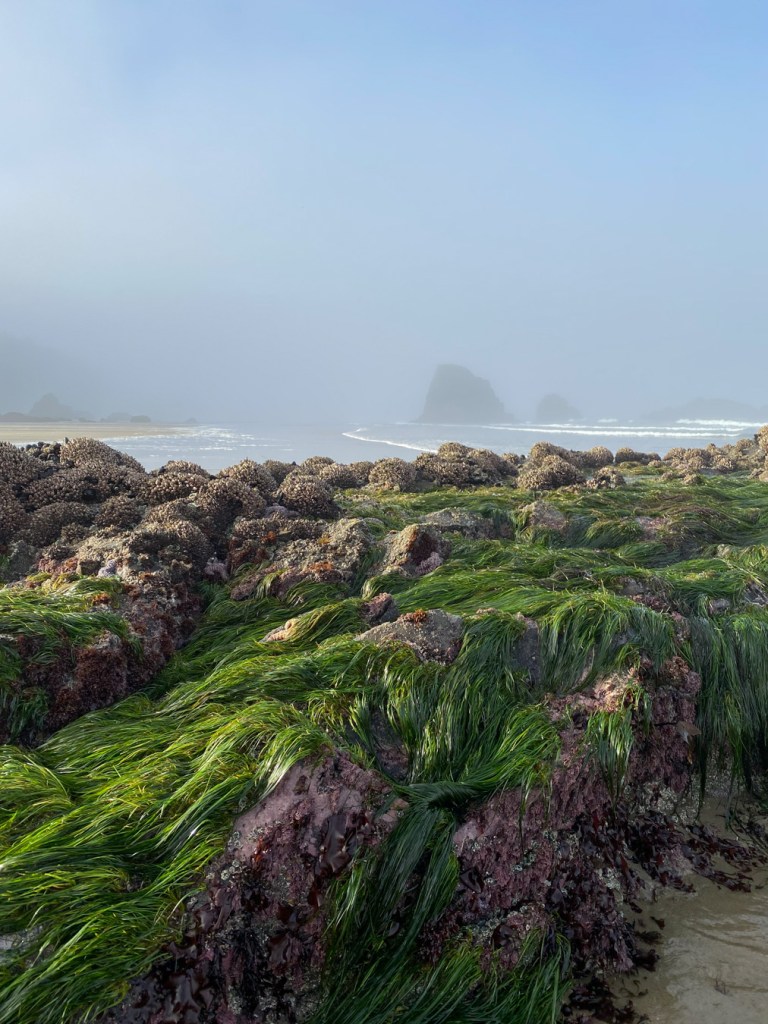

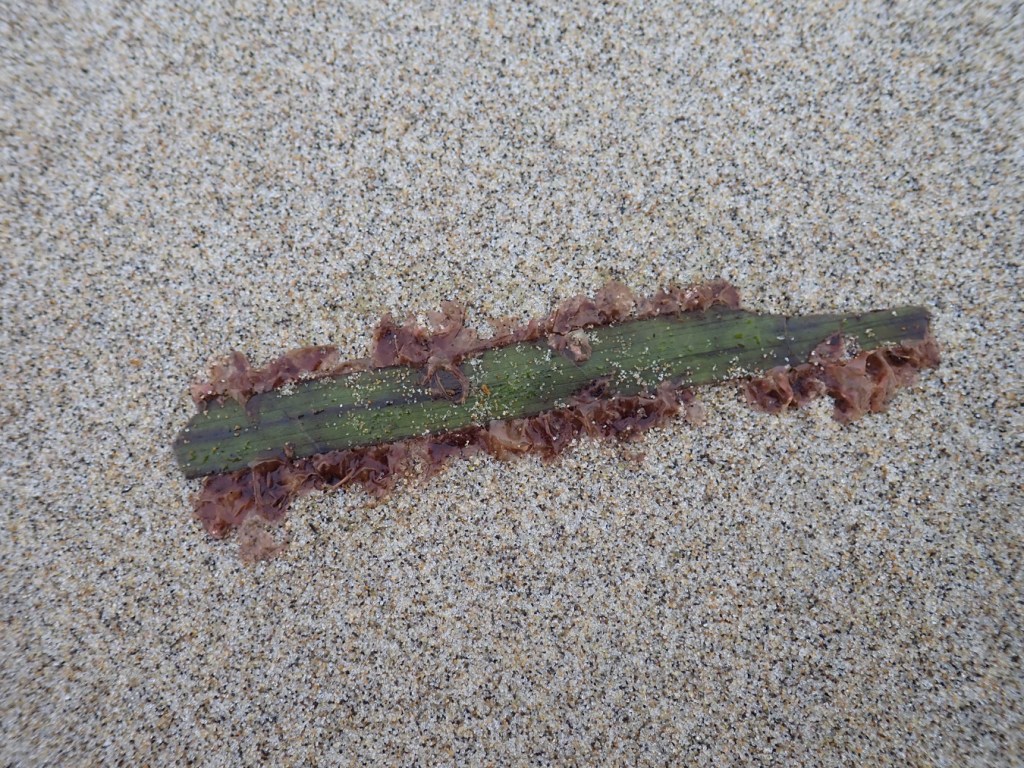
Another good way, and I guess a more routine way to find Smithora, is to look for it on the beach, washed up on the blades of drifted Phyllospadix or Zostera.

Pyropia gardneri Kelp Laver
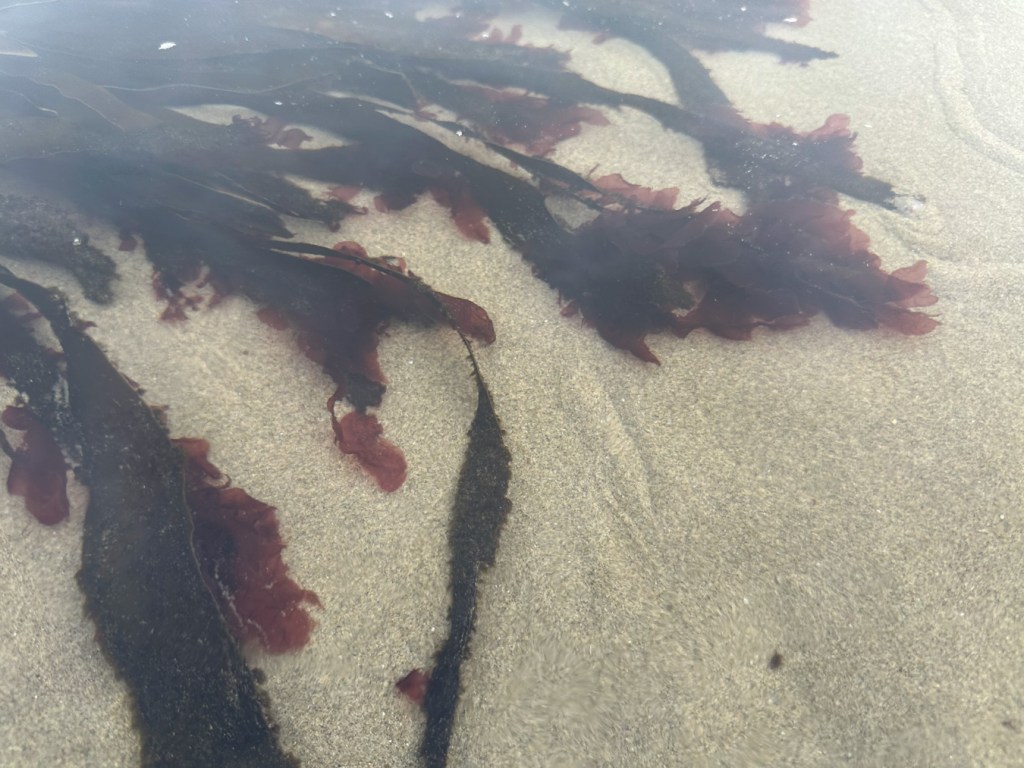
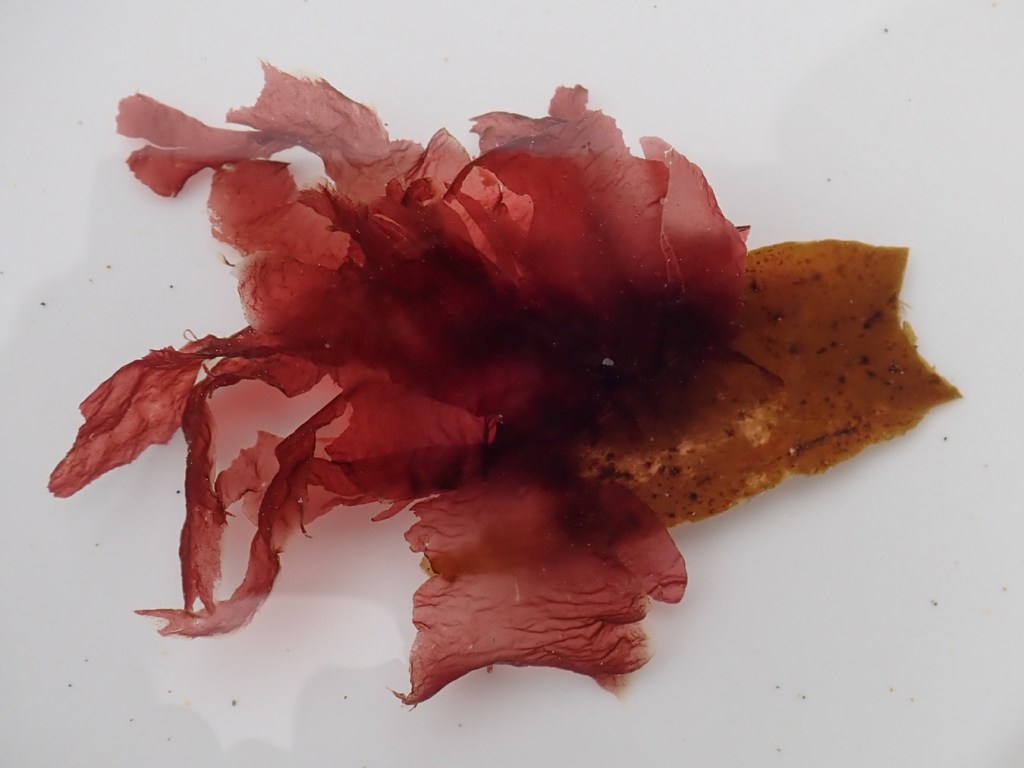
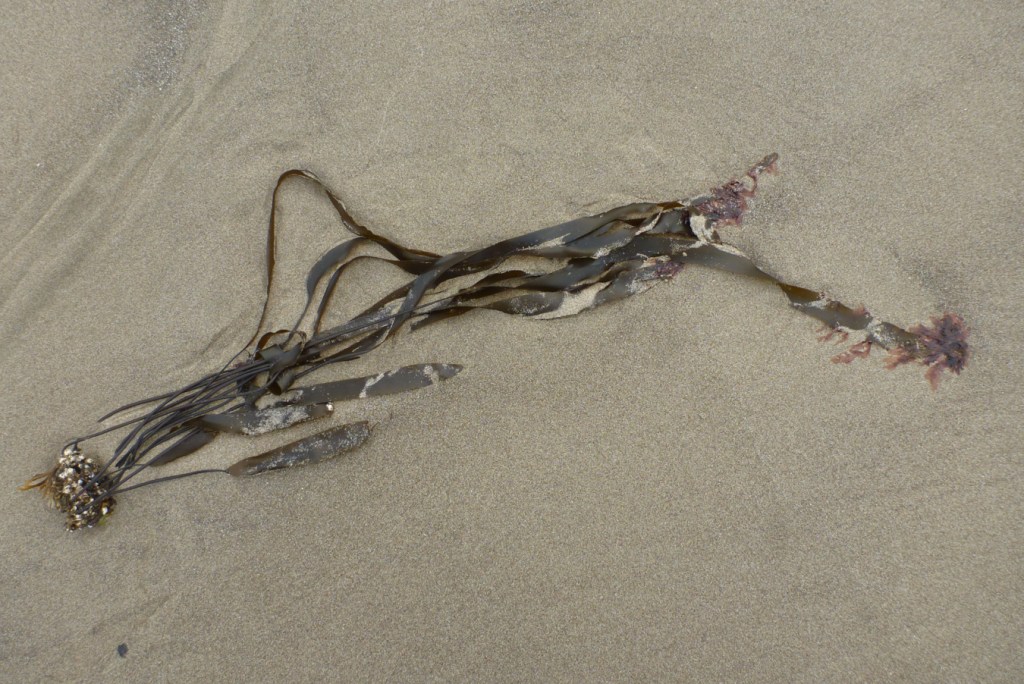
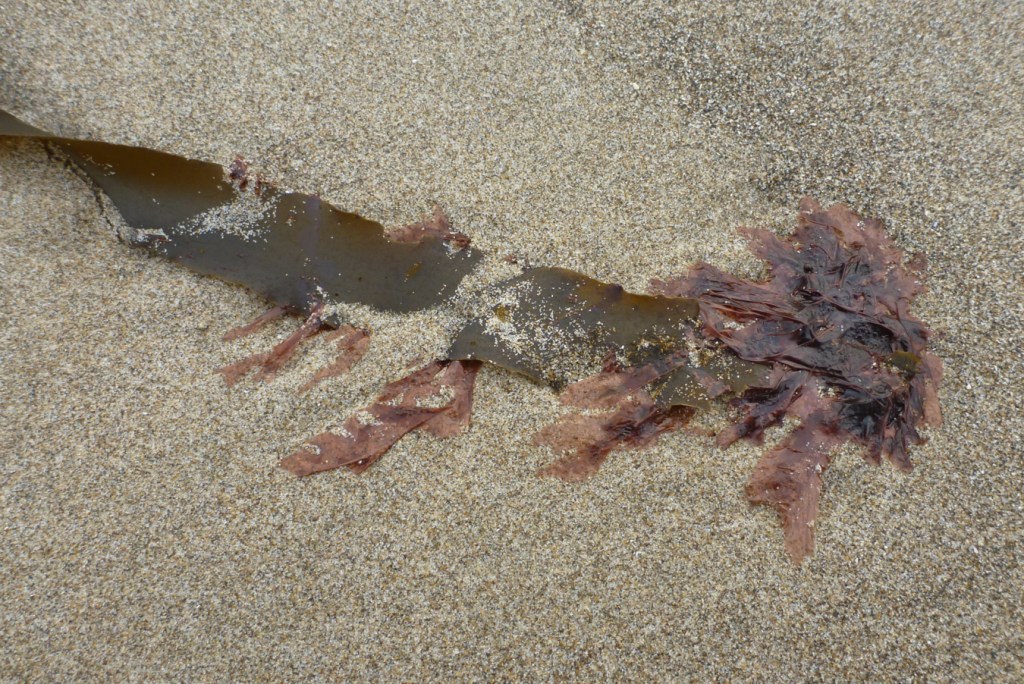
An epiphyte on kelps, the examples in this entry are Pyropia gardneri or something very much resembling it. I think I’ve only seen it growing on Laminaria sinclairii, often on worn blade tips.
The two images immediately below are from shallow, sand-filled pools.

Floated in a bowl, you can see some of the blade characteristics a little better.

Kelp laver occasionally appears on the beach with drifted Laminaria sinclairii. The lower image shows a closeup of the blade tip at the right-hand edge of the upper image.
Polyneura latissima
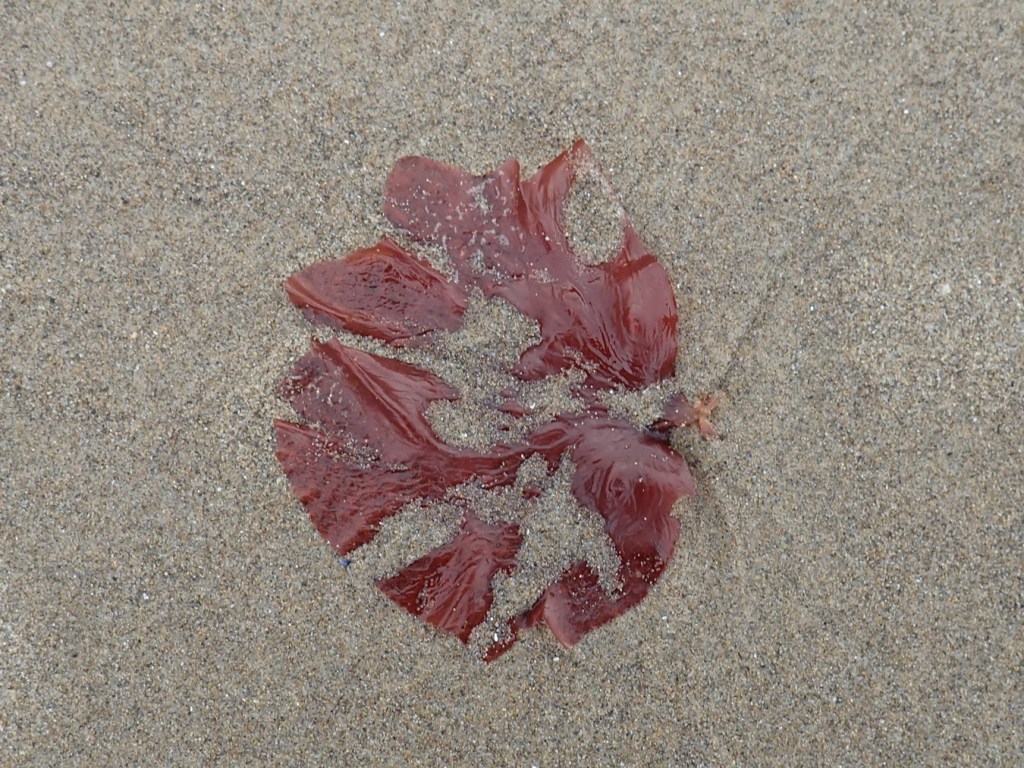
Simplicity is rare among the reds, but we’ll take it where we can get it. Any Polyneura encountered on Pacific northwest shores is P. latissima.

Bits of Polyneura occasionally appear in the drift.
Constantinea Cup and Saucer
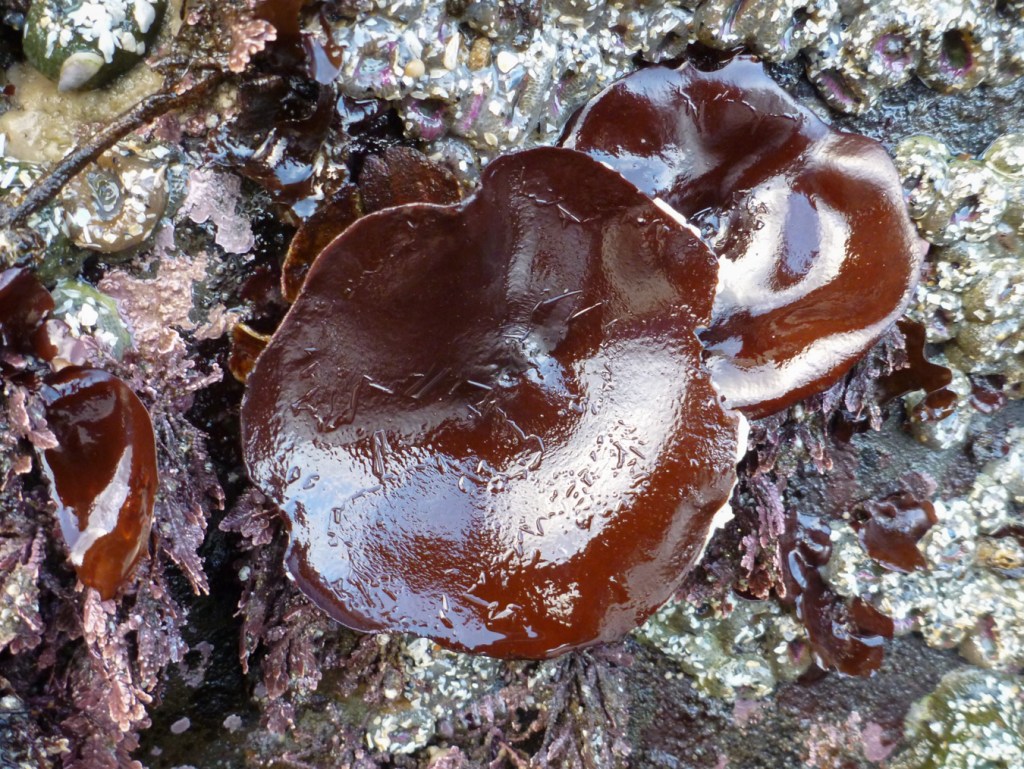
On shores otherwise awash, sheltered niches suit Constantinea and thus it’s not too uncommon for it to appear in dioramic settings.
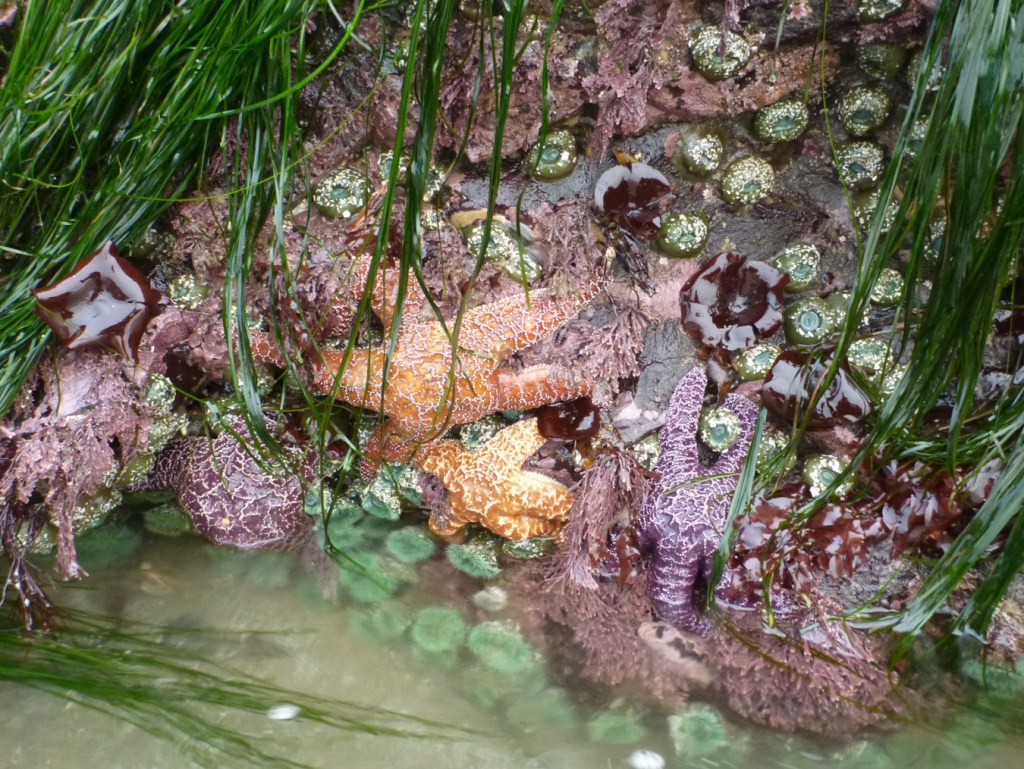

Cup and saucer scenes



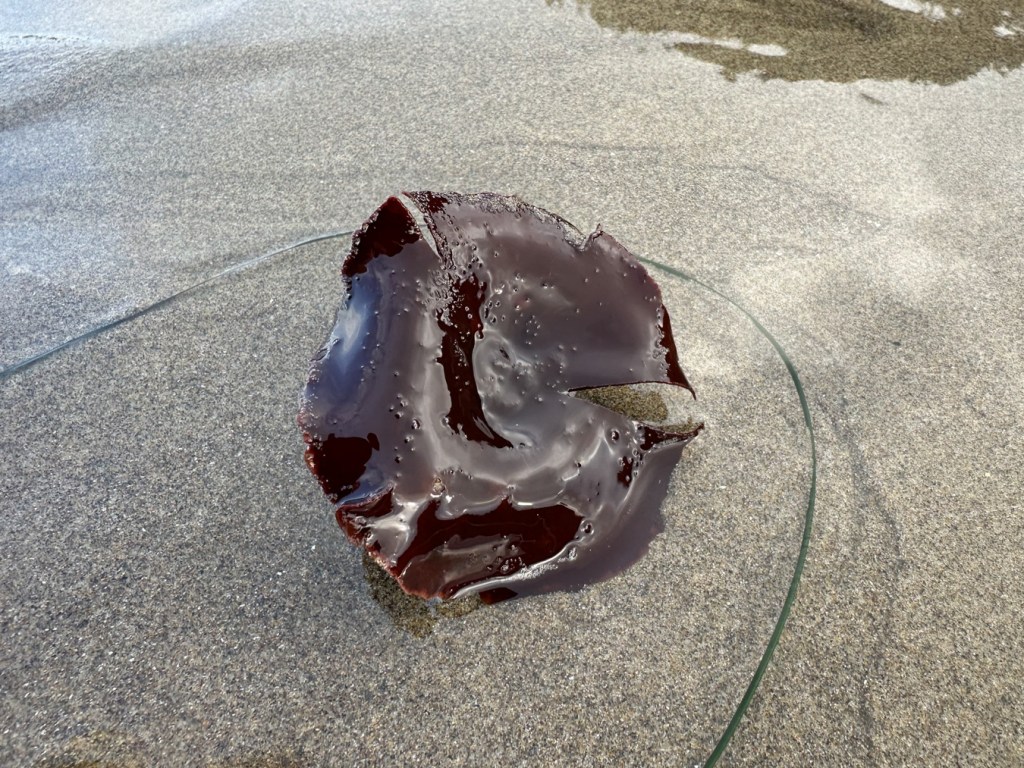
It’s not too common to find Constantinea washed up on the beach, but it does happen.

Pyropia nereocystis, bull kelp nori
These thin red blades are fairly common in fall and winter, when drift bull kelp appears on the beaches.

Something approximating Antithamnionella, red sea skein
If indeed it is Antithamnionella, you’ll see it as Irtugovia in some of the guides. It also goes by hooked or red skein. There are several filamentous reds which are hard to tell apart from photos alone. Antithamnionella a common epiphyte on bull kelp stipes, so I’m trusting that’s what at least two of these images show. They all seem to have the same look so I’ve lumped in the reds on the drifted timber too.


Pterochondria woodii
I’m pretty sure this lacy epiphyte is P. woodii.

***
A rose red mystery
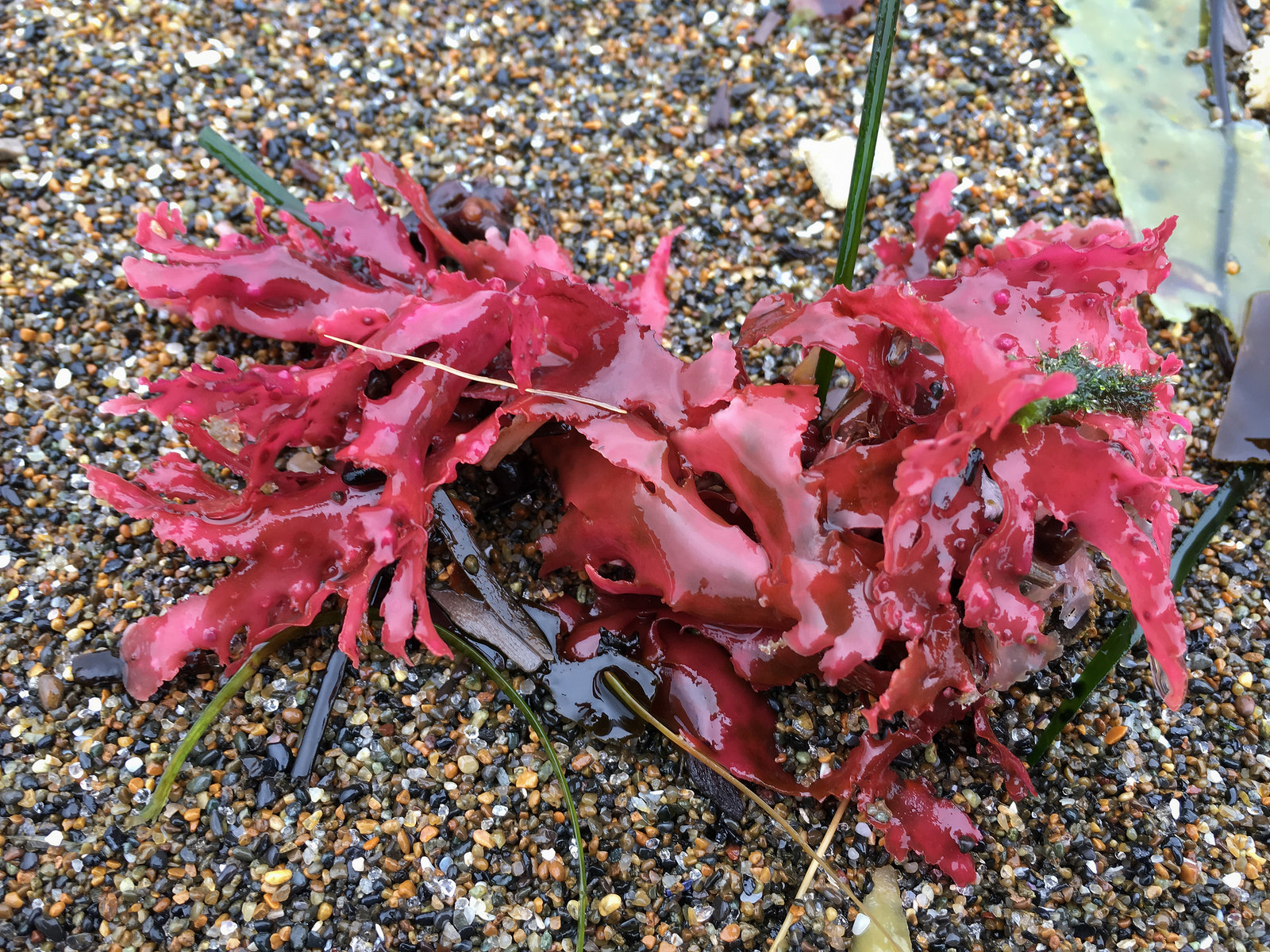
Rose-purple frills on a deep purple blade

References
Abbott, I. A. and G. J. Hollenberg. 1976. Marine Algae of California. Stanford University Press.
Druehl, L. D. and B. E. Clarkston. 2016. Pacific Seaweeds: A Guide To Common Seaweeds of the Pacific Coast. 2nd ed. Harbour Publishing Co.
Harbo, R. M. 2011. Whelks to Whales: Coastal Marine Life of the Pacific Northwest. 2nd ed. Harbour Publishing Co.
Kozloff, E. N. 1993. Seashore Life of the Northern Pacific Coast. 3rd ed. University of Washington Press.
Lamb, A. and B. P. Hanby. 2005. Marine Life of the Pacific Northwest. Harbour Publishing.
Mondragon, J., and J. Mondragon. 2010. Seaweeds of the Pacific Coast. Shoreline Press.
Sept. J. D. 2019. The New Beachcomber’s Guide to the Pacific Northwest. Harbour Publishing.
Online Resources for Reds
Netarts Bay Today – Red Seaweeds. Accessed 01/27/2023.
Seaweeds of Alaska – Seaweed: Rhodophyta. Accessed 01/27/2023.
Give the Seaweed Sorter App a try!
I updated this page on November 19, 2024
 theoutershores